
BuddhistCatholicContemplativeEvangelicalGeneral ChristianHinduJewishLatter-day SaintMuslimNew VisionsProgressive Christian
Beliefs
- Buddhist
- Catholic
- Contemplative
- Evangelical
- General Christian
- Hindu
- Jewish
- Latter-day Saint
- More Voices
- Muslim
- New Visions
- Pagan
- Progressive Christian
Topics
- Religion News
- Food and Religion
- Sports and Religion
- Religious Art
- Religious Music and Entertainment
- Religious Events
- History and Religion
- Style and Religion
- Politics and Religion
- Women in Religion
- Recreation Outdoors and Religion
- Business Finance and Religion
- Careers Workplace and Religion
- Education and Religion
- Family Parenting and Religion
- Health Fitness and Religion
- Home and Religion
- Relationships and Religion
- Technology and Religion
- Travel and Religion
Columnists
- Buddhist Columnists
- Business Finance and Religion Columnists
- Careers Workplace and Religion Columnists
- Catholic Columnists
- Contemplative Columnists
- Education and Religion Columnists
- Evangelists Columnists
- Family Parenting and Religion Columnists
- General Christian Columnists
- Health Fitness and Religion Columnists
- Hindu Columnists
- History and Religion Columnists
- Home and Religion Columnists
- Jewish Columnists
- More Voices Columnists
- Latter Day Columnists
- Muslim Columnists
- New Visions Columnists
- Nonreligious Columnists
- Pagan Columnists
- Politics and Religion Columnists
- Progressive Columnists
- Recreation Outdoors and Religion Columnists
- Relationships and Religion Columnists
- Religion News Columnists
- Religious Art Columnists
- Religious Events Columnists
- Religious Music and Entertainment Columnists
- Sports and Religion Columnists
- Style and Religion Columnists
- Technology and Religion Columnists
- Travel and Religion Columnists
- Women in Religion Columnists
Resource Library
- 2026 Calendar
- Library of World Religions
- The 100 Most Holy Places on Earth
- Patheos Answers
- Podcasts
- Videos
- Faith Leaders Database
- Anglican Episcopalian
- Bahai
- Baptist
- Buddhism
- Christianity
- Confucianism
- Eastern Orthodoxy
- Hinduism
- Holiness and Pentecostal
- ISKCON
- Islam
- Judaism
- Lutheran
- Methodist
- The Church of Jesus Christ of Latter-day Saints
- New Age
- Paganism
- Presbytarian and Reformed
- Protestantism
- Religion Behind the Scenes
- Roman Catholic
- Scientology
- Shia Islam
- Sikhism
- Sufism
- Sunni Islam
- Taoism
- Zen
- See all religions
Research Tools
 Ad-Free & Subscriber Log-In Subscription Support
Ad-Free & Subscriber Log-In Subscription Support
Follow Patheos 

- Trending:
- Forgiveness
- |
- Marriage
- |
- Consciousness
- |
- Death Penalty
- |
- Election
- |
- Halloween

-
Tools
-
Support the Work
- Home
- Evangelical
- Can we be Confucian Christians?
Can we be Confucian Christians?
Last updated on: August 9, 2016 at 3:29 pm by Brad Vaughn
Can we be Confucian Christians? 2016-08-09T15:29:45-07:00 Brad Vaughn
Patheos Explore the world's faith through different perspectives on religion and spirituality! Patheos has the views of the prevalent religions and spiritualities of the world.

(For full disclosure, I recently become the new book reviews editor for Themelios’ Mission and Culture section.)

I should first add a note of appreciation. Without question, Song strives to protect the church against syncretism and wrong interpretations of the Bible. It’s refreshing to see his candid engagement with the book since many book reviews are dry reads.
Nevertheless, Song seriously misinterprets what Elshof does in Confucius for Christians. I’ll survey some of Song’s comments.
Confused about Confucius?
Song objects to Ten Elshof emphasis on Confucianism centrally as a type of moral or wisdom tradition. He says Ten Elshof’s “understanding of Confucianism as a wisdom tradition is confusing, problematic, and misleading,” citing sociologist Anna Sun, who “observes that it is common for a Confucian to worship Taoist Caishen (“god of wealth”) and Buddha together. Thus, it is syncretic for Ten Elshof to propose the identity of ‘Confucian Christian.’”
In my opinion, Song’s objection is unfair to what Ten Elshof actually says. Early on, Ten Elshof acknowledges,
But it’s a matter of some controversy among scholars whether or not Confucianism is, in fact, a religion. The question turns on complicated issues having to do with the defining marks of a religion.…. What is not controversial is that Confucianism (whether or not it is a religion) is a deep and influential wisdom tradition. (p. 5–6)
In other words, it makes no difference to Ten Elshof’s argument whether some Confucians worship this or that god. Ten Elshof never claims Confucianism is merely about ethics. Rather, he simply begins with what is common and not controversial about various expressions of Confucianism. Song’s appeal to his own experience in China or to certain person’s worship of gods does not set aside Ten Elshof’s specific point.
Recall that in recent years the Chinese government has utilized Confucianism for his own purposes. Certainly, the atheistic government isn’t exploiting Confucianism because they want to encourage the worship of gods. In fact, the Chinese Education ministry explicitly states that the use of Confucianism is “to aid ‘personality development,’ encourage altruism and instill ‘Chinese national moral thinking.’”
Is it syncretism to be a “Confucian Christian”?
Song thinks “it is syncretic for Ten Elshof to propose the identity of ‘Confucian Christian.’” Unfortunately, Song seems unaware of how intertwined are some cultural and religious/philosophical terms. In the West, unlike elsewhere, a person’s “religion/philosophy” is routinely separated from one’s identity in the larger culture.
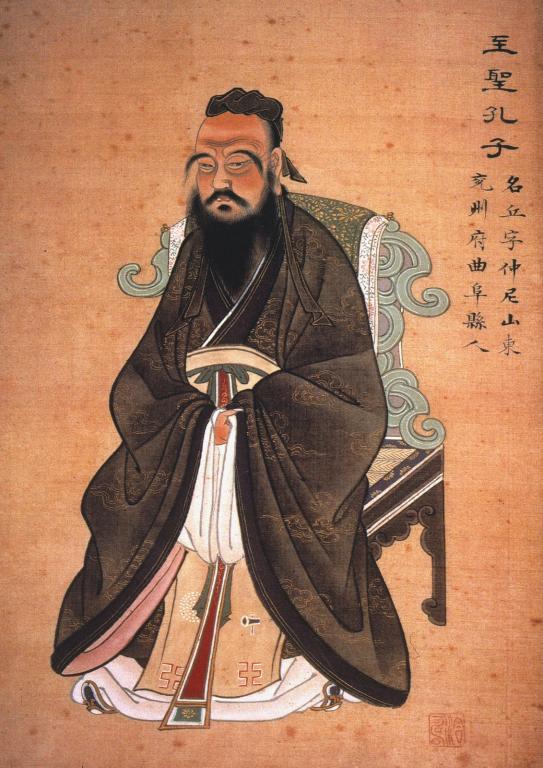
credit: wikipedia
For example, a number of evangelical Christians would claim to be “Muslim Christians” because they regard the term “Muslim” as a cultural marker, not necessarily implying the worship of the god of Mohammad. While people might not be comfortable with this, we can’t deny the fact that people use terms in multiple senses. Thus, the label “Christian” is diversely used to describe people, music, and even T-shirts.
Since Ten Elshof clearly states that he primarily uses “Confucian” to refer to a way of ethical thinking, it is unfair to charge him with syncretism, especially true since the phrase “Confucian Christian” prioritizes Christian identity whereby “Confucian,” for many people, becomes synonymous with “Eastern” or “Chinese.”
Are Analects and the Bible equal?
Song then accuses Ten Elshof of “valuing Confucian Analects and the Scripture as equal.” However, Song never substantiates the claim. It’s a sheer accusation. At the beginning of the book, Ten Elshof affirms, “As a Christian, my fundamental allegiance is to Jesus Christ” (p. 6). Furthermore, he adds that not everything that “Plato or Confucius taught can be reconciled with the claims of Christianity” (p. 3).
What then is Ten Elshof doing? In part, he uses Confucius to balance the influence of Plato on Western Christianity (pp. 3–4). In so doing, Confucianism is simply a tool to remind Christians that the Bible says a lot more about certain issues and priorities than people typically notice. For example, collective identity, the importance of family, mutual dependence, familial piety, practical ethics, etc.
It appears that Ten Elshof anticipates the sort of misreading we find in Song’s review. On page 2, Ten Elshof reminds readers that “to deviate from stereotypical Western Christian thinking is not to abandon Christianity.” Song seems to have not taken this warning seriously enough.
Restoring the Imago Dei?
Furthermore, I cannot make sense of Song’s criticism below:
It appears that Confucians later adopted Mencius’ (372–289 BC) view of the innate goodness of the individual. It seems that Ten Elshof has adopted an optimistic anthropology, and such a view affects his view of the family and filial piety. He explains that as for Confucians, “a human person just is a being in-relationship” (p. 12, emphasis original). Family becomes then “the primary venue for growth into the full expression of being human” (p. 13).
Unless I’m grossly missing something, this argument is a non-sequitur. On the one hand, it does not follow that the view of Mencius should somehow be attributed to Ten Elshof. On the other hand, nothing in what Ten Elshof says about being human should be construed as “optimistic anthropology,” at least in any unbiblical sense.
In context, Ten Elshof simply makes the claim that God created humans to live in community. Ten Elshof challenges Western individualism. He says,
To fail to be in relationship — and to do relationship well — is to fail at being human. To grow in goodness you must find your way increasingly into the full expression of what you are. And a human person just is a being-in-relationship. A life devoid of significant and well-ordered relationships can no more be human than can an organism devoid of a root system be a tree. (p. 12)
Therefore, he adds,
If we wish to be good, we must grow in our ability to be together. This is why filial piety is at the center of virtue — the root of goodness — for the Confucian. (p 13)
Ten Elshof issues a much needed corrective.

credit: wikipedia
Far from denying human sin, he highlights the human problem that results from the fall. In fact, Song himself quotes Ten Elshof’s who says, “But after the fall, our obsession with knowledge has blinded us to the beauty of unknowing, impotence, submission, and dependence (p. 34).”
This hardly resembles an “optimistic anthropology” that warrants the concern expressed by Song.
Song seems to stumble on Ten Elshof’s phraseology. Song writes, “for Ten Elshof, it is possible to ‘find our way back’ by simply ‘reflecting on the Confucian emphasis on the love of learning’ (p. 35).” He apparently interprets Ten Elshof as referring to the imago Dei (image of God). Such an inference is unfounded. A simple search of the book shows that Confucius for Christians not once uses the terms “image,” imago, and Dei.
Read the paragraph from which Song quotes. Ten Elshof writes,
But at the center of the fall, then and now, is a profound disenchantment with the power-down condition built into the fabric of human nature. We’ve fallen out of love with what God designed us to be. Our obsession with knowledge has blinded us to the beauty of unknowing, impotence, submission, and dependence. Perhaps reflecting on the Confucian emphasis on the love of learning can help us find our way back. (pp. 34–35)
In context, “finding our way back” refers to our once again loving what God designed us to be––i.e. followers. Lest someone accuse Ten Elshof of being unclear, in the immediate prior paragraph, he explains,
Adam was designed for inclusion in a community wherein he would eternally be the follower. In the context of the community for which he was created, Adam was designed to be eternally — inescapably — in the power-down position. He was designed to be relatively impotent, submissive, dependent, unknowing — to be the follower. (p. 34)
The phrase “finding our way back” does not suggest that restore imago Dei through self-study, etc.
Rather, he simply seeks an answer to a question posed early in the book, “Steeped as we are in the patterns of thought and life shaped by an individualistic heritage, how can we find our way into something more human?” (pp. 10–11)
Was Jesus “merely a man”?
Finally, Song makes a charge against Ten Elshof yet again does not explain why. Song states, “Ten Elshof portrays Jesus as merely a man whose work was to make people follow his way to distinguish justice and love.” What is peculiar about Song’s criticism is that he pulls from Ten Elshof’s chapter on ethics. Naturally, he would focus on the ethical implications of Jesus’ life. It’s completely unfair to criticize Ten Elshof as if he tries to present a full-orbed Christology.
Instead, Ten Elshof simply tries to stress the fact that Jesus “invites his disciples to follow him into the nitty-gritty circumstances of life” (p. 58). Accordingly, Ten Elshof says Confucianism can help us reclaim important insights about Christian discipleship. He says,
But for those of us who’ve been caught up in the attempt to codify the ethics of Jesus, the Confucian emphases on context-sensitivity and the centrality of the master-apprentice relationship for the cultivation of the moral life may call attention in a new way to the emphasis on discipleship in Jesus’ strategy for bringing his students into his Way. (pp. 59–60)
In other words, Christian discipleship and ethical training is personal and practical.
Given Song’s criticism, I can only guess he wants Ten Elshof to somehow link Christ’s divine nature with ethics. Since none of us have a divine nature, I’m not exactly sure what that would even look like or how useful it would be.
If anything, what Ten Elshof does do only reinforces the findings of brilliant theologians like Richard Bauckham and others (which I’ve discussed previously on this blog). They point out a paradoxical truth of ancient Jewish monotheism. One thing that made Israel’s God so distinctive is that he dwelt among them in practical ways, intervening in concrete history. The Lord is not an abstract idea or a far off deity. Thus, Ted Elshof’s portrait of Jesus only reinforces the glorious truth that our God dwells among us “the nitty-gritty circumstances of life.”
In this post, I mainly defend Ten Elshof’s work by responding to Song’s review. In the next post, I’ll offer a more positive and constructive review of the book. I will highlight some of the great insights you’ll find in Confucius for Christians.
Save
Save
Save
Save
Save
Save
Save
Save
Previous Post
August 3, 2016
What the Gospels Teach about Contextualization
Next Post

August 16, 2016 Review of Ten Elshof’s "Confucius for Christians"
Browse Our Archives
Select a Category Atonement Biblical Theology Book Reviews China Chinese Church Chinese Culture Chinese Language Collectivism Contextualization Culture (General) Ecclesiology Evangelism Gospel Honor & Shame (Face) Interpretation/Exegesis Justification/Righteousness Missiology Mission Methods One Gospel for All Nations Other Practical Contextualization Reading Romans with Eastern Eyes Resources Romans Salvation (General) Saving God's Face Seeking God's Face The Cross in Context Theological Contextualization Theological Education Theology Uncategorized
Select a Month October 2026 September 2026 August 2026 July 2026 June 2026 May 2026 April 2026 March 2026 February 2026 January 2026 December 2025 November 2025 October 2025 September 2025 August 2025 July 2025 June 2025 May 2025 April 2025 March 2025 February 2025 January 2025 December 2024 November 2024 October 2024 September 2024 August 2024 July 2024 June 2024 May 2024 April 2024 March 2024 February 2024 January 2024 December 2023 November 2023 October 2023 September 2023 August 2023 July 2023 June 2023 May 2023 April 2023 March 2023 February 2023 January 2023 December 2022 November 2022 October 2022 September 2022 August 2022 July 2022 June 2022 May 2022 April 2022 March 2022 February 2022 January 2022 December 2021 November 2021 October 2021 September 2021 August 2021 July 2021 June 2021 May 2021 April 2021 March 2021 February 2021 January 2021 December 2020 November 2020 October 2020 September 2020 August 2020 July 2020 June 2020 May 2020 April 2020 March 2020 February 2020 January 2020 December 2019 November 2019 October 2019 September 2019 August 2019 July 2019 June 2019 May 2019 April 2019 March 2019 February 2019 January 2019 December 2018 November 2018 October 2018 September 2018 August 2018 July 2018 June 2018 May 2018 April 2018 March 2018 February 2018 January 2018 December 2017 November 2017 October 2017 September 2017 August 2017 July 2017 June 2017 May 2017 April 2017 March 2017 February 2017 January 2017 December 2016 November 2016 October 2016 September 2016 August 2016 July 2016 June 2016 May 2016 April 2016 March 2016 February 2016 January 2016 December 2015 November 2015 October 2015 September 2015 August 2015 July 2015 June 2015 May 2015 April 2015 March 2015 February 2015 January 2015 December 2014 November 2014 October 2014 September 2014 August 2014 July 2014 June 2014 May 2014 April 2014 March 2014 February 2014 January 2014 December 2013 November 2013 October 2013 September 2013 August 2013 July 2013 June 2013 May 2013 April 2013 March 2013 February 2013 January 2013 December 2012 November 2012
Follow Us!
TAKE THE
Religious Wisdom Quiz
What was the rainbow a sign of in the flood story?
Select your answer to see how you score.
War Famine Danger God's promise
Books by This Author Books by Brad Vaughn
Related posts from Saving God's Face

Why Christianity Needs Individuals but Rejects Individualism

Glory, Violence, and the Gospel of Peace

Pride Economy: When Passion Becomes Workplace Exploitation
Tribal is a book worth reading!
TRENDING AT PATHEOS Evangelical

57th Dove Awards Honor Dolly Parton, Crown New...
On gospel music’s biggest night, the 57th annual GMA Dove Awards honored...

The First Eucharistic Controversy: Christ’s Real Presence
For Catholics, the Eucharist is the source and summit of the Christian...

What a Stop Sign Can Teach Us About...
How to Make a Decision When You Can't Hear God Main point:...

Archdiocese Hosts Military Marriage Retreat in Germany
RASTATT, Germany — The transient military lifestyle, with its frequent deployments and...

Nearly every morning, I make the drive to Detroit with my high-school-age...

The Real AI Story Is Adoption Without Trust
Artificial intelligence has crossed a political threshold. It is no longer a...
view all Evangelical blogs
Ad-Free & Subscriber Log-In Subscription Support
- About Us
- 2026 Calendar
- Videos
- Podcasts
- Library of World Religions
- Faith In Media Tracker
- Advertise With Us
- Write for Us
- Privacy Policy
- Terms of Service
- Do Not Sell My Data
- Contact Us
- Radiant Digital
- Manage Newsletter Subscriptions
- Unsubscribe From Notifications
- Sitemap
Copyright 2008-2026, Patheos. All rights reserved.
Subscription Support Ad-Free & Subscriber Log-In
Follow Patheos