
BuddhistCatholicContemplativeEvangelicalGeneral ChristianHinduJewishLatter-day SaintMuslimNew VisionsProgressive Christian
Beliefs
- Buddhist
- Catholic
- Contemplative
- Evangelical
- General Christian
- Hindu
- Jewish
- Latter-day Saint
- More Voices
- Muslim
- New Visions
- Pagan
- Progressive Christian
Topics
- Religion News
- Food and Religion
- Sports and Religion
- Religious Art
- Religious Music and Entertainment
- Religious Events
- History and Religion
- Style and Religion
- Politics and Religion
- Women in Religion
- Recreation Outdoors and Religion
- Business Finance and Religion
- Careers Workplace and Religion
- Education and Religion
- Family Parenting and Religion
- Health Fitness and Religion
- Home and Religion
- Relationships and Religion
- Technology and Religion
- Travel and Religion
Columnists
- Buddhist Columnists
- Business Finance and Religion Columnists
- Careers Workplace and Religion Columnists
- Catholic Columnists
- Contemplative Columnists
- Education and Religion Columnists
- Evangelists Columnists
- Family Parenting and Religion Columnists
- General Christian Columnists
- Health Fitness and Religion Columnists
- Hindu Columnists
- History and Religion Columnists
- Home and Religion Columnists
- Jewish Columnists
- More Voices Columnists
- Latter Day Columnists
- Muslim Columnists
- New Visions Columnists
- Nonreligious Columnists
- Pagan Columnists
- Politics and Religion Columnists
- Progressive Columnists
- Recreation Outdoors and Religion Columnists
- Relationships and Religion Columnists
- Religion News Columnists
- Religious Art Columnists
- Religious Events Columnists
- Religious Music and Entertainment Columnists
- Sports and Religion Columnists
- Style and Religion Columnists
- Technology and Religion Columnists
- Travel and Religion Columnists
- Women in Religion Columnists
Resource Library
- 2026 Calendar
- Library of World Religions
- The 100 Most Holy Places on Earth
- Patheos Answers
- Podcasts
- Videos
- Faith Leaders Database
- Anglican Episcopalian
- Bahai
- Baptist
- Buddhism
- Christianity
- Confucianism
- Eastern Orthodoxy
- Hinduism
- Holiness and Pentecostal
- ISKCON
- Islam
- Judaism
- Lutheran
- Methodist
- The Church of Jesus Christ of Latter-day Saints
- New Age
- Paganism
- Presbytarian and Reformed
- Protestantism
- Religion Behind the Scenes
- Roman Catholic
- Scientology
- Shia Islam
- Sikhism
- Sufism
- Sunni Islam
- Taoism
- Zen
- See all religions
Research Tools
 Ad-Free & Subscriber Log-In Subscription Support
Ad-Free & Subscriber Log-In Subscription Support
Follow Patheos 

- Trending:
- Forgiveness
- |
- Marriage
- |
- Consciousness
- |
- Death Penalty
- |
- Election
- |
- Halloween

-
Tools
-
Support the Work
- Home
- Evangelical
- The Difference Between Worth and Wages
The Difference Between Worth and Wages
Last updated on: February 10, 2016 at 6:56 am by Brad Vaughn
The Difference Between Worth and Wages 2016-02-10T06:56:15-07:00 Brad Vaughn
Patheos Explore the world's faith through different perspectives on religion and spirituality! Patheos has the views of the prevalent religions and spiritualities of the world.
In Romans and Galatians, Paul does not correct views about the merit of one’s works as much as he challenges the measure of one’s worth.
This conclusion stems from John Barclay’s recent work Paul and the Gift (which I introduced in part 1 of the series). This post begins to explain Barclay’s distinction and the difference it makes for our message and mission.
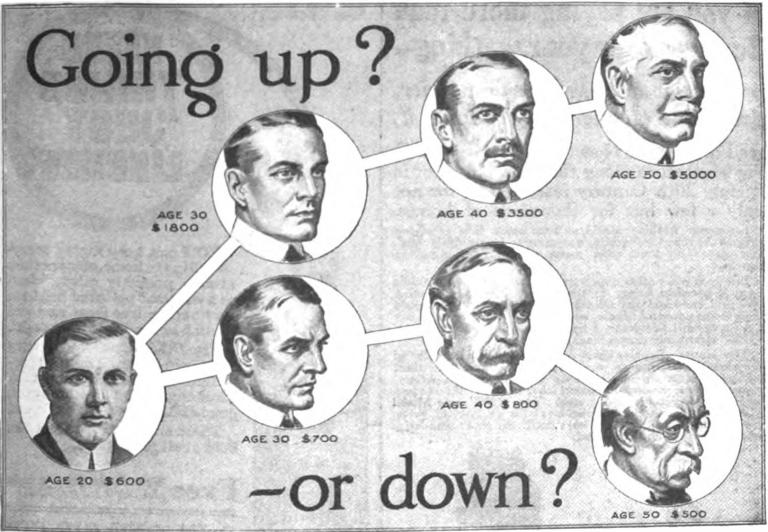
Illustration from a 1916 advertisement for a vocational school in the back of a US magazine (Credit: wikipedia)
He forces us to rethink why the Bible contrasts grace and works. Works are not attempts to “earn” salvation (like a “wage”); instead, they are social symbols of worth.
In part 1 of the series, I explained 6 aspects of grace. In part 2, I introduced grace (gift-giving) as a honor-shame issue. This leads us to clarify two points about Paul’s own message.
1. Paul opposes the worth of our works
“We can’t earn salvation.”
This is the basic message many of us are taught (or teach), especially when talking about Romans or theological topics like justification and salvation. Even though this statement is true, it’s simply not a major idea in Paul’s thinking (if it actually ever existed at all).
Barclay helpfully navigates a way between the so-called “Old Perspective on Paul” (OPP) and the “New Perspective on Paul” (NPP). Whereas traditionalists think Paul rebuts Jewish moralism, the latter claim that Paul criticizes Jewish ethnocentrism.
Credit: Pixabay/CC0 Public Domain
Barclay rightly introduces a third category –– worth. He writes
In declaring that God counts worth (“righteousness”) by reference to Torah-observance but to faith in Christ, Paul subverts the normative authority of the Torah, which no longer shape (“enslave”) the common life of believers. . . . Torah––like every other pre-constituted norm––has been dethroned as a criterion of worth by the unconditional gift of Christ. (567–68)
Thus, the problem was not simply about doing or not doing moral works. What makes works problematic is when they become the basis of one’s worth. Stated this way, we get a greater view of “works.” Someone can regard “works” as ethnic markers (the NPP) or as moral achievements (OPP); yet whatever nuance one uses, the key issue is still worth.
2. Paul opposes the measure of our merit
It’s not exactly correct to say that Paul’s Jewish opponents sought to “merit” salvation via good works. That emphasis still draws more from the thinking opposed during the Reformation. So, what is his goal?

Credit: wikipedia
Paul challenges the measure that people used to assess their worth.
In Barclay’s words,
Since ethnicity, status, and gender are no longer criteria of superior worth (Gal 3:28), and since God pays not regard to the “face” (Gal 2:6) but distributes his grace without regard for the worth, the normal grounds for competition have lost their significance. The assembly of believers forms a new community of opinion, constituted by the gift to the unworthy. Within this community arises, of course, an alternative system of worth, a new form of “social capital” . . . . (435)
What precisely is that “social capital” will be explored more in a coming post.
Every community uses various measures to estimate a person’s relative value or honor within God’s people. That measure could be individualistic (i.e. based on personal achievements and failures) or communal (i.e. based on one’s group identity or position).
The OPP tends to reduce Paul’s concern merely to individualistic works righteousness. The NPP veers more towards a collectivistic orientation. Barclay goes deeper by looking at how “works” and “grace” functioned (regardless of the nuance given to works).
By the way, if you missed his guest post on honorshame.com, I reposted it here with permission. He discussed the relationship between grace and honor-shame.
Previous Post

February 4, 2016
Does the "Plan of Salvation" Make Disciples?
Next Post

February 17, 2016 Grace, Gift-giving, and Guanxi in Chinese Culture
Browse Our Archives
Select a Category Atonement Biblical Theology Book Reviews China Chinese Church Chinese Culture Chinese Language Collectivism Contextualization Culture (General) Ecclesiology Evangelism Gospel Honor & Shame (Face) Interpretation/Exegesis Justification/Righteousness Missiology Mission Methods One Gospel for All Nations Other Practical Contextualization Reading Romans with Eastern Eyes Resources Romans Salvation (General) Saving God's Face Seeking God's Face The Cross in Context Theological Contextualization Theological Education Theology Uncategorized
Select a Month October 2026 September 2026 August 2026 July 2026 June 2026 May 2026 April 2026 March 2026 February 2026 January 2026 December 2025 November 2025 October 2025 September 2025 August 2025 July 2025 June 2025 May 2025 April 2025 March 2025 February 2025 January 2025 December 2024 November 2024 October 2024 September 2024 August 2024 July 2024 June 2024 May 2024 April 2024 March 2024 February 2024 January 2024 December 2023 November 2023 October 2023 September 2023 August 2023 July 2023 June 2023 May 2023 April 2023 March 2023 February 2023 January 2023 December 2022 November 2022 October 2022 September 2022 August 2022 July 2022 June 2022 May 2022 April 2022 March 2022 February 2022 January 2022 December 2021 November 2021 October 2021 September 2021 August 2021 July 2021 June 2021 May 2021 April 2021 March 2021 February 2021 January 2021 December 2020 November 2020 October 2020 September 2020 August 2020 July 2020 June 2020 May 2020 April 2020 March 2020 February 2020 January 2020 December 2019 November 2019 October 2019 September 2019 August 2019 July 2019 June 2019 May 2019 April 2019 March 2019 February 2019 January 2019 December 2018 November 2018 October 2018 September 2018 August 2018 July 2018 June 2018 May 2018 April 2018 March 2018 February 2018 January 2018 December 2017 November 2017 October 2017 September 2017 August 2017 July 2017 June 2017 May 2017 April 2017 March 2017 February 2017 January 2017 December 2016 November 2016 October 2016 September 2016 August 2016 July 2016 June 2016 May 2016 April 2016 March 2016 February 2016 January 2016 December 2015 November 2015 October 2015 September 2015 August 2015 July 2015 June 2015 May 2015 April 2015 March 2015 February 2015 January 2015 December 2014 November 2014 October 2014 September 2014 August 2014 July 2014 June 2014 May 2014 April 2014 March 2014 February 2014 January 2014 December 2013 November 2013 October 2013 September 2013 August 2013 July 2013 June 2013 May 2013 April 2013 March 2013 February 2013 January 2013 December 2012 November 2012
Follow Us!
TAKE THE
Religious Wisdom Quiz
What were the first man and woman’s names in the Bible?
Select your answer to see how you score.
Samson and Delilah Adam and Eve Jacob and Rachel Joseph and Mary
Books by This Author Books by Brad Vaughn
Related posts from Saving God's Face

Should We Emphasize Jesus as King to People...

Why Egalitarians Can Stay in a Complementarian Church
"Why Have You Forsaken Me?” and the Problem...

What motivates obedience when I don’t want to...
TRENDING AT PATHEOS Evangelical

The First Eucharistic Controversy: Christ’s Real Presence
For Catholics, the Eucharist is the source and summit of the Christian...

What a Stop Sign Can Teach Us About...
How to Make a Decision When You Can't Hear God Main point:...

Archdiocese Hosts Military Marriage Retreat in Germany
RASTATT, Germany — The transient military lifestyle, with its frequent deployments and...

Nearly every morning, I make the drive to Detroit with my high-school-age...

The Real AI Story Is Adoption Without Trust
Artificial intelligence has crossed a political threshold. It is no longer a...

A new article, written by Jeff Lindsay and Gale L. Pooley,...
view all Evangelical blogs
Ad-Free & Subscriber Log-In Subscription Support
- About Us
- 2026 Calendar
- Videos
- Podcasts
- Library of World Religions
- Faith In Media Tracker
- Advertise With Us
- Write for Us
- Privacy Policy
- Terms of Service
- Do Not Sell My Data
- Contact Us
- Radiant Digital
- Manage Newsletter Subscriptions
- Unsubscribe From Notifications
- Sitemap
Copyright 2008-2026, Patheos. All rights reserved.
Subscription Support Ad-Free & Subscriber Log-In
Follow Patheos