
BuddhistCatholicContemplativeEvangelicalGeneral ChristianHinduJewishLatter-day SaintMuslimNew VisionsProgressive Christian
Beliefs
- Buddhist
- Catholic
- Contemplative
- Evangelical
- General Christian
- Hindu
- Jewish
- Latter-day Saint
- More Voices
- Muslim
- New Visions
- Pagan
- Progressive Christian
Topics
- Religion News
- Food and Religion
- Sports and Religion
- Religious Art
- Religious Music and Entertainment
- Religious Events
- History and Religion
- Style and Religion
- Politics and Religion
- Women in Religion
- Recreation Outdoors and Religion
- Business Finance and Religion
- Careers Workplace and Religion
- Education and Religion
- Family Parenting and Religion
- Health Fitness and Religion
- Home and Religion
- Relationships and Religion
- Technology and Religion
- Travel and Religion
Columnists
- Buddhist Columnists
- Business Finance and Religion Columnists
- Careers Workplace and Religion Columnists
- Catholic Columnists
- Contemplative Columnists
- Education and Religion Columnists
- Evangelists Columnists
- Family Parenting and Religion Columnists
- General Christian Columnists
- Health Fitness and Religion Columnists
- Hindu Columnists
- History and Religion Columnists
- Home and Religion Columnists
- Jewish Columnists
- More Voices Columnists
- Latter Day Columnists
- Muslim Columnists
- New Visions Columnists
- Nonreligious Columnists
- Pagan Columnists
- Politics and Religion Columnists
- Progressive Columnists
- Recreation Outdoors and Religion Columnists
- Relationships and Religion Columnists
- Religion News Columnists
- Religious Art Columnists
- Religious Events Columnists
- Religious Music and Entertainment Columnists
- Sports and Religion Columnists
- Style and Religion Columnists
- Technology and Religion Columnists
- Travel and Religion Columnists
- Women in Religion Columnists
Resource Library
- 2026 Calendar
- Library of World Religions
- The 100 Most Holy Places on Earth
- Patheos Answers
- Podcasts
- Videos
- Faith Leaders Database
- Anglican Episcopalian
- Bahai
- Baptist
- Buddhism
- Christianity
- Confucianism
- Eastern Orthodoxy
- Hinduism
- Holiness and Pentecostal
- ISKCON
- Islam
- Judaism
- Lutheran
- Methodist
- The Church of Jesus Christ of Latter-day Saints
- New Age
- Paganism
- Presbytarian and Reformed
- Protestantism
- Religion Behind the Scenes
- Roman Catholic
- Scientology
- Shia Islam
- Sikhism
- Sufism
- Sunni Islam
- Taoism
- Zen
- See all religions
Research Tools
 Ad-Free & Subscriber Log-In Subscription Support
Ad-Free & Subscriber Log-In Subscription Support
Follow Patheos 

- Trending:
- Forgiveness
- |
- Marriage
- |
- Consciousness
- |
- Death Penalty
- |
- Election
- |
- Halloween

-
Tools
-
Support the Work
- Home
- Evangelical
- The Exodus as God’s “People Planting Movement”
The Exodus as God’s “People Planting Movement”
Last updated on: October 6, 2015 at 7:45 am by Brad Vaughn
The Exodus as God’s “People Planting Movement” 2015-09-12T14:41:38-07:00 Brad Vaughn
Patheos Explore the world's faith through different perspectives on religion and spirituality! Patheos has the views of the prevalent religions and spiritualities of the world.
In Exodus, God catalyzes a “people planting movement.”

Credit: Billy Alexander/FreeImages.com
This differs from “disciple making movements” or “church planting movements” (CPM). In fact, I have argued elsewhere that there are no CPMs in in the Bible.
In Exodus 13, we see God in the early stages of planting a royal priesthood and a holy nation (cf. Exod 19:6). From these Israelites, the Lord would grow a people who are called by His name.
Out of a desire to see people saved, we face the temptation to compromise by yielding to pragmatism, especially in church planting methodology. Instead, we should be mindful that the Bible has something to say about our methods, not only our message.
How does God plant His people?
God is Faithful, not Fast
In Exodus 13:1–10, 19 explicitly remind us of God’s promises to Abraham, Isaac, and Jacob. This is why
Moses took the bones of Joseph with him, for Joseph had made the sons of Israel solemnly swear, saying, “God will surely visit you, and you shall carry up my bones with you from here.” (v. 19)
It took around 400 years for God to fulfill His promises to rescue Israel from slavery. One can almost understand why some people might think the Lord had forgot them. What are we to learn from this?
The Lord is faithful.
The Lord keeps His promises to His people. He will save them and build them up. However, it may take longer that we think. His plan might cause us to suffer more than we would like.
This raises a few relevant questions.
Are we willing to take measures or make plans for the long term? Are we willing to stay and be buried in the places we serving? Ask yourself, “What do we call ‘home’?” Your passport country or the country in which you serve?
Rapidity is Not Always Right
Notice how Exodus 13:17–18a contrasts much of modern mission thinking,
When Pharaoh let the people go, God did not lead them by way of the land of the Philistines, although that was near. For God said, “Lest the people change their minds when they see war and return to Egypt.” But God led the people around by the way of the wilderness toward the Red Sea.
Here is a key idea for us: the Lord does not always want us to take the fastest route.
God prioritizes His reputation, not rapidity.

Credit: James Cawley via FreeImages.com
The Lord’s will does not always make sense to us. Why? In part, we often are quite unaware of the true condition of our heart. The Israelites’ hearts were not ready for the “faster” route.
In view of Exodus 14:17–18, the Lord had a greater plan, one that gave God glory in Israel and among all nations.
And I will harden the hearts of the Egyptians so that they shall go in after them, and I will get glory over Pharaoh and all his host, his chariots, and his horsemen. And the Egyptians shall know that I am the Lord, when I have gotten glory over Pharaoh, his chariots, and his horsemen.”
What do we learn about God’s “people planting movement” (i.e. the exodus)? It is about more than Israel’s salvation; it primarily concerns God’s glory.
The faster, more “efficient” path often is not most glorifying to God.
Our goal is to magnify and only then to multiply. We shouldn’t confuse the two. They are not necessarily the same thing.
Here are a few application questions:
- As you consider your ministry strategies, which of the possible “slower” paths might actually be the one chosen by God that will give Him glory and protect our hearts?
- Shouldn’t we intentionally reflect on ways that may be counter-intuitive, immediately slower, but better in the long run?
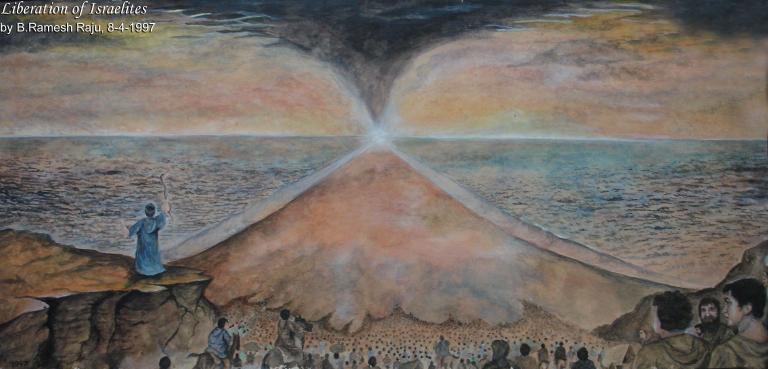
Credit: Creative Commons 2.0/en.wikipedia.org
God’s manner of leading in the past is at least suggestive of how He might lead us in the present. The unfolding of salvation history is testimony enough that the Lord is patient and less concerned with speed than we are. There is a difference between urgency and hastiness. The former entails intentionality; the latter is concerned foremost with time
As far as the Lord is concerned, it was more urgent that Israel know more about the Lord than it was for them to
…. do what most rapidly led to salvation,
…. get to Sinai to receive the Law, and
…. be comfortable, finding rest in the promised land.
This is a key point for those who minimize theological education in a missions context.
There is a Cost
What can we learn about the people within God’s “people planting movement”?
Redemption is costly even to those who are redeemed.
Why? They must give up their old ways in order to follow the Lord and embrace their new way of life. Consider Exodus 13:12–15,
. . . you shall set apart to the Lord all that first opens the womb. All the firstborn of your animals that are males shall be the Lord’s. Every firstborn of a donkey you shall redeem with a lamb, or if you will not redeem it you shall break its neck. Every firstborn of man among your sons you shall redeem . . . . Therefore I sacrifice to the Lord all the males that first open the womb, but all the firstborn of my sons I redeem.
The people are redeemed through sacrifice.
How often do people emphasize that salvation is “free”? We really need to define “free.” The truth is, God’s people must count the cost of following Him. Yet, I rarely see or hear people talking about the cost of faith.
Tell people the cost!
Saved for Conflict . . . Not from It
Finally, in Exodus 13:18b, we see one more intriguing observation:
And the people of Israel went up out of the land of Egypt equipped for battle.
They assume salvation comes through conflict (not that salvation means freedom from conflict).
God’s promises lead to preparation, not presumption.
As we serve God, do we have proper expectations? God’s will is that we would glorify him by waiting for Him with patient joy. How are we enduring the wait?
May Col. 1:11 be our prayer, “May you be strengthened with all power, according to his glorious might, for all endurance and patience with joy.”
(This post previously appeared on the Training Leaders International blog, 3 Aug 2015)
Previous Post

October 1, 2015
The Atonement in Historical Context
Next Post

October 7, 2015 Pastor Centered Chinese Churches
Browse Our Archives
Select a Category Atonement Biblical Theology Book Reviews China Chinese Church Chinese Culture Chinese Language Collectivism Contextualization Culture (General) Ecclesiology Evangelism Gospel Honor & Shame (Face) Interpretation/Exegesis Justification/Righteousness Missiology Mission Methods One Gospel for All Nations Other Practical Contextualization Reading Romans with Eastern Eyes Resources Romans Salvation (General) Saving God's Face Seeking God's Face The Cross in Context Theological Contextualization Theological Education Theology Uncategorized
Select a Month October 2026 September 2026 August 2026 July 2026 June 2026 May 2026 April 2026 March 2026 February 2026 January 2026 December 2025 November 2025 October 2025 September 2025 August 2025 July 2025 June 2025 May 2025 April 2025 March 2025 February 2025 January 2025 December 2024 November 2024 October 2024 September 2024 August 2024 July 2024 June 2024 May 2024 April 2024 March 2024 February 2024 January 2024 December 2023 November 2023 October 2023 September 2023 August 2023 July 2023 June 2023 May 2023 April 2023 March 2023 February 2023 January 2023 December 2022 November 2022 October 2022 September 2022 August 2022 July 2022 June 2022 May 2022 April 2022 March 2022 February 2022 January 2022 December 2021 November 2021 October 2021 September 2021 August 2021 July 2021 June 2021 May 2021 April 2021 March 2021 February 2021 January 2021 December 2020 November 2020 October 2020 September 2020 August 2020 July 2020 June 2020 May 2020 April 2020 March 2020 February 2020 January 2020 December 2019 November 2019 October 2019 September 2019 August 2019 July 2019 June 2019 May 2019 April 2019 March 2019 February 2019 January 2019 December 2018 November 2018 October 2018 September 2018 August 2018 July 2018 June 2018 May 2018 April 2018 March 2018 February 2018 January 2018 December 2017 November 2017 October 2017 September 2017 August 2017 July 2017 June 2017 May 2017 April 2017 March 2017 February 2017 January 2017 December 2016 November 2016 October 2016 September 2016 August 2016 July 2016 June 2016 May 2016 April 2016 March 2016 February 2016 January 2016 December 2015 November 2015 October 2015 September 2015 August 2015 July 2015 June 2015 May 2015 April 2015 March 2015 February 2015 January 2015 December 2014 November 2014 October 2014 September 2014 August 2014 July 2014 June 2014 May 2014 April 2014 March 2014 February 2014 January 2014 December 2013 November 2013 October 2013 September 2013 August 2013 July 2013 June 2013 May 2013 April 2013 March 2013 February 2013 January 2013 December 2012 November 2012
Follow Us!
TAKE THE
Religious Wisdom Quiz
Which Psalm begins, "The Lord is my light and my salvation; whom shall I fear?"
Select your answer to see how you score.
Psalm 27 Psalm 14 Psalm 139 Psalm 91
Books by This Author Books by Brad Vaughn
Related posts from Saving God's Face

Why Christianity Needs Individuals but Rejects Individualism

Glory, Violence, and the Gospel of Peace
How Technique Undermines Mission
“I’ll be wherever you call me.”
TRENDING AT PATHEOS Evangelical

The Problem with False Prophets
Miller’s Station UMC| 10/18/26| Anchor Verse: Jeremiah 23: 1, 9-23 I...

Emotion in Early Christianity by Andrew Crislip
Andrew Crislip’s Emotion in Early Christianity examines an often overlooked dimension of...

16 Spiritual Touchstones for a More Grounded Life
After decades of spiritual study, here are 16 principles I try...

Catholic Evangelization: Sharing Your Faith Every Day
Welcome back to the Graceful Awakening mini-series called, “From Faith to Mission.” ...

The Pillar of the Boatmen: the Ancient Monument...
The Pillar of the Boatmen is a Romano-Gaulish sculpture that dates from...

In one sense walking into Westminster Abbey is like walking down the...
view all Evangelical blogs
Ad-Free & Subscriber Log-In Subscription Support
- About Us
- 2026 Calendar
- Videos
- Podcasts
- Library of World Religions
- Faith In Media Tracker
- Advertise With Us
- Write for Us
- Privacy Policy
- Terms of Service
- Do Not Sell My Data
- Contact Us
- Radiant Digital
- Manage Newsletter Subscriptions
- Unsubscribe From Notifications
- Sitemap
Copyright 2008-2026, Patheos. All rights reserved.
Subscription Support Ad-Free & Subscriber Log-In
Follow Patheos