
BuddhistCatholicContemplativeEvangelicalGeneral ChristianHinduJewishLatter-day SaintMuslimNew VisionsProgressive Christian
Beliefs
- Buddhist
- Catholic
- Contemplative
- Evangelical
- General Christian
- Hindu
- Jewish
- Latter-day Saint
- More Voices
- Muslim
- New Visions
- Pagan
- Progressive Christian
Topics
- Religion News
- Food and Religion
- Sports and Religion
- Religious Art
- Religious Music and Entertainment
- Religious Events
- History and Religion
- Style and Religion
- Politics and Religion
- Women in Religion
- Recreation Outdoors and Religion
- Business Finance and Religion
- Careers Workplace and Religion
- Education and Religion
- Family Parenting and Religion
- Health Fitness and Religion
- Home and Religion
- Relationships and Religion
- Technology and Religion
- Travel and Religion
Columnists
- Buddhist Columnists
- Business Finance and Religion Columnists
- Careers Workplace and Religion Columnists
- Catholic Columnists
- Contemplative Columnists
- Education and Religion Columnists
- Evangelists Columnists
- Family Parenting and Religion Columnists
- General Christian Columnists
- Health Fitness and Religion Columnists
- Hindu Columnists
- History and Religion Columnists
- Home and Religion Columnists
- Jewish Columnists
- More Voices Columnists
- Latter Day Columnists
- Muslim Columnists
- New Visions Columnists
- Nonreligious Columnists
- Pagan Columnists
- Politics and Religion Columnists
- Progressive Columnists
- Recreation Outdoors and Religion Columnists
- Relationships and Religion Columnists
- Religion News Columnists
- Religious Art Columnists
- Religious Events Columnists
- Religious Music and Entertainment Columnists
- Sports and Religion Columnists
- Style and Religion Columnists
- Technology and Religion Columnists
- Travel and Religion Columnists
- Women in Religion Columnists
Resource Library
- 2026 Calendar
- Library of World Religions
- The 100 Most Holy Places on Earth
- Patheos Answers
- Podcasts
- Videos
- Faith Leaders Database
- Anglican Episcopalian
- Bahai
- Baptist
- Buddhism
- Christianity
- Confucianism
- Eastern Orthodoxy
- Hinduism
- Holiness and Pentecostal
- ISKCON
- Islam
- Judaism
- Lutheran
- Methodist
- The Church of Jesus Christ of Latter-day Saints
- New Age
- Paganism
- Presbytarian and Reformed
- Protestantism
- Religion Behind the Scenes
- Roman Catholic
- Scientology
- Shia Islam
- Sikhism
- Sufism
- Sunni Islam
- Taoism
- Zen
- See all religions
Research Tools
 Ad-Free & Subscriber Log-In Subscription Support
Ad-Free & Subscriber Log-In Subscription Support
Follow Patheos 

- Trending:
- Forgiveness
- |
- Marriage
- |
- Consciousness
- |
- Death Penalty
- |
- Election
- |
- Halloween

-
Tools
-
Support the Work
- Home
- Evangelical
- Six Places Honor and Shame Hide in the Bible
Six Places Honor and Shame Hide in the Bible
Last updated on: August 1, 2014 at 9:50 pm by Brad Vaughn
Six Places Honor and Shame Hide in the Bible 2014-08-01T21:50:40-07:00 Brad Vaughn
Patheos Explore the world's faith through different perspectives on religion and spirituality! Patheos has the views of the prevalent religions and spiritualities of the world.
HonorShame.com was gracious enough to allow me to reblog his most recent post.
It is extremely helpful in equipping people to identity honor/shame themes in Scripture. Enjoy! And take a few minute to check out and subscribe to honorshame.com.
There has to be a sociological term for this, because it is a universal phenomenon. When something new comes onto your radar, you begin seeing it everywhere. This is true not only of tangible things, but ideas as well – if you learn a new concept, you recognize it frequently thereafter.
 The themes of honor and shame permeate the Bible, but they often “hide” in our Western blind spots. By knowing where honor and shame are typically found, we can begin to uncover amazing Biblical truths . Here are six ways biblical writers package their ideas about honor and shame.
1) Propositions – The Bible makes explicit comments about ‘shame’, ‘disgrace’, ‘glory’, ‘name’, ‘honor’, ‘reputation’, etc.. We often read right over these words. Did you know the words ‘shame’, ‘honor’, and ‘glory’ appear 40 times in Romans (while ‘guilt’, ‘innocence’, and ‘forgiveness’ appear only twice in Romans)? Don’t forget to see the most obvious!
- “My salvation and honor depend upon God,” Ps 62:7
- “Whoever believes in him will not be put to shame. So the honor is for you who believe,” 1 Peter 2:6-7
2) Metaphors – Biblical authors often employ metaphors from the tangible world to communicate our status transposition (from shame to honor) in the spiritual realm. Our new honor in Christ is abstract, so we need concrete images to grasp it.
- “He raises up the poor from the dust; he lifts the needy from the ash heap, to make them sit with princes and inherit a seat of honor.” 1 Sam 2:7-8
- “So then you are no longer strangers and aliens, but you are citizens with the saints and also members of the household of God” Eph 2:19
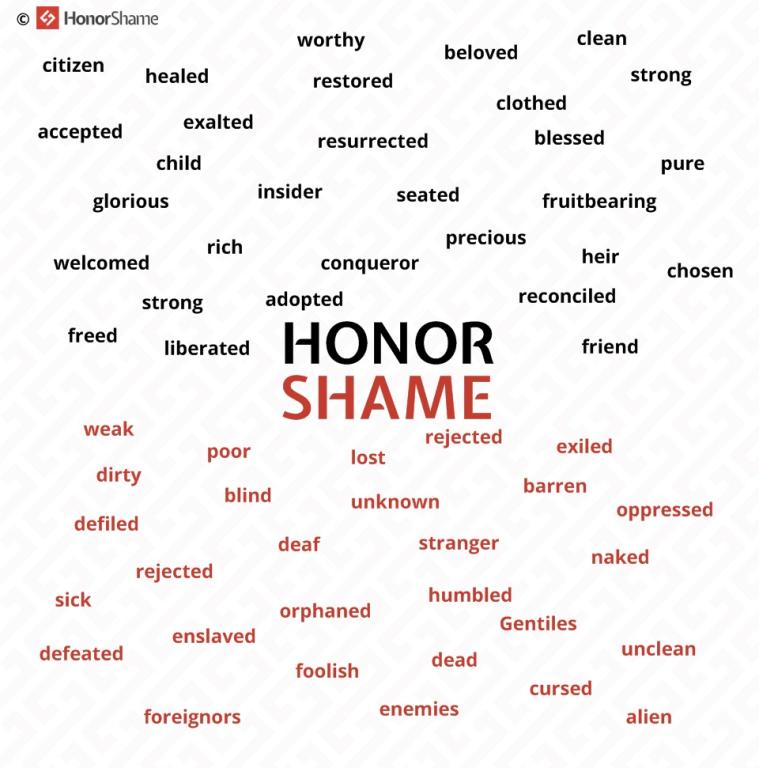 3) Narratives – OT writers often told stories about faithful Israelites being exalted from the threat of shame unto honor. Without using any explicit words, they show how Yahweh’s salvation included honor for his people.
- Notable examples include: Adam, Abraham, Joseph, Moses, David, Mephibosheth, Hannah, Esther/Mordecai, Daniel and friends, Haggai, etc.
- A previous post examined Job this way.
4) Genealogies – Honor (and shame) is determined primarily by the group you belong to. So to know your identity and status, you must know your family. For this reason, genealogies are perhaps the most basic way honor is communicated in the Bible.
- The book of Ruth concludes with a genealogy connecting Naomi to the great king David (Ruth 4:16-21).
- The NT comes out of the gate with 17 verses of sizzling birth announcements (Matt 1:1-17)! There is hardly a more effective way to communicate the honor of God’s only begotten Son.
5) Covenants – Ancient Near Eastern covenants formed family-like relationships. Such covenants, in which Yawheh as the patron commits to honor someone (for the sake of His own honor!), were the cornerstone of Israel’s worldview and theology.
- Abram is covenanted land, blessings, peace, descendants, and global benefaction – a marks of honor (Gen 12:1-3).
- David is promised the virtually every type of ancient honor (read over 2 Sam 7:8-16).
6) Symbols – Since honor and shame are invisible social values, cultures must tangibly symbolize people’s status through food, meals, clothes, colors, crowns, thrones, blood, names, head,face, feet and many other ways. All these physical object carry social meaning, and confer honor (or shame).
- The Prodigal Son’s Father said, ‘Bring quickly the best robe, and put it on him, and put a ring on his hand, and shoes on his feet. And bring the fattened calf and kill it, and let us eat and celebrate (Luke 15:22-23).
- “So Hanun took David’s servants and shaved off half the beard of each and cut off their garments in the middle, at their hips, and sent them away. When it was told David, he sent to meet them, for the men were greatly ashamed“ (2 Sam 10:4-5).
May your vision be expanded to better see how God is working to remove shame and restore honor all throughout the scriptures!!
Related articles
 10 Ideas for Crafting the Biblical Story among UPGs
 Don’t Adamize the Gospel
 How to Talk about Shame
 HS in the blogosphere
 Why Western Theology Neglects HonorShame
Previous Post

July 30, 2014
Sin is personal because it is social
Next Post
August 6, 2014 Why Not Begin with Babel?
Browse Our Archives
Select a Category Atonement Biblical Theology Book Reviews China Chinese Church Chinese Culture Chinese Language Collectivism Contextualization Culture (General) Ecclesiology Evangelism Gospel Honor & Shame (Face) Interpretation/Exegesis Justification/Righteousness Missiology Mission Methods One Gospel for All Nations Other Practical Contextualization Reading Romans with Eastern Eyes Resources Romans Salvation (General) Saving God's Face Seeking God's Face The Cross in Context Theological Contextualization Theological Education Theology Uncategorized
Select a Month October 2026 September 2026 August 2026 July 2026 June 2026 May 2026 April 2026 March 2026 February 2026 January 2026 December 2025 November 2025 October 2025 September 2025 August 2025 July 2025 June 2025 May 2025 April 2025 March 2025 February 2025 January 2025 December 2024 November 2024 October 2024 September 2024 August 2024 July 2024 June 2024 May 2024 April 2024 March 2024 February 2024 January 2024 December 2023 November 2023 October 2023 September 2023 August 2023 July 2023 June 2023 May 2023 April 2023 March 2023 February 2023 January 2023 December 2022 November 2022 October 2022 September 2022 August 2022 July 2022 June 2022 May 2022 April 2022 March 2022 February 2022 January 2022 December 2021 November 2021 October 2021 September 2021 August 2021 July 2021 June 2021 May 2021 April 2021 March 2021 February 2021 January 2021 December 2020 November 2020 October 2020 September 2020 August 2020 July 2020 June 2020 May 2020 April 2020 March 2020 February 2020 January 2020 December 2019 November 2019 October 2019 September 2019 August 2019 July 2019 June 2019 May 2019 April 2019 March 2019 February 2019 January 2019 December 2018 November 2018 October 2018 September 2018 August 2018 July 2018 June 2018 May 2018 April 2018 March 2018 February 2018 January 2018 December 2017 November 2017 October 2017 September 2017 August 2017 July 2017 June 2017 May 2017 April 2017 March 2017 February 2017 January 2017 December 2016 November 2016 October 2016 September 2016 August 2016 July 2016 June 2016 May 2016 April 2016 March 2016 February 2016 January 2016 December 2015 November 2015 October 2015 September 2015 August 2015 July 2015 June 2015 May 2015 April 2015 March 2015 February 2015 January 2015 December 2014 November 2014 October 2014 September 2014 August 2014 July 2014 June 2014 May 2014 April 2014 March 2014 February 2014 January 2014 December 2013 November 2013 October 2013 September 2013 August 2013 July 2013 June 2013 May 2013 April 2013 March 2013 February 2013 January 2013 December 2012 November 2012
Follow Us!
TAKE THE
Religious Wisdom Quiz
Which prophet spoke of a 'new covenant' in the Old Testament?
Select your answer to see how you score.
Malachi Jeremiah Isaiah Ezekiel
Books by This Author Books by Brad Vaughn
Related posts from Saving God's Face

No King forgets his crown. Why do we?

Recovering Moral Vision Between Shame and Shamelessness

Refuge, Confession, and the End of Shame

Psalm 25 and the Fear of Being Put...
TRENDING AT PATHEOS Evangelical

Pope Leo Celebrates Mass for Nurses & Docs...
I don't have any idea how he did it, but Pope Leo...

The Sermon on the Mount, Part I: Matthew...
The Sermon on the Mount, Part I (Matthew 4:12-5:12) St. Matthew moves...

What's up from Crossway: Reviewing some of their latest A few weeks...

Janie Learns the Way of the Cross: A...
Teaching children about Jesus' Passion can be challenging. Many parents and educators...

Looking For Good Catholic Writing - October 2026
He alone extends the heavens, and he walks upon the waves of...

In "Irreplaceable," our book on vocation and technology, Trevor Sutton and I...
view all Evangelical blogs
Ad-Free & Subscriber Log-In Subscription Support
- About Us
- 2026 Calendar
- Videos
- Podcasts
- Library of World Religions
- Faith In Media Tracker
- Advertise With Us
- Write for Us
- Privacy Policy
- Terms of Service
- Do Not Sell My Data
- Contact Us
- Radiant Digital
- Manage Newsletter Subscriptions
- Unsubscribe From Notifications
- Sitemap
Copyright 2008-2026, Patheos. All rights reserved.
Subscription Support Ad-Free & Subscriber Log-In
Follow Patheos