
BuddhistCatholicContemplativeEvangelicalGeneral ChristianHinduJewishLatter-day SaintMuslimNew VisionsProgressive Christian
Beliefs
- Buddhist
- Catholic
- Contemplative
- Evangelical
- General Christian
- Hindu
- Jewish
- Latter-day Saint
- More Voices
- Muslim
- New Visions
- Pagan
- Progressive Christian
Topics
- Religion News
- Food and Religion
- Sports and Religion
- Religious Art
- Religious Music and Entertainment
- Religious Events
- History and Religion
- Style and Religion
- Politics and Religion
- Women in Religion
- Recreation Outdoors and Religion
- Business Finance and Religion
- Careers Workplace and Religion
- Education and Religion
- Family Parenting and Religion
- Health Fitness and Religion
- Home and Religion
- Relationships and Religion
- Technology and Religion
- Travel and Religion
Columnists
- Buddhist Columnists
- Business Finance and Religion Columnists
- Careers Workplace and Religion Columnists
- Catholic Columnists
- Contemplative Columnists
- Education and Religion Columnists
- Evangelists Columnists
- Family Parenting and Religion Columnists
- General Christian Columnists
- Health Fitness and Religion Columnists
- Hindu Columnists
- History and Religion Columnists
- Home and Religion Columnists
- Jewish Columnists
- More Voices Columnists
- Latter Day Columnists
- Muslim Columnists
- New Visions Columnists
- Nonreligious Columnists
- Pagan Columnists
- Politics and Religion Columnists
- Progressive Columnists
- Recreation Outdoors and Religion Columnists
- Relationships and Religion Columnists
- Religion News Columnists
- Religious Art Columnists
- Religious Events Columnists
- Religious Music and Entertainment Columnists
- Sports and Religion Columnists
- Style and Religion Columnists
- Technology and Religion Columnists
- Travel and Religion Columnists
- Women in Religion Columnists
Resource Library
- 2026 Calendar
- Library of World Religions
- The 100 Most Holy Places on Earth
- Patheos Answers
- Podcasts
- Videos
- Faith Leaders Database
- Anglican Episcopalian
- Bahai
- Baptist
- Buddhism
- Christianity
- Confucianism
- Eastern Orthodoxy
- Hinduism
- Holiness and Pentecostal
- ISKCON
- Islam
- Judaism
- Lutheran
- Methodist
- The Church of Jesus Christ of Latter-day Saints
- New Age
- Paganism
- Presbytarian and Reformed
- Protestantism
- Religion Behind the Scenes
- Roman Catholic
- Scientology
- Shia Islam
- Sikhism
- Sufism
- Sunni Islam
- Taoism
- Zen
- See all religions
Research Tools
 Ad-Free & Subscriber Log-In Subscription Support
Ad-Free & Subscriber Log-In Subscription Support
Follow Patheos 

- Trending:
- Forgiveness
- |
- Marriage
- |
- Consciousness
- |
- Death Penalty
- |
- Election
- |
- Halloween

-
Tools
-
Support the Work
- Home
- Evangelical
- Should We Use Biblical Languages to Teach Chinese Christians?
Should We Use Biblical Languages to Teach Chinese Christians?
Last updated on: October 26, 2017 at 2:20 pm by Brad Vaughn
Should We Use Biblical Languages to Teach Chinese Christians? 2017-10-26T14:20:38-07:00 Brad Vaughn
Patheos Explore the world's faith through different perspectives on religion and spirituality! Patheos has the views of the prevalent religions and spiritualities of the world.
A reader sent me a question after my previous post about using “context” to interpret a Bible passage. He asked,
“I agree with you that conjunctions are the most important words in the Bible, however the 和合本 often leaves out conjunctions. Do you teach your students using English Bibles? Do you have them read Hebrew/Greek? Or do you just tell them every time a conjunction is left out of the Chinese?”
I felt like my response could be helpful to others as well, not simply those in China. I want to share a few thoughts that are relevant to anyone who teaches the Bible using a modern translation (especially in Chinese).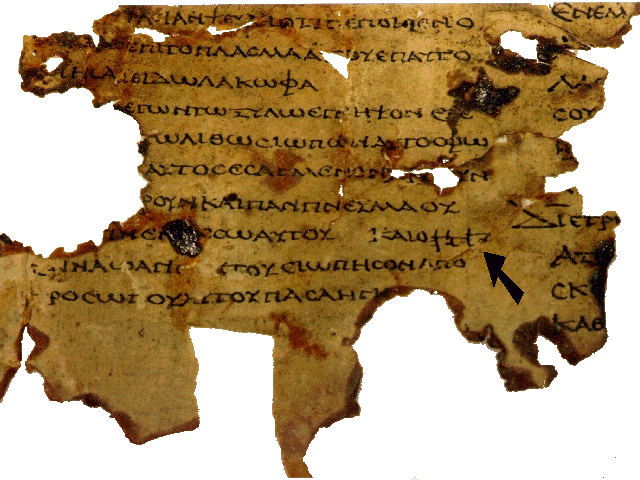 Teaching the Bible Using a Modern Language
First of all, I do not use English Bibles when teaching. I only teach in Chinese. Although our school teaches people Greek and Hebrew, not all the students have taken those classes. I cannot assume that knowledge.
Also, I do use the CUV (HeHeBen, 和合本) despite its gross deficiencies. I do this mainly because this is the version that most of my student use or most of their congregants use. Somehow or another, I need to help make my points using the HeHeBen so that they can do the same for those they teach.
I certainly reference other translations (like the XinYiBen) where it helps. I do this for two reasons. I want to persuade them to switch translations. Also, I want them to see that other widely known versions affirm what I’m saying about a translation of a verse or phrase.
Naturally, I have faced the same frustration and puzzled over this question. On the one hand, people sometimes say that we shouldn’t appeal to the original languages too often because this will make them lose confidence in the Bible they hold in their hands. I understand the concern, but I think we go too far if we don’t talk about the Greek/Hebrew where the point is significant.
Use the Biblical Languages
So, yes, I do appeal to the original languages.
Many of them have language resources that help them at least verify the thrust of what I’m asserting. How often I do this will depend on the class I teach. In Romans, for example, I discuss the Greek very, very frequently. This is because Paul’s logic is so tight in places yet the HeHeBen omits a lot of key words like “therefore” and “because,” sometimes even giving a word its opposite meaning!
 People have to keep in mind that modern translations are not inspired. We ultimately have to use the original languages; otherwise, we enslave our theology to that of the translators and the patterns of thinking inherent to our own language. For instance, Chinese doesn’t utilize participles, yet the entire Greek New Testament hangs on them.
If you only permit yourself to use the Chinese, then there will be certain points you simply cannot make when teaching. Consequently, you can only teach selective portions of the Chinese Bible. This is a flawed approach on many levels. The solution is not to ignore the original languages. Rather, the goal should be to teach the Chinese both Hebrew and Greek.
I recall the words of my own Greek teacher,
We teach you Greek not so that you can translate. We teach you Greek so that you are not a slave to the “big books.”
He was referring to the big scholarly books that give very technical information at points. The person who is not familiar with the biblical languages must simply take the author at his word. However, what if other scholars disagree? What is a writer exaggerates the point a little bit too much?
As a rule, I definitely do NOT want to appeal to other modern languages like English. This gives English authority as a biblical language that it doesn’t deserve.
So, what exactly do we do?
In the next post, I’ll give a few positive suggestions and tips about how to navigate this issue.
Photo Credit: CC 2.0/wikipedia
Related articles
 How Do We Interpret a Bible? (a new series)
 Interpreting Scripture When You Only Have a Bible (Steps 1 and 2)
 What is the “Context” of Scripture?
 “What does the text mean?” and other unhelpful questions
 When You Only Have a Bible: Context and Questions

Previous Post

January 22, 2014
What is the "Context" of Scripture?
Next Post
January 30, 2014 What to do if they don't know Greek or Hebrew
Browse Our Archives
Select a Category Atonement Biblical Theology Book Reviews China Chinese Church Chinese Culture Chinese Language Collectivism Contextualization Culture (General) Ecclesiology Evangelism Gospel Honor & Shame (Face) Interpretation/Exegesis Justification/Righteousness Missiology Mission Methods One Gospel for All Nations Other Practical Contextualization Reading Romans with Eastern Eyes Resources Romans Salvation (General) Saving God's Face Seeking God's Face The Cross in Context Theological Contextualization Theological Education Theology Uncategorized
Select a Month October 2026 September 2026 August 2026 July 2026 June 2026 May 2026 April 2026 March 2026 February 2026 January 2026 December 2025 November 2025 October 2025 September 2025 August 2025 July 2025 June 2025 May 2025 April 2025 March 2025 February 2025 January 2025 December 2024 November 2024 October 2024 September 2024 August 2024 July 2024 June 2024 May 2024 April 2024 March 2024 February 2024 January 2024 December 2023 November 2023 October 2023 September 2023 August 2023 July 2023 June 2023 May 2023 April 2023 March 2023 February 2023 January 2023 December 2022 November 2022 October 2022 September 2022 August 2022 July 2022 June 2022 May 2022 April 2022 March 2022 February 2022 January 2022 December 2021 November 2021 October 2021 September 2021 August 2021 July 2021 June 2021 May 2021 April 2021 March 2021 February 2021 January 2021 December 2020 November 2020 October 2020 September 2020 August 2020 July 2020 June 2020 May 2020 April 2020 March 2020 February 2020 January 2020 December 2019 November 2019 October 2019 September 2019 August 2019 July 2019 June 2019 May 2019 April 2019 March 2019 February 2019 January 2019 December 2018 November 2018 October 2018 September 2018 August 2018 July 2018 June 2018 May 2018 April 2018 March 2018 February 2018 January 2018 December 2017 November 2017 October 2017 September 2017 August 2017 July 2017 June 2017 May 2017 April 2017 March 2017 February 2017 January 2017 December 2016 November 2016 October 2016 September 2016 August 2016 July 2016 June 2016 May 2016 April 2016 March 2016 February 2016 January 2016 December 2015 November 2015 October 2015 September 2015 August 2015 July 2015 June 2015 May 2015 April 2015 March 2015 February 2015 January 2015 December 2014 November 2014 October 2014 September 2014 August 2014 July 2014 June 2014 May 2014 April 2014 March 2014 February 2014 January 2014 December 2013 November 2013 October 2013 September 2013 August 2013 July 2013 June 2013 May 2013 April 2013 March 2013 February 2013 January 2013 December 2012 November 2012
Follow Us!
TAKE THE
Religious Wisdom Quiz
"Train up a child in the way he should go" is found in which book?
Select your answer to see how you score.
Matthew Job Jonah Proverbs
Books by This Author Books by Brad Vaughn
Related posts from Saving God's Face

Why Christianity Needs Individuals but Rejects Individualism

Glory, Violence, and the Gospel of Peace
How Technique Undermines Mission

“I’ll be wherever you call me.”
TRENDING AT PATHEOS Evangelical

How to Make a Decision When You Can't...
Main point: It’s much more valuable to stay close to God so...

Archdiocese Hosts Military Marriage Retreat in Germany
RASTATT, Germany — The transient military lifestyle, with its frequent deployments and...

Nearly every morning, I make the drive to Detroit with my high-school-age...

The Real AI Story Is Adoption Without Trust
Artificial intelligence has crossed a political threshold. It is no longer a...

A new article, written by Jeff Lindsay and Gale L. Pooley,...

Swimfan: Forgotten Aughts Pleasures
This is a recovery effort. In 2002, My Big Fat Greek Wedding...
view all Evangelical blogs
Ad-Free & Subscriber Log-In Subscription Support
- About Us
- 2026 Calendar
- Videos
- Podcasts
- Library of World Religions
- Faith In Media Tracker
- Advertise With Us
- Write for Us
- Privacy Policy
- Terms of Service
- Do Not Sell My Data
- Contact Us
- Radiant Digital
- Manage Newsletter Subscriptions
- Unsubscribe From Notifications
- Sitemap
Copyright 2008-2026, Patheos. All rights reserved.
Subscription Support Ad-Free & Subscriber Log-In
Follow Patheos