
BuddhistCatholicContemplativeEvangelicalGeneral ChristianHinduJewishLatter-day SaintMuslimNew VisionsProgressive Christian
Beliefs
- Buddhist
- Catholic
- Contemplative
- Evangelical
- General Christian
- Hindu
- Jewish
- Latter-day Saint
- More Voices
- Muslim
- New Visions
- Pagan
- Progressive Christian
Topics
- Religion News
- Food and Religion
- Sports and Religion
- Religious Art
- Religious Music and Entertainment
- Religious Events
- History and Religion
- Style and Religion
- Politics and Religion
- Women in Religion
- Recreation Outdoors and Religion
- Business Finance and Religion
- Careers Workplace and Religion
- Education and Religion
- Family Parenting and Religion
- Health Fitness and Religion
- Home and Religion
- Relationships and Religion
- Technology and Religion
- Travel and Religion
Columnists
- Buddhist Columnists
- Business Finance and Religion Columnists
- Careers Workplace and Religion Columnists
- Catholic Columnists
- Contemplative Columnists
- Education and Religion Columnists
- Evangelists Columnists
- Family Parenting and Religion Columnists
- General Christian Columnists
- Health Fitness and Religion Columnists
- Hindu Columnists
- History and Religion Columnists
- Home and Religion Columnists
- Jewish Columnists
- More Voices Columnists
- Latter Day Columnists
- Muslim Columnists
- New Visions Columnists
- Nonreligious Columnists
- Pagan Columnists
- Politics and Religion Columnists
- Progressive Columnists
- Recreation Outdoors and Religion Columnists
- Relationships and Religion Columnists
- Religion News Columnists
- Religious Art Columnists
- Religious Events Columnists
- Religious Music and Entertainment Columnists
- Sports and Religion Columnists
- Style and Religion Columnists
- Technology and Religion Columnists
- Travel and Religion Columnists
- Women in Religion Columnists
Resource Library
- 2026 Calendar
- Library of World Religions
- The 100 Most Holy Places on Earth
- Patheos Answers
- Podcasts
- Videos
- Faith Leaders Database
- Anglican Episcopalian
- Bahai
- Baptist
- Buddhism
- Christianity
- Confucianism
- Eastern Orthodoxy
- Hinduism
- Holiness and Pentecostal
- ISKCON
- Islam
- Judaism
- Lutheran
- Methodist
- The Church of Jesus Christ of Latter-day Saints
- New Age
- Paganism
- Presbytarian and Reformed
- Protestantism
- Religion Behind the Scenes
- Roman Catholic
- Scientology
- Shia Islam
- Sikhism
- Sufism
- Sunni Islam
- Taoism
- Zen
- See all religions
Research Tools
 Ad-Free & Subscriber Log-In Subscription Support
Ad-Free & Subscriber Log-In Subscription Support
Follow Patheos 

- Trending:
- Forgiveness
- |
- Marriage
- |
- Consciousness
- |
- Death Penalty
- |
- Election
- |
- Halloween

-
Tools
-
Support the Work
- Home
- Evangelical
- Theology is Like Making a Baby
Theology is Like Making a Baby
Last updated on: October 22, 2013 at 8:21 am by Brad Vaughn
Theology is Like Making a Baby 2013-10-22T08:21:57-07:00 Brad Vaughn
Patheos Explore the world's faith through different perspectives on religion and spirituality! Patheos has the views of the prevalent religions and spiritualities of the world.
In talking about justification, Paul first answers the who-question, then the how-question. That was the point of my last post. Why does it matter?
Why order matters

Credit: Flickr/Angelo Yap
Sadly, Western theology rarely stresses the identity question; instead, the greater emphasis is given to the how question (how is one justified?). Why do the Jedi masters of theology confuse the “who?” and “how?” questions?
If we only talk about “achieved righteousness” (i.e. works vs. faith), we can quickly lose the historical context in which people would think of themselves as righteous by virtue of group identity (Jew rather than Gentile). The latter is “ascribed righteousness.” Accordingly, justification quickly becomes abstracted from history. If we first talk about how to get saved, we can easily forget that Paul is facing a *who-*question.
However, if we recognize that Paul is confronting the problem of Jewish ethnocentrism, then we can still easily see how some Jews would seek after “achieved righteousness” (i.e. legalism). After all, striving to obey the Mosaic Law would only have been an honor within a Jewish worldview. Within a Jewish community, no doubt some people would try to achieve greater levels of honor and “righteousness.” In short, the who-question naturally leads to the how question (as we will see below).
When we first recognize the ethnicity problem, we still have the ethical dimension. Yet, if we start with ethics (per traditional western theology), then we quickly overlook the ethnicity problem. I sometimes put is this way: The traditional interpretation is a right application of Paul’s message: “People cannot do good works to earn their salvation.” However, Paul’s meaning is “Gentiles can also be Abraham’s offspring.”
In this way, I completely affirm the traditional view yet I also retain Paul’s original message so immediately relevant to Eastern cultures. We can give up the false dichotomy between the “old” and “new” perspectives.
Who belongs to God’s Covenant?
The New Perspective on Paul (NPP) often talks about people being “in God’s covenant.” In response, their critics often ask, “What covenant are you talking about?” I’ll give my answer–––the Abrahamic covenant. For example, see Romans 4.
In previous post, I noted that the Jews in Paul’s day had collapsed two categories together–– salvation and society. In preaching justification, Paul confronts more than just a “social” problem (ethnicity). He is also doing more than rebutting legalism (ethics). The Jews thought Gentiles had to become Jewish in order to be justified. In the mind of Paul’s Jewish opponents, “being righteous” carried both ethnic and ethical connotations.
Accordingly, our view of justification goes wrong if we simply divide the world into the “righteous” and “unrighteous” without reference to the concept of “covenant.” Apart from this covenant theme, we abstract Paul’s meaning when he speaks of “righteousness.” As Romans 4 makes plain, being justified (declared righteous) meant being included in Abraham’s covenant (cf. Gal 3:13-14).
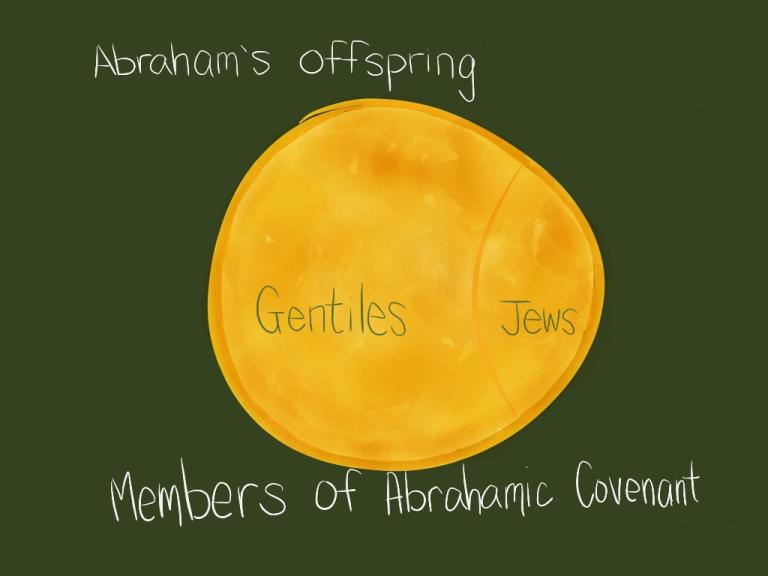
Therefore, we need to change the terms that are traditionally used when talking about justification. The graph above adapts the original graph (below) that I used when describing “Old Perspective on Paul” (OPP). Instead of using the blanket term “righteous,” we should reclaim Paul’s language, as when he talks about who can be Abraham’s “offspring.”
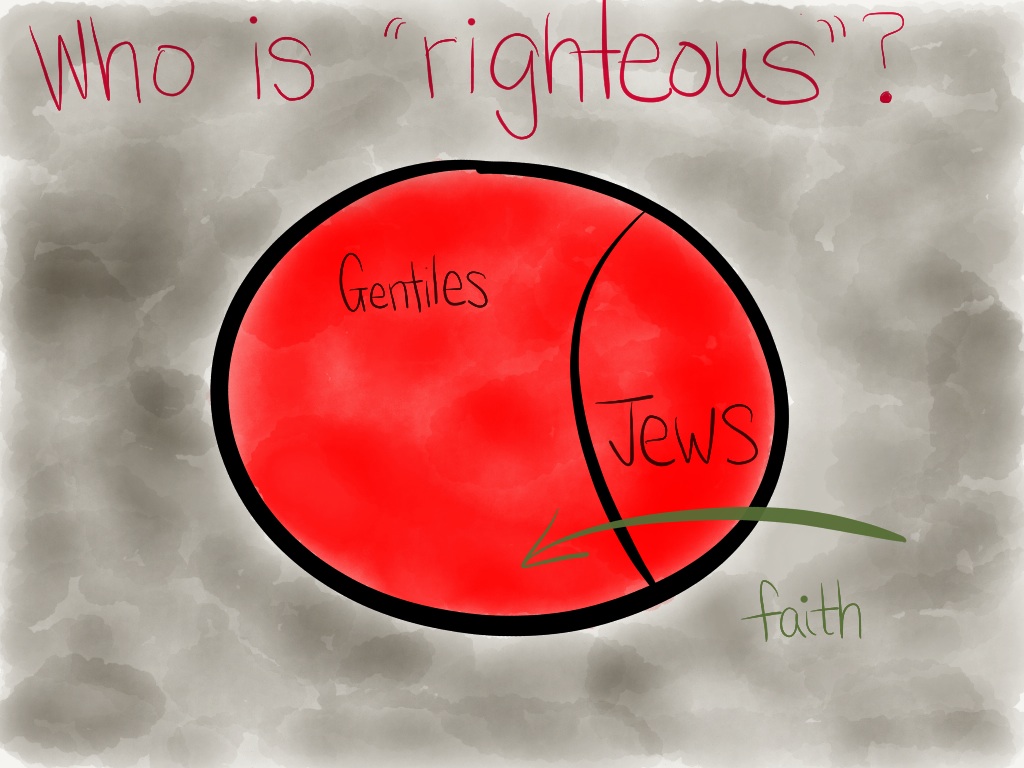
We must not settle for a merely “correct” word at the expense of losing the biblical and theological context of justification. If we settle for the ethical dimension of “righteousness,” we easily lose Paul’s ethnic focus.
This matters for ministry. We compromise the gospel message in China when we settle for a true but abstract truth.
“How to make a baby”
Here is an analogy to illustrate the importance of this entire who versus how distinction.
If I claimed, “Men can have babies,” you would naturally rebut my who-question by talking about HOW people have babies. Perhaps, a debate would then break out where everyone begins focusing on the nuances of the subject: “Exactly how do we make babies?” Eventually, that fixation on method distracts us from the original question.
By the time we have decided that implantation and other more traditional means can both produce a baby, we have forgotten that we first wanted to answer a who question.
Talking about how was essential but, in the end, we still missed the point.
Previous Post
October 17, 2013
The "Old Perspective": Right Answer, Wrong Problem?
Next Post
October 24, 2013 A Chinese Perspective on Justification
Browse Our Archives
Select a Category Atonement Biblical Theology Book Reviews China Chinese Church Chinese Culture Chinese Language Collectivism Contextualization Culture (General) Ecclesiology Evangelism Gospel Honor & Shame (Face) Interpretation/Exegesis Justification/Righteousness Missiology Mission Methods One Gospel for All Nations Other Practical Contextualization Reading Romans with Eastern Eyes Resources Romans Salvation (General) Saving God's Face Seeking God's Face The Cross in Context Theological Contextualization Theological Education Theology Uncategorized
Select a Month October 2026 September 2026 August 2026 July 2026 June 2026 May 2026 April 2026 March 2026 February 2026 January 2026 December 2025 November 2025 October 2025 September 2025 August 2025 July 2025 June 2025 May 2025 April 2025 March 2025 February 2025 January 2025 December 2024 November 2024 October 2024 September 2024 August 2024 July 2024 June 2024 May 2024 April 2024 March 2024 February 2024 January 2024 December 2023 November 2023 October 2023 September 2023 August 2023 July 2023 June 2023 May 2023 April 2023 March 2023 February 2023 January 2023 December 2022 November 2022 October 2022 September 2022 August 2022 July 2022 June 2022 May 2022 April 2022 March 2022 February 2022 January 2022 December 2021 November 2021 October 2021 September 2021 August 2021 July 2021 June 2021 May 2021 April 2021 March 2021 February 2021 January 2021 December 2020 November 2020 October 2020 September 2020 August 2020 July 2020 June 2020 May 2020 April 2020 March 2020 February 2020 January 2020 December 2019 November 2019 October 2019 September 2019 August 2019 July 2019 June 2019 May 2019 April 2019 March 2019 February 2019 January 2019 December 2018 November 2018 October 2018 September 2018 August 2018 July 2018 June 2018 May 2018 April 2018 March 2018 February 2018 January 2018 December 2017 November 2017 October 2017 September 2017 August 2017 July 2017 June 2017 May 2017 April 2017 March 2017 February 2017 January 2017 December 2016 November 2016 October 2016 September 2016 August 2016 July 2016 June 2016 May 2016 April 2016 March 2016 February 2016 January 2016 December 2015 November 2015 October 2015 September 2015 August 2015 July 2015 June 2015 May 2015 April 2015 March 2015 February 2015 January 2015 December 2014 November 2014 October 2014 September 2014 August 2014 July 2014 June 2014 May 2014 April 2014 March 2014 February 2014 January 2014 December 2013 November 2013 October 2013 September 2013 August 2013 July 2013 June 2013 May 2013 April 2013 March 2013 February 2013 January 2013 December 2012 November 2012
Follow Us!
TAKE THE
Religious Wisdom Quiz
Who said, "For me to live is Christ, and to die is gain"?
Select your answer to see how you score.
Peter John James Paul
Books by This Author Books by Brad Vaughn
Related posts from Saving God's Face

Why Do I Wear a Guillotine Around My...
Romans 2 is Not about General Human Conscience
The Depth and Breadth of a Name in...

Romans 7 Does Not Say People Have a...
TRENDING AT PATHEOS Evangelical

'Super Scam Me' Exposes AI Jon Bon Jovi...
Leslie Pickett believed she was in a relationship with Jon Bon Jovi....

The Brazilian Remake of Kendricks' 'Flywheel' Opens in...
“Flywheel,” the story that launched the Kendrick Brothers’ filmmaking career is getting...

The Dangers of Gradual Accommodation (Winking at Sin)
Recently, the “law of gradualness” resurfaced during the opening of a weeklong,...

The Iron Gates and the Lion of the...
Yesterday, I didn't finish my report about, well, yesterday. So I'll...

The Image: On the Horror of Capitalism and...
The Image Then went the Pharisees, and took counsel how they might...

We are approaching the date of our new American national holiday: October...
view all Evangelical blogs
Ad-Free & Subscriber Log-In Subscription Support
- About Us
- 2026 Calendar
- Videos
- Podcasts
- Library of World Religions
- Faith In Media Tracker
- Advertise With Us
- Write for Us
- Privacy Policy
- Terms of Service
- Do Not Sell My Data
- Contact Us
- Radiant Digital
- Manage Newsletter Subscriptions
- Unsubscribe From Notifications
- Sitemap
Copyright 2008-2026, Patheos. All rights reserved.
Subscription Support Ad-Free & Subscriber Log-In
Follow Patheos