
BuddhistCatholicContemplativeEvangelicalGeneral ChristianHinduJewishLatter-day SaintMuslimNew VisionsProgressive Christian
Beliefs
- Buddhist
- Catholic
- Contemplative
- Evangelical
- General Christian
- Hindu
- Jewish
- Latter-day Saint
- More Voices
- Muslim
- New Visions
- Pagan
- Progressive Christian
Topics
- Religion News
- Food and Religion
- Sports and Religion
- Religious Art
- Religious Music and Entertainment
- Religious Events
- History and Religion
- Style and Religion
- Politics and Religion
- Women in Religion
- Recreation Outdoors and Religion
- Business Finance and Religion
- Careers Workplace and Religion
- Education and Religion
- Family Parenting and Religion
- Health Fitness and Religion
- Home and Religion
- Relationships and Religion
- Technology and Religion
- Travel and Religion
Columnists
- Buddhist Columnists
- Business Finance and Religion Columnists
- Careers Workplace and Religion Columnists
- Catholic Columnists
- Contemplative Columnists
- Education and Religion Columnists
- Evangelists Columnists
- Family Parenting and Religion Columnists
- General Christian Columnists
- Health Fitness and Religion Columnists
- Hindu Columnists
- History and Religion Columnists
- Home and Religion Columnists
- Jewish Columnists
- More Voices Columnists
- Latter Day Columnists
- Muslim Columnists
- New Visions Columnists
- Nonreligious Columnists
- Pagan Columnists
- Politics and Religion Columnists
- Progressive Columnists
- Recreation Outdoors and Religion Columnists
- Relationships and Religion Columnists
- Religion News Columnists
- Religious Art Columnists
- Religious Events Columnists
- Religious Music and Entertainment Columnists
- Sports and Religion Columnists
- Style and Religion Columnists
- Technology and Religion Columnists
- Travel and Religion Columnists
- Women in Religion Columnists
Resource Library
- 2026 Calendar
- Library of World Religions
- The 100 Most Holy Places on Earth
- Patheos Answers
- Podcasts
- Videos
- Faith Leaders Database
- Anglican Episcopalian
- Bahai
- Baptist
- Buddhism
- Christianity
- Confucianism
- Eastern Orthodoxy
- Hinduism
- Holiness and Pentecostal
- ISKCON
- Islam
- Judaism
- Lutheran
- Methodist
- The Church of Jesus Christ of Latter-day Saints
- New Age
- Paganism
- Presbytarian and Reformed
- Protestantism
- Religion Behind the Scenes
- Roman Catholic
- Scientology
- Shia Islam
- Sikhism
- Sufism
- Sunni Islam
- Taoism
- Zen
- See all religions
Research Tools
 Ad-Free & Subscriber Log-In Subscription Support
Ad-Free & Subscriber Log-In Subscription Support
Follow Patheos 

- Trending:
- Forgiveness
- |
- Marriage
- |
- Consciousness
- |
- Death Penalty
- |
- Election
- |
- Halloween

-
Tools
-
Support the Work
- Home
- Evangelical
- Can We Balance the Ying-Yang of Justification?
Can We Balance the Ying-Yang of Justification?
Last updated on: August 14, 2015 at 7:59 am by Brad Vaughn
Can We Balance the Ying-Yang of Justification? 2015-08-14T07:59:45-07:00 Brad Vaughn
Patheos Explore the world's faith through different perspectives on religion and spirituality! Patheos has the views of the prevalent religions and spiritualities of the world.
What do recent debates about justification have to do with China? In the last post, I summarized the traditional view (sometimes called the “Old Perspective on Paul“). In the past 30+ years, more and more scholars have adjusted their views due to the influence of what is called the “New Perspective on Paul” (NPP).
What is the New Perspective on Paul?
 The NPP emphasizes one particular point above others: Paul’s doctrine of justification confronts the problem of ethnocentrism, not simply that of ethical moralism. (Different strands of the NPP tease out the implications of this idea in diverse ways.) The Jews of Paul’s day were not mere legalists trying to earn their way to heaven. Because God has chosen Israel as his special people, salvation comes through the Jews. However, Paul opposes the idea that people must first become Jews in order to be reckoned righteous. The NPP focuses more on the question: Who are God’s people?
In Romans and Galatians, being “righteous,” while having moral connotations, primarily refers to a status given to people by God. A righteous person was someone in good standing within God’s covenant. In biblical terms, being “righteous” is not equivalent to being “perfect.” After all, the Law itself established a sacrificial system that presupposed that people would sin.
Instead, being righteous concerned one’s identity and sense of loyalty (i.e. to the Lord). Obedience to the Mosaic Covenant signified that one was a Jew. When Gentiles received circumcision, they identified with the God of Israel and in this sense represented their “conversion” and inclusion into God’s people, i.e. Israel according to the flesh.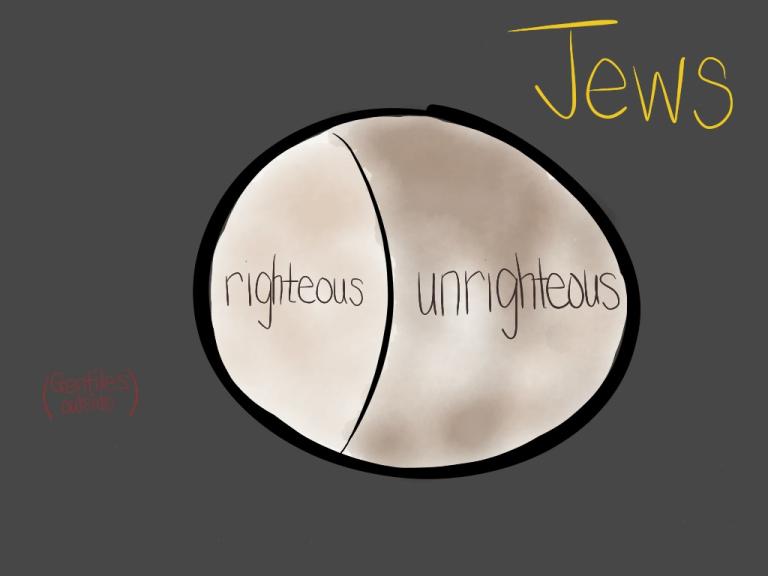
In the graph above, there are two kinds of people. There are Jews (represented by the circle) and Gentiles (outside the circle). The Mosaic Law acts as a boundary marker. Obedience to the Law (e.g. circumcision, Sabbath keeping) signifies allegiance to the God of Abraham and the nation of Israel. The Law is not simply God’s “moral law” (for humanity), understood abstractly.
Of course, Paul’s Jewish opponents were not asserting that one was saved simply because of bloodline. While law keeping was necessarily to “get in” to God’s covenant, so also it is needed in order to “stay in.” The Jews certainly recognizes the reality of unrighteous, reprobate Jews within Israel. In that respect, the graph above distinguishes God’s people (i.e. Israel) into two types––those who faithful to keep the Law and those who are “Jewish”, for example, by birth but neglect to obey God’s commands.
A Summary of the Two Perspectives
In a nutshell, what can we say?
According to the OPP, Paul divided the world into the “righteous” and the “unrighteous,” irrespective of ethnic identity. Paul opposed works-righteousness and affirms faith as the way in which one is saved. Stress is given to how one is saved.
In contrast, the NPP says that Paul confronts Jewish ethnocentrism. According to Paul’s opponents, keeping the Mosaic Law meant being/becoming Jewish. Paul thus affirms faith as a way of saying that God’s covenant with Abraham is not limited to Jews according to the flesh. Instead, Gentiles also can be reckoned righteous. Greater emphasis falls on the question who can be saved.
The implications are too many to flesh out here. This topic concerns everything from how we interpret various passages, to salvation, our doctrine of the church, etc.
Traditionally, Chinese like to find a middle way between extremes. How might we reconcile these two positions? I’ll explain in a coming post.
Photo Credit (Yin Yang): CC 2.0/wikimedia
Previous Post
October 8, 2013
The Doctrine of Justification in a Chinese Context
Next Post

October 15, 2013 The Problem of "Ascribed Righteousness"
Browse Our Archives
Select a Category Atonement Biblical Theology Book Reviews China Chinese Church Chinese Culture Chinese Language Collectivism Contextualization Culture (General) Ecclesiology Evangelism Gospel Honor & Shame (Face) Interpretation/Exegesis Justification/Righteousness Missiology Mission Methods One Gospel for All Nations Other Practical Contextualization Reading Romans with Eastern Eyes Resources Romans Salvation (General) Saving God's Face Seeking God's Face The Cross in Context Theological Contextualization Theological Education Theology Uncategorized
Select a Month October 2026 September 2026 August 2026 July 2026 June 2026 May 2026 April 2026 March 2026 February 2026 January 2026 December 2025 November 2025 October 2025 September 2025 August 2025 July 2025 June 2025 May 2025 April 2025 March 2025 February 2025 January 2025 December 2024 November 2024 October 2024 September 2024 August 2024 July 2024 June 2024 May 2024 April 2024 March 2024 February 2024 January 2024 December 2023 November 2023 October 2023 September 2023 August 2023 July 2023 June 2023 May 2023 April 2023 March 2023 February 2023 January 2023 December 2022 November 2022 October 2022 September 2022 August 2022 July 2022 June 2022 May 2022 April 2022 March 2022 February 2022 January 2022 December 2021 November 2021 October 2021 September 2021 August 2021 July 2021 June 2021 May 2021 April 2021 March 2021 February 2021 January 2021 December 2020 November 2020 October 2020 September 2020 August 2020 July 2020 June 2020 May 2020 April 2020 March 2020 February 2020 January 2020 December 2019 November 2019 October 2019 September 2019 August 2019 July 2019 June 2019 May 2019 April 2019 March 2019 February 2019 January 2019 December 2018 November 2018 October 2018 September 2018 August 2018 July 2018 June 2018 May 2018 April 2018 March 2018 February 2018 January 2018 December 2017 November 2017 October 2017 September 2017 August 2017 July 2017 June 2017 May 2017 April 2017 March 2017 February 2017 January 2017 December 2016 November 2016 October 2016 September 2016 August 2016 July 2016 June 2016 May 2016 April 2016 March 2016 February 2016 January 2016 December 2015 November 2015 October 2015 September 2015 August 2015 July 2015 June 2015 May 2015 April 2015 March 2015 February 2015 January 2015 December 2014 November 2014 October 2014 September 2014 August 2014 July 2014 June 2014 May 2014 April 2014 March 2014 February 2014 January 2014 December 2013 November 2013 October 2013 September 2013 August 2013 July 2013 June 2013 May 2013 April 2013 March 2013 February 2013 January 2013 December 2012 November 2012
Follow Us!
TAKE THE
Religious Wisdom Quiz
What is the first book of the New Testament?
Select your answer to see how you score.
Mark John Matthew Luke
Books by This Author Books by Brad Vaughn
Related posts from Saving God's Face

Americans, not Asians, have Positive Illusions

The Psychology of Broad and Eastern Thinking

Why punish parents for kids’ bad behavior?
Register for my “Confucian Shame in Christian Thinking”...
TRENDING AT PATHEOS Evangelical

Catholic Evangelization: Sharing Your Faith Every Day
Welcome back to the Graceful Awakening mini-series called, “From Faith to Mission.” ...

The Pillar of the Boatmen: the Ancient Monument...
The Pillar of the Boatmen is a Romano-Gaulish sculpture that dates from...

In one sense walking into Westminster Abbey is like walking down the...

'Super Scam Me' Exposes AI Jon Bon Jovi...
Leslie Pickett believed she was in a relationship with Jon Bon Jovi....

The Brazilian Remake of Kendricks' 'Flywheel' Opens in...
“Flywheel,” the story that launched the Kendrick Brothers’ filmmaking career is getting...

The Dangers of Gradual Accommodation (Winking at Sin)
Recently, the “law of gradualness” resurfaced during the opening of a weeklong,...
view all Evangelical blogs
Ad-Free & Subscriber Log-In Subscription Support
- About Us
- 2026 Calendar
- Videos
- Podcasts
- Library of World Religions
- Faith In Media Tracker
- Advertise With Us
- Write for Us
- Privacy Policy
- Terms of Service
- Do Not Sell My Data
- Contact Us
- Radiant Digital
- Manage Newsletter Subscriptions
- Unsubscribe From Notifications
- Sitemap
Copyright 2008-2026, Patheos. All rights reserved.
Subscription Support Ad-Free & Subscriber Log-In
Follow Patheos