
BuddhistCatholicContemplativeEvangelicalGeneral ChristianHinduJewishLatter-day SaintMuslimNew VisionsProgressive Christian
Beliefs
- Buddhist
- Catholic
- Contemplative
- Evangelical
- General Christian
- Hindu
- Jewish
- Latter-day Saint
- More Voices
- Muslim
- New Visions
- Pagan
- Progressive Christian
Topics
- Religion News
- Food and Religion
- Sports and Religion
- Religious Art
- Religious Music and Entertainment
- Religious Events
- History and Religion
- Style and Religion
- Politics and Religion
- Women in Religion
- Recreation Outdoors and Religion
- Business Finance and Religion
- Careers Workplace and Religion
- Education and Religion
- Family Parenting and Religion
- Health Fitness and Religion
- Home and Religion
- Relationships and Religion
- Technology and Religion
- Travel and Religion
Columnists
- Buddhist Columnists
- Business Finance and Religion Columnists
- Careers Workplace and Religion Columnists
- Catholic Columnists
- Contemplative Columnists
- Education and Religion Columnists
- Evangelists Columnists
- Family Parenting and Religion Columnists
- General Christian Columnists
- Health Fitness and Religion Columnists
- Hindu Columnists
- History and Religion Columnists
- Home and Religion Columnists
- Jewish Columnists
- More Voices Columnists
- Latter Day Columnists
- Muslim Columnists
- New Visions Columnists
- Nonreligious Columnists
- Pagan Columnists
- Politics and Religion Columnists
- Progressive Columnists
- Recreation Outdoors and Religion Columnists
- Relationships and Religion Columnists
- Religion News Columnists
- Religious Art Columnists
- Religious Events Columnists
- Religious Music and Entertainment Columnists
- Sports and Religion Columnists
- Style and Religion Columnists
- Technology and Religion Columnists
- Travel and Religion Columnists
- Women in Religion Columnists
Resource Library
- 2026 Calendar
- Library of World Religions
- The 100 Most Holy Places on Earth
- Patheos Answers
- Podcasts
- Videos
- Faith Leaders Database
- Anglican Episcopalian
- Bahai
- Baptist
- Buddhism
- Christianity
- Confucianism
- Eastern Orthodoxy
- Hinduism
- Holiness and Pentecostal
- ISKCON
- Islam
- Judaism
- Lutheran
- Methodist
- The Church of Jesus Christ of Latter-day Saints
- New Age
- Paganism
- Presbytarian and Reformed
- Protestantism
- Religion Behind the Scenes
- Roman Catholic
- Scientology
- Shia Islam
- Sikhism
- Sufism
- Sunni Islam
- Taoism
- Zen
- See all religions
Research Tools
 Ad-Free & Subscriber Log-In Subscription Support
Ad-Free & Subscriber Log-In Subscription Support
Follow Patheos 

- Trending:
- Forgiveness
- |
- Marriage
- |
- Consciousness
- |
- Death Penalty
- |
- Election
- |
- Halloween

-
Tools
-
Support the Work
- Home
- Evangelical
- Geography of Theological Thought?
Geography of Theological Thought?
Last updated on: July 26, 2022 at 7:33 am by Brad Vaughn
Geography of Theological Thought? 2022-07-26T07:33:31-07:00 Brad Vaughn
Patheos Explore the world's faith through different perspectives on religion and spirituality! Patheos has the views of the prevalent religions and spiritualities of the world.
How might social psychology contribute to our theological and missiological thinking? Nisbett’s book The Geography of Thought: How Asians and Westerners Think Differently…and Why (Free Press, 2003) is one of the more exciting books I’ve read in terms of both explaining differences between East-West thinking and also backing it up with empirical research.
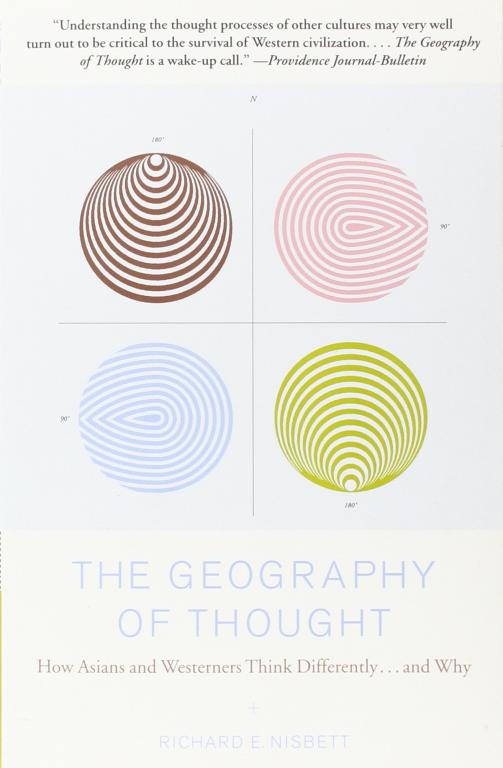
I won’t do a full review here. One qualifier for those who decide to read it––he starts off with some (pretty reasonable) historical conjecture, then defends the conclusions with research data. Frequently, books work the other direction (proof to conclusions), so I don’t want readers to be turned off by the first 20-30 pages where they might assume Nisbett is making a sheer assertion.
I want to give an example of how missiologists and theologians can use the insights of social psychology. I would after all agree with David Clark that our method of theologizing-contextualizing needs to be dialogical.
In one experiment, Nisbett and a colleague explore the tendency of Westerners to dichotomize (use either/or thinking) in contrast to Easterners’ preference for harmonizing ideas (using both/and thinking). First, I’ll insert an excerpt from the book, then comment afterward.
“What would happen if Easterners and Westerners were confronted with apparently conflicting propositions? The logical approach would seem to require rejecting one of the propositions in favor of the other in order to avoid a possible contradiction. The dialectical approach would favor finding some truth in both, in a search for the Middle Way.
In order to examine this question, Peng and I asked undergraduates at the University of Michigan and Beijing University to read what we described as summaries of the results of several social science studies. There were five different topics altogether and we asked participants either to read about a study reporting a particular finding, a study strongly implying something quite different, or both. The opposing studies did not necessarily contradict each other in a logical sense, but at least had the character that, if one was true, then the other would seem to be quite unlikely to be true. The pair of statements below was typical of the more obviously contradictory ones” (Kindle Locations 2351-2358).
After explaining the experiment further, Nisbett continues:
“What inferences should the participants have made? That seems pretty clear. The participants who were exposed to two propositions that are apparently contradictory ought to have believed in each of them less than those who knew about only one. This should be particularly true for less plausible propositions that are countered by more plausible ones.
But neither the Americans nor the Chinese behaved that way. The Chinese who saw both propositions reported about equal belief in both. They properly rated the more plausible proposition as less believable if they saw it contradicted than if they didn’t. But the Chinese rated the less plausible proposition as more believable if they saw it contradicted than if they didn’t. This inappropriate inference would be the consequence of feeling it necessary to find the truth in each of two contradictory propositions.
The Americans, instead of converging in their belief in the two propositions, actually diverged, believing the more plausible proposition more if they saw it contradicted than if they didn’t. This seems the likely result of feeling it necessary to decide which of two conflicting propositions is correct. But it’s pretty dubious inferential practice to believe something more if it’s contradicted than if it isn’t. My guess is that the Americans behaved the way they did because they are good at generating counterarguments— a skill that comes from a lifetime of doing just that. When confronted with a weak argument against a proposition they are inclined to believe, they have no trouble in shooting it down.
The problem is that the ease with which they generate counterarguments may serve to bolster their belief in a proposition that ought to seem shakier if it is contradicted than if it is not. There is evidence in fact that Americans do tend to generate more counterarguments than Chinese do. In effect, Americans may not know their own strength, failing to understand how easy it is for them to attack an argument they find implausible” (Kindle Locations 2372-2386).
I won’t write an entire essay here.
Still, think with me of the implications for theology. Many of our theological conclusions and convictions may stem from our basic cultural wiring as much as other factors. This does not lead to relativism or a fatalistic view of interpretation.
However, the strength with which we hold a position and thus our openness to other ideas may result from our habit of mind to either harmonize or dichotomize. I wonder how many controversies in church history reflect an inability to think in terms of both-and (rather than simply either-or). To compound the problem, Christians think they are “defending truth” against error and heresy when, in fact, the dispute is simply one of emphasis.
Naturally, there are implications for missions. In contextualization attempts, mission strategy, and social adjustment, the propensity to polarize options will doubtless result in conflict and frustration. Consequently, this habit of mind could cut short a missionary’s career and stunt effectiveness in ministry.
What are some other applications of Nisbett’s experiment/observation? What about social psychology in general? Any reading suggestions or implications for missiology and theology?
Previous Post

November 9, 2012
(Mis)understanding Honor, Shame, or Face? (Part 1)
Next Post
November 12, 2012 Premarital Counseling for Arranged "Left Overs"?
Browse Our Archives
Select a Category Atonement Biblical Theology Book Reviews China Chinese Church Chinese Culture Chinese Language Collectivism Contextualization Culture (General) Ecclesiology Evangelism Gospel Honor & Shame (Face) Interpretation/Exegesis Justification/Righteousness Missiology Mission Methods One Gospel for All Nations Other Practical Contextualization Reading Romans with Eastern Eyes Resources Romans Salvation (General) Saving God's Face Seeking God's Face The Cross in Context Theological Contextualization Theological Education Theology Uncategorized
Select a Month October 2026 September 2026 August 2026 July 2026 June 2026 May 2026 April 2026 March 2026 February 2026 January 2026 December 2025 November 2025 October 2025 September 2025 August 2025 July 2025 June 2025 May 2025 April 2025 March 2025 February 2025 January 2025 December 2024 November 2024 October 2024 September 2024 August 2024 July 2024 June 2024 May 2024 April 2024 March 2024 February 2024 January 2024 December 2023 November 2023 October 2023 September 2023 August 2023 July 2023 June 2023 May 2023 April 2023 March 2023 February 2023 January 2023 December 2022 November 2022 October 2022 September 2022 August 2022 July 2022 June 2022 May 2022 April 2022 March 2022 February 2022 January 2022 December 2021 November 2021 October 2021 September 2021 August 2021 July 2021 June 2021 May 2021 April 2021 March 2021 February 2021 January 2021 December 2020 November 2020 October 2020 September 2020 August 2020 July 2020 June 2020 May 2020 April 2020 March 2020 February 2020 January 2020 December 2019 November 2019 October 2019 September 2019 August 2019 July 2019 June 2019 May 2019 April 2019 March 2019 February 2019 January 2019 December 2018 November 2018 October 2018 September 2018 August 2018 July 2018 June 2018 May 2018 April 2018 March 2018 February 2018 January 2018 December 2017 November 2017 October 2017 September 2017 August 2017 July 2017 June 2017 May 2017 April 2017 March 2017 February 2017 January 2017 December 2016 November 2016 October 2016 September 2016 August 2016 July 2016 June 2016 May 2016 April 2016 March 2016 February 2016 January 2016 December 2015 November 2015 October 2015 September 2015 August 2015 July 2015 June 2015 May 2015 April 2015 March 2015 February 2015 January 2015 December 2014 November 2014 October 2014 September 2014 August 2014 July 2014 June 2014 May 2014 April 2014 March 2014 February 2014 January 2014 December 2013 November 2013 October 2013 September 2013 August 2013 July 2013 June 2013 May 2013 April 2013 March 2013 February 2013 January 2013 December 2012 November 2012
Follow Us!
TAKE THE
Religious Wisdom Quiz
Who said: "Therefore, since we have a great high priest who has ascended into heaven, Jesus the Son of God, let us hold firmly to the faith"?
Select your answer to see how you score.
Paul James John Peter
Books by This Author Books by Brad Vaughn
Related posts from Saving God's Face

Americans, not Asians, have Positive Illusions

Bathsheba, #MeToo, and Eisegesis
I'm launching 3 online courses!
What's your political denomination?
TRENDING AT PATHEOS Evangelical

How to Make a Decision When You Can't...
Main point: It’s much more valuable to stay close to God so...

Archdiocese Hosts Military Marriage Retreat in Germany
RASTATT, Germany — The transient military lifestyle, with its frequent deployments and...

Nearly every morning, I make the drive to Detroit with my high-school-age...

The Real AI Story Is Adoption Without Trust
Artificial intelligence has crossed a political threshold. It is no longer a...

A new article, written by Jeff Lindsay and Gale L. Pooley,...

Swimfan: Forgotten Aughts Pleasures
This is a recovery effort. In 2002, My Big Fat Greek Wedding...
view all Evangelical blogs
Ad-Free & Subscriber Log-In Subscription Support
- About Us
- 2026 Calendar
- Videos
- Podcasts
- Library of World Religions
- Faith In Media Tracker
- Advertise With Us
- Write for Us
- Privacy Policy
- Terms of Service
- Do Not Sell My Data
- Contact Us
- Radiant Digital
- Manage Newsletter Subscriptions
- Unsubscribe From Notifications
- Sitemap
Copyright 2008-2026, Patheos. All rights reserved.
Subscription Support Ad-Free & Subscriber Log-In
Follow Patheos