
BuddhistCatholicContemplativeEvangelicalGeneral ChristianHinduJewishLatter-day SaintMuslimNew VisionsProgressive Christian
Beliefs
- Buddhist
- Catholic
- Contemplative
- Evangelical
- General Christian
- Hindu
- Jewish
- Latter-day Saint
- More Voices
- Muslim
- New Visions
- Pagan
- Progressive Christian
Topics
- Religion News
- Food and Religion
- Sports and Religion
- Religious Art
- Religious Music and Entertainment
- Religious Events
- History and Religion
- Style and Religion
- Politics and Religion
- Women in Religion
- Recreation Outdoors and Religion
- Business Finance and Religion
- Careers Workplace and Religion
- Education and Religion
- Family Parenting and Religion
- Health Fitness and Religion
- Home and Religion
- Relationships and Religion
- Technology and Religion
- Travel and Religion
Columnists
- Buddhist Columnists
- Business Finance and Religion Columnists
- Careers Workplace and Religion Columnists
- Catholic Columnists
- Contemplative Columnists
- Education and Religion Columnists
- Evangelists Columnists
- Family Parenting and Religion Columnists
- General Christian Columnists
- Health Fitness and Religion Columnists
- Hindu Columnists
- History and Religion Columnists
- Home and Religion Columnists
- Jewish Columnists
- More Voices Columnists
- Latter Day Columnists
- Muslim Columnists
- New Visions Columnists
- Nonreligious Columnists
- Pagan Columnists
- Politics and Religion Columnists
- Progressive Columnists
- Recreation Outdoors and Religion Columnists
- Relationships and Religion Columnists
- Religion News Columnists
- Religious Art Columnists
- Religious Events Columnists
- Religious Music and Entertainment Columnists
- Sports and Religion Columnists
- Style and Religion Columnists
- Technology and Religion Columnists
- Travel and Religion Columnists
- Women in Religion Columnists
Resource Library
- 2026 Calendar
- Library of World Religions
- The 100 Most Holy Places on Earth
- Patheos Answers
- Podcasts
- Videos
- Faith Leaders Database
- Anglican Episcopalian
- Bahai
- Baptist
- Buddhism
- Christianity
- Confucianism
- Eastern Orthodoxy
- Hinduism
- Holiness and Pentecostal
- ISKCON
- Islam
- Judaism
- Lutheran
- Methodist
- The Church of Jesus Christ of Latter-day Saints
- New Age
- Paganism
- Presbytarian and Reformed
- Protestantism
- Religion Behind the Scenes
- Roman Catholic
- Scientology
- Shia Islam
- Sikhism
- Sufism
- Sunni Islam
- Taoism
- Zen
- See all religions
Research Tools
 Ad-Free & Subscriber Log-In Subscription Support
Ad-Free & Subscriber Log-In Subscription Support
Follow Patheos 

- Trending:
- Forgiveness
- |
- Marriage
- |
- Consciousness
- |
- Death Penalty
- |
- Election
- |
- Halloween

- Home
- Muslim
- Modesty–A universal Value
Modesty–A universal Value
Last updated on: March 28, 2015 at 8:18 am by Muslims Writers Guild of America
Modesty–A universal Value 2015-03-28T08:18:39-05:00 Muslims Writers Guild of America
Patheos Explore the world's faith through different perspectives on religion and spirituality! Patheos has the views of the prevalent religions and spiritualities of the world.
By
Saima Sheikh
“This is America; you don’t have to wear that thing on your head anymore.” “You force your wife to cover herself” shouted a protester at CAIR Dallas event in January. “Once they get that established, we’re all going to be wearing hijabs,” Christine Weick said. “Women, come on, do you want this oppression coming upon you?”These are just few examples of recent incidences in America where Non-Muslims have expressed their phobia at Muslim women for wearing a hijab / veil.
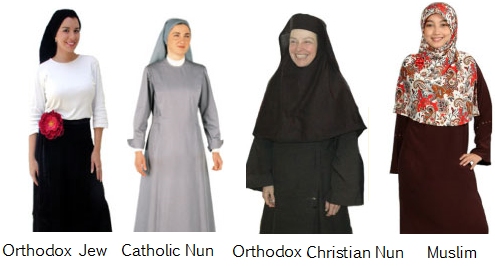
The concept of hijab or veil is not new to Islam. Women have used veil to cover their hair since ancient times. Classical Greek and Hellenistic statues sometimes depict Greek women with both their head and face covered by a veil. In Judaism and Christianity, the concept of covering the head was associated with modesty.
Veiling is mentioned in both the Old Testament and the New Testament. The Old Testament mentions what Rebekah did before Isaac in, “When Re-bek’ah raised her eyes, she caught sight of Isaac and she swung herself down from off the camel. Then she said to the servant ‘who is that walking in the field to meet us?’ and the servant said ‘It is my master’ And she proceeded to take a headcloth and to cover herself” (Genesis: 24: 64 and 65).
The New Testament states, “but every woman praying or prophesying with her head uncovered dishonors her head – it is the same as if her head were shaven. For if a woman will not be covered, then let her be shorn! But since it is disgraceful for woman to be shorn or shaven, let her be covered” (1 Corinthians: 11: 5, 6).
Most traditional depictions of Mary, the mother of Jesus show her veiled. Veiling was a common practice with church-going women and a number of very traditional churches retain the custom especially Latin American countries such as Mexico. Catholic nuns still cover their heads.
In Judaism, there are different ways of veiling depending on how strictly a woman adheres to Jewish or Torah laws. Orthodox Jewish women and Hasidic women dress modestly and cover their hair when they go out in the public. According to Jewish law, all married women have to cover their hair either with a ‘tikhel’ (scarf) or a ‘sheytl’ (wig). Some Hasidic women go as far as to cover their wigs with a scarf. They also dress modestly by wearing long skirts and shirts with long sleeves and high necklines. Some European Hasidic women shave their heads day after their wedding and repeat it monthly to ensure that not a single strand of hair is ever visible.
As is evident, veiling is mentioned in both Judaism and Christianity. In Islam, veiling or ‘purdah’ is also associated with modesty. Islam lays great emphasis on moral standards of society and provides guidelines on how men and women should interact with each other. The Holy Quran first addresses men, “Say to the believing men that they restrain their eyes and guard their private parts. That is purer for them. Surely, Allah is well aware of what they do” (24:31). Then it addresses the women, “Say to the believing women that they restrain their looks and guard their private parts, and that they display not their beauty or their embellishment except that which is apparent thereof, and that they draw their head coverings over their bosoms….”(24:32).This means that Muslim women dress modestly, cover their heads and wear an outer garment to conceal their beauty from strangers.
The Messiah and Imam of today, Mirza Ghulam Ahmad further expounds on these verses and said in his book, “The Philosophy of the Teachings of Islam”, “The Book of God does not aim at keeping women in seclusion like prisoners. This is the concept of those who are not acquainted with the correct pattern of Islamic ways. The purpose of these regulations is to restrain men and women from letting their eyes to rove freely and from displaying their good looks and beauties, for therein lies the good both of men and of women. It should be remembered that to restrain one’s looks and to direct them only towards observing that which is permissible is described in Arabic by the expression ghadd-e-basar… It does not behoove a pious person who desires to keep his heart pure that he should lift his eyes freely in every direction like an animal. It is necessary that such a one should cultivate the habit of ghadd-e-basar in his social life. This is a blessed habit through which his natural impulses would be converted into a high moral quality without interfering with his social needs. This is the quality which is called chastity in Islam.”
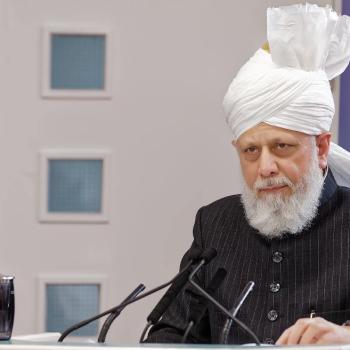
His Holiness the Khalifa of Islam, Mirza Masroor Ahmad said in his address at the annual convention of the Women’s Auxiliary of the Ahmadiyya Muslim Community, UK on October 26, 2014, “Today, I have spoken particularly about Purdah because it is often alleged that Purdah takes away women’s rights. However, we know that this is not the case andthe truth is that Purdah and Hijab actually establish the true dignity, independence and freedom of women. Hijab does not only give women physical security but is also a key means of giving them spiritual security and purity of heart.”
There is a common misconception that Muslim women are forced to observe purdah / hijab. Islam teaches that faith is something personal and that each person is responsible for his or her own decisions. It does not say that a man must force the female members of his family to observe Purdah. If this was truly the case and Muslim men were allowed to force the female members of their family to wear a veil or burqa, then more than half of the 1.6 billion Muslims in the world today would be wearing a burqa and a veil. It is apparent that women who choose to wear a veil or burqa do so voluntarily.
Follow Saima on twitter at @SaimaGSheikh
Previous Post

March 13, 2015
New Atheism: The Mother Lode of Bad Ideas
Next Post
April 2, 2015 A Muslim's Views on the Theology of Easter
Browse Our Archives
Select a Category American-Muslims Economic Justice Interfaith Jesus Palestine Ramadan Uncategorized World Peace
Select a Month September 2025 August 2025 July 2025 June 2025 May 2025 April 2025 March 2025 January 2025 December 2024 November 2024 October 2024 November 2019 October 2019 September 2019 August 2019 November 2018 September 2018 August 2018 July 2018 May 2018 April 2018 February 2018 December 2017 October 2017 September 2017 August 2017 July 2017 June 2017 May 2017 April 2017 March 2017 February 2017 January 2017 December 2016 November 2016 October 2016 September 2016 August 2016 July 2016 June 2016 May 2016 April 2016 March 2016 February 2016 January 2016 December 2015 November 2015 October 2015 September 2015 August 2015 July 2015 June 2015 May 2015 April 2015 March 2015 February 2015 January 2015 December 2014
Follow Us!
TAKE THE
Religious Wisdom Quiz
What is the small, portable cross worn as a sign of faith and blessing called?
Select your answer to see how you score.
Chalice Crucifix Tabernacle Mitre
Related posts from Ahmadiyya Muslim Youth Angle

Apostasy In Islam: Facts From Fiction

The Need to Escalate to Justice to De-Escalate...

I'm a Muslim and This is Why I...
TRENDING AT PATHEOS Muslim

25 Years Later: How Much Has Changed for...
As we approach the 25th anniversary of September 11th, I’ve found myself...

Podcast: Third Spaces & The Rise of Yemeni...
In the latest episode of The Artistic Foodies Podcast, hosts Abbas...

HalalFest Picks: Best 60 Halal Spots for Super...
Back in 2016, I came up with a list of 29...

Unity Is America’s Strength — Division Is Its...
by Hidayatullah Ahsan When Valentina Gomez, a Republican candidate for Congress in...

Zohran Mamdani and New York’s Fight Against Islamophobia
This past June, against all odds, Zohran Mamdani won the Democratic primary...

What the Fourth of July Means to a...
As we mark another Fourth of July, millions of Americans will celebrate...
view all Muslim blogs
Ad-Free & Subscriber Log-In Subscription Support
- About Us
- 2026 Calendar
- Videos
- Podcasts
- Library of World Religions
- Faith In Media Tracker
- Advertise With Us
- Write for Us
- Privacy Policy
- Terms of Service
- Do Not Sell My Data
- Contact Us
- Radiant Digital
- Manage Newsletter Subscriptions
- Unsubscribe From Notifications
- Sitemap
Copyright 2008-2026, Patheos. All rights reserved.
Subscription Support Ad-Free & Subscriber Log-In
Follow Patheos