
BuddhistCatholicContemplativeEvangelicalGeneral ChristianHinduJewishLatter-day SaintMuslimNew VisionsProgressive Christian
Beliefs
- Buddhist
- Catholic
- Contemplative
- Evangelical
- General Christian
- Hindu
- Jewish
- Latter-day Saint
- More Voices
- Muslim
- New Visions
- Pagan
- Progressive Christian
Topics
- Religion News
- Food and Religion
- Sports and Religion
- Religious Art
- Religious Music and Entertainment
- Religious Events
- History and Religion
- Style and Religion
- Politics and Religion
- Women in Religion
- Recreation Outdoors and Religion
- Business Finance and Religion
- Careers Workplace and Religion
- Education and Religion
- Family Parenting and Religion
- Health Fitness and Religion
- Home and Religion
- Relationships and Religion
- Technology and Religion
- Travel and Religion
Columnists
- Buddhist Columnists
- Business Finance and Religion Columnists
- Careers Workplace and Religion Columnists
- Catholic Columnists
- Contemplative Columnists
- Education and Religion Columnists
- Evangelists Columnists
- Family Parenting and Religion Columnists
- General Christian Columnists
- Health Fitness and Religion Columnists
- Hindu Columnists
- History and Religion Columnists
- Home and Religion Columnists
- Jewish Columnists
- More Voices Columnists
- Latter Day Columnists
- Muslim Columnists
- New Visions Columnists
- Nonreligious Columnists
- Pagan Columnists
- Politics and Religion Columnists
- Progressive Columnists
- Recreation Outdoors and Religion Columnists
- Relationships and Religion Columnists
- Religion News Columnists
- Religious Art Columnists
- Religious Events Columnists
- Religious Music and Entertainment Columnists
- Sports and Religion Columnists
- Style and Religion Columnists
- Technology and Religion Columnists
- Travel and Religion Columnists
- Women in Religion Columnists
Resource Library
- 2026 Calendar
- Library of World Religions
- The 100 Most Holy Places on Earth
- Patheos Answers
- Podcasts
- Videos
- Faith Leaders Database
- Anglican Episcopalian
- Bahai
- Baptist
- Buddhism
- Christianity
- Confucianism
- Eastern Orthodoxy
- Hinduism
- Holiness and Pentecostal
- ISKCON
- Islam
- Judaism
- Lutheran
- Methodist
- The Church of Jesus Christ of Latter-day Saints
- New Age
- Paganism
- Presbytarian and Reformed
- Protestantism
- Religion Behind the Scenes
- Roman Catholic
- Scientology
- Shia Islam
- Sikhism
- Sufism
- Sunni Islam
- Taoism
- Zen
- See all religions
Research Tools
 Ad-Free & Subscriber Log-In Subscription Support
Ad-Free & Subscriber Log-In Subscription Support
Follow Patheos 

- Trending:
- Forgiveness
- |
- Marriage
- |
- Consciousness
- |
- Death Penalty
- |
- Election
- |
- Halloween

- Home
- Muslim
- Women: Equal Space in Islam, Equal Space in the Mosque
Women: Equal Space in Islam, Equal Space in the Mosque
Last updated on: January 21, 2015 at 5:43 pm by Muslims Writers Guild of America
Women: Equal Space in Islam, Equal Space in the Mosque 2015-01-21T17:43:32-05:00 Muslims Writers Guild of America
Patheos Explore the world's faith through different perspectives on religion and spirituality! Patheos has the views of the prevalent religions and spiritualities of the world.
By
Ayesha Noor
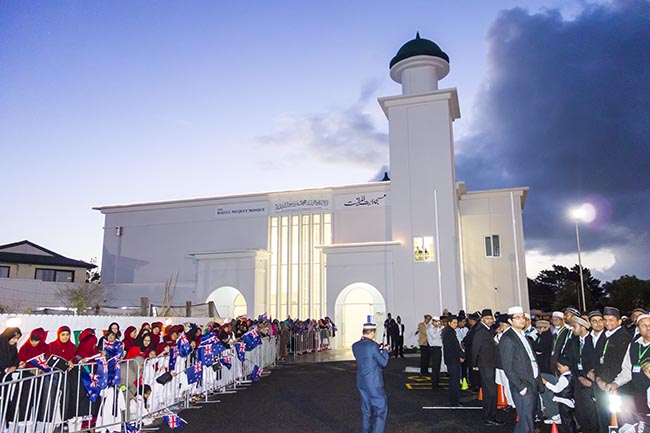
Baitul Muqeet Mosque, Auckland, New Zealand
Today I happened to read an article titled “Why are women not made more welcome in mosques” written by Nabeelah Hafeez of Muslim Women Council, UK. The title immediately caught my attention and I agreed with every word she penned. I agreed with her frustration and her annoyance for being considered a second-class citizen at the mosques. I salute her decision for bringing this issue up. Fortunately, my mosque experiences have, without a doubt, always been pleasant and welcoming. Here I present my experiences from the mosques I regularly visited in 3 continents: Asia, Europe and North America. Although extremely diverse in nature and distinctive in design, all the mosques I visited offered the same welcoming aura for the women.
I spent my early childhood in Rabwah, a town spread on the bank of river Chenab in Pakistan. The town’s 90% population consists of Ahmadi Muslims. Rabwah is known for two things, its unpretentious mosques and 100% literacy rate among Ahmadi Muslim men and women. One of my most vivid memories is to offer Jumma prayers with friends at Rabwah’s largest mosque known as Aqsa Mosque.Aqsa mosque was only a mile away from my house, but we knew a secret short cut through the hill that separated our neighborhood from the mosque. From the hilltop we could see thousands of worshippers – men and women and children, hurriedly making their way to the Aqsa mosque. Those men who weren’t lucky or quick enough to make it to the main hall, would offer their prayers outside in the prayer designated area. Women had their own massive hall. Additionally, the entire top floor was designated for women. Most of the times both halls-upstairs and downstairs would be packed and numerous women would have to pray outside too just like men.
My neighborhood’s local mosque was a simple single-story edifice. There would be a curtain exactly in the middle, ensuring equal space for both men and women. Rabwah’s Mubarak mosque, although smaller in size, still pulls me towards it for its serenity. Adorned with pink marble, the mosque hosts those women who wish to spend last 10 days of Ramadan (Muslims’ Holy month) in solitude. I visited several other mosques belonging to the Ahmadiyya Muslim Community in Pakistan and found them all equally remarkable.
It was only during my teen years that I realized that not every Muslim woman could attend the mosque that conveniently. In fact, some of my non-Ahmadi friends would admonish me for attending mosques because they deemed it un-Islamic and unwomanly for a woman to attend any mosque. No amount of Hadith references could make them comprehend that female companions of the Holy Prophet always attended the Prophet’s Mosque in Medina. While for me offering Eid prayers at a mosque was the most jovial part of my Eid celebrations, it was non-existent for my non-Ahmadi Muslim friends in Pakistan.
In England, I attended two mosques regularly: Fazl Mosque also known as The London Mosque in Wimbledon and Baitul Futuh Mosque in Surrey. The former one, built in 1924, is London’s oldest mosque and is a modest one. Still, women are given adequate space to offer prayers. On extremely busy days, women use an adjacent multi purpose hall while men attend the main prayer hall and the rest pray outside in the driveway. Even in limited space, women’s needs are given precedence. The newly built Baitul Futuh Mosque in Surrey is Western Europe’s largest mosque. The mosque is a state of the art complex that offers huge prayer halls for men and women, library, offices, gym, kitchen, TV Studios, guesthouses and two additional multipurpose halls for social events.

In America and Canada, I have seen at least a dozen mosques belonging to the Ahmadiyya Muslim Community. Some are humble and some are huge purpose built mosques. Without exception all of them are equally appealing for women worshippers. I started my journey of North American mosques at Sadiq Mosque, among the oldest American mosques, located on the Southside of Chicago. It is small, it is simple and it serves its purpose. I have visited mosques in Los Angeles, New York, Dayton, Miami, Houston, Washington DC, Harrisburg, and Toronto and I regularly attend the mosque in my hometown Richmond. They may be big or small, purpose built or former day cares, or converted from an old church or a synagogue. But they are all open and welcoming to their worshippers whether they are male or female.
The Ahmadiyya Muslim Community has built over 15000 mosques all over the world. Equal space and similar facilities are given but some offer extra features for women. For example many newly built mosques provide crèche or nurseries for young mothers. If women are not designated the ground floor then elevators are installed for those who may need them. Some noticeable mosques built by the Ahmadiyya Muslim Community are Mubarak Mosque, Qadian, Indian, Baitul Rahman Mosque in Silver Spring, Maryland, Noor Mosque, Calgary, Canada, Baitul Islam Mosque, Toronto, Canada, and newly built Maryum Mosque, Galway, Ireland.


There is another distinct feature of Ahmadiyya Mosques. Women have financially contributed to all 15000 mosques that the community has built or acquired. In addition to this there are several such mosques, which have been built solely with the financial contribution of women. For instance, Muslim women wholly financed the construction of Fazl Mosque in London, Nusrat Jehan Mosque in Denmark and Khadija Mosque in Berlin.

I welcome Nabeelah and all such women who are frustrated for being treated as unwelcomed guests to visit any mosque belonging to the Ahmadiyya Muslim Community for a welcoming experience. Mosques are the houses of God and God does not discriminate.
As a final note, it is worth asking- what is it about mosques built by the Ahmadiyya Muslim Community that ensures women receive equal entrance and aren’t relegated to a dingy side room? I will answer that in my next post.
For now, I hope you follow @EqualEntrance for a pleasant mosque journey.
Follow Ayesha at @FriendlyMuslim
Previous Post

January 18, 2015
Three Facts About Women in Islam
Next Post
February 2, 2015 Atheists and the blind belief in free will
Browse Our Archives
Select a Category American-Muslims Economic Justice Interfaith Jesus Palestine Ramadan Uncategorized World Peace
Select a Month September 2025 August 2025 July 2025 June 2025 May 2025 April 2025 March 2025 January 2025 December 2024 November 2024 October 2024 November 2019 October 2019 September 2019 August 2019 November 2018 September 2018 August 2018 July 2018 May 2018 April 2018 February 2018 December 2017 October 2017 September 2017 August 2017 July 2017 June 2017 May 2017 April 2017 March 2017 February 2017 January 2017 December 2016 November 2016 October 2016 September 2016 August 2016 July 2016 June 2016 May 2016 April 2016 March 2016 February 2016 January 2016 December 2015 November 2015 October 2015 September 2015 August 2015 July 2015 June 2015 May 2015 April 2015 March 2015 February 2015 January 2015 December 2014
Follow Us!
TAKE THE
Religious Wisdom Quiz
What is the Jewish "coming of age" ceremony?
Select your answer to see how you score.
Circumcision Sabbath Passover Bar Mitzvah
Related posts from Ahmadiyya Muslim Youth Angle

Apostasy In Islam: Facts From Fiction
The Need to Escalate to Justice to De-Escalate...

I'm a Muslim and This is Why I...
TRENDING AT PATHEOS Muslim

25 Years Later: How Much Has Changed for...
As we approach the 25th anniversary of September 11th, I’ve found myself...

Podcast: Third Spaces & The Rise of Yemeni...
In the latest episode of The Artistic Foodies Podcast, hosts Abbas...

HalalFest Picks: Best 60 Halal Spots for Super...
Back in 2016, I came up with a list of 29...

Unity Is America’s Strength — Division Is Its...
by Hidayatullah Ahsan When Valentina Gomez, a Republican candidate for Congress in...

Zohran Mamdani and New York’s Fight Against Islamophobia
This past June, against all odds, Zohran Mamdani won the Democratic primary...

What the Fourth of July Means to a...
As we mark another Fourth of July, millions of Americans will celebrate...
view all Muslim blogs
Ad-Free & Subscriber Log-In Subscription Support
- About Us
- 2026 Calendar
- Videos
- Podcasts
- Library of World Religions
- Faith In Media Tracker
- Advertise With Us
- Write for Us
- Privacy Policy
- Terms of Service
- Do Not Sell My Data
- Contact Us
- Radiant Digital
- Manage Newsletter Subscriptions
- Unsubscribe From Notifications
- Sitemap
Copyright 2008-2026, Patheos. All rights reserved.
Subscription Support Ad-Free & Subscriber Log-In
Follow Patheos