
BuddhistCatholicContemplativeEvangelicalGeneral ChristianHinduJewishLatter-day SaintMuslimNew VisionsProgressive Christian
Beliefs
- Buddhist
- Catholic
- Contemplative
- Evangelical
- General Christian
- Hindu
- Jewish
- Latter-day Saint
- More Voices
- Muslim
- New Visions
- Pagan
- Progressive Christian
Topics
- Religion News
- Food and Religion
- Sports and Religion
- Religious Art
- Religious Music and Entertainment
- Religious Events
- History and Religion
- Style and Religion
- Politics and Religion
- Women in Religion
- Recreation Outdoors and Religion
- Business Finance and Religion
- Careers Workplace and Religion
- Education and Religion
- Family Parenting and Religion
- Health Fitness and Religion
- Home and Religion
- Relationships and Religion
- Technology and Religion
- Travel and Religion
Columnists
- Buddhist Columnists
- Business Finance and Religion Columnists
- Careers Workplace and Religion Columnists
- Catholic Columnists
- Contemplative Columnists
- Education and Religion Columnists
- Evangelists Columnists
- Family Parenting and Religion Columnists
- General Christian Columnists
- Health Fitness and Religion Columnists
- Hindu Columnists
- History and Religion Columnists
- Home and Religion Columnists
- Jewish Columnists
- More Voices Columnists
- Latter Day Columnists
- Muslim Columnists
- New Visions Columnists
- Nonreligious Columnists
- Pagan Columnists
- Politics and Religion Columnists
- Progressive Columnists
- Recreation Outdoors and Religion Columnists
- Relationships and Religion Columnists
- Religion News Columnists
- Religious Art Columnists
- Religious Events Columnists
- Religious Music and Entertainment Columnists
- Sports and Religion Columnists
- Style and Religion Columnists
- Technology and Religion Columnists
- Travel and Religion Columnists
- Women in Religion Columnists
Resource Library
- 2026 Calendar
- Library of World Religions
- The 100 Most Holy Places on Earth
- Patheos Answers
- Podcasts
- Videos
- Faith Leaders Database
- Anglican Episcopalian
- Bahai
- Baptist
- Buddhism
- Christianity
- Confucianism
- Eastern Orthodoxy
- Hinduism
- Holiness and Pentecostal
- ISKCON
- Islam
- Judaism
- Lutheran
- Methodist
- The Church of Jesus Christ of Latter-day Saints
- New Age
- Paganism
- Presbytarian and Reformed
- Protestantism
- Religion Behind the Scenes
- Roman Catholic
- Scientology
- Shia Islam
- Sikhism
- Sufism
- Sunni Islam
- Taoism
- Zen
- See all religions
Research Tools
 Ad-Free & Subscriber Log-In Subscription Support
Ad-Free & Subscriber Log-In Subscription Support
Follow Patheos 

- Trending:
- Forgiveness
- |
- Marriage
- |
- Consciousness
- |
- Death Penalty
- |
- Election
- |
- Halloween
 Irreverin
- Home
- Progressive Christian
- Toppling of Silent Sam: The End of Another Battle in a War We Can’t Quit Fighting
Toppling of Silent Sam: The End of Another Battle in a War We Can’t Quit Fighting
Last updated on: August 23, 2018 at 12:55 pm by Erin Wathen
Toppling of Silent Sam: The End of Another Battle in a War We Can’t Quit Fighting 2018-08-23T12:55:42-07:00 Erin Wathen
Patheos Explore the world's faith through different perspectives on religion and spirituality! Patheos has the views of the prevalent religions and spiritualities of the world.
Guest post by the Rev. Chris Furr
As an undergraduate at UNC, I took a number of history courses, including a course on the Civil War. I remember where I sat in the small auditorium, where just outside “Silent Sam” memorialized the students and alumni whose lives were lost fighting for the Confederacy. We were just across campus from William Saunders Hall, named for a 19th century KKK leader (Saunders Hall has since been renamed “Carolina Hall”). On the first day of class, the professor asked how many people believed the Civil War was about something other than slavery. More than half raised their hands.
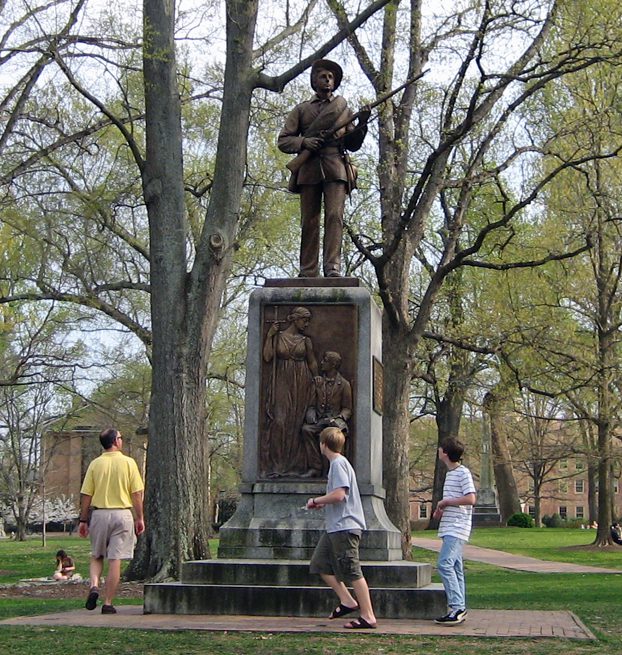
Silent Sam, seen here in 2007, on the campus of the University of North Carolina at Chapel Hill.
The rest of the semester was a systematic academic proof that the root causes had to be traced to the institution of slavery if we were to have any academic or intellectual integrity at all. He wanted us to understand that saying the Civil War was about “economics” was insufficient, since the southern agrarian economy was built on chattel slavery. Saying it was about “state’s rights” was insufficient, since the right those states were fighting for was the legal right to (ruthlessly and violently) subjugate a group of people on the basis of skin color. On the last day of class, the professor asked the same question. There were fewer hands, but only slightly fewer. He was flabbergasted.
On Monday night, Silent Sam (the saying went that he fired a shot each time a virgin walked by) crashed to the ground, thanks to some rope and a group of protestors sick and tired of waiting for the university and the North Carolina legislature to act. This did not come about suddenly; Silent Sam has been the object of debate and protest for years, and surged back into focus when the clash between white supremacists and protestors resulted in violence and the death of Heather Heyer in Charlottesville last year. The legislature acted swiftly to take the power to remove the statue out of the hands of UNC officials. Newly elected Gov. Roy Cooper (D) offered Chancellor Carol Folt an out, saying she could remove the statue if it had become a threat to “public safety,” but she passed and was roundly criticized by those who wanted to see Silent Sam go. Letters to the editor and online arguments have filled UNC alumni forums ever since. Now, the issue has been forced and it’s clear the fight is only beginning.

On August 20, 2018, protesters used a contraption made of bamboo and rope to pull down the statue of Silent Sam from its pedestal at the University of North Carolina at Chapel Hill, North Carolina. Crowds gathered even hours after the event.
The trope most often offered in defense of Silent Sam and monuments like it is that removing them “erases” our history. This is true, but not the whole truth. The history at stake is the history my classmates were holding fast to in that course, the history taught to them by the towns and cities in which they were raised, by their families, by the surrounding culture—myth but not truth. This history is a false history, romanticizing the antebellum South, insisting on “benevolent” slave owners, erasing the violence and trauma inflicted on black bodies, and ignoring how much wealth was accumulated by both private citizens and the government through forced labor. UNC is the flagship institution in what has been an exemplary system of state universities with highly regarded medical, law and business schools. It is frequently cited as one of the nation’s best educations given the cost of tuition. And its foundations were laid by slaves. This is history.
It is also true that Silent Sam and monuments like it were erected not so much as monuments to young men who lost their lives, but some 50 years after the Civil War—after Reconstruction had been sabotaged and fusion governments disbanded (sometimes violently, as in my hometown of Wilmington in 1898). In the heart of the Jim Crow South, they served as towering messages to passersby that the legacy of white supremacy would not be lost—a sanitized version of the lynching tree, communicating who ruled the economy, the courts, America. Julian Carr, a successful UNC alumnus and Civil War veteran, spoke at the dedication of Silent Sam in 1913.
Among his remarks:
“One hundred yards from where we stand, less than 90 days perhaps after my return from Appomattox, I horse-whipped a negro wench until her skirts hung in shreds, because upon the streets of this quiet village she had publicly insulted and maligned a Southern lady, and then rushed for protection to these University buildings where was stationed a garrison of 100 Federal soldiers . . . The cause for which they fought is not lost, never can be, never will be lost while it is enshrined in the hearts of the people of the South, especially the hearts of the dear, loyal, patriotic women, who, like so many Vestal Virgins (God’s name be praised), keep the fires lighted upon the Altars.”
It isn’t that the university students and other protestors gathered around Silent Sam Monday night want to erase history. They have perhaps finally understood the history that generations before them, including my classmates in that Civil War history class, have been trying to deny or dismiss. They are not interested in venerating or elevating a cause which was, at its heart, about systematic violence and oppression. They have reached the clearly moral conclusion that continuing to allow symbols of that oppression to remain only perpetuates the societal norms that made it possible in the first place. They are no longer willing to engage in the intellectual dishonesty it takes to sit in diverse classrooms, presided over by accomplished academics, and deny the simple facts about the stone walls and brick sidewalks outside. Perhaps they will be the ones to teach us that we cannot be healed of the festering racial wound that exists in this nation until we tell the truth about it—the whole truth. The truth is that Silent Sam was a symbol of the terror perpetrated on a large portion of Americans, and UNC students. Finally, after more than 100 years, they grew tired of studying, conversing and living under it.
If there was an admonition I would give to those who danced around Silent Sam’s corpse Monday night, it would be this: they should know that the sound the statue made when it hit the ground is going to ring like a shot through a deeply divided state. There was already a battle happening at UNC for the heart and soul of the university itself and the statewide system. A largely Republican Board of Governors has shuttered groundbreaking work the university was doing in the Center for Civil Rights and the Poverty Center, and openly feuded with system president Margaret Spellings (who is herself conservative, though apparently not conservative enough for the extremists who run the NC legislature).
There will be reaction from people in powerful places. Those who toppled Silent Sam are going to be villainized, perhaps prosecuted, and used as a tool for preying on the fears of white North Carolinians (and perhaps white Americans) who are still devotees of the politics of white supremacy. I suppose Monday night felt like a victory for those who have organized and worked for the monument’s removal. But as I looked at the image of that statue face down in the dirt, all I could think was that it was the end of another battle in a war we just can’t quit fighting, because we can’t tell the truth about why we started.
 The Rev. Chris Furr is Senior Pastor of Covenant Christian Church in Cary, North Carolina. He and his wife, Katie, have two sons.
Previous Post

August 22, 2018
In the Midst of Political Firestorms, Life Goes On: Don't Miss It
Next Post

August 24, 2018 A Border Wall Won't Protect Against Toxic Masculinity
Browse Our Archives
Select a Category a good week for progress Advent and Christmas Being a Person desert life faith and community Good News for Progressives Lent and Easter Marriage and Family S*^! Jesus Says sabbatical road tripping Spirituality in Culture Talking to Strangers the "Best Stuff I Ever Ate" diet travel Uncategorized writing Writing Prompt Wednesday
Select a Month January 2021 December 2020 November 2020 September 2020 August 2020 July 2020 June 2020 May 2020 April 2020 March 2020 February 2020 January 2020 December 2019 November 2019 October 2019 September 2019 August 2019 July 2019 June 2019 May 2019 April 2019 March 2019 February 2019 January 2019 December 2018 November 2018 October 2018 September 2018 August 2018 July 2018 June 2018 May 2018 April 2018 March 2018 February 2018 January 2018 December 2017 November 2017 October 2017 September 2017 August 2017 July 2017 June 2017 May 2017 April 2017 March 2017 February 2017 January 2017 December 2016 November 2016 October 2016 September 2016 August 2016 July 2016 June 2016 May 2016 April 2016 March 2016 February 2016 January 2016 December 2015 November 2015 October 2015 September 2015 August 2015 July 2015 June 2015 May 2015 April 2015 March 2015 February 2015 January 2015 December 2014 November 2014 October 2014 September 2014 August 2014 July 2014 June 2014 May 2014 April 2014 March 2014 February 2014 January 2014 December 2013 November 2013 October 2013 September 2013 August 2013 July 2013 June 2013 May 2013 April 2013 March 2013 February 2013 January 2013 December 2012 November 2012 October 2012 September 2012 August 2012 July 2012 June 2012 May 2012 April 2012 March 2012 February 2012 January 2012 December 2011 November 2011 October 2011 September 2011 August 2011 July 2011 June 2011 May 2011 April 2011 February 2011 July 2010 May 2010 April 2010 March 2010 January 2010 December 2009 November 2009 October 2009 September 2009 August 2009
Follow Us!
TAKE THE
Religious Wisdom Quiz
Which prophet predicted God would pour out His Spirit on all people?
Select your answer to see how you score.
Micah Hosea Joel Amos
Related posts from Irreverin

Hard Candy Christmas: And Other Songs You Need...


TRENDING AT PATHEOS Progressive Christian

Why Christians Have a Sacred Duty to Vote:...
The Bible offers strong support for the sacred duty to vote. Here...

What Being a Modern-Day Apostle Means to Me
In my last column, I discussed the ins and outs of modern-day...

Did Ancient China Once Worship the God of...
Across human history, a common thread weaves through the origins of the...

Love Your Neighbor – Including Earth-Kin: Lev. 19,...
God’s command to love your neighbor means acting in an ethical and...

Lead a Church Study of “Jesus and Lao...
Guest writer Jack Thomas (The Irreverent Reverend) reflects on leading his church...

Principles for Understanding the Apostolic Ministry Today
Whenever people discover that my formal ministry title is "apostle," as in...
view all Progressive Christian blogs
Ad-Free & Subscriber Log-In Subscription Support
- About Us
- 2026 Calendar
- Videos
- Podcasts
- Library of World Religions
- Faith In Media Tracker
- Advertise With Us
- Write for Us
- Privacy Policy
- Terms of Service
- Do Not Sell My Data
- Contact Us
- Radiant Digital
- Manage Newsletter Subscriptions
- Unsubscribe From Notifications
- Sitemap
Copyright 2008-2026, Patheos. All rights reserved.
Subscription Support Ad-Free & Subscriber Log-In
Follow Patheos