
BuddhistCatholicContemplativeEvangelicalGeneral ChristianHinduJewishLatter-day SaintMuslimNew VisionsProgressive Christian
Beliefs
- Buddhist
- Catholic
- Contemplative
- Evangelical
- General Christian
- Hindu
- Jewish
- Latter-day Saint
- More Voices
- Muslim
- New Visions
- Pagan
- Progressive Christian
Topics
- Religion News
- Food and Religion
- Sports and Religion
- Religious Art
- Religious Music and Entertainment
- Religious Events
- History and Religion
- Style and Religion
- Politics and Religion
- Women in Religion
- Recreation Outdoors and Religion
- Business Finance and Religion
- Careers Workplace and Religion
- Education and Religion
- Family Parenting and Religion
- Health Fitness and Religion
- Home and Religion
- Relationships and Religion
- Technology and Religion
- Travel and Religion
Columnists
- Buddhist Columnists
- Business Finance and Religion Columnists
- Careers Workplace and Religion Columnists
- Catholic Columnists
- Contemplative Columnists
- Education and Religion Columnists
- Evangelists Columnists
- Family Parenting and Religion Columnists
- General Christian Columnists
- Health Fitness and Religion Columnists
- Hindu Columnists
- History and Religion Columnists
- Home and Religion Columnists
- Jewish Columnists
- More Voices Columnists
- Latter Day Columnists
- Muslim Columnists
- New Visions Columnists
- Nonreligious Columnists
- Pagan Columnists
- Politics and Religion Columnists
- Progressive Columnists
- Recreation Outdoors and Religion Columnists
- Relationships and Religion Columnists
- Religion News Columnists
- Religious Art Columnists
- Religious Events Columnists
- Religious Music and Entertainment Columnists
- Sports and Religion Columnists
- Style and Religion Columnists
- Technology and Religion Columnists
- Travel and Religion Columnists
- Women in Religion Columnists
Resource Library
- 2026 Calendar
- Library of World Religions
- The 100 Most Holy Places on Earth
- Patheos Answers
- Podcasts
- Videos
- Faith Leaders Database
- Anglican Episcopalian
- Bahai
- Baptist
- Buddhism
- Christianity
- Confucianism
- Eastern Orthodoxy
- Hinduism
- Holiness and Pentecostal
- ISKCON
- Islam
- Judaism
- Lutheran
- Methodist
- The Church of Jesus Christ of Latter-day Saints
- New Age
- Paganism
- Presbytarian and Reformed
- Protestantism
- Religion Behind the Scenes
- Roman Catholic
- Scientology
- Shia Islam
- Sikhism
- Sufism
- Sunni Islam
- Taoism
- Zen
- See all religions
Research Tools
 Ad-Free & Subscriber Log-In Subscription Support
Ad-Free & Subscriber Log-In Subscription Support
Follow Patheos 

- Trending:
- Forgiveness
- |
- Marriage
- |
- Consciousness
- |
- Death Penalty
- |
- Election
- |
- Halloween
 Irreverin
- Home
- Progressive Christian
- A Better Way: Support of Haiti Orphanages Does More Harm Than Good
A Better Way: Support of Haiti Orphanages Does More Harm Than Good
Last updated on: February 20, 2018 at 8:22 am by Erin Wathen
A Better Way: Support of Haiti Orphanages Does More Harm Than Good 2018-02-20T08:22:02-07:00 Erin Wathen
Patheos Explore the world's faith through different perspectives on religion and spirituality! Patheos has the views of the prevalent religions and spiritualities of the world.
Guest Post: Margot DeGreef
It’s a common sight: American church groups traveling in matching t-shirts, with a catchy phrase describing how they are going to help Haiti. Often their help consists of raising money for an orphanage, doing maintenance work at the buildings and playing with the children. After a week the group leaves, feeling transformed and happy to have helped.
How helpful is this though? Is volunteering with orphanages a positive way to make a difference?
Orphanages supported by well-meaning congregations and faith-based groups from the U.S. are a common phenomenon in Haiti. However, the word ‘orphanage’ is not a correct description of this type of institution. According to a recent report an estimated 80 percent of the children living in them have at least one living parent.
Ironically, most of the support going to self-labeled orphanages in Haiti comes from U.S. groups. But as early as 1909, the U.S. government began to recognize the importance of family values and develop alternatives to foster care, rather than sustain institutional orphanages. It was then that the foundation was laid for social welfare to support families and family-strengthening initiatives in the U.S. Orphanages are no longer utilized domestically. In addition, the U.S. enacted policies promoting family-based care, not orphanages, in their official international development assistance. The UN convention on the rights of the child also states that children have the right to know and be cared for by their birth families and not to be separated from their parents (articles 7 and 9).
The best place for a child to grow up is with his or her parents. If this is not possible, uncles and aunts are the first alternative care. In fact, in many Haitian households children are entrusted to the care of uncles and aunts after the passing of their parents. Care for extended family is an important value and responsibility in Haitian culture.

“The best place for a child to grow up is with his or her parents. If this is not possible, uncles and aunts are the first alternative care.”
A recent report published by Lumos shockingly found that there are many cases of abuse in Haitian orphanages, including verbal, mental, physical and sexual violence. Children in orphanages are also at a higher risk of human trafficking. Given the size of families, parents often have difficulties taking good care of all of their children. Consequently, children are successfully recruited from their biological families upon false promises that good care will be taken of their children. More ‘orphans’ to report in an orphanage means more money for the director.
A 2013 IBESR (national Institute of Social Wellbeing and Research) assessment evaluated 752 orphanages in Haiti with 30,000 children. 140 of these institutions required immediate closure due to the extremely poor conditions in the institutions that place children at risk of severe harm. That means 20% of institutions were harmful for children. The same report found that only 15 percent of orphanages in Haiti are officially registered.
Working and living in Haiti over the past ten years, I have seen parents struggle to provide a living and to send their children to school, preparing a better future for them. I know too well the challenges facing Haitian families, and I also understand the desire of American groups to offer help. These visitors are well-intentioned, and have a genuine desire to help families and children in Haiti. But “helping” is a complicated process.
The chores done by volunteers – painting and other facility maintenance or upgrades – can be done by skilled and unemployed Haitian workers (painters, plumbers or other professionals), who often have trouble finding enough employment already. Most importantly, the money raised on behalf of the children often does not really go to them. Instead, many orphanages are merely a business, good to fill the director’s pockets.
Most orphanages are established with the best of intentions, but good intentions can still have negative consequences. As summarized in the Lumos reports, 80 years of research has demonstrated the significant harm caused to children in orphanages who are deprived of loving parental care and consequently suffer lifelong physical and psychological harm. Public policy in Haiti favors reducing reliance on orphanage care, to ensure children can be raised in families. U.S. donors and volunteers, however, continue to support Haitian orphanages on a large scale.
If not orphanages, what would be a better way to support Haiti’s children?
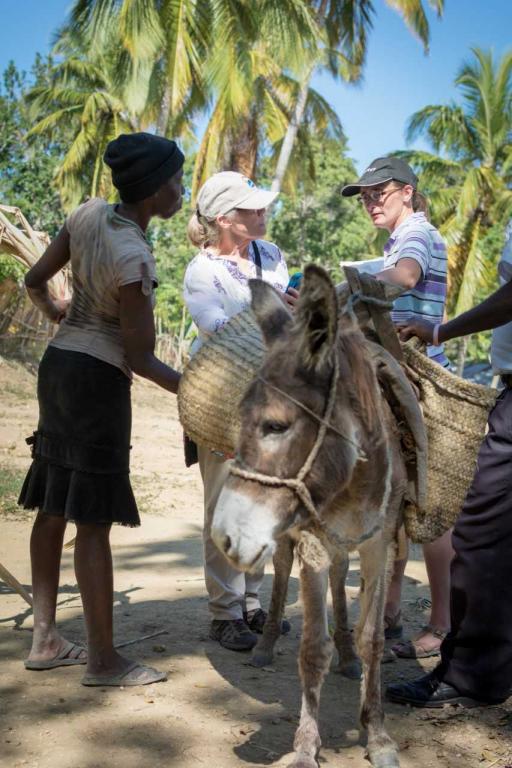
Margot DeGreef, country representative of Haiti for Church World Service helps Brenda Kunau to interview a woman taking goods to market during a visit to a community development project.
If your group or congregation is engaged in orphanage-support:
- Ensure that partner orphanages are properly registered with the Haitian government.
- Try to ensure that they are not involved in harmful or illegal practices, and that funding and other forms of support are not mismanaged. Ask how children arrive at the orphanage, ask if there are living relatives, ask to see a financial report on the support you send, and when possible try to have an independent translator.
- If possible, move away from taking part in short-term volunteering or mission trip visits to orphanages, which may be harmful to child development.
If your church or group does not partner with an orphanage; or wants to move away from supporting an orphanage:
- Supporting ‘orphanages’ where the majority of children are not orphans is not a solution to a problem. Instead, parents need support to be able to take care of their children. A good way to support is therefore to consider funding community development and family preservation programs such as access to education, clean water, day care, sport facilities, job training or income generating activities via access to microcredit (for animal husbandry or small businesses for example). With better access to education and possibilities to provide for their families, there is less incentive for parents to give in to sending their children to an orphanage.
- In the U.S, congregations can educate others by promoting understanding that children should be in families, not orphanages, and that funds could be better spent on preventing the separation of children from their families.
It can be very difficult to work through the cultural and language barriers, even with really good partners. If you need support please feel free to contact [email protected] with questions.
Margot DeGreef is the country representative of Haiti for Church World Service. Margot joined CWS in Haiti in 2011 and oversees their long-term development work and emergency response work. She moved to Haiti in 2008, but was born and raised in the Netherlands. She has a master’s degree in international economics and business from the University of Groningen.
Previous Post

February 15, 2018
Jesus is Not the Answer: 5 Tangible Actions for Gun Sense
Next Post

February 27, 2018 A Long List of Questions: And Why Arming Teachers Is Not the Answer
Browse Our Archives
Select a Category a good week for progress Advent and Christmas Being a Person desert life faith and community Good News for Progressives Lent and Easter Marriage and Family S*^! Jesus Says sabbatical road tripping Spirituality in Culture Talking to Strangers the "Best Stuff I Ever Ate" diet travel Uncategorized writing Writing Prompt Wednesday
Select a Month January 2021 December 2020 November 2020 September 2020 August 2020 July 2020 June 2020 May 2020 April 2020 March 2020 February 2020 January 2020 December 2019 November 2019 October 2019 September 2019 August 2019 July 2019 June 2019 May 2019 April 2019 March 2019 February 2019 January 2019 December 2018 November 2018 October 2018 September 2018 August 2018 July 2018 June 2018 May 2018 April 2018 March 2018 February 2018 January 2018 December 2017 November 2017 October 2017 September 2017 August 2017 July 2017 June 2017 May 2017 April 2017 March 2017 February 2017 January 2017 December 2016 November 2016 October 2016 September 2016 August 2016 July 2016 June 2016 May 2016 April 2016 March 2016 February 2016 January 2016 December 2015 November 2015 October 2015 September 2015 August 2015 July 2015 June 2015 May 2015 April 2015 March 2015 February 2015 January 2015 December 2014 November 2014 October 2014 September 2014 August 2014 July 2014 June 2014 May 2014 April 2014 March 2014 February 2014 January 2014 December 2013 November 2013 October 2013 September 2013 August 2013 July 2013 June 2013 May 2013 April 2013 March 2013 February 2013 January 2013 December 2012 November 2012 October 2012 September 2012 August 2012 July 2012 June 2012 May 2012 April 2012 March 2012 February 2012 January 2012 December 2011 November 2011 October 2011 September 2011 August 2011 July 2011 June 2011 May 2011 April 2011 February 2011 July 2010 May 2010 April 2010 March 2010 January 2010 December 2009 November 2009 October 2009 September 2009 August 2009
Follow Us!
TAKE THE
Religious Wisdom Quiz
What Christian group uses the term "Elder" for its church leaders?
Select your answer to see how you score.
Methodists Baptists Pentecostals Presbyterians
Related posts from Irreverin


Hard Candy Christmas: And Other Songs You Need...


TRENDING AT PATHEOS Progressive Christian

Why Christians Have a Sacred Duty to Vote:...
The Bible offers strong support for the sacred duty to vote. Here...

What Being a Modern-Day Apostle Means to Me
In my last column, I discussed the ins and outs of modern-day...

Did Ancient China Once Worship the God of...
Across human history, a common thread weaves through the origins of the...

Love Your Neighbor – Including Earth-Kin: Lev. 19,...
God’s command to love your neighbor means acting in an ethical and...

Lead a Church Study of “Jesus and Lao...
Guest writer Jack Thomas (The Irreverent Reverend) reflects on leading his church...

Principles for Understanding the Apostolic Ministry Today
Whenever people discover that my formal ministry title is "apostle," as in...
view all Progressive Christian blogs
Ad-Free & Subscriber Log-In Subscription Support
- About Us
- 2026 Calendar
- Videos
- Podcasts
- Library of World Religions
- Faith In Media Tracker
- Advertise With Us
- Write for Us
- Privacy Policy
- Terms of Service
- Do Not Sell My Data
- Contact Us
- Radiant Digital
- Manage Newsletter Subscriptions
- Unsubscribe From Notifications
- Sitemap
Copyright 2008-2026, Patheos. All rights reserved.
Subscription Support Ad-Free & Subscriber Log-In
Follow Patheos