
BuddhistCatholicContemplativeEvangelicalGeneral ChristianHinduJewishLatter-day SaintMuslimNew VisionsProgressive Christian
Beliefs
- Buddhist
- Catholic
- Contemplative
- Evangelical
- General Christian
- Hindu
- Jewish
- Latter-day Saint
- More Voices
- Muslim
- New Visions
- Pagan
- Progressive Christian
Topics
- Religion News
- Food and Religion
- Sports and Religion
- Religious Art
- Religious Music and Entertainment
- Religious Events
- History and Religion
- Style and Religion
- Politics and Religion
- Women in Religion
- Recreation Outdoors and Religion
- Business Finance and Religion
- Careers Workplace and Religion
- Education and Religion
- Family Parenting and Religion
- Health Fitness and Religion
- Home and Religion
- Relationships and Religion
- Technology and Religion
- Travel and Religion
Columnists
- Buddhist Columnists
- Business Finance and Religion Columnists
- Careers Workplace and Religion Columnists
- Catholic Columnists
- Contemplative Columnists
- Education and Religion Columnists
- Evangelists Columnists
- Family Parenting and Religion Columnists
- General Christian Columnists
- Health Fitness and Religion Columnists
- Hindu Columnists
- History and Religion Columnists
- Home and Religion Columnists
- Jewish Columnists
- More Voices Columnists
- Latter Day Columnists
- Muslim Columnists
- New Visions Columnists
- Nonreligious Columnists
- Pagan Columnists
- Politics and Religion Columnists
- Progressive Columnists
- Recreation Outdoors and Religion Columnists
- Relationships and Religion Columnists
- Religion News Columnists
- Religious Art Columnists
- Religious Events Columnists
- Religious Music and Entertainment Columnists
- Sports and Religion Columnists
- Style and Religion Columnists
- Technology and Religion Columnists
- Travel and Religion Columnists
- Women in Religion Columnists
Resource Library
- 2026 Calendar
- Library of World Religions
- The 100 Most Holy Places on Earth
- Patheos Answers
- Podcasts
- Videos
- Faith Leaders Database
- Anglican Episcopalian
- Bahai
- Baptist
- Buddhism
- Christianity
- Confucianism
- Eastern Orthodoxy
- Hinduism
- Holiness and Pentecostal
- ISKCON
- Islam
- Judaism
- Lutheran
- Methodist
- The Church of Jesus Christ of Latter-day Saints
- New Age
- Paganism
- Presbytarian and Reformed
- Protestantism
- Religion Behind the Scenes
- Roman Catholic
- Scientology
- Shia Islam
- Sikhism
- Sufism
- Sunni Islam
- Taoism
- Zen
- See all religions
Research Tools
 Ad-Free & Subscriber Log-In Subscription Support
Ad-Free & Subscriber Log-In Subscription Support
Follow Patheos 

- Trending:
- Forgiveness
- |
- Marriage
- |
- Consciousness
- |
- Death Penalty
- |
- Election
- |
- Halloween
 Irreverin
- Home
- Progressive Christian
- Ashes to Ashes, Stardust to Stardust
Ashes to Ashes, Stardust to Stardust
Last updated on: March 2, 2017 at 12:39 pm by Erin Wathen
Ashes to Ashes, Stardust to Stardust 2017-03-02T12:39:15-07:00 Erin Wathen
Patheos Explore the world's faith through different perspectives on religion and spirituality! Patheos has the views of the prevalent religions and spiritualities of the world.
Guest post: This was the message for Saint Andrew’s Ash Wednesday service last night, as we kicked off our Lent worship series “Everyday Marvels.”
I am hoping you will indulge me and let me take you on two very quick journeys. First, we are going to go outward, away from the Earth like explorers into a vast cosmic ocean, into a Universe so enormous our human brains are physically incapable of understanding the scale of it. Next, we are going to go inward, to the very core of the cells of our body, where the complexity is so great, so unequalled, that our human brains are incapable of understanding that, either. Then, hopefully, I will explain how these are two sides of the exact same coin, that coin being the everyday marvel of God’s Creation.
To do this I’ve brought a single prop: this softball that I’ve borrowed without permission from my 9 year-old.
Sometimes, the science geek in me thinks the Creation story in Genesis actually gets pretty close to the mark: In the beginning there was the Void. Scientists readily admit they have no idea what came before the big bang, but suffice it to say “the Void” is a perfect description. So imagine with me a tiny ball of superheated plasma, about the size of this softball, is the entire Universe. At the moment of Creation, all that material explodes outwards far, far faster than the speed of light and the Universe is born. Some might think that the Creation of the Entire Universe was a pretty big miracle in and of itself and they wouldn’t be wrong, but in my esteem an even bigger marvel is that upon exploding outwards the Universe didn’t immediately collapse right back into a little, super dense softball of energy.
You see, one of the unspoken marvels of the Universe is that gravity is – for lack of a better way to put it – exactly the value it needs to be. If gravity were but a tiny fraction stronger the Universe would never have come to be: it would have collapsed back into a little ball of energy almost immediately. If gravity were a tiny fraction less strong, stars would have formed much slower and our own Sun would not yet exist. If gravity were a lot weaker, stars would probably never have formed at all.
It’s hard to wrap one’s head around how old the Universe is. Similar to gravity, an easy way to describe the age of the Universe is “exactly as old as it needed to be.” This is, admittedly, a very human-centric interpretation but hear me out. 13ish billion years ago the Universe formed in the big bang. After a period of a billion years or so, the super-hot stuff that existed at the beginning of the beginning cooled and formed basically nothing but hydrogen. Hydrogen by itself isn’t good for a whole lot but it is really good at powering fusion in stars. And so the first stars formed. There was nothing at all in the Universe at this point, no comets, no asteroids, no planets, certainly no International Space Station, just hydrogen stars. After a few billion years, some of these stars burned out. What happens inside a star’s fusion engine is not complicated: hydrogen atoms get shoved together into heavier atoms, like lithium, beryllium, and increasingly heavy elements like carbon and nitrogen. When those stars finally give out and explode, there’s a final, last burst of fusion and the star can produce really useful and heavy elements like iron. The star blasts these, along with unused hydrogen and helium, deep into space.
In space nothing is wasted. Gravity gathers all that stuff up and recycles it into a new 2nd generation star: for instance our star, the Sun. In this case though, the lighter hydrogen gets pulled quickly into the star but the heavy stuff like carbon and iron stays farther out – and sometimes forms rocky planets. And some of the oxygen from a dead star joins with hydrogen and you get water. Some of the carbon from the dead star joins with nitrogen and hydrogen and you get things like “life.” When Carl Sagan said in 1973 “we are made of star-stuff” he was being quite literal. Every atom of carbon, nitrogen, and oxygen in your body was produced billions and billions of years ago in the heat of a dying star, and you are a walking, talking memorial to that long-dead star.
And so astrophysical marvel #2 is that it is very possible that the Universe was simply not heavy enough for Life until now, until about the time the Earth formed 4 billion years ago. And possibly we are on one of the first planets at the right time, with the right galactic ingredients, to produce things like people, their pets, and fresh produce.
But the miracle of space foundries doesn’t stop there – in fact it never stops. In another several billion years our star will finally die, just like its ancestor, and after swelling and absorbing many of its planets – Earth included – it will explode in a massive supernovae and blast off its shell of heavy atoms deep into space. Someday, those fragments will congeal again, thanks to gravity, and eventually a new planet, circling a new star, might fill with life as wondrous and varied as ours was. Ashes to ashes, star-dust to star-dust.
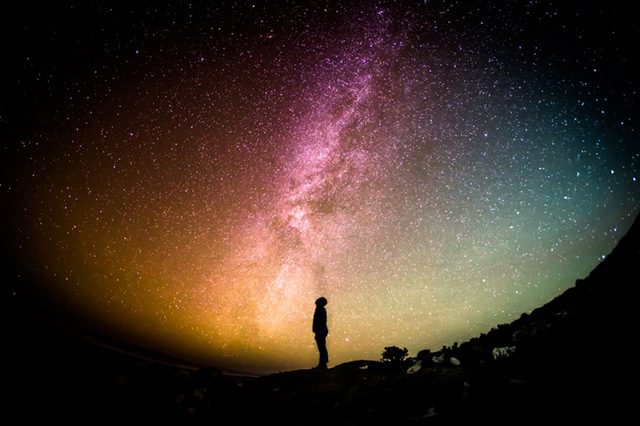
This grand process is playing out in billions of solar systems in billions of galaxies across the Universe. The sheer size of the Universe alone is, like I said before, physically impossible for our brains to fathom.
But let’s try! Imagine, if you will, that I started filling the sanctuary with softballs, like this one. We fill this sanctuary to the very top, to those skylights. That would be, based on my rough calculation, about four or five million softballs. Seems like a lot, right? Okay what if instead of this softball it was a mustard seed? Might as well try Biblically relevant math, right? What if we filled the entire sanctuary, to the very top, with mustard seeds. How many mustard seeds would there be?
The answer is about 400 billion. Coincidentally, the Milky Way Galaxy is currently estimated to hold about 400 billion stars. “Wow, that’s a lot, right?” you might say to yourself. But hold the phone. Right now astronomers believe there are between 100 and 200 billion galaxies in our Universe. And our galaxy is a small one! Galaxies like our nearest neighbor, Andromeda, could easily have a trillion stars. In fact, while the exact number is impossible to know, a reasonable estimate of the number of stars in the entire Universe is somewhere around a 1 with twenty two zeros after it.
To put it another way, imagine you are capable of planting a mustard seed every second in some sort of marathon biblical parable. At that rate of 1 seed per second, it would take – no joke – 1.2 quadrillion years to plant your farm. Every time you look into the night sky, every time you see a star, I hope you remember what an incomprehensibly brief time we have here. In cosmological terms, our lives…the history of our entire species, has happened in less than the blink of an eye, on a tiny patch of rock in an incomprehensibly small corner of the Universe.
However, the vastness and complexity of the observable Universe, in my opinion, pales in comparison to the complexity of a single cell in our bodies. So let’s trade our telescope for a microscope and look inwards. Inside each and every cell in our bodies, most of which are much smaller than a mustard seed, is a complete set of 3 billion nucleotides that form our DNA. And every minute of every day, that DNA is being read and copied and many of your cells are dividing. Let me put this into softball-sized perspective. If the cells of your body were the size of this softball, the DNA in each of them would stretch from where I stand to over half a mile that way. The actual DNA in a single cell is actually nearly 3 inches long. 3 inches of noodly DNA crammed into a tiny cell too small to see with the naked eye. Take all the DNA in all the cells of a single adult human being, and the total length is – no joke – twice the length across our entire solar system. If you thought of our DNA as a book, it would be 12 million pages long. And in many of our cells, that whole “book” is photocopied perfectly every 24 hours for our entire lives.
To me, DNA represents lineage, or rather it represents an ancestry longer and more sacred than any family tree can illustrate. As I stand here today, every cell in my body represents an unbroken line working backwards through and past Adam to the single first cell in existence. I share that lineage with each of you. We share it with every living thing on this planet that has DNA. Every cell that exists is the daughter of a mother cell before it, which came from the one before it, and so on and so forth backwards and backwards to the very dawn of time, to some primordial pool filled with: star stuff.
Perhaps the most obvious marvel of all of this is the very existence of each of you. All that star stuff, all those billions of years and all those galaxies, all those thousands and thousands of times cells divide and double and here each of you are, listening to me. As anyone with more than one child will attest, just because you put two people together twice doesn’t mean you get the same results. Sometimes 1 + 1 = Ava and sometimes the exact same 1 + 1 = Leo. Without getting too into the details, every one of us is a product of a 1 in 100 million biological chance. Two parents, two 1 in 100 million chances, their child another 1 in 100 million chance. In case you’re curious, if you take a 1 in 100 million chance and marry it to a 1 in 100 million chance and those two rarities have a 1 in 100 million chance baby, the odds that baby ended up the exact person it is…is a 1 with 22 zeros after it.
One thing atheists and Christians can agree on is that the statistical likelihood that humanity should ever have existed in the first place is exceedingly rare. And yet here we are.
One final thought for you: in an average person’s lifetime they take about 600 million breaths. After a person breathes, their air is mixed into the atmosphere and most of it floats about until it is, among other things, breathed in by someone or something else. Because of the sheer number of molecules in a lungful of air, statisticians have figured out that every single time you take a breath, you are breathing in – no joke – 36 billion molecules of air that were breathed out by Jesus during his lifetime. Take a deep breath with me. We all just collectively breathed in, silly as it sounds, billions of actual molecules of air that were in Jesus’ lungs. Can anyone guess approximately how many total molecules of air Jesus breathed in and out in his 33 years?
About a 1 with 22 zeros after it.
 Alex Waller is an engineer, and was a founding member of Saint Andrew Christian Church. He lives with his wife and two children in Olathe, KS.
Previous Post

March 1, 2017
The Fast I Choose: Lent, and What Consumes Us
Next Post

March 4, 2017 The World All Around: How We Can and Can't Shield Kids From Violence
Browse Our Archives
Select a Category a good week for progress Advent and Christmas Being a Person desert life faith and community Good News for Progressives Lent and Easter Marriage and Family S*^! Jesus Says sabbatical road tripping Spirituality in Culture Talking to Strangers the "Best Stuff I Ever Ate" diet travel Uncategorized writing Writing Prompt Wednesday
Select a Month January 2021 December 2020 November 2020 September 2020 August 2020 July 2020 June 2020 May 2020 April 2020 March 2020 February 2020 January 2020 December 2019 November 2019 October 2019 September 2019 August 2019 July 2019 June 2019 May 2019 April 2019 March 2019 February 2019 January 2019 December 2018 November 2018 October 2018 September 2018 August 2018 July 2018 June 2018 May 2018 April 2018 March 2018 February 2018 January 2018 December 2017 November 2017 October 2017 September 2017 August 2017 July 2017 June 2017 May 2017 April 2017 March 2017 February 2017 January 2017 December 2016 November 2016 October 2016 September 2016 August 2016 July 2016 June 2016 May 2016 April 2016 March 2016 February 2016 January 2016 December 2015 November 2015 October 2015 September 2015 August 2015 July 2015 June 2015 May 2015 April 2015 March 2015 February 2015 January 2015 December 2014 November 2014 October 2014 September 2014 August 2014 July 2014 June 2014 May 2014 April 2014 March 2014 February 2014 January 2014 December 2013 November 2013 October 2013 September 2013 August 2013 July 2013 June 2013 May 2013 April 2013 March 2013 February 2013 January 2013 December 2012 November 2012 October 2012 September 2012 August 2012 July 2012 June 2012 May 2012 April 2012 March 2012 February 2012 January 2012 December 2011 November 2011 October 2011 September 2011 August 2011 July 2011 June 2011 May 2011 April 2011 February 2011 July 2010 May 2010 April 2010 March 2010 January 2010 December 2009 November 2009 October 2009 September 2009 August 2009
Follow Us!
TAKE THE
Religious Wisdom Quiz
Who said, "Here I am, send me!"?
Select your answer to see how you score.
Isaiah Moses Peter Elijah
Related posts from Irreverin


Hard Candy Christmas: And Other Songs You Need...


TRENDING AT PATHEOS Progressive Christian

Why Christians Have a Sacred Duty to Vote:...
The Bible offers strong support for the sacred duty to vote. Here...

What Being a Modern-Day Apostle Means to Me
In my last column, I discussed the ins and outs of modern-day...

Did Ancient China Once Worship the God of...
Across human history, a common thread weaves through the origins of the...

Love Your Neighbor – Including Earth-Kin: Lev. 19,...
God’s command to love your neighbor means acting in an ethical and...

Lead a Church Study of “Jesus and Lao...
Guest writer Jack Thomas (The Irreverent Reverend) reflects on leading his church...

Principles for Understanding the Apostolic Ministry Today
Whenever people discover that my formal ministry title is "apostle," as in...
view all Progressive Christian blogs
Ad-Free & Subscriber Log-In Subscription Support
- About Us
- 2026 Calendar
- Videos
- Podcasts
- Library of World Religions
- Faith In Media Tracker
- Advertise With Us
- Write for Us
- Privacy Policy
- Terms of Service
- Do Not Sell My Data
- Contact Us
- Radiant Digital
- Manage Newsletter Subscriptions
- Unsubscribe From Notifications
- Sitemap
Copyright 2008-2026, Patheos. All rights reserved.
Subscription Support Ad-Free & Subscriber Log-In
Follow Patheos