
BuddhistCatholicContemplativeEvangelicalGeneral ChristianHinduJewishLatter-day SaintMuslimNew VisionsProgressive Christian
Beliefs
- Buddhist
- Catholic
- Contemplative
- Evangelical
- General Christian
- Hindu
- Jewish
- Latter-day Saint
- More Voices
- Muslim
- New Visions
- Pagan
- Progressive Christian
Topics
- Religion News
- Food and Religion
- Sports and Religion
- Religious Art
- Religious Music and Entertainment
- Religious Events
- History and Religion
- Style and Religion
- Politics and Religion
- Women in Religion
- Recreation Outdoors and Religion
- Business Finance and Religion
- Careers Workplace and Religion
- Education and Religion
- Family Parenting and Religion
- Health Fitness and Religion
- Home and Religion
- Relationships and Religion
- Technology and Religion
- Travel and Religion
Columnists
- Buddhist Columnists
- Business Finance and Religion Columnists
- Careers Workplace and Religion Columnists
- Catholic Columnists
- Contemplative Columnists
- Education and Religion Columnists
- Evangelists Columnists
- Family Parenting and Religion Columnists
- General Christian Columnists
- Health Fitness and Religion Columnists
- Hindu Columnists
- History and Religion Columnists
- Home and Religion Columnists
- Jewish Columnists
- More Voices Columnists
- Latter Day Columnists
- Muslim Columnists
- New Visions Columnists
- Nonreligious Columnists
- Pagan Columnists
- Politics and Religion Columnists
- Progressive Columnists
- Recreation Outdoors and Religion Columnists
- Relationships and Religion Columnists
- Religion News Columnists
- Religious Art Columnists
- Religious Events Columnists
- Religious Music and Entertainment Columnists
- Sports and Religion Columnists
- Style and Religion Columnists
- Technology and Religion Columnists
- Travel and Religion Columnists
- Women in Religion Columnists
Resource Library
- 2026 Calendar
- Library of World Religions
- The 100 Most Holy Places on Earth
- Patheos Answers
- Podcasts
- Videos
- Faith Leaders Database
- Anglican Episcopalian
- Bahai
- Baptist
- Buddhism
- Christianity
- Confucianism
- Eastern Orthodoxy
- Hinduism
- Holiness and Pentecostal
- ISKCON
- Islam
- Judaism
- Lutheran
- Methodist
- The Church of Jesus Christ of Latter-day Saints
- New Age
- Paganism
- Presbytarian and Reformed
- Protestantism
- Religion Behind the Scenes
- Roman Catholic
- Scientology
- Shia Islam
- Sikhism
- Sufism
- Sunni Islam
- Taoism
- Zen
- See all religions
Research Tools
 Ad-Free & Subscriber Log-In Subscription Support
Ad-Free & Subscriber Log-In Subscription Support
Follow Patheos 

- Trending:
- Forgiveness
- |
- Marriage
- |
- Consciousness
- |
- Death Penalty
- |
- Election
- |
- Halloween
 Interspirituality for the Modern Day Seeker
- Home
- New Visions
- Does Religion Equal Division?
Does Religion Equal Division?
Last updated on: December 28, 2017 at 9:45 pm by Gudjon Bergmann
Does Religion Equal Division? 2017-12-28T21:45:48+00:00 Gudjon Bergmann
Patheos Explore the world's faith through different perspectives on religion and spirituality! Patheos has the views of the prevalent religions and spiritualities of the world.
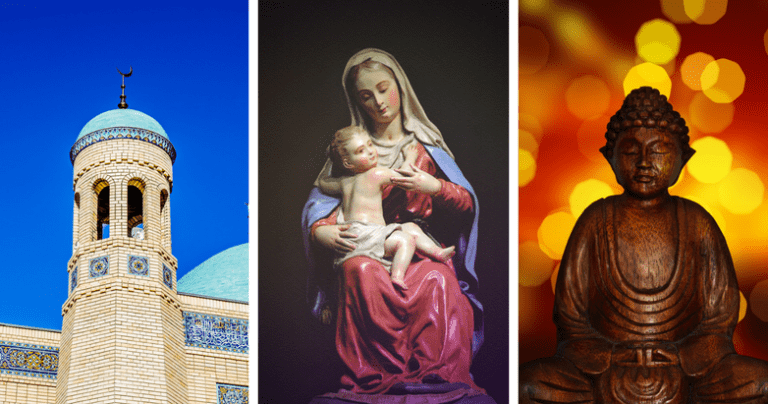
Does religion equal division?
It is a seemingly easy question to answer.
From observing the news on any given day, most people would answer yes, religion does divide. A number of conflicts around the world can be attributed to religious differences and modern political rhetoric often uses religion to pit people against each other. The same can be said when we look back at history. Religious differences seem to be at the root of many conflicts.
Dividing aspects are easy to amplify.
“I believe this, you believe that, and that is why we are different. In fact, your beliefs so offend me that I am willing to take up arms against you.”
Those who place religion at the center of most conflicts use this rhetoric.
But, is it that simple?
Divisive People Cause Divisions
Comparative religion author, Huston Smith, maintained the position that most wars are not fought because of religion but over lands and resources, because of tribal history (as in, “your tribe did this to my tribe many years ago, that is why we fight”), or instigated by power hungry individuals who use religion to fan the flames of war.
In short, divisive people cause division with divisive rhetoric and actions.
Can religious divisions be explained away like that?
Based on what I know (which is limited in scope) there is probably truth to his reasoning. If wars were based only on religion, then everyone who professed the same religion would be at war with the same adversary at the same time. Lands, resources, tribal history, and hunger for power are probably bigger culprits.
At the same time, organized religion can’t be exempt from it’s own checkered history.
But religion is far from being all bad. When we look at the other side of the ledger, we see that religious practices have the potential to extract the very finest in people and be the cause for harmony.
Spreading Harmony
Let me give you an example.
I follow Pope Francis and the Dalai Lama on social media.
Both men preach their message but also place tremendous emphasis on kindness and compassion. Furthermore, both seem to be seeking harmony between religions of the world.
That is in stark contrast with what many preachers, pundits, and politicians are doing here in the USA.
That begs a question. What do the Dalai Lama and Pope Francis have in common?
Well, from what I have observed, they both seem to practice their faith deeply to the point where it shows in their behavior towards others.
Isn’t that the hallmark of true religion, practicing your faith until it shows in your behavior?
In The Varieties of Religious Experience, William James notes that:
“…the feelings on the one hand and the conduct on the other are almost always the same, for Stoic, Christian, and Buddhist saints are practically indistinguishable in their lives.”
Practically indistinguishable.
That doesn’t exactly rhyme with the idea that religion causes division.
In fact, what it says to me is that if more people truly practiced their religion—instead of using it as a tribal identifier—we, as a society, would likely experience more harmony than division.
Going in the Right Direction?
If the choice is between using religion as a wedge issue to create tribal divisions for personal or political gain on one hand, and practicing religion to achieve the human pinnacles of oneness and goodness on the other, I can’t say whether or not we are going in the right direction at the moment.
When I turn on the TV and look at social media, all I see are divisions.
However, when I look at people who live peacefully together in my neighborhood, my fellow Interfaith Ministers who are working towards harmony, people from all faiths who come to local interfaith events, and the growing number of clergy members from all faiths who are calling for kindness, and compassion, I am encouraged.
I choose to focus on the encouraging half of the equation.
We don’t all have to share the same beliefs to get along, but if we truly practice the experiential aspects of our faith traditions, if we tread the path towards oneness and do our best to water the seeds of goodness (the two paths of experience found in all religious traditions and among humanists), then we have a better than average chance of getting along.
Our Choice
We are faced with a choice between these two forces on a near daily basis.
A religious person can choose to view his or her religion either as a dividing force (us against them) or as a personal practice that will bring forth an increased capacity for love and compassion.
A person that stands outside of religion can either focus solely on critiquing those who use religious rhetoric with malice and then paint all religions with those same colors or balance the view by seeing the good that religion has produced as well as the differences.
A religious leader can either be a preacher of fear or a preacher of kindness and harmony, either bring out the best in the people or prove all the critics of religion right by deepening the divisions that already exist.
We live at a truly auspicious moment in history and we have a choice. We can work towards harmony or we can work on deepening divisions. The latter path is easier, the former more important than ever.
Gudjon Bergmann
Author & Interfaith Minister
Visit Experifaith.Org to learn about an experiential approach to interfaith communications.
Pictures: Pexels.com CC0 License
Previous Post

December 6, 2017
Solitude: A Reflection
Next Post

December 13, 2017 Using Experifaith for Dialogue
Browse Our Archives
Select a Category Beliefs and Values Change Compassion Contemplation Creating Moments of Peace Cultural Division Culture Wars Current Events Environmental Protection Experifaith Forgiveness Global Warming Golden Rule Gratitude Gun Debate Gun Safety Integral Theory Interfaith Interfaith Dialogue Interfaith Quotes Interspirituality Islam Language Meditation Mindfulness Morality mysticism Nonduality Parenthood Pluralism Poetry Prayer Quotes Religion Religion and Politics Science and Religion Self-Care Social Harmony Spiritual Practice Spirituality Stress Uncategorized Yoga
Select a Month September 2023 August 2023 June 2023 February 2023 January 2023 December 2022 November 2022 October 2022 September 2022 August 2022 July 2022 June 2022 May 2022 September 2018 August 2018 July 2018 June 2018 May 2018 April 2018 March 2018 February 2018 January 2018 December 2017 November 2017 October 2017 September 2017
Follow Us!
TAKE THE
Religious Wisdom Quiz
What Christian group requires its members to serve as missionaries?
Select your answer to see how you score.
Anglicans Jehovah’s Witnesses Latter-day Saints Baptists
Related posts from Interspirituality for the Modern Day Seeker

The Ten Most Read Articles of 2022: Interspirituality...
Interspirituality for the Modern Day Seeker

Interspirituality for the Modern Day Seeker

Introducing the Monk of All Faiths
Interspirituality for the Modern Day Seeker

Interfaith Methods Don’t Work in Politics: Especially Not...
Interspirituality for the Modern Day Seeker
TRENDING AT PATHEOS New Visions

Did Prayer Cure His Cancer? Or Was It...
At 4 AM one morning, Joshua W. Brown’s wife awoke to a...

8 Ways a Near-Death Experience Rewires the Soul
Does Consciousness Survive Physical Death? After 50 Years of Research, Dr. Raymond...

Holy Longing: What Our Restlessness Is Telling Us
“One can find so many pains when the rain is falling.” -John...

What this is NOT about. This blog is definitely not about...

Who said the Israelites were God’s chosen? That’s right, they did. Who...

The Spirit World Is the Real World: God...
A Monk’s Wisdom on Body and Spirit I sit with Brother Martin...
view all New Visions blogs
Ad-Free & Subscriber Log-In Subscription Support
- About Us
- 2026 Calendar
- Videos
- Podcasts
- Library of World Religions
- Faith In Media Tracker
- Advertise With Us
- Write for Us
- Privacy Policy
- Terms of Service
- Do Not Sell My Data
- Contact Us
- Radiant Digital
- Manage Newsletter Subscriptions
- Unsubscribe From Notifications
- Sitemap
Copyright 2008-2026, Patheos. All rights reserved.
Subscription Support Ad-Free & Subscriber Log-In
Follow Patheos