
BuddhistCatholicContemplativeEvangelicalGeneral ChristianHinduJewishLatter-day SaintMuslimNew VisionsProgressive Christian
Beliefs
- Buddhist
- Catholic
- Contemplative
- Evangelical
- General Christian
- Hindu
- Jewish
- Latter-day Saint
- More Voices
- Muslim
- New Visions
- Pagan
- Progressive Christian
Topics
- Religion News
- Food and Religion
- Sports and Religion
- Religious Art
- Religious Music and Entertainment
- Religious Events
- History and Religion
- Style and Religion
- Politics and Religion
- Women in Religion
- Recreation Outdoors and Religion
- Business Finance and Religion
- Careers Workplace and Religion
- Education and Religion
- Family Parenting and Religion
- Health Fitness and Religion
- Home and Religion
- Relationships and Religion
- Technology and Religion
- Travel and Religion
Columnists
- Buddhist Columnists
- Business Finance and Religion Columnists
- Careers Workplace and Religion Columnists
- Catholic Columnists
- Contemplative Columnists
- Education and Religion Columnists
- Evangelists Columnists
- Family Parenting and Religion Columnists
- General Christian Columnists
- Health Fitness and Religion Columnists
- Hindu Columnists
- History and Religion Columnists
- Home and Religion Columnists
- Jewish Columnists
- More Voices Columnists
- Latter Day Columnists
- Muslim Columnists
- New Visions Columnists
- Nonreligious Columnists
- Pagan Columnists
- Politics and Religion Columnists
- Progressive Columnists
- Recreation Outdoors and Religion Columnists
- Relationships and Religion Columnists
- Religion News Columnists
- Religious Art Columnists
- Religious Events Columnists
- Religious Music and Entertainment Columnists
- Sports and Religion Columnists
- Style and Religion Columnists
- Technology and Religion Columnists
- Travel and Religion Columnists
- Women in Religion Columnists
Resource Library
- 2026 Calendar
- Library of World Religions
- The 100 Most Holy Places on Earth
- Patheos Answers
- Podcasts
- Videos
- Faith Leaders Database
- Anglican Episcopalian
- Bahai
- Baptist
- Buddhism
- Christianity
- Confucianism
- Eastern Orthodoxy
- Hinduism
- Holiness and Pentecostal
- ISKCON
- Islam
- Judaism
- Lutheran
- Methodist
- The Church of Jesus Christ of Latter-day Saints
- New Age
- Paganism
- Presbytarian and Reformed
- Protestantism
- Religion Behind the Scenes
- Roman Catholic
- Scientology
- Shia Islam
- Sikhism
- Sufism
- Sunni Islam
- Taoism
- Zen
- See all religions
Research Tools
 Ad-Free & Subscriber Log-In Subscription Support
Ad-Free & Subscriber Log-In Subscription Support
Follow Patheos 

- Trending:
- Forgiveness
- |
- Marriage
- |
- Consciousness
- |
- Death Penalty
- |
- Election
- |
- Halloween
 Interspirituality for the Modern Day Seeker
- Home
- New Visions
- A Trans-Rational Approach to Meditation
A Trans-Rational Approach to Meditation
Last updated on: January 5, 2018 at 4:04 pm by Gudjon Bergmann
A Trans-Rational Approach to Meditation 2018-01-05T16:04:34+00:00 Gudjon Bergmann
Patheos Explore the world's faith through different perspectives on religion and spirituality! Patheos has the views of the prevalent religions and spiritualities of the world.
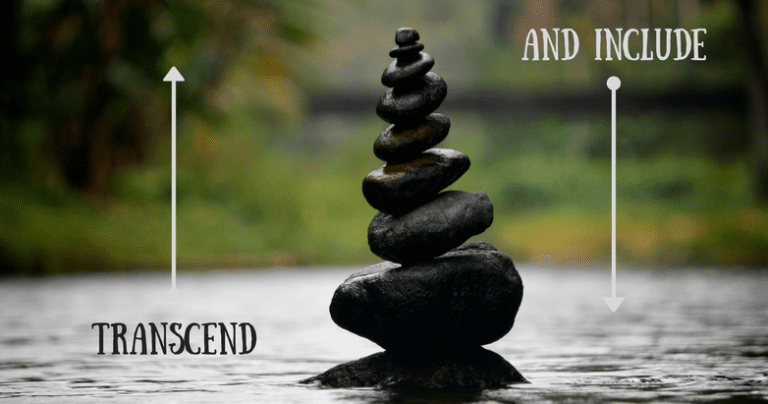
Transcend and include. That is an idea from Ken Wilber that changed the way I thought about several things, including meditation. If you buy into several well-researched growth models that generally show that human beings grow from being egocentric to mythic to rational to pluralistic to integral, then it is worth entertaining this idea of transcendence and inclusion.
What does it mean to transcend and include?
In the simplest sense it means that when you grow from one stage of development to another, you bring with you whatever you believed in the previous stage but, having transcended it, you see the previous stage in a new light.
Let’s say for example that you grow from mythic to rational.
At the mythic stage, you believed that myths (unsubstantiated truth claims) were literally true. Once you entered the rational level of development, however, you had two choices. You could (1) disavow the mythic stage altogether (transcend and repress) or you could (2) start doing what Joseph Campbell did, which is read into myths from a rational standpoint (transcend and include).
When you grow from the rational stage to the pluralistic and integral stages you have the same two choices. (1) Dismiss rationality as being all-bad (this happens quite a lot in pluralistic New Age circles, as in, “don’t live in your head man”) or (2) include rationality and honor it, while at the same time seeing its limits. As an example of this, Huston Smith rightly pointed out that even with all its fantastic capacities science (rationality) is unable to look “above itself.”
Both are Irrational—but Not the Same
Once you accept growth models and the process of transcending and including, it is important to grapple with another Wilber concept that he calls the pre-trans fallacy.
Because both pre-rational (mythic) and trans-rational (pluralistic, integral) levels of growth are in some ways irrational, people often confuse the two. Without discernment, people are more likely to embrace mythical or even magical ideas in relation to their meditation practice. For example, most Eastern philosophies (the original vehicles for meditative practices in the West) have strong mythical foundations. Without assuming a trans-rational stance, which includes but is not limited to rationality, then a student is apt to swallow the mythic philosophies, hook, line, and sinker.
This is something I struggled with in the past—especially when I was beginning on the path in my early twenties—discerning between the trans-rational meditative techniques, which don’t throw rationality out the window, and mythical philosophies, which essentially preach make-believe in the form of great stories (let’s face it, all myths tend to be great stories).
Without rational interpretation—i.e. focusing on what the stories can teach us about human nature—we quickly get sucked into a parallel world that has more in common with Alice in Wonderland than with actual spiritual experiences.
Rational Plus, Not Minus Rationality
In its essence, meditation is a non-dogmatic practice. These days, you can learn several different meditation techniques without feeling pressured to adapt to mythical teachings. However, because meditation is so deeply steeped in ancient myths, it is important to have the mental tools to deal with them, which is exactly what the trans-rational approach provides.
For example, if you have grown psychologically and repressed the previous level, you will tend to make fun of the myths or discard them all together. If you transcend and include, on the other hand, you will be able to entertain some of the great teachings found in ancient myths without having to swallow them whole.
When I first encountered this understanding, it completely changed the way I interacted with meditation teachings. I had been resistant towards many of my teachers and several of the books I was reading on the topic, but, armed with this new understanding, it was easier for me to navigate the space without getting sucked into the world of mythical stories and magical beings.
I created a simple way to remind myself. A trans-rational approach to meditation is rational plus, not minus rationality, which means that it can never go completely against the scientific understanding and rational thinking that I so value—but it can add to it.
Don’t worry, though. It took me several years from the time I first encountered these ideas to fully assimilate what they meant to my life. If your interest is peaked by this short column, I urge you to study these growth models. My introduction came through an audio program back in 2005.
Gudjon Bergmann
Author & Interfaith Minister
Read my article about Stages of Faith to learn more about this topic.
Picture: Pexels.com CC0 License
Previous Post

October 15, 2017
Stages of Faith Simplified
Next Post

October 18, 2017 Using Pluralism Against Pluralists
Browse Our Archives
Select a Category Beliefs and Values Change Compassion Contemplation Creating Moments of Peace Cultural Division Culture Wars Current Events Environmental Protection Experifaith Forgiveness Global Warming Golden Rule Gratitude Gun Debate Gun Safety Integral Theory Interfaith Interfaith Dialogue Interfaith Quotes Interspirituality Islam Language Meditation Mindfulness Morality mysticism Nonduality Parenthood Pluralism Poetry Prayer Quotes Religion Religion and Politics Science and Religion Self-Care Social Harmony Spiritual Practice Spirituality Stress Uncategorized Yoga
Select a Month September 2023 August 2023 June 2023 February 2023 January 2023 December 2022 November 2022 October 2022 September 2022 August 2022 July 2022 June 2022 May 2022 September 2018 August 2018 July 2018 June 2018 May 2018 April 2018 March 2018 February 2018 January 2018 December 2017 November 2017 October 2017 September 2017
Follow Us!
TAKE THE
Religious Wisdom Quiz
What was the primary legal document?
Select your answer to see how you score.
Scroll Tablet Contract Deed
Related posts from Interspirituality for the Modern Day Seeker

Practical Spirituality: Key Questions
Interspirituality for the Modern Day Seeker

Conscious Spiritual Homeostasis
Interspirituality for the Modern Day Seeker

Can Nonduality Be Life-Affirming?
Interspirituality for the Modern Day Seeker

The Easiest Way to Give Meaning to Emotional...
Interspirituality for the Modern Day Seeker
TRENDING AT PATHEOS New Visions

Did Prayer Cure His Cancer? Or Was It...
At 4 AM one morning, Joshua W. Brown’s wife awoke to a...

8 Ways a Near-Death Experience Rewires the Soul
Does Consciousness Survive Physical Death? After 50 Years of Research, Dr. Raymond...

Holy Longing: What Our Restlessness Is Telling Us
“One can find so many pains when the rain is falling.” -John...

What this is NOT about. This blog is definitely not about...

Who said the Israelites were God’s chosen? That’s right, they did. Who...

The Spirit World Is the Real World: God...
A Monk’s Wisdom on Body and Spirit I sit with Brother Martin...
view all New Visions blogs
Ad-Free & Subscriber Log-In Subscription Support
- About Us
- 2026 Calendar
- Videos
- Podcasts
- Library of World Religions
- Faith In Media Tracker
- Advertise With Us
- Write for Us
- Privacy Policy
- Terms of Service
- Do Not Sell My Data
- Contact Us
- Radiant Digital
- Manage Newsletter Subscriptions
- Unsubscribe From Notifications
- Sitemap
Copyright 2008-2026, Patheos. All rights reserved.
Subscription Support Ad-Free & Subscriber Log-In
Follow Patheos