
BuddhistCatholicContemplativeEvangelicalGeneral ChristianHinduJewishLatter-day SaintMuslimNew VisionsProgressive Christian
Beliefs
- Buddhist
- Catholic
- Contemplative
- Evangelical
- General Christian
- Hindu
- Jewish
- Latter-day Saint
- More Voices
- Muslim
- New Visions
- Pagan
- Progressive Christian
Topics
- Religion News
- Food and Religion
- Sports and Religion
- Religious Art
- Religious Music and Entertainment
- Religious Events
- History and Religion
- Style and Religion
- Politics and Religion
- Women in Religion
- Recreation Outdoors and Religion
- Business Finance and Religion
- Careers Workplace and Religion
- Education and Religion
- Family Parenting and Religion
- Health Fitness and Religion
- Home and Religion
- Relationships and Religion
- Technology and Religion
- Travel and Religion
Columnists
- Buddhist Columnists
- Business Finance and Religion Columnists
- Careers Workplace and Religion Columnists
- Catholic Columnists
- Contemplative Columnists
- Education and Religion Columnists
- Evangelists Columnists
- Family Parenting and Religion Columnists
- General Christian Columnists
- Health Fitness and Religion Columnists
- Hindu Columnists
- History and Religion Columnists
- Home and Religion Columnists
- Jewish Columnists
- More Voices Columnists
- Latter Day Columnists
- Muslim Columnists
- New Visions Columnists
- Nonreligious Columnists
- Pagan Columnists
- Politics and Religion Columnists
- Progressive Columnists
- Recreation Outdoors and Religion Columnists
- Relationships and Religion Columnists
- Religion News Columnists
- Religious Art Columnists
- Religious Events Columnists
- Religious Music and Entertainment Columnists
- Sports and Religion Columnists
- Style and Religion Columnists
- Technology and Religion Columnists
- Travel and Religion Columnists
- Women in Religion Columnists
Resource Library
- 2026 Calendar
- Library of World Religions
- The 100 Most Holy Places on Earth
- Patheos Answers
- Podcasts
- Videos
- Faith Leaders Database
- Anglican Episcopalian
- Bahai
- Baptist
- Buddhism
- Christianity
- Confucianism
- Eastern Orthodoxy
- Hinduism
- Holiness and Pentecostal
- ISKCON
- Islam
- Judaism
- Lutheran
- Methodist
- The Church of Jesus Christ of Latter-day Saints
- New Age
- Paganism
- Presbytarian and Reformed
- Protestantism
- Religion Behind the Scenes
- Roman Catholic
- Scientology
- Shia Islam
- Sikhism
- Sufism
- Sunni Islam
- Taoism
- Zen
- See all religions
Research Tools
 Ad-Free & Subscriber Log-In Subscription Support
Ad-Free & Subscriber Log-In Subscription Support
Follow Patheos 

- Trending:
- Forgiveness
- |
- Marriage
- |
- Consciousness
- |
- Death Penalty
- |
- Election
- |
- Halloween
 Interspirituality for the Modern Day Seeker
- Home
- New Visions
- In Religion, Words Matter!
In Religion, Words Matter!
Last updated on: January 5, 2018 at 3:59 pm by Gudjon Bergmann
In Religion, Words Matter! 2018-01-05T15:59:01+00:00 Gudjon Bergmann
Patheos Explore the world's faith through different perspectives on religion and spirituality! Patheos has the views of the prevalent religions and spiritualities of the world.
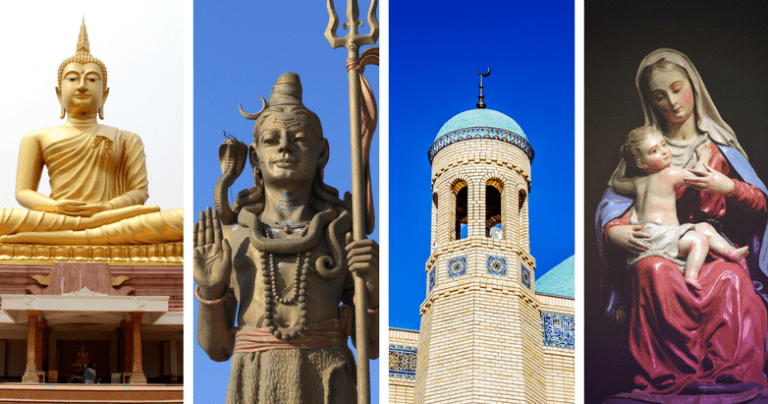
Words are the means by which we communicate. They point to things, emotions, and ideas. They help us understand each other. Words only come into being when two or more people have the same or similar experience and need to be able to talk about it. But through use, the meaning of words changes, and sometimes it is important to revisit the original intent to better understand.
Socrates reportedly said that he never wrote anything down because then he couldn’t be the steward of his words; he wanted to be present to guide people towards the real meaning of what he was saying. Although his sentiment is true upon examination, writing still one of the best means of communications we have, and in writing, as in religion, words matter.
In this article, I want to explore four examples from Buddhism, Hinduism, Islam, and Christianity.
Buddhism: Dukkha
In the modern English vernacular, the main principle of Buddhism is that life is dukkha, which is usually translated to mean that life is suffering.
But is that true?
According to Huston Smith, the original word, dukkha, means out of place, like a wheel on a cart that is off its axis, a dislocated shoulder, or something that doesn’t quite fit.
Dukkha = Out of place.
Can you see how much of a difference that translation makes?
Compare the two:
- Life is suffering.
- Life is out of place.
Totally different meanings, right?
Most of us link the word suffering to something terrible, unbearable even. How can life be that? It doesn’t make any sense.
But if life is out of place, just about everyone can agree to that, because sometimes everyone gets the feeling that life is out of place, out of sorts, like something is not quite right, like something is missing, like it doesn’t fit.
Many of those, who preach Buddhism in the West, are stuck in a difficult situation, trying to explain to people how life is suffering. If they would use the words out of place instead, they would be having a completely different dialogue.
Hinduism: Brahman
In Hinduism, the term Brahman means One Without a Second. It is a nondual concept. Everything is Brahman, the interior of the world, the exterior of the world, and everything in between.
However, in many Hindu and yoga circles, the term Brahman has been translated as God, which a problem, because, while Brahman is a nondual concept, God is a dualistic concept, derived from the word good in several languages, including German, Dutch, and Old English.
And so, when the term Brahman is translated as God, it invites misunderstanding. Brahman is reduced from its original nondual and all-inclusive meaning to a dualistic concept that has a variety of meanings for different people.
Therefore, it makes more sense to use the original word, Brahman, and explain it’s meaning rather than make the mistake of translating it as God.
Islam: Allah
In Islam, there is a different problem because one of their most important terms has not consistently been translated into English, which means that the term Allah has crept into our vernacular. We say that Muslims believe in Allah, not that Muslims believe in God.
Unfortunately, thanks in part to simplified television and movie portrayals, the term Allah has begun to sound ominous to many—as in a terrorist screaming Allah Hu Akbar as he attacks.
However, when the root word is examined, Allah, as Huston Smith explains:
“…is formed by joining the definite article al (meaning “the”) with Ilah (God). Literally, Allah means “the God.” Not a god, for there is only one.”
Allah = The God.
Now, can you imagine the difference if we used the English translation?
We would say that Muslims believe in The God.
Instead of Allah Hu Akbar, we would hear The God is Great.
It sounds like something you would hear at an Evangelical Christian church. God is great. Praise the Lord.
Hearing it that way, talking about it that way, could increase understanding, especially when we remember that the Abrahamic faiths (Judaism, Christianity, and Islam) all share the same God.
Christianity: Yeshu
As Christianity spread, cultures across the world assimilated the central figure, Jesus the Christ of Nazareth, and made him their own.
Few have done as good a job of it as the white populations in Europe and America.
Influenced by paintings, church ornaments, and beyond, many people (including myself, growing up in Iceland where he was called Jesú) could, for the longest time, only perceive Jesus as white.
It goes without saying—but I am going to say it anyway—that Jesus was a Middle Eastern man with dark skin, black hair, and features similar to his fellow men at the time. His Aramaic name was Yeshu.
The blonde haired, fair skinned, blue-eyed, Jesus of my childhood, is a figment of our imagination.
He existed historically, but as Yeshu, not as Jesus.
Imagine if we changed our current vernacular to reflect that. Not to change the teachings of Yeshu, but to change our internal image of him.
Yeshu Christ.
I follow Yeshu.
Sure, we would have to change an awful lot of t-shirts and bumper stickers, but I think it would be worth it overall. It would give us an image of Yeshu that was closer to the truth.
Words Matter
From these examples, you can see how words and their meanings influence both our external and internal dialogues. Words exist independent of us, but, in solitude, we cannot think without them.
I was a public speaker for many years, and every time I stood up in front of a crowd, I would begin my talk by defining the word that would be my primary focus for the next thirty to sixty minutes. I have definitions for stress, self-confidence, meditation, forgiveness, and other concepts. My goal was to make sure that we were all on the same page when I started talking.
Similarly to that, we would all do well to stop from time to time and reflect on the original meaning of the words we use, especially if those words form the foundation for our belief structure.
Gudjon Bergmann
Author & Interfaith Minister
p.s. Please feel free to share more examples in the comment section below.
Pictures: Pexels.com CC0 License
Previous Post

October 6, 2017
Secular Means Both All Religions and No Religion
Next Post

October 10, 2017 The Birth of an Interfaith Model
Browse Our Archives
Select a Category Beliefs and Values Change Compassion Contemplation Creating Moments of Peace Cultural Division Culture Wars Current Events Environmental Protection Experifaith Forgiveness Global Warming Golden Rule Gratitude Gun Debate Gun Safety Integral Theory Interfaith Interfaith Dialogue Interfaith Quotes Interspirituality Islam Language Meditation Mindfulness Morality mysticism Nonduality Parenthood Pluralism Poetry Prayer Quotes Religion Religion and Politics Science and Religion Self-Care Social Harmony Spiritual Practice Spirituality Stress Uncategorized Yoga
Select a Month September 2023 August 2023 June 2023 February 2023 January 2023 December 2022 November 2022 October 2022 September 2022 August 2022 July 2022 June 2022 May 2022 September 2018 August 2018 July 2018 June 2018 May 2018 April 2018 March 2018 February 2018 January 2018 December 2017 November 2017 October 2017 September 2017
Follow Us!
TAKE THE
Religious Wisdom Quiz
"Those who wait on the Lord will renew their strength. They will soar with wings like ____ ..."
Select your answer to see how you score.
Angels Raptors Hawks Eagles
Related posts from Interspirituality for the Modern Day Seeker

The Ten Most Read Articles of 2022: Interspirituality...
Interspirituality for the Modern Day Seeker
Interspirituality for the Modern Day Seeker

Introducing the Monk of All Faiths
Interspirituality for the Modern Day Seeker

The Paths of Oneness and Goodness Are Not...
Interspirituality for the Modern Day Seeker
TRENDING AT PATHEOS New Visions

Did Prayer Cure His Cancer? Or Was It...
At 4 AM one morning, Joshua W. Brown’s wife awoke to a...

8 Ways a Near-Death Experience Rewires the Soul
Does Consciousness Survive Physical Death? After 50 Years of Research, Dr. Raymond...

Holy Longing: What Our Restlessness Is Telling Us
“One can find so many pains when the rain is falling.” -John...

What this is NOT about. This blog is definitely not about...

Who said the Israelites were God’s chosen? That’s right, they did. Who...

The Spirit World Is the Real World: God...
A Monk’s Wisdom on Body and Spirit I sit with Brother Martin...
view all New Visions blogs
Ad-Free & Subscriber Log-In Subscription Support
- About Us
- 2026 Calendar
- Videos
- Podcasts
- Library of World Religions
- Faith In Media Tracker
- Advertise With Us
- Write for Us
- Privacy Policy
- Terms of Service
- Do Not Sell My Data
- Contact Us
- Radiant Digital
- Manage Newsletter Subscriptions
- Unsubscribe From Notifications
- Sitemap
Copyright 2008-2026, Patheos. All rights reserved.
Subscription Support Ad-Free & Subscriber Log-In
Follow Patheos