
BuddhistCatholicContemplativeEvangelicalGeneral ChristianHinduJewishLatter-day SaintMuslimNew VisionsProgressive Christian
Beliefs
- Buddhist
- Catholic
- Contemplative
- Evangelical
- General Christian
- Hindu
- Jewish
- Latter-day Saint
- More Voices
- Muslim
- New Visions
- Pagan
- Progressive Christian
Topics
- Religion News
- Food and Religion
- Sports and Religion
- Religious Art
- Religious Music and Entertainment
- Religious Events
- History and Religion
- Style and Religion
- Politics and Religion
- Women in Religion
- Recreation Outdoors and Religion
- Business Finance and Religion
- Careers Workplace and Religion
- Education and Religion
- Family Parenting and Religion
- Health Fitness and Religion
- Home and Religion
- Relationships and Religion
- Technology and Religion
- Travel and Religion
Columnists
- Buddhist Columnists
- Business Finance and Religion Columnists
- Careers Workplace and Religion Columnists
- Catholic Columnists
- Contemplative Columnists
- Education and Religion Columnists
- Evangelists Columnists
- Family Parenting and Religion Columnists
- General Christian Columnists
- Health Fitness and Religion Columnists
- Hindu Columnists
- History and Religion Columnists
- Home and Religion Columnists
- Jewish Columnists
- More Voices Columnists
- Latter Day Columnists
- Muslim Columnists
- New Visions Columnists
- Nonreligious Columnists
- Pagan Columnists
- Politics and Religion Columnists
- Progressive Columnists
- Recreation Outdoors and Religion Columnists
- Relationships and Religion Columnists
- Religion News Columnists
- Religious Art Columnists
- Religious Events Columnists
- Religious Music and Entertainment Columnists
- Sports and Religion Columnists
- Style and Religion Columnists
- Technology and Religion Columnists
- Travel and Religion Columnists
- Women in Religion Columnists
Resource Library
- 2026 Calendar
- Library of World Religions
- The 100 Most Holy Places on Earth
- Patheos Answers
- Podcasts
- Videos
- Faith Leaders Database
- Anglican Episcopalian
- Bahai
- Baptist
- Buddhism
- Christianity
- Confucianism
- Eastern Orthodoxy
- Hinduism
- Holiness and Pentecostal
- ISKCON
- Islam
- Judaism
- Lutheran
- Methodist
- The Church of Jesus Christ of Latter-day Saints
- New Age
- Paganism
- Presbytarian and Reformed
- Protestantism
- Religion Behind the Scenes
- Roman Catholic
- Scientology
- Shia Islam
- Sikhism
- Sufism
- Sunni Islam
- Taoism
- Zen
- See all religions
Research Tools
 Ad-Free & Subscriber Log-In Subscription Support
Ad-Free & Subscriber Log-In Subscription Support
Follow Patheos 

- Trending:
- Forgiveness
- |
- Marriage
- |
- Consciousness
- |
- Death Penalty
- |
- Election
- |
- Halloween
 Interspirituality for the Modern Day Seeker
- Home
- New Visions
- Four Stages of Interfaith Communications
Four Stages of Interfaith Communications
Last updated on: January 5, 2018 at 4:07 pm by Gudjon Bergmann
Four Stages of Interfaith Communications 2018-01-05T16:07:22+00:00 Gudjon Bergmann
Patheos Explore the world's faith through different perspectives on religion and spirituality! Patheos has the views of the prevalent religions and spiritualities of the world.
History has taught us that when understanding and tolerance are fostered, people of different faiths can live together in harmony.
Regrettably, history has also taught us the opposite, that such states of equilibrium can quickly degenerate and succumb to a rhetoric of anger and fear, sometimes leading to violence and even war.
A balance of mutual respect and tolerance needs to be maintained through good works for harmony to prevail. Interrelations need continual nurturing.
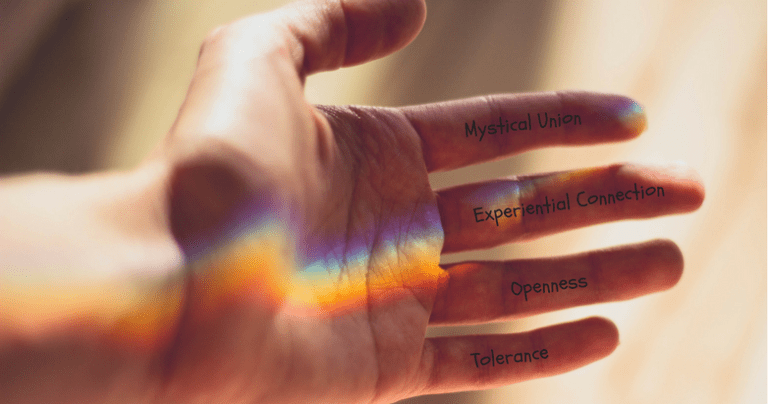
For that purpose, there are four possible stages of interfaith communications.
Stage 1 – Tolerance
In our secular Western society—note, the word secular here is used to mean a society for both those who want to be religious and those who don’t—the first stage, tolerance, is the most common form of interfaith relations.
Tolerance is exemplified by the sentiment: “You are free to believe whatever you want, but please don’t tell me about your faith or try to teach your theology to my kids.”
Although this kind of tolerance may seem reluctant and lack understanding, it is far better than theocracy, where people are either considered second-class citizens if they do not submit themselves to the prevailing religious view or worse, are persecuted for their beliefs.
Ever since the Enlightenment era in the 17th and 18th Centuries—which, among other things, gave birth to the U.S. Constitution and our de facto motto E Pluribus Unum (out of the many, one)—interfaith tolerance has been sown into the fabric of Western society. The rules of one religion are not made into law for all citizens because of a simple social agreement: For you to believe what you want, you must allow me to do the same, even if we disagree.
This kind of tolerance is periodically under attack and requires both maintenance and vigilance if it is to be sustained, as recent events have starkly reminded us.
Stage 2 – Openness
The second stage of interfaith relations is openness. “Maybe, just maybe, my truth isn’t the only truth,” is the sentiment that represents this worldview.
While openness does not ask believers to change their religion or identity, it does ask them to acknowledge that the truth is a vast concept. Ultimate reality has many faces and all human systems of thinking (even systems that are considered divine in nature entered their existence through a human filter, which makes them divinely inspired but human nonetheless) contain both truth and potential errors or oversights.
By recognizing the vastness of truth, people enter into the mindset of humility.
At it’s best, the stage of pluralistic openness leads to education about different religions and increased participation in interfaith services.
Stage 3 – Experiential Connection
The third stage of interfaith relations is experiential in nature. It focuses on the communications that take place between spiritual practitioners of different faiths when they begin to compare their experiences.
- “How do you feel when you pray or meditate?”
- “What do the acts of service, tolerance, forgiveness, etc. do for your religious life?”
- “How does your spiritual life influence the way you act on a daily basis?”
This notion of shared experience is important.
A hiker, for example, has much more in common with other hikers who have walked paths foreign to him than with sedentary people who have never hiked anywhere but have read books about the hiker’s favorite path. If someone has hiked in Switzerland, for instance, he or she is likely to have more in common with those who have hiked in the Rocky Mountains than with those who have never hiked at all. The terrain may be different, but the act of hiking is similar.
The same is true about spirituality. The acts of praying, meditating, fasting, contemplating deeply, and having other direct forms of experience, all influence practitioners differently than mere reading or listening. Moreover, because we all have the same tools to work with—body, mind, and spirit—practitioners from different faiths will have more in common than they realize.
This third stage epitomizes the kind of interaction that my Experifaith model promises to facilitate.
With experience as the guiding light, Christian monks and nuns could, for example, come together with Sufis and Yogis to pray and meditate, then discuss their experiences by talking about how silence and inner peace have changed their lives, instead of talking about the content of their prayers or focusing on theology. Hindus, Christians, and Muslims, who tread the path of goodness, could come together and do good works. Doing good side by side would show them that they are not as different as previously thought and that their various beliefs can lead to similar outcomes.
Furthermore, communications that are based on personal experience are, by their very nature, more honest. They do not rely on borrowed wisdom. No one is parroting ideologies they have been exposed to.
Of course, it must be noted that only people who truly practice their faith or spiritual path are able to participate in experiential interfaith communications.
I am reminded of a key insight that Swami Vivekananda offered at the Parliament of World’s Religions in 1893 when he said that “holiness, purity and charity” were not exclusive possessions of any one church and that all religious paths had produced “men and women of the most exalted character.”
William James echoed that sentiment when he said that:
“…the feelings on the one hand and the conduct on the other are almost always the same, for Stoic, Christian, and Buddhist saints are practically indistinguishable in their lives.”
Ideologies may differ but the results of dedicated spiritual practices seem to be similar across the board.
Stage 4 – Mystical Union
Although rare, it is important to name the fourth stage of interfaith relations, namely mystical union, which is described to be more like an exchange of energy than a conventional process of communications. It takes place between mystics of different religions who have experienced either a personal communion with the divine or a direct revelation of their own essence. The result is complete harmony.
Conclusion
It is my hope that more and more people who truly practice their faith or spiritual path will engage in the third stage of experiential interfaith communications in the future, whether they use they Experifaith model to facilitate the process or not.
Having said that, I recognize that in our current social climate, tolerance, even if somewhat reluctant, is better than the alternative of hate and intolerance.
Gudjon Bergmann
Author & Interfaith Minister
This article was adapted from my book, Experifaith: At the Heart of Every Religion (click on the link to get your free web edition).
Picture: Pexels.com CC0 License
Previous Post

October 22, 2017
Are You a Peach or a Coconut?
Next Post

October 30, 2017 The Difference Between Interfaith and Interspirituality
Browse Our Archives
Select a Category Beliefs and Values Change Compassion Contemplation Creating Moments of Peace Cultural Division Culture Wars Current Events Environmental Protection Experifaith Forgiveness Global Warming Golden Rule Gratitude Gun Debate Gun Safety Integral Theory Interfaith Interfaith Dialogue Interfaith Quotes Interspirituality Islam Language Meditation Mindfulness Morality mysticism Nonduality Parenthood Pluralism Poetry Prayer Quotes Religion Religion and Politics Science and Religion Self-Care Social Harmony Spiritual Practice Spirituality Stress Uncategorized Yoga
Select a Month September 2023 August 2023 June 2023 February 2023 January 2023 December 2022 November 2022 October 2022 September 2022 August 2022 July 2022 June 2022 May 2022 September 2018 August 2018 July 2018 June 2018 May 2018 April 2018 March 2018 February 2018 January 2018 December 2017 November 2017 October 2017 September 2017
Follow Us!
TAKE THE
Religious Wisdom Quiz
According to James, what should you do when you are in trouble?
Select your answer to see how you score.
Serve others Sing Hymns Pray Repent
Related posts from Interspirituality for the Modern Day Seeker

Two Reasons Why Some People Fear Interfaith Relations
Interspirituality for the Modern Day Seeker

Interspirituality is Best Understood at 30.000 Feet but...
Interspirituality for the Modern Day Seeker

How Interspirituality Informs My Attempts to Be Compassionate
Interspirituality for the Modern Day Seeker

Writing Your Interspiritual Life Story
Interspirituality for the Modern Day Seeker
TRENDING AT PATHEOS New Visions

Did Prayer Cure His Cancer? Or Was It...
At 4 AM one morning, Joshua W. Brown’s wife awoke to a...

8 Ways a Near-Death Experience Rewires the Soul
Does Consciousness Survive Physical Death? After 50 Years of Research, Dr. Raymond...

Holy Longing: What Our Restlessness Is Telling Us
“One can find so many pains when the rain is falling.” -John...

What this is NOT about. This blog is definitely not about...

Who said the Israelites were God’s chosen? That’s right, they did. Who...

The Spirit World Is the Real World: God...
A Monk’s Wisdom on Body and Spirit I sit with Brother Martin...
view all New Visions blogs
Ad-Free & Subscriber Log-In Subscription Support
- About Us
- 2026 Calendar
- Videos
- Podcasts
- Library of World Religions
- Faith In Media Tracker
- Advertise With Us
- Write for Us
- Privacy Policy
- Terms of Service
- Do Not Sell My Data
- Contact Us
- Radiant Digital
- Manage Newsletter Subscriptions
- Unsubscribe From Notifications
- Sitemap
Copyright 2008-2026, Patheos. All rights reserved.
Subscription Support Ad-Free & Subscriber Log-In
Follow Patheos