
BuddhistCatholicContemplativeEvangelicalGeneral ChristianHinduJewishLatter-day SaintMuslimNew VisionsProgressive Christian
Beliefs
- Buddhist
- Catholic
- Contemplative
- Evangelical
- General Christian
- Hindu
- Jewish
- Latter-day Saint
- More Voices
- Muslim
- New Visions
- Pagan
- Progressive Christian
Topics
- Religion News
- Food and Religion
- Sports and Religion
- Religious Art
- Religious Music and Entertainment
- Religious Events
- History and Religion
- Style and Religion
- Politics and Religion
- Women in Religion
- Recreation Outdoors and Religion
- Business Finance and Religion
- Careers Workplace and Religion
- Education and Religion
- Family Parenting and Religion
- Health Fitness and Religion
- Home and Religion
- Relationships and Religion
- Technology and Religion
- Travel and Religion
Columnists
- Buddhist Columnists
- Business Finance and Religion Columnists
- Careers Workplace and Religion Columnists
- Catholic Columnists
- Contemplative Columnists
- Education and Religion Columnists
- Evangelists Columnists
- Family Parenting and Religion Columnists
- General Christian Columnists
- Health Fitness and Religion Columnists
- Hindu Columnists
- History and Religion Columnists
- Home and Religion Columnists
- Jewish Columnists
- More Voices Columnists
- Latter Day Columnists
- Muslim Columnists
- New Visions Columnists
- Nonreligious Columnists
- Pagan Columnists
- Politics and Religion Columnists
- Progressive Columnists
- Recreation Outdoors and Religion Columnists
- Relationships and Religion Columnists
- Religion News Columnists
- Religious Art Columnists
- Religious Events Columnists
- Religious Music and Entertainment Columnists
- Sports and Religion Columnists
- Style and Religion Columnists
- Technology and Religion Columnists
- Travel and Religion Columnists
- Women in Religion Columnists
Resource Library
- 2026 Calendar
- Library of World Religions
- The 100 Most Holy Places on Earth
- Patheos Answers
- Podcasts
- Videos
- Faith Leaders Database
- Anglican Episcopalian
- Bahai
- Baptist
- Buddhism
- Christianity
- Confucianism
- Eastern Orthodoxy
- Hinduism
- Holiness and Pentecostal
- ISKCON
- Islam
- Judaism
- Lutheran
- Methodist
- The Church of Jesus Christ of Latter-day Saints
- New Age
- Paganism
- Presbytarian and Reformed
- Protestantism
- Religion Behind the Scenes
- Roman Catholic
- Scientology
- Shia Islam
- Sikhism
- Sufism
- Sunni Islam
- Taoism
- Zen
- See all religions
Research Tools
 Ad-Free & Subscriber Log-In Subscription Support
Ad-Free & Subscriber Log-In Subscription Support
Follow Patheos 

- Trending:
- Forgiveness
- |
- Marriage
- |
- Consciousness
- |
- Death Penalty
- |
- Election
- |
- Halloween

- Home
- Nonreligious
- Careers, Workplace and Religion
- How To Win Arguments Through Collaborative Truth-Seeking
How To Win Arguments Through Collaborative Truth-Seeking
Last updated on: December 6, 2019 at 7:03 am by Gleb Tsipursky
How To Win Arguments Through Collaborative Truth-Seeking 2019-12-06T07:03:07-04:00 Gleb Tsipursky
Patheos Explore the world's faith through different perspectives on religion and spirituality! Patheos has the views of the prevalent religions and spiritualities of the world.

We frequently use debates to resolve different opinions about the truth. However, debates are not always the best course for figuring out the truth. In more emotionally charged situations, the technique of collaborative truth-seeking is often better.
The Problem with Debates
The usual method of hashing out disagreements in order to discover the truth about reality is through debates, in person or online. Yet more often than not, people on opposing sides of a debate end up seeking to persuade rather than prioritizing truth discovery. Indeed, research suggests that debates have a specific evolutionary function – not for discovering the truth but to ensure that our perspective prevails within a tribal social context. No wonder debates are often compared to wars.
This is especially so in emotionally charged topics, such as politics, as our autopilot system takes over and inhibits our ability to be rational in our engagement with others. We fall into many dangerous judgment errors, which are mental blindspots resulting from how our brain is wired that scholars in cognitive neuroscience and behavioral economics call cognitive biases.
Fortunately, recent research in these fields shows how you can use pragmatic strategies to address these dangerous judgment errors, whether in your professional life, your relationships, your shopping choices, or other life areas.
You need to evaluate where cognitive biases are hurting you and others in your team and organization. Then, you can use structured decision-making methods to make “good enough” daily decisions quickly; more thorough ones for moderately important choices; and an in-depth one for truly major decisions.
Such techniques will also help you implement your decisions well, and formulate truly effective long-term strategic plans. In addition, you can develop mental habits and skills to notice cognitive biases and prevent yourself from slipping into them.
For example, we may hope that we would strive to discover the truth during debates. Yet given that we are not always fully rational and strategic in our social engagements, it is easy to slip up within debate mode and orient toward winning instead of uncovering the truth. Heck, I know that I sometimes forget in the midst of a heated debate that I may be the one who is wrong – I’d be surprised if this didn’t happen with you. So while we should certainly continue to engage in debates, we should also use additional strategies – less natural and intuitive ones. These strategies could put us in a better mindset for updating our beliefs and improving our perspective on the truth. One such solution is a mode of engagement called collaborative truth-seeking.
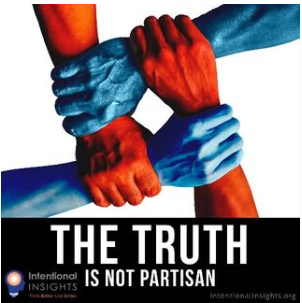
Caption: Meme saying “The Truth Is Not Partisan” (Created by Lexie Holliday for Intentional Insights)
Collaborative Truth-Seeking
Collaborative truth-seeking is one way of describing a more intentional approach in which two or more people with different opinions engage in a process that focuses on finding out the truth. Collaborative truth-seeking is a modality that should be used among people with shared goals and a shared sense of trust.
Some important features of collaborative truth-seeking, which are often not present in debates, are: focusing on a desire to change one’s own mind toward the truth; a curious attitude; being sensitive to others’ emotions; striving to avoid arousing emotions that will hinder updating beliefs and truth discovery; and a trust that all other participants are doing the same. These can contribute to increased social sensitivity, which, together with other attributes, correlate with accomplishing higher group performance on a variety of activities.
- Share weaknesses and uncertainties in your own position
- Share your biases about your position
- Share your social context and background as relevant to the discussion. For instance, I grew up poor once my family immigrated to the US when I was 10, and this naturally influences me to care about poverty more than some other issues, thus biasing me in this area
- Vocalize curiosity and the desire to learn
- Ask the other person to call you out if they think you’re getting emotional or engaging in emotive debate instead of collaborative truth-seeking, and consider using a safe word
Here are additional techniques that can help you stay in collaborative truth-seeking mode after establishing trust:
- Self-signal: signal to yourself that you want to engage in collaborative truth-seeking, instead of debating
- Empathize: try to empathize with the other perspective that you do not hold by considering where their viewpoint came from, why they think what they do, and recognizing that they feel that their viewpoint is correct
- Keep calm: be prepared with emotional management to calm your emotions and those of the people you engage with when a desire for debate arises. Watch out for defensiveness and aggressiveness in particular
- Go slow: take the time to listen fully and think fully
- Consider pausing: have an escape route for complex thoughts and emotions if you can’t deal with them in the moment by pausing and picking up the discussion later. Say “I will take some time to think about this,” and/or write things down
- Echo: paraphrase the other person’s position to indicate and check whether you’ve fully understood their thoughts
- Be open: orient toward improving the other person’s points to argue against their strongest form
- Stay the course: be passionate about wanting to update your beliefs, maintain the most truthful perspective, and adopt the best evidence and arguments, no matter if they are yours of those of others
- Be diplomatic: when you think the other person is wrong, strive to avoid saying “you’re wrong because of X” but instead to use questions, such as “what do you think X implies about your argument?”
- Be specific and concrete: go down levels of abstraction
- Be clear: make sure the semantics are clear to all by defining terms. Consider tabooing terms if some are emotionally arousing, and make sure you are describing the same territory of reality
- Be probabilistic: use probabilistic thinking and probabilistic language, to help get at the extent of disagreement and be as specific and concrete as possible. For instance, avoid saying that X is absolutely true, but say that you think there’s an 80% chance it’s the true position. Consider adding what evidence and reasoning led you to believe so, for both you and the other participants to examine this chain of thought
- When people whose perspective you respect fail to update their beliefs in response to your clear chain of reasoning and evidence, update a little somewhat toward their position, since that presents evidence that your position is not very convincing
- Confirm your sources: look up information when it’s possible to do so (Google is your friend)
- Charity mode: try to be more charitable to others and their expertise than seems intuitive to you, as our intuitions are a bad guide to seeking the truth when the person with whom we are in discussion has a perspective different from our own. For instance, if someone says something that seems wrong to you, check to make sure that is what the person actually said – you might have misheard things, or the person might have misstated something
- Use the reversal test to check for status quo bias: If you are discussing whether to change some specific numeric parameter – say increase by 50% the money donated to charity X – state the reverse of your positions, for example decreasing the amount of money donated to charity X by 50%, and see how that impacts your perspective
- Use CFAR’s double crux: in this technique, two parties who hold different positions on an argument each writes the fundamental reason for their position (the crux of their position). This reason has to be the key one, so if it was proven incorrect, then each would change their perspective. Then, look for experiments that can test the crux. Repeat as needed. If a person identifies more than one reason as crucial, you can go through each as needed.
- Finally, consider using this Collaborative Truth-Seeking web app to help you evaluate the quality and extent of evidence on each side.
Of course, not all of these techniques are necessary for high-quality collaborative truth-seeking. Some are easier than others, and different techniques apply better to different kinds of truth-seeking discussions. You can apply some of these techniques during debates as well, such as double crux and the reversal test. Try some out and see how they work for you.
Conclusion
Engaging in collaborative truth-seeking goes against our natural impulses to win in a debate, and is thus more cognitively costly. It also tends to take more time and effort than just debating. It is also easy to slip into debate mode even when using collaborative truth-seeking, because of the intuitive nature of debate mode.
Moreover, collaborative truth-seeking need not replace debates at all times. This non-intuitive mode of engagement can be chosen when discussing issues that relate to deeply-held beliefs and/or ones that risk emotional triggering for the people involved. Because of my own background, I would prefer to discuss poverty in collaborative truth-seeking mode rather than debate mode, for example. On such issues, collaborative truth-seeking can provide a shortcut to resolution, in comparison to protracted, tiring, and emotionally challenging debates.
Likewise, using collaborative truth-seeking to resolve differing opinions on all issues holds the danger of creating a community oriented excessively toward sensitivity to the perspectives of others, which might result in important issues not being discussed candidly. After all, research shows the importance of having disagreement in order to make wise decisions and to figure out the truth. Of course, collaborative truth-seeking is well suited to expressing disagreements in a sensitive way, so if used appropriately, it might permit even people with triggers around certain topics to express their opinions.
Taking these caveats into consideration, collaborative truth-seeking is a great tool to use to discover the truth and to update our beliefs, as it can get past the high emotional barriers to altering our perspectives that have been put up by evolution.
Key Takeaway
Questions to Consider (answer in the comments section)
- In the past, when do you wish you could have applied collaborative truth-seeking techniques?
- In what contexts would collaborative truth-seeking serve you well in the future?
- What might be challenges to your use of collaborative truth-seeking?
First Published In Disaster Avoidance Experts on April 3, 2018.
—
Bio: Dr. Gleb Tsipursky empowers you to avoid business disasters as CEO of the boutique consulting, coaching, and training firm Disaster Avoidance Experts. A best-selling author, he wrote Never Go With Your Gut, The Blindspots Between Us, and The Truth Seeker’s Handbook. Tsipursky’s cutting-edge thought leadership was featured in over 400 articles and 350 interviews in Fast Company, CBS News, Time, Scientific American, Psychology Today, Inc. Magazine, and elsewhere. His expertise stems from his background of over 20 years of consulting, coaching, speaking, and training experience across North America, Europe, and Australia. It also comes from his strong research and teaching background in behavioral economics and cognitive neuroscience with over 15 years in academia, including 7 years as a professor at the Ohio State University, with dozens of peer-reviewed academic publications. Contact him at Gleb[at]DisasterAvoidanceExperts[dot]com, follow him on Twitter @gleb_tsipursky, Instagram @dr_gleb_tsipursky, Facebook, YouTube, and LinkedIn. Most importantly, help yourself avoid disasters and maximize success, and get a free copy of the Assessment on Dangerous Judgment Errors in the Workplace, by signing up for his free Wise Decision Maker Guide.

About Dr. Gleb Tsipursky
Known as the Disaster Avoidance Expert, Dr. Gleb Tsipursky is on a mission to protect leaders from dangerous judgment errors known as cognitive biases, which devastate bottom lines and bring down high-flying careers. His expertise and passion is developing the most effective and profitable decision-making strategies, based on pragmatic business experience and cutting-edge behavioral economics and cognitive neuroscience, to empower leaders to avoid business disasters and maximize their bottom lines. You can learn more here https://disasteravoidanceexperts.com/glebtsipursky/ The bestselling author of several books, Dr. Tsipursky is best known for his national bestseller on avoiding disasters and achieving success in business and other life areas, The Truth Seeker’s Handbook: A Science-Based Guide. His next book, Never Go With Your Gut: How Pioneering Leaders Make the Best Decisions and Avoid Business Disasters, is forthcoming with Career Press in November 2019. It’s the first book to focus on cognitive biases in business leadership and reveal how leaders can overcome these dangerous judgment errors effectively. After that he’s publishing The Blindspots Between Us: How to Overcome Unconscious Cognitive Bias and Build Better Relationships with New Harbinger in April 2020, the first book to focus on cognitive biases in professional and personal relationships and illustrate how we can defeat these dangerous judgment errors in our relationships. See more information here https://disasteravoidanceexperts.com/author-page/ Dr. Tsipursky’s cutting-edge thought leadership was featured in over 400 articles he published and over 350 interviews he gave to popular venues that include Fast Company, CBS News, Time, Scientific American, Psychology Today, The Conversation, Business Insider, Government Executive, The Chronicle of Philanthropy, Inc. Magazine, and many others, as you can see here https://disasteravoidanceexperts.com/media/ Dr. Tsipursky's expertise comes from over 20 years of consulting, coaching, speaking, and training for businesses and nonprofits. He serves as the CEO of the boutique consulting, coaching, and training firm Disaster Avoidance Experts, which uses a proprietary methodology based on groundbreaking research to help leaders and organizations maximize their bottom lines by addressing potential threats, seizing unexpected opportunities, and resolving persistent personnel problems. His clients include Aflac, Balance Employment Assistance Provider, Edison Welding Institute, Fifth Third Bank, Honda, IBM, International Coaches Federation, Ohio Hospitals Association, National Association of Women Business Owners, Sentinel Real Estate, The Society for Human Resource Management, RealManage, The Columbus Foundation, Vistage, Wells Fargo, the World Wildlife Fund, and over a hundred others who achieve outstanding client results. You can learn more about that here: https://disasteravoidanceexperts.com/about Dr. Tsipursky also has a strong research and teaching background in behavioral economics and cognitive neuroscience with over 15 years in academia, including 7 years as a professor at the Ohio State University and before that a Fellow at the University of North Carolina-Chapel Hill. His dozens of peer-reviewed academic publications include journals such as Behavior and Social Issues, Journal of Social and Political Psychology, and International Journal of Existential Psychology and Psychotherapy. His civic service includes over 4 years as the Chair of the Board of Directors of Intentional Insights, an educational nonprofit advocating for research-based decision-making in all life areas. He also co-founded the Pro-Truth Pledge, a civic project to promote truthfulness and integrity for individual professionals and leaders in the same way that the Better Business Bureau serves as a commitment for businesses. He serves on the Advisory Board of Canonical Debate Lab and Planet Purpose, and is on the Editorial Board of the peer-reviewed journal Behavior and Social Issues. A highly in-demand international speaker, Dr. Tsipursky has over two decades of professional speaking experience across North America, Europe, and Australia. He gets top marks from audiences for his highly facilitative, interactive, and humor-filled speaking style and the way he thoroughly customizes speeches for diverse audiences. Meeting planners describe Dr. Tsipursky as "very relatable," as "a snap to work with," and as someone who "does everything that you would want a speaker to do." Drawing on best practices in adult learning, his programs address the wide spectrum of diverse learning styles, as attested by enthusiastic client testimonials and references. He regularly shares the stage with prominent leaders, for example recently speaking on a roundtable panel with the President of the European Commission Ursula von der Leyen, Secretary General of the International Federation of Red Cross and Red Crescent Societies Elhadj As Sy, Chancellor of Austria Brigitte Bierlein, CEO of Penguin Random House Markus Dohle, and billionaire philanthropist and Chair of the Bertelsmann Management Company Liz Mohn. You can learn more about his speaking and see videos here: https://disasteravoidanceexperts.com/speaking/ Dr. Tsipursky earned his PhD in the History of Behavioral Science at the University of North Carolina at Chapel Hill in 2011, his M.A. at Harvard University in 2004, and his B.A. at New York University in 2002. He lives in and travels from Columbus, OH. In his free time, he enjoys tennis, hiking, and playing with his two cats, and most importantly, he makes sure to spend abundant quality time with his wife to avoid disasters in his personal life. Learn more about him at https://DisasterAvoidanceExperts.com/GlebTsipursky, contact him at Gleb[at]DisasterAvoidanceExperts[dot]com, follow him on Instagram @dr_gleb_tsipursky and Twitter @gleb_tsipursky. Most importantly, help yourself avoid disasters and maximize success, and get a free copy of the “Assessment on Dangerous Judgment Errors in the Workplace,” by signing up for his free Wise Decision Maker Course at https:// DisasterAvoidanceExperts.com/Subscribe You can read more about the author here.
Previous Post

September 18, 2019
How to Evaluate Unconscious Bias Caused by Cognitive Biases
Next Post

September 28, 2019 The Keys to Avoid “Failing at Other Minds”
Browse Our Archives
Select a Category Alternative Facts Behavioral Science Cognitive Bias Debates Deception Decision Making Donald Trump Effective giving Fake news Leadership Meaning and Purpose Personal Politics Post-Truth Pro-Truth Pro-Truth Pledge Psychology Rationality Secular Spirituality Uncategorized Wise decision Making
Select a Month October 2026 September 2026 August 2026 July 2026 June 2026 May 2026 April 2026 March 2026 February 2026 January 2026 December 2025 November 2025 October 2025 August 2025 July 2025 June 2025 May 2025 April 2025 March 2025 February 2025 January 2025 December 2024 November 2024 October 2024 September 2024 June 2024 May 2024 April 2024 March 2024 February 2024 January 2024 December 2023 November 2023 October 2023 September 2023 August 2023 July 2023 June 2023 May 2023 April 2023 March 2023 January 2023 December 2022 October 2022 September 2022 August 2022 July 2022 June 2022 May 2022 April 2022 March 2022 January 2022 December 2021 November 2021 October 2021 September 2021 August 2021 July 2021 June 2021 May 2021 April 2021 March 2021 February 2021 January 2021 December 2020 November 2020 October 2020 September 2020 August 2020 July 2020 June 2020 May 2020 April 2020 March 2020 February 2020 January 2020 December 2019 November 2019 October 2019 September 2019 September 2018 August 2018 July 2018 January 2018 December 2017 November 2017 October 2017 September 2017 August 2017 July 2017 June 2017 May 2017 April 2017 March 2017
Follow Us!
TAKE THE
Religious Wisdom Quiz
What animal was used to represent the Holy Spirit?
Select your answer to see how you score.
Lamb Dove Eagle Sparrow
Related posts from Intentional Insights

Saving Your Relationships From the COVID-19 Coronavirus Pandemic

12 Mental Skills to Defeat Cognitive Biases

The Psychology of Knowledge Management: Uniting the Majority...

Why Your Negotiations Are Doomed (And How to...
TRENDING AT PATHEOS Nonreligious

Methodist Central Hall and Westminster Abbey
Situated on the same square is Methodist Central Hall and Westminster Abbey. ...

57th Dove Awards Honor Dolly Parton, Crown New...
On gospel music’s biggest night, the 57th annual GMA Dove Awards honored...

The First Eucharistic Controversy: Christ’s Real Presence
For Catholics, the Eucharist is the source and summit of the Christian...

What a Stop Sign Can Teach Us About...
How to Make a Decision When You Can't Hear God Main point:...

Archdiocese Hosts Military Marriage Retreat in Germany
RASTATT, Germany — The transient military lifestyle, with its frequent deployments and...

Nearly every morning, I make the drive to Detroit with my high-school-age...
view all Nonreligious blogs
Ad-Free & Subscriber Log-In Subscription Support
- About Us
- 2026 Calendar
- Videos
- Podcasts
- Library of World Religions
- Faith In Media Tracker
- Advertise With Us
- Write for Us
- Privacy Policy
- Terms of Service
- Do Not Sell My Data
- Contact Us
- Radiant Digital
- Manage Newsletter Subscriptions
- Unsubscribe From Notifications
- Sitemap
Copyright 2008-2026, Patheos. All rights reserved.
Subscription Support Ad-Free & Subscriber Log-In
Follow Patheos