
BuddhistCatholicContemplativeEvangelicalGeneral ChristianHinduJewishLatter-day SaintMuslimNew VisionsProgressive Christian
Beliefs
- Buddhist
- Catholic
- Contemplative
- Evangelical
- General Christian
- Hindu
- Jewish
- Latter-day Saint
- More Voices
- Muslim
- New Visions
- Pagan
- Progressive Christian
Topics
- Religion News
- Food and Religion
- Sports and Religion
- Religious Art
- Religious Music and Entertainment
- Religious Events
- History and Religion
- Style and Religion
- Politics and Religion
- Women in Religion
- Recreation Outdoors and Religion
- Business Finance and Religion
- Careers Workplace and Religion
- Education and Religion
- Family Parenting and Religion
- Health Fitness and Religion
- Home and Religion
- Relationships and Religion
- Technology and Religion
- Travel and Religion
Columnists
- Buddhist Columnists
- Business Finance and Religion Columnists
- Careers Workplace and Religion Columnists
- Catholic Columnists
- Contemplative Columnists
- Education and Religion Columnists
- Evangelists Columnists
- Family Parenting and Religion Columnists
- General Christian Columnists
- Health Fitness and Religion Columnists
- Hindu Columnists
- History and Religion Columnists
- Home and Religion Columnists
- Jewish Columnists
- More Voices Columnists
- Latter Day Columnists
- Muslim Columnists
- New Visions Columnists
- Nonreligious Columnists
- Pagan Columnists
- Politics and Religion Columnists
- Progressive Columnists
- Recreation Outdoors and Religion Columnists
- Relationships and Religion Columnists
- Religion News Columnists
- Religious Art Columnists
- Religious Events Columnists
- Religious Music and Entertainment Columnists
- Sports and Religion Columnists
- Style and Religion Columnists
- Technology and Religion Columnists
- Travel and Religion Columnists
- Women in Religion Columnists
Resource Library
- 2026 Calendar
- Library of World Religions
- The 100 Most Holy Places on Earth
- Patheos Answers
- Podcasts
- Videos
- Faith Leaders Database
- Anglican Episcopalian
- Bahai
- Baptist
- Buddhism
- Christianity
- Confucianism
- Eastern Orthodoxy
- Hinduism
- Holiness and Pentecostal
- ISKCON
- Islam
- Judaism
- Lutheran
- Methodist
- The Church of Jesus Christ of Latter-day Saints
- New Age
- Paganism
- Presbytarian and Reformed
- Protestantism
- Religion Behind the Scenes
- Roman Catholic
- Scientology
- Shia Islam
- Sikhism
- Sufism
- Sunni Islam
- Taoism
- Zen
- See all religions
Research Tools
 Ad-Free & Subscriber Log-In Subscription Support
Ad-Free & Subscriber Log-In Subscription Support
Follow Patheos 

- Trending:
- Forgiveness
- |
- Marriage
- |
- Consciousness
- |
- Death Penalty
- |
- Election
- |
- Halloween

- Home
- Nonreligious
- Careers, Workplace and Religion
- The Pro-Truth Pledge prompts truthful behavior, according to psychology studies
The Pro-Truth Pledge prompts truthful behavior, according to psychology studies
Last updated on: September 12, 2018 at 5:29 pm by Gleb Tsipursky
The Pro-Truth Pledge prompts truthful behavior, according to psychology studies 2018-09-12T17:29:32-04:00 Gleb Tsipursky
Patheos Explore the world's faith through different perspectives on religion and spirituality! Patheos has the views of the prevalent religions and spiritualities of the world.
Traditionally, identifying truth in politics comes from mainstream media and its fact checking. A recent Gallup poll, however, showed that only 29 percent of Americans trust fact checking.
Research in behavioral science suggests that we can address the spread of misinformation through a number of other effective strategies, which are brought together in the Pro-Truth Pledge (PTP) project. Several months ago, I wrote a post explaining the Pro-Truth Pledge and its mission. Since that time, two peer-reviewed studies have provided evidence of its effectiveness in changing the behavior of pledge-takers — private citizens and public figures both— to be more truthful, for more than a month after they have taken the pledge. Both studies were published in prestigious psychology journals, Behavior and Social Issues and the Journal of Social and Political Psychology.
Quantitative evidence shows the Pledge is effective
The study in the peer-reviewed Journal of Social and Political Psychology suggests that taking the pledge results in a statistically significant increase in alignment with the behaviors of the pledge. The survey involved 24 participants filling out Likert scale (1–5) surveys self-reporting their Facebook engagement with news-relevant content on their own profiles and also with other people’s posts and in groups before and after they took the pledge, with 1 at lowest level of alignment to the pledge behaviors and 5 being full alignment. To avoid the Hawthorne effect of study participants being impacted by observation, the study did not evaluate current behavior, but past behavior.
We only recruited participants who took the pledge 4 or more weeks ago to fill out the survey, and asked them about their behavior after taking the pledge. Giving them this period also gave people an opportunity to have the immediate impact of taking the pledge fade from their mind, thus enabling an evaluation of the medium-term impact of the PTP on sharing news-relevant content.
This study method was informed by the approaches used by studies of whether honor codes address cheating, which is the most comparable form of intervention to the PTP. Such studies similarly rely on self-reporting by students on whether they have cheated or not cheated.
The study found that on one’s own Facebook profile, the median alignment with the PTP score before taking the PTP is 4 (SD=1.14), and the median alignment score after taking the PTP is 4.5 (SD=0.51). For engaging with newsworthy content on other people’s profiles and in groups, the median PTP alignment score before taking the Truth Pledge is 3.5 (SD=1.06).
The median PTP alignment score after taking the Truth Pledge is 4.5 (SD=0.65). For sharing content, 70.83% of participants (17 of 24 respondents) reported an increase of their PTP alignment after taking the PTP. The figure below provides a visual summary of the preliminary survey data.
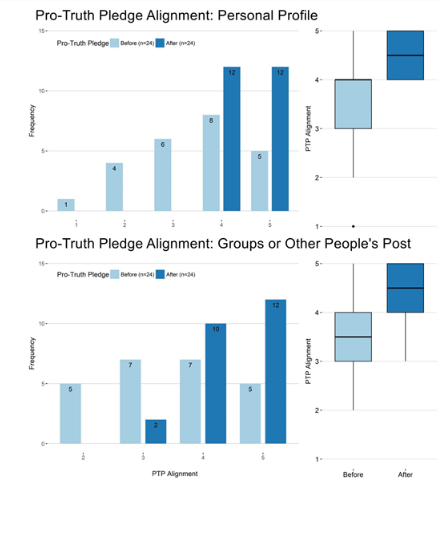
Figure 1, Visual summary of preliminary survey data with PTP alignment in Facebook engagement
We conducted a second study, the one published in Behavior and Social Issues, to address the weakness of the first study’s reliance on self-reporting. The second study sampled 21 people, and involved researchers observing and evaluating the quality of Facebook engagement by study participants on their own Facebook profile.
Similarly to the first study, the second study avoided the Hawthorne effect of study participants being impacted by observation by evaluating past behavior. Researchers looked at the first ten Facebook posts with news-relevant content made four weeks after the pledge. Then, the researchers compared these ten posts to the first ten posts for the same period the year before the study participant took the pledge. Each post was coded according to quality, from 1 of lowest level of alignment with the PTP, to 5 of highest alignment.
The second study showed that the average PTP alignment before taking the pledge was 2.49, and after taking the pledge was 3.65, and conducted a paired t-test to examine whether Pro-Truth Pledge Alignment is significantly different after taking the PTP. The null hypothesis H0 for the paired t-test states that there is no significant alignment difference before and after taking the pledge and the alternative hypothesis H1 proposes a significant difference. There was a significant difference in the scores for Pledge Alignment before(M=2.49, SD=0.60) and after (M=3.65, SD=0.41) taking the PTP; t(20) = -8.86, p < 0.001. An estimation of the effect size indicates that the found difference can be considered to be large (Cohen’s d=-1.93). Thus hypothesis H0 can be rejected in favor of hypothesis H1. These results suggest that taking the PTP really does have an effect on inducing truthful sharing behavior on Facebook.
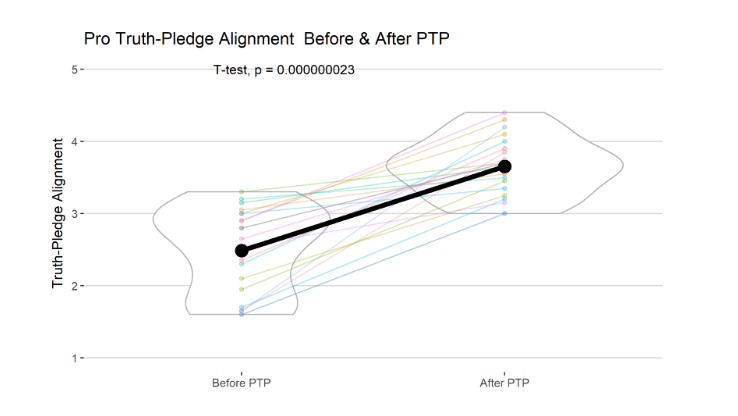
Figure 2, Showing the results of PTP alignment before and after taking the PTP.
The figure above provides a visualization of the results. The thick black line shows the median. The small colored lines represent change among individuals. Note that every individual who took the PTP has improved their sharing on Facebook to be more aligned with the PTP, some drastically.
The first study showed that individuals self-report behaving more truthfully both on their own profiles and in other contexts on Facebook — such as on the profiles of friends and in groups — after taking the PTP. The improvement was large, with a clear statistical significance, of about 1 unit on a 1–5 scale. The second study focused on observing people’s behavior on their own profiles, and confirmed that pledge-takers behaved more truthfully four weeks after taking the pledge. Again, the improvement had clear statistical significance, and was large, also about 1 unit on a 1–5 scale.
In other words, people’s self-reports about their improvement of behavior on their own profiles — and the extent of their improvement — were corroborated by external observers. We can thus assume that people also behaved more truthfully on other people’s profiles and in groups, even though we have no realistic way of observing that.
Overall, these two studies provide compelling evidence that people improved the honesty of their behavior on Facebook because they have heard about and signed the pledge, and there is no reason to believe they would have improved if they did not hear about and sign the pledge. The combination of these two studies provides solid evidence that taking the PTP decreases the spread of misinformation on social media.
The Pledge approach to misinformation
The Pro-Truth Pledge team, made up of behavioral science experts and concerned citizens, determined that tilting the scale requires a two-pronged approach, targeting both private citizens and public figures. Research shows that without any intervention, people tend to ignore information that goes against their beliefs, and are more likely to deceive others both when they see others do so and when it benefits their in-group.
However, increased risk of suffering negative consequences, being reminded of ethics, publicity and committing in advance to honesty all decrease the incentive to lie for ordinary citizens. For public figures, research suggests that transparent, clear information about who is truthful, coupled with reputational rewards for socially beneficial behavior, such as honesty, and enforced with penalties for dishonesty, are the most vital interventions.
The Pro-Truth Pledge incorporates all of these elements by asking signees to commit to 12 truth-oriented behaviors, such as fact-checking, retracting incorrect information, and celebrating others for changing their minds toward the facts, that are meant to counter our brain’s tendencies toward deceiving themselves and others. Private citizens who sign the pledge get the benefit of contributing to a more truth-oriented society. Public figures and organizations get more substantive rewards for signing the pledge, in the form of positive media and public recognition.
The pledge crowdsources the truth by holding them accountable through a reporting and evaluation mechanism. Thus, the PTP offers the same kind of credibility mechanic offered by the Better Business Bureau: just like the BBB holds businesses accountable to ethical business practices, the PTP holds public figures and organizations accountable for truthfulness in their public statements.
Similarly, just like anyone can lodge a complaint to the BBB and a business will have to respond to a legitimate complaint, anyone can lodge a complaint to the PTP. If after initial investigation the PTP evaluators consider the complaint legitimate, the public figure or organization will be asked to respond.
Since its launch in December 2016, the PTP has over 8,000 signers so far across the globe, including over 1200 public figures and organizations. The PTP has already had positive media coverage in prominent US and international media venues on the right and left. They include Newsweek, The Guardian, The Daily Caller, Raw Story, Scientific American, The Hindu, NPR, CBS News, and others. Unsurprisingly, signers include prominent leaders in the misinformation-fighting movement, and one of the most prominent scholars of misinformation, Stephan Lewandowsky, is on the Advisory Board of the organization running the Pro-Truth Pledge project, Intentional Insights.
Perhaps more surprising is that over 600 Republican, Democratic, and minor party politicians across the political spectrum took the pledge, including US state legislators Eric Nelson (PA), James White (TX), and Ogden Driskell (WY) and national congress members Beto O’Rourke (TX), Matt Cartwright (PA), and Marcia Fudge (OH).
Over 800 other public figures have taken the pledge, such as globally-known public intellectuals Peter Singer, Steven Pinker, Michael Shermer, and Jonathan Haidt, religious leaders such as Pierre Whalon, Jim Burklo, and Lorenzo Neal, media personalities such as Ethan Bearman, Andrew Keen, and Bob Fitrakis, and civic activists such as Bill Shireman, Andrew Hanauer, and Ricken Patel. Over 80 organizations, whether news-oriented ones such as Media Bias/Fact Check, Media in Action, Columbus Free Press, and Fugitive Watch, or civic-oriented ones such as Stand Up Republic, Faith and Freedom Coalition Delaware, George Mason University Center for Climate Change, and BridgeUSA also took the pledge. While they may have many disagreements, they are united around a commitment to truthful behavior.
The pledge organizers make a strong effort to reach across the political divide. Included on the Advisory Board of the organization running the pledge project is the founder of the Houston Tea Party Society, Felicia Winfree Cravens (who described why she took the pledge here), and also a conservative Christian pastor, Lorenzo Neal (who described why he took the pledge here). The very popular far-right website The Daily Caller published a positive story about the pledge. A number of Republican legislators, such as members of state legislatures Eric Nelson (PA), James White (TX), and Ogden Driskell (WY).
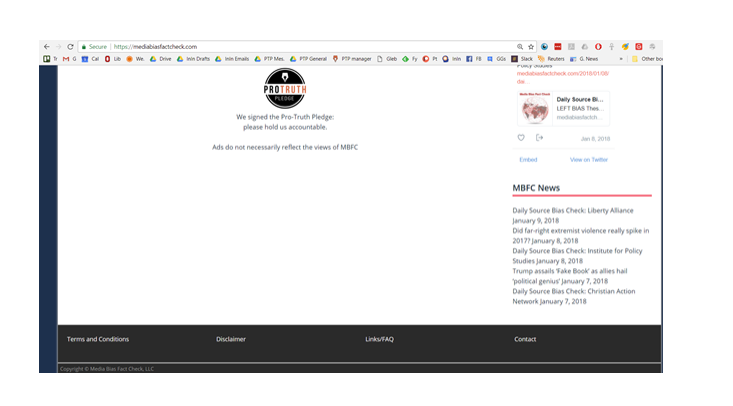
Many organizations and public figures added the PTP badge to their website and social media, in similarity to how businesses add the BBB badge to their website, which is one of many ways that these organizations and public figures can get a positive reputation boost while also promoting truthful behavior.
Will the PTP work to tilt the scale toward truth? In order to tell, we’ll need to evaluate whether and why people are taking the pledge and also whether the pledge changes their behavior. Michael Smith, a candidate for Congress in Idaho, took the Pledge, and later posted on his Facebook wall a screenshot of a tweet by Donald Trump criticizing minority and disabled children. After being called out on it, he went and searched Trump’s feed. He could not find the original tweet, and although Trump may have deleted it, the candidate edited his own Facebook post to say, “Due to a Truth Pledge I have taken, I have to say I have not been able to verify this post.”
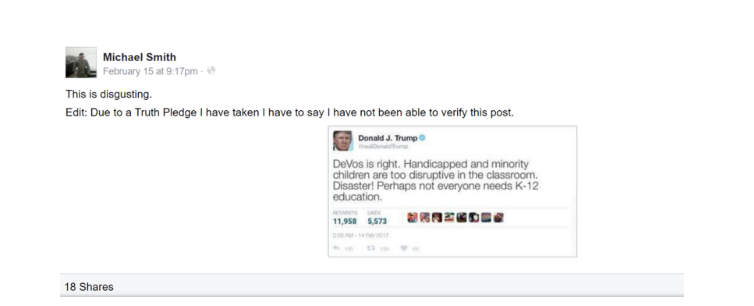
Further research is needed to determine whether that is indeed the case. We also do not know whether presenting the PTP in a semi-voluntary context, such as when students are presented with an honor code with an implicit expectation that they sign it in order to attend the college of their choice, will maintain the impact of the PTP: further research is needed as well.
The evidence so far shows that the Pro-Truth Pledge has the potential to protect our democracy from the tide of lies. Whether it will succeed depends on how many people go to ProTruthPledge.org to sign the pledge, spread the word, lobby public figures to sign it and monitor those who do. The early results look promising.
— — —
Dr. Gleb Tsipursky is the author of The Truth-Seeker’s Handbook: A Science-Based Guide. He is President of the nonprofit Intentional Insights and co-founder of the Pro-Truth Pledge.
__________________________________________________________________
Connect with Dr. Gleb Tsipursky on Twitter, on Facebook, and on LinkedIn, and learn more about him on his website.

Next Post
September 18, 2019 How to Evaluate Unconscious Bias Caused by Cognitive Biases
Browse Our Archives
Select a Category Alternative Facts Behavioral Science Cognitive Bias Debates Deception Decision Making Donald Trump Effective giving Fake news Leadership Meaning and Purpose Personal Politics Post-Truth Pro-Truth Pro-Truth Pledge Psychology Rationality Secular Spirituality Uncategorized Wise decision Making
Select a Month October 2026 September 2026 August 2026 July 2026 June 2026 May 2026 April 2026 March 2026 February 2026 January 2026 December 2025 November 2025 October 2025 August 2025 July 2025 June 2025 May 2025 April 2025 March 2025 February 2025 January 2025 December 2024 November 2024 October 2024 September 2024 June 2024 May 2024 April 2024 March 2024 February 2024 January 2024 December 2023 November 2023 October 2023 September 2023 August 2023 July 2023 June 2023 May 2023 April 2023 March 2023 January 2023 December 2022 October 2022 September 2022 August 2022 July 2022 June 2022 May 2022 April 2022 March 2022 January 2022 December 2021 November 2021 October 2021 September 2021 August 2021 July 2021 June 2021 May 2021 April 2021 March 2021 February 2021 January 2021 December 2020 November 2020 October 2020 September 2020 August 2020 July 2020 June 2020 May 2020 April 2020 March 2020 February 2020 January 2020 December 2019 November 2019 October 2019 September 2019 September 2018 August 2018 July 2018 January 2018 December 2017 November 2017 October 2017 September 2017 August 2017 July 2017 June 2017 May 2017 April 2017 March 2017
Follow Us!
TAKE THE
Religious Wisdom Quiz
What is the shortest book in the New Testament?
Select your answer to see how you score.
2 John Jude Philemon 3 John
Related posts from Intentional Insights

Hybrid Work Policies: The Future Of The Modern...

10 Tips to Protect Your Romantic Relationships From...

How Global Elites Can Address Misinformation

How To Win Arguments Through Collaborative Truth-Seeking
TRENDING AT PATHEOS Nonreligious

The Problem with False Prophets
Miller’s Station UMC| 10/18/26| Anchor Verse: Jeremiah 23: 1, 9-23 I...

Emotion in Early Christianity by Andrew Crislip
Andrew Crislip’s Emotion in Early Christianity examines an often overlooked dimension of...

16 Spiritual Touchstones for a More Grounded Life
After decades of spiritual study, here are 16 principles I try...

Catholic Evangelization: Sharing Your Faith Every Day
Welcome back to the Graceful Awakening mini-series called, “From Faith to Mission.” ...

The Pillar of the Boatmen: the Ancient Monument...
The Pillar of the Boatmen is a Romano-Gaulish sculpture that dates from...

In one sense walking into Westminster Abbey is like walking down the...
view all Nonreligious blogs
Ad-Free & Subscriber Log-In Subscription Support
- About Us
- 2026 Calendar
- Videos
- Podcasts
- Library of World Religions
- Faith In Media Tracker
- Advertise With Us
- Write for Us
- Privacy Policy
- Terms of Service
- Do Not Sell My Data
- Contact Us
- Radiant Digital
- Manage Newsletter Subscriptions
- Unsubscribe From Notifications
- Sitemap
Copyright 2008-2026, Patheos. All rights reserved.
Subscription Support Ad-Free & Subscriber Log-In
Follow Patheos