
BuddhistCatholicContemplativeEvangelicalGeneral ChristianHinduJewishLatter-day SaintMuslimNew VisionsProgressive Christian
Beliefs
- Buddhist
- Catholic
- Contemplative
- Evangelical
- General Christian
- Hindu
- Jewish
- Latter-day Saint
- More Voices
- Muslim
- New Visions
- Pagan
- Progressive Christian
Topics
- Religion News
- Food and Religion
- Sports and Religion
- Religious Art
- Religious Music and Entertainment
- Religious Events
- History and Religion
- Style and Religion
- Politics and Religion
- Women in Religion
- Recreation Outdoors and Religion
- Business Finance and Religion
- Careers Workplace and Religion
- Education and Religion
- Family Parenting and Religion
- Health Fitness and Religion
- Home and Religion
- Relationships and Religion
- Technology and Religion
- Travel and Religion
Columnists
- Buddhist Columnists
- Business Finance and Religion Columnists
- Careers Workplace and Religion Columnists
- Catholic Columnists
- Contemplative Columnists
- Education and Religion Columnists
- Evangelists Columnists
- Family Parenting and Religion Columnists
- General Christian Columnists
- Health Fitness and Religion Columnists
- Hindu Columnists
- History and Religion Columnists
- Home and Religion Columnists
- Jewish Columnists
- More Voices Columnists
- Latter Day Columnists
- Muslim Columnists
- New Visions Columnists
- Nonreligious Columnists
- Pagan Columnists
- Politics and Religion Columnists
- Progressive Columnists
- Recreation Outdoors and Religion Columnists
- Relationships and Religion Columnists
- Religion News Columnists
- Religious Art Columnists
- Religious Events Columnists
- Religious Music and Entertainment Columnists
- Sports and Religion Columnists
- Style and Religion Columnists
- Technology and Religion Columnists
- Travel and Religion Columnists
- Women in Religion Columnists
Resource Library
- 2026 Calendar
- Library of World Religions
- The 100 Most Holy Places on Earth
- Patheos Answers
- Podcasts
- Videos
- Faith Leaders Database
- Anglican Episcopalian
- Bahai
- Baptist
- Buddhism
- Christianity
- Confucianism
- Eastern Orthodoxy
- Hinduism
- Holiness and Pentecostal
- ISKCON
- Islam
- Judaism
- Lutheran
- Methodist
- The Church of Jesus Christ of Latter-day Saints
- New Age
- Paganism
- Presbytarian and Reformed
- Protestantism
- Religion Behind the Scenes
- Roman Catholic
- Scientology
- Shia Islam
- Sikhism
- Sufism
- Sunni Islam
- Taoism
- Zen
- See all religions
Research Tools
 Ad-Free & Subscriber Log-In Subscription Support
Ad-Free & Subscriber Log-In Subscription Support
Follow Patheos 

- Trending:
- Forgiveness
- |
- Marriage
- |
- Consciousness
- |
- Death Penalty
- |
- Election
- |
- Halloween

- Home
- Nonreligious
- Careers, Workplace and Religion
- Knowing Just Enough to be Dangerous: How Overconfidence Subverts Rational Politics
Knowing Just Enough to be Dangerous: How Overconfidence Subverts Rational Politics
Last updated on: October 5, 2017 at 7:24 am by Gleb Tsipursky
Knowing Just Enough to be Dangerous: How Overconfidence Subverts Rational Politics 2017-10-05T07:24:08-04:00 Gleb Tsipursky
Patheos Explore the world's faith through different perspectives on religion and spirituality! Patheos has the views of the prevalent religions and spiritualities of the world.
By Joel Lehman
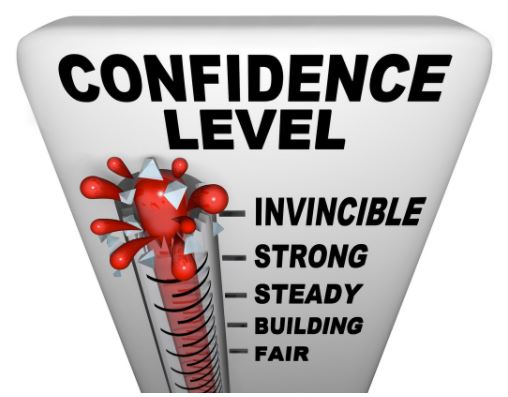
Caption: Illustration of excessive confidence (Vic/Flickr)
______________________________________________________________
“The fool doth think he is wise, but the wise man knows himself to be a fool.”
-Shakespeare
It happens every year. It’s the beginning round tryouts on the talent show American Idol, and a man confidently takes the stage, sparks in his eyes. He thinks he’s destined for greatness, this is his moment.
The music starts, and with anticipation quaking, he smiles full of composure, and boldly unleashes — a cracked and cringe-worthy voice! Clearly, he can’t carry a tune if his life depended on it. The audience begins to boo, the singer’s face grows red as his bravado shakes, the judges prepare their cut-throat feedback, and you wonder, how could he have been so wrong about his ability?
Stop wondering: you might be setting yourself up to be in his place. This overconfident lack of self-awareness isn’t unique to reality-show auditions. In general, we tend to motivate our reasoning so that the world appears well-aligned with our pre-existing story about how it should work.
Overconfidence and Dunning-Kruger
Do you think you’re a good driver, at least better than average? A full ninety-three percent of Americans say they’re better than average drivers. In another study, college students who performed the worst in tests of logic, humor, or grammar still believed they were better than most. Most of us are the heroes of our own story, even when the reality is more ordinary.
These studies shed light on the Dunning-Kruger effect, which is one of many predictable flaws in how we think. The main idea is that when we know just a little about something, we often struggle to evaluate just how little we know. Maybe you know a friend who read one article on a topic and now believes he’s an expert. That’s the Dunning-Kruger effect in action.
A similar thinking flaw is the overconfidence effect, when we take our feeling of certainty as proof that we actually have the right answer. There’s an important difference between how well we actually understand something, and how certain about it we feel. Maybe you’ve noticed this in your friends, when you’ve had to fact-check a disagreement over who sings the tune currently playing over the loudspeakers. Both sides are 100% sure of their conflicting answers, but one friend is blindsided by what you find googling on your cell phone.
Science shows that this isn’t an isolated case. For example, one study shows that when people were completely confident they knew the right spelling of a difficult word, they were actually wrong 20% of the time. Think about what that means, if it’s true in general — you may be overconfident about many “sure things.”
Okay, so maybe it’s not completely surprising that we’re often overconfident, but does it matter? It’s sometimes amusing when we‘re blindly optimistic about our own charisma and musical ability. But it’s tragic when the same mistaken confidence can hurt the world, like when it distorts beliefs about political policy.
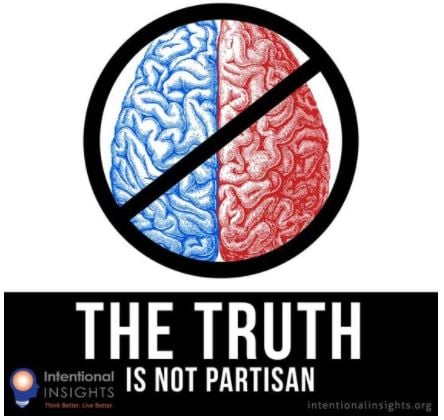
Caption: Image highlighting that the truth is not partisan (Created by Lexie Holliday for Intentional Insights)
A Case Study: Minimum Wage
Take, for example, the idea of raising the minimum wage. One side argues it would raise the standard of living for hard-working citizens (everyone should get a living wage!), while the other argues it would actually make the poorest worse-off (higher minimum wage will destroy jobs!). A policy change like this can have huge effect, bringing serious consequences upon the lives of real people, either for good or for bad.
Generally, liberals support big boosts to minimum wage, while conservatives tend to oppose such a move. And every year, liberal and conservative politicians rehash the similar battles over taxes and government spending. These economic issues likely have better and worse answers, although in the public debate it seems we never get any closer to finding out which is which. Why should that be? And can the Dunning-Kruger effect help us understand it?
Isn’t it strange that Democrats and Republicans have near-opposite opinions about the economy, and yet neither group seemingly has any more economic expertise? Perhaps most of the political soundbites we hear about raising (or lowering) the minimum wage, or taxes, or stimulus plans, are just over-simplified noise. So often we depend upon our favorite politicians to teach us about economics. Yet they are clearly one-sidedly invested in their party’s answer, and rarely have any strong qualifications. Why not take lessons from the community of experts that study economics, instead?
The base platforms of the Democratic and Republican parties seem to pre-commit them to particular economic policies, no matter what evidence from economics actually suggests. Are either a Democrat running to lower the taxes on the wealthy, or a Republican running to raise taxes on the wealthy, likely to be nominated or elected? It’s interesting then that individual Democrat and Republican voters each find the theory of their preferred politician and political party so plausible, even though those theories are so different.
One explanation is that it’s the Dunning-Kruger effect biting us. Each of us rarely recognizes how little we actually know. We latch onto simple stories that make sense on their surface, but don’t respect the complexity of the real world. We tend to parrot the “folk economics” (simple common-sense theories) of our political bandwagon. There’s some truth that raising minimum wages could ease the lives of hard-working people struggling to raise a family. And there’s also truth in the idea that a large minimum wage increase could cause struggles for small businesses. But the problem with folk economics is that both of these simple stories sound reasonable, and yet contradict each other.
There are many different simple stories that could be right, but the real world works only in one particular way, and likely has complicated wrinkles. To uncover truer stories, we need to be rooted in evidence. But most of us don’t look to the evidence. Instead, we’re satisfied with whatever folk economic theory appeals to how we think the world should work. The poet Alexander Pope anticipated the Dunning-Kruger effect in 1709 when he wrote, “A little learning is a dangerous thing.” We feel certain we understand minimum wage policy and its effects, even though the economy is hugely complicated, and there is so much we personally don’t know.
As a result, we make poor use of what knowledge and evidence has been accumulated by the hard work of economists — some of whom have studied questions like minimum wage their entire career. The Dunning-Kruger trap leads our country to again and again debate minimum wage through sound-bites and folk arguments fiercely divorced from reality. Most of us simply don’t understand economics well enough to weigh in with any real authority, and yet the overconfidence effect still gives us the certain feeling that our political team obviously has the right answer.
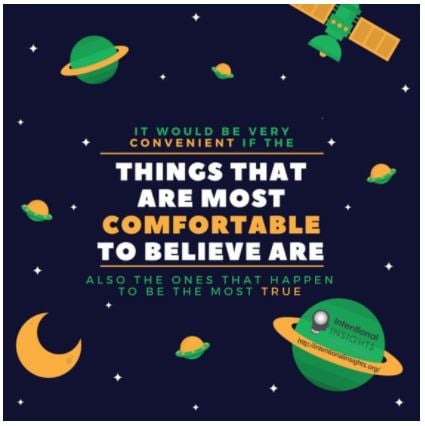
Caption: Image warning us that comfortable beliefs aren’t always true (Created by Isabelle Phuong for Intentional Insights)
Solutions
If we stop and think, we can see through the illusion. If we notice ourselves unwavering in our opinion on minimum wage or another controversial policy, we can summon the courage to question our true knowledge. This requires some self-awareness, but it’s something you can develop through practice, if you really care about truth. We can learn to notice overconfidence, and become curious enough to search for possible weaknesses in our cozy beliefs. We can explore first-hand whether there’s any difference between what feels right and what the evidence truly suggests.
One rule of thumb is to go on high alert when we’re dealing with a complex issue, and notice a pleasant feeling of certainty. That pleasant confident feeling might only signal that we’re deceiving ourselves with the folk theory of our political tribe. So, the next time you listen to your favorite show with a political bent, whether it’s The Daily Show or Tucker Carlson, pay attention to how good it feels when the host sticks it to the other side. Ask yourself if it’s possible that you’re getting a partisan sketch of reality, one that’s designed not to cut towards truth, but to reinforce the cozy things your tribe believes already.
The inconvenient truth is that reality is often much more complicated than we’d like it to be, and requires real knowledge and expertise to understand correctly. So, if we actually want to put into place political policies that do good instead of those that just feel good, then we need to wrestle with that complexity. We also need to wrestle with the unpleasant truth that most political discussions focus on folksy Dunning-Krugerish assumptions about the world, ones that miss the heart of the matter.
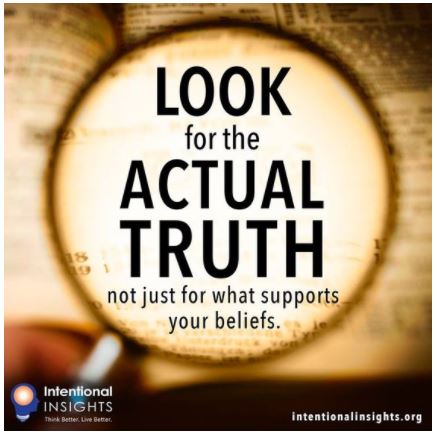
Caption: Image motivating us to seek the actual truth, whatever it is (Created by Lexie Holliday for Intentional Insights)
Conclusion
To conclude, a sad facet of human nature is that we’re often too sunny in gauging our competence. Having just a little bit of knowledge, like a simple folk theory, can easily plunge us into a misleading feeling of deep understanding. What’s worse, this kind of overconfidence plays a big role in corrupting a rational discussion of big-impact political policies. But, each of us can strive to bring more self-awareness to situations ripe for this kind of delusion — whenever there’s a huge angry divide over a complicated issue, for example.
Of course, it’s not fun to face the music: We don’t know as much as we think we do. But really, there’s no shame in it. Our world is astoundingly complicated. It’s only ego that we should expect to understand its entirety, anyway. In the end, we’re all better off the more honest we can be with ourselves, so we can hone in on the actual truth together. The beauty of truth in politics is that it leads us to policies with a good chance of working, which means a better world for all of us.
Here are some final questions to think about:
1) What divisive political issues might I be overconfident about?
2) What did it feel like the last time I noticed myself being overconfident?
3) How can I better respond to when I feel unbudging certainty?
P.S. Care about the truth in politics? Take the Pro-Truth Pledge to get politicians and other public figures to stop lying!
______________________________________________________________
Connect with Dr. Gleb Tsipursky on Twitter, on Facebook, and on LinkedIn, and follow his RSS feed and newsletter.
Previous Post

September 13, 2017
Fighting the Normalization of Post-Truth Politics

Browse Our Archives
Select a Category Alternative Facts Behavioral Science Cognitive Bias Debates Deception Decision Making Donald Trump Effective giving Fake news Leadership Meaning and Purpose Personal Politics Post-Truth Pro-Truth Pro-Truth Pledge Psychology Rationality Secular Spirituality Uncategorized Wise decision Making
Select a Month October 2026 September 2026 August 2026 July 2026 June 2026 May 2026 April 2026 March 2026 February 2026 January 2026 December 2025 November 2025 October 2025 August 2025 July 2025 June 2025 May 2025 April 2025 March 2025 February 2025 January 2025 December 2024 November 2024 October 2024 September 2024 June 2024 May 2024 April 2024 March 2024 February 2024 January 2024 December 2023 November 2023 October 2023 September 2023 August 2023 July 2023 June 2023 May 2023 April 2023 March 2023 January 2023 December 2022 October 2022 September 2022 August 2022 July 2022 June 2022 May 2022 April 2022 March 2022 January 2022 December 2021 November 2021 October 2021 September 2021 August 2021 July 2021 June 2021 May 2021 April 2021 March 2021 February 2021 January 2021 December 2020 November 2020 October 2020 September 2020 August 2020 July 2020 June 2020 May 2020 April 2020 March 2020 February 2020 January 2020 December 2019 November 2019 October 2019 September 2019 September 2018 August 2018 July 2018 January 2018 December 2017 November 2017 October 2017 September 2017 August 2017 July 2017 June 2017 May 2017 April 2017 March 2017
Follow Us!
TAKE THE
Religious Wisdom Quiz
I am a ladder reaching to heaven with angels ascending and descending. What am I?
Select your answer to see how you score.
Jacob's ladder The way to God Heaven's gate A vision
Related posts from Intentional Insights

How Generative AI is Revolutionizing Marketing Efficiency

Navigating the Technology Transformation Through Brain Training

Discovering the Formula for Hybrid Work

How Confirmation Bias Reduces Business Profits (Video &...
TRENDING AT PATHEOS Nonreligious

In one sense walking into Westminster Abbey is like walking down the...

'Super Scam Me' Exposes AI Jon Bon Jovi...
Leslie Pickett believed she was in a relationship with Jon Bon Jovi....

The Brazilian Remake of Kendricks' 'Flywheel' Opens in...
“Flywheel,” the story that launched the Kendrick Brothers’ filmmaking career is getting...

The Dangers of Gradual Accommodation (Winking at Sin)
Recently, the “law of gradualness” resurfaced during the opening of a weeklong,...

The Iron Gates and the Lion of the...
Yesterday, I didn't finish my report about, well, yesterday. So I'll...

The Image: On the Horror of Capitalism and...
The Image Then went the Pharisees, and took counsel how they might...
view all Nonreligious blogs
Ad-Free & Subscriber Log-In Subscription Support
- About Us
- 2026 Calendar
- Videos
- Podcasts
- Library of World Religions
- Faith In Media Tracker
- Advertise With Us
- Write for Us
- Privacy Policy
- Terms of Service
- Do Not Sell My Data
- Contact Us
- Radiant Digital
- Manage Newsletter Subscriptions
- Unsubscribe From Notifications
- Sitemap
Copyright 2008-2026, Patheos. All rights reserved.
Subscription Support Ad-Free & Subscriber Log-In
Follow Patheos