
BuddhistCatholicContemplativeEvangelicalGeneral ChristianHinduJewishLatter-day SaintMuslimNew VisionsProgressive Christian
Beliefs
- Buddhist
- Catholic
- Contemplative
- Evangelical
- General Christian
- Hindu
- Jewish
- Latter-day Saint
- More Voices
- Muslim
- New Visions
- Pagan
- Progressive Christian
Topics
- Religion News
- Food and Religion
- Sports and Religion
- Religious Art
- Religious Music and Entertainment
- Religious Events
- History and Religion
- Style and Religion
- Politics and Religion
- Women in Religion
- Recreation Outdoors and Religion
- Business Finance and Religion
- Careers Workplace and Religion
- Education and Religion
- Family Parenting and Religion
- Health Fitness and Religion
- Home and Religion
- Relationships and Religion
- Technology and Religion
- Travel and Religion
Columnists
- Buddhist Columnists
- Business Finance and Religion Columnists
- Careers Workplace and Religion Columnists
- Catholic Columnists
- Contemplative Columnists
- Education and Religion Columnists
- Evangelists Columnists
- Family Parenting and Religion Columnists
- General Christian Columnists
- Health Fitness and Religion Columnists
- Hindu Columnists
- History and Religion Columnists
- Home and Religion Columnists
- Jewish Columnists
- More Voices Columnists
- Latter Day Columnists
- Muslim Columnists
- New Visions Columnists
- Nonreligious Columnists
- Pagan Columnists
- Politics and Religion Columnists
- Progressive Columnists
- Recreation Outdoors and Religion Columnists
- Relationships and Religion Columnists
- Religion News Columnists
- Religious Art Columnists
- Religious Events Columnists
- Religious Music and Entertainment Columnists
- Sports and Religion Columnists
- Style and Religion Columnists
- Technology and Religion Columnists
- Travel and Religion Columnists
- Women in Religion Columnists
Resource Library
- 2026 Calendar
- Library of World Religions
- The 100 Most Holy Places on Earth
- Patheos Answers
- Podcasts
- Videos
- Faith Leaders Database
- Anglican Episcopalian
- Bahai
- Baptist
- Buddhism
- Christianity
- Confucianism
- Eastern Orthodoxy
- Hinduism
- Holiness and Pentecostal
- ISKCON
- Islam
- Judaism
- Lutheran
- Methodist
- The Church of Jesus Christ of Latter-day Saints
- New Age
- Paganism
- Presbytarian and Reformed
- Protestantism
- Religion Behind the Scenes
- Roman Catholic
- Scientology
- Shia Islam
- Sikhism
- Sufism
- Sunni Islam
- Taoism
- Zen
- See all religions
Research Tools
 Ad-Free & Subscriber Log-In Subscription Support
Ad-Free & Subscriber Log-In Subscription Support
Follow Patheos 

- Trending:
- Forgiveness
- |
- Marriage
- |
- Consciousness
- |
- Death Penalty
- |
- Election
- |
- Halloween

- Home
- Nonreligious
- Careers, Workplace and Religion
- What Would Gandhi Do About Trump? High-Time for a Science of Wisdom
What Would Gandhi Do About Trump? High-Time for a Science of Wisdom
Last updated on: August 18, 2017 at 11:42 am by Gleb Tsipursky
What Would Gandhi Do About Trump? High-Time for a Science of Wisdom 2017-08-18T11:42:46-04:00 Gleb Tsipursky
Patheos Explore the world's faith through different perspectives on religion and spirituality! Patheos has the views of the prevalent religions and spiritualities of the world.
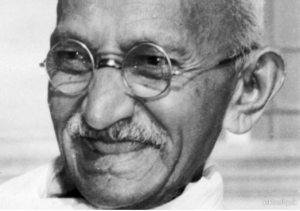
Caption: Mahatma Gandhi, close-up portrait (image credit)

Written by Charles Cassidy MPhys, Director of Evidence-based Wisdom
______________________________________
It was 3:30 AM, and my wife and I were crumpled in stunned silence in the back of a taxi, racing through the deserted streets of South London. Our all-night US election party on November 8, 2016 had taken an unexpected turn from a celebration to a tragedy. Black comedy was fast becoming a dark reality.
In defiance of all expectations, post-truth politics won and Donald Trump was soon to be the most powerful individual on the planet. My British stiff upper lip was no match for the shockwave. My American wife’s can-do spirit was buckling under the emotional wallop. An adequate response seemed beyond my grasp.
But then, an uninvited thought popped into my mind – What would Gandhi do (WWGD)?
In shattering times like these, it can be hard to know how to respond. When faced with crisis, we often turn to role models who can offer guidance on how best to forge a wise path forward. Mahatma Gandhi is often cited across generations and cultures as one of the wisest people of the 20th century. That, I believe, is how I came to be thinking about WWGD in the back of a taxi at 3:30 AM.
While Gandhi’s wisdom is no longer with us, a new field of scientific research has recently emerged, which aims to provide guidance for dealing with these kinds of problems. This new field is “Wisdom Research” and it will come as no surprise to learn that it has been growing rapidly of late. As neuroscientist Dilip Jeste suggested in his recent TED talk, “wisdom” includes much more than intelligence: “Wise people are intelligent, but not all intelligent people are wise.” Wisdom is called for when facing “wicked problems,” where the path ahead is full of uncertainty. Sound familiar?
THE BERLIN WISDOM PARADIGM – A Science of Wisdom
A “science of wisdom” almost seems too audacious to say out loud. Can the scientific method really tell us how to navigate our unpredictable and messy lives in the real world? This is what a bold team of behavioural scientists in Berlin decided to find out.
It was 1984 and, after years of neglect by the academic community, “wisdom” was about to meet the scientific method for the very first time. Their pioneering work evolved into the “Berlin Wisdom Paradigm.” It was the first scientific attempt to grapple seriously with the ancient concept of wisdom and, as The New York Times writer Stephen Hall states, “The Berlin researchers nonetheless obtained the most comprehensive empirical understanding of wisdom by any single group in modern psychology.”
The team defined wise people as having “expertise in the fundamental pragmatics of life.” So, essentially, “life experts.” Their 5-component framework is quite detailed and sets high standards for anyone hoping to ‘achieve wisdom’. Two aspects of their wisdom framework, however, relate directly to the pressing questions I faced sitting shocked in the back of that taxi on election night.
WISDOM PART I: RELATIVISM OF VALUES AND LIFE PRIORITIES – There is more than one perspective
The initial research in Berlin showed clearly that high wisdom performers recognise and accept that different groups have different values. We generally believe that we see the world around us “as it is.” Therefore those that disagree with us are evidently “out-of-line” in some regard. This human tendency is known by the scientific term Naïve Realism.
The famous “Blind Men and The Elephant” tale of Buddhist tradition illustrates this point beautifully. One blind man feels only the tusk of the animal and concludes that an elephant is like a plough. Another man feels its leg and insists an elephant is like a pillar. You get the picture. Only by acknowledging that people have different perspectives, and that therefore our perspective is also only one of many, can we get a fuller picture of how the world really works.
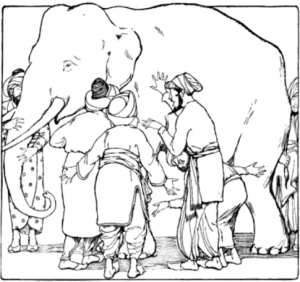
Caption: Blind Men and Elephant (image credit)

The current political system is so brutally partisan that genuine attempts to understand “the other view” have all but disappeared. Wise people, the Berlin researchers found, see that their view is only one of many, and that only by seeking out alternative views can they expand their understanding of reality. As social psychologist Jonathan Haidt wrote in The Happiness Hypothesis: “A good place to look for wisdom, therefore, is where you least expect to find it: in the minds of your opponents.”
Our political adversaries should not be viewed as fools, but rather as a potential means of broadening our understanding of the world. It seems a problem can best be understood and tackled when viewed from many sides.
translate scientific wisdom research into understandable and helpful resources for the public. In my work I am lucky enough to pick the brains of many scientists operating at the cutting edge of this new field, and I often ask them the question, ‘Why now?’
The reply of one such trailblazer, Igor Grossmann, Assistant Professor of Psychology and Director of The Wisdom and Culture Lab at the University of Waterloo, was illuminating:
In essence, most wisdom traditions try to grapple with questions of managing the complexities and uncertainties of life. Therefore, in uncertain times wisdom is likely to be more appealing. I would also think that the work of developmental psychologists in the This was slowly dawning on me during my nighttime taxi ride. Uncomfortable as it might be, I was going to have to engage with people from the other end of the political spectrum. It was time to burst that filter bubble.
WISDOM PART II: RECOGNITION OF AND MANAGEMENT OF UNCERTAINTY – Known Unknowns
The Berlin scientists’ research also revealed that strong wisdom performers are especially good at engaging skilfully with uncertainty.
Behavioural science has shown that many thinking errors and cognitive biases stem from overconfidence in our own knowledge or skill.
Top wisdom performers were found to be acutely aware of the limits of their knowledge and yet are still able to take reasonable “best-guess” real-world decisions. This suggests that, when forging a path of action, we need to do what we think is best, yet maintain a healthy scepticism of certainty in ourselves and in others. This also makes it much easier for us to update our beliefs as the situation changes around us.
So how did Gandhi demonstrate this wise self-doubt? He changed his position on vital issues a number of times. In 1939, for example, when the British entered into war against Nazi Germany, Gandhi suggested that the British be offered non-violent moral support from the Indian people. However, following discussion with many of his colleagues who disagreed with him, he reconsidered. He concluded that it wasn’t wise to support the British in a fight for democratic freedoms when India itself was still under British rule. He went on to trigger a huge civil disobedience movement with his famous “Quit India” speech aimed squarely at the British occupiers. Gandhi clearly maintained sufficient self-doubt to change his path of action when necessary.
Since we are all now engaged in making choices in a climate of great political and social uncertainty, such skilful engagement with and management of incomplete information seems especially crucial.
So, there I sat in the taxi, pretty certain and righteous that I was right and America was wrong. Thoughts of Gandhi reminded me again that I was not on the wise path. I had to loosen my grip on my position, and open up to a new possibility – I might be wrong. As Gandhi would know, that’s a big ask.
WISDOM, FINE. BUT WHY NOW?
The application of science to wisdom seems to be exploding. The number of publications since the early work in Berlin has skyrocketed. I run a project called Evidence-Based Wisdom. We 80s and Paul Baltes, Ursula Staudinger and their colleagues at the Max Planck Institute in Berlin in the 90s provided a fruitful soil for nurturing a scientific study of wisdom.
So, in our current challenging and uncertain times, a science of wisdom has emerged, perhaps not a moment too soon. Facing greater and greater uncertainty and complexity, we need a framework for making choices that: integrates intelligence with emotion; considers multiple perspectives, often in uncertain situations; and directs our efforts to the common good. As our world continues to get more uncertain and complex, and technology further entwines our fates, you will be hearing a lot more about the science of wisdom.
Although, of course, I can’t be certain.
SO, WHAT WOULD GANDHI DO? – PRACTICAL ACTIONS
Unfortunately, even though we see clear signs of wisdom in Gandhi’s choices, we can’t know exactly what he would do if he was faced with the prospect of a Trump presidency. However, science can now suggest how to respond with the wisdom for which he was so renowned. So, when you are deciding how best to respond to the recent political shockwave, try activating your capacity for wise behaviour by using the following two strategies:
ACTION 1: Seek out other perspectives, and view your opponents not as fools, but as sources of alternative insight.
ACTION 2: Be aware that your understanding is always partial – we, each of us, “sees through a glass darkly” – so maintain a healthy scepticism of certainty in yourself and in others. You will ultimately make more progress by declaring your uncertainty than hiding it.
As the taxi pulled up outside my apartment, a “wise plan” was forming. If I hoped to get a clearer idea of what on earth had just happened, I would need help from Trump supporters in understanding where they were coming from. And I would also need to let go of pretending to have all the answers.
As a first step, I like to think it’s what Gandhi would do.
QUESTIONS:
- Do you tend to believe that you alone see the world objectively, or are you able to integrate multiple perspectives on a problem, like top wisdom performers?
- Are you aware of the limits of your areas of knowledge? Do you find yourself frequently roaming into areas that you know very little about?
- Could you sit down with someone from the other end of the political spectrum and have a civil chat and perhaps even gain useful insight from them?
P.S. Care about promoting wisdom and truth? Take the Pro-Truth Pledge!
__________________________________________________________________
Connect with Dr. Gleb Tsipursky on Twitter, on Facebook, and on LinkedIn, and follow his RSS feed and newsletter.
Previous Post
August 12, 2017
Rumors About Me in the Secular Community
Next Post

August 21, 2017 The One Thing Trump Got Right on Charlottesville
Browse Our Archives
Select a Category Alternative Facts Behavioral Science Cognitive Bias Debates Deception Decision Making Donald Trump Effective giving Fake news Leadership Meaning and Purpose Personal Politics Post-Truth Pro-Truth Pro-Truth Pledge Psychology Rationality Secular Spirituality Uncategorized Wise decision Making
Select a Month October 2026 September 2026 August 2026 July 2026 June 2026 May 2026 April 2026 March 2026 February 2026 January 2026 December 2025 November 2025 October 2025 August 2025 July 2025 June 2025 May 2025 April 2025 March 2025 February 2025 January 2025 December 2024 November 2024 October 2024 September 2024 June 2024 May 2024 April 2024 March 2024 February 2024 January 2024 December 2023 November 2023 October 2023 September 2023 August 2023 July 2023 June 2023 May 2023 April 2023 March 2023 January 2023 December 2022 October 2022 September 2022 August 2022 July 2022 June 2022 May 2022 April 2022 March 2022 January 2022 December 2021 November 2021 October 2021 September 2021 August 2021 July 2021 June 2021 May 2021 April 2021 March 2021 February 2021 January 2021 December 2020 November 2020 October 2020 September 2020 August 2020 July 2020 June 2020 May 2020 April 2020 March 2020 February 2020 January 2020 December 2019 November 2019 October 2019 September 2019 September 2018 August 2018 July 2018 January 2018 December 2017 November 2017 October 2017 September 2017 August 2017 July 2017 June 2017 May 2017 April 2017 March 2017
Follow Us!
TAKE THE
Religious Wisdom Quiz
What Christian group follows the Augsburg Confession?
Select your answer to see how you score.
Presbyterians Lutherans Methodists Pentecostals
Related posts from Intentional Insights

How Generative AI is Revolutionizing Marketing Efficiency

Navigating the Technology Transformation Through Brain Training

Saving Your Relationships From the COVID-19 Coronavirus Pandemic

12 Mental Skills to Defeat Cognitive Biases
TRENDING AT PATHEOS Nonreligious

Emotion in Early Christianity by Andrew Crislip
Andrew Crislip’s Emotion in Early Christianity examines an often overlooked dimension of...

16 Spiritual Touchstones for a More Grounded Life
After decades of spiritual study, here are 16 principles I try...

Catholic Evangelization: Sharing Your Faith Every Day
Welcome back to the Graceful Awakening mini-series called, “From Faith to Mission.” ...

The Pillar of the Boatmen: the Ancient Monument...
The Pillar of the Boatmen is a Romano-Gaulish sculpture that dates from...

In one sense walking into Westminster Abbey is like walking down the...

'Super Scam Me' Exposes AI Jon Bon Jovi...
Leslie Pickett believed she was in a relationship with Jon Bon Jovi....
view all Nonreligious blogs
Ad-Free & Subscriber Log-In Subscription Support
- About Us
- 2026 Calendar
- Videos
- Podcasts
- Library of World Religions
- Faith In Media Tracker
- Advertise With Us
- Write for Us
- Privacy Policy
- Terms of Service
- Do Not Sell My Data
- Contact Us
- Radiant Digital
- Manage Newsletter Subscriptions
- Unsubscribe From Notifications
- Sitemap
Copyright 2008-2026, Patheos. All rights reserved.
Subscription Support Ad-Free & Subscriber Log-In
Follow Patheos