
BuddhistCatholicContemplativeEvangelicalGeneral ChristianHinduJewishLatter-day SaintMuslimNew VisionsProgressive Christian
Beliefs
- Buddhist
- Catholic
- Contemplative
- Evangelical
- General Christian
- Hindu
- Jewish
- Latter-day Saint
- More Voices
- Muslim
- New Visions
- Pagan
- Progressive Christian
Topics
- Religion News
- Food and Religion
- Sports and Religion
- Religious Art
- Religious Music and Entertainment
- Religious Events
- History and Religion
- Style and Religion
- Politics and Religion
- Women in Religion
- Recreation Outdoors and Religion
- Business Finance and Religion
- Careers Workplace and Religion
- Education and Religion
- Family Parenting and Religion
- Health Fitness and Religion
- Home and Religion
- Relationships and Religion
- Technology and Religion
- Travel and Religion
Columnists
- Buddhist Columnists
- Business Finance and Religion Columnists
- Careers Workplace and Religion Columnists
- Catholic Columnists
- Contemplative Columnists
- Education and Religion Columnists
- Evangelists Columnists
- Family Parenting and Religion Columnists
- General Christian Columnists
- Health Fitness and Religion Columnists
- Hindu Columnists
- History and Religion Columnists
- Home and Religion Columnists
- Jewish Columnists
- More Voices Columnists
- Latter Day Columnists
- Muslim Columnists
- New Visions Columnists
- Nonreligious Columnists
- Pagan Columnists
- Politics and Religion Columnists
- Progressive Columnists
- Recreation Outdoors and Religion Columnists
- Relationships and Religion Columnists
- Religion News Columnists
- Religious Art Columnists
- Religious Events Columnists
- Religious Music and Entertainment Columnists
- Sports and Religion Columnists
- Style and Religion Columnists
- Technology and Religion Columnists
- Travel and Religion Columnists
- Women in Religion Columnists
Resource Library
- 2026 Calendar
- Library of World Religions
- The 100 Most Holy Places on Earth
- Patheos Answers
- Podcasts
- Videos
- Faith Leaders Database
- Anglican Episcopalian
- Bahai
- Baptist
- Buddhism
- Christianity
- Confucianism
- Eastern Orthodoxy
- Hinduism
- Holiness and Pentecostal
- ISKCON
- Islam
- Judaism
- Lutheran
- Methodist
- The Church of Jesus Christ of Latter-day Saints
- New Age
- Paganism
- Presbytarian and Reformed
- Protestantism
- Religion Behind the Scenes
- Roman Catholic
- Scientology
- Shia Islam
- Sikhism
- Sufism
- Sunni Islam
- Taoism
- Zen
- See all religions
Research Tools
 Ad-Free & Subscriber Log-In Subscription Support
Ad-Free & Subscriber Log-In Subscription Support
Follow Patheos 

- Trending:
- Forgiveness
- |
- Marriage
- |
- Consciousness
- |
- Death Penalty
- |
- Election
- |
- Halloween

- Home
- Nonreligious
- Careers, Workplace and Religion
- The One Thing Trump Got Right on Charlottesville
The One Thing Trump Got Right on Charlottesville
Last updated on: August 24, 2017 at 1:40 pm by Gleb Tsipursky
The One Thing Trump Got Right on Charlottesville 2017-08-24T13:40:21-04:00 Gleb Tsipursky
Patheos Explore the world's faith through different perspectives on religion and spirituality! Patheos has the views of the prevalent religions and spiritualities of the world.
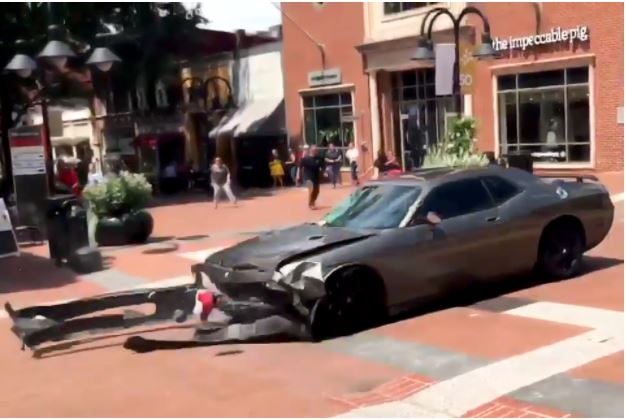
Caption: Photo of car involved in car ramming attack (Wikimedia commons)

_______________________________________
Both Democratic and Republican leaders roundly denounced President Donald Trump’s statement putting “blame on both sides” about the violence at the “Unite the Right” rally in Charlottesville, NC on August 12. However, while I personally find reprehensible various forms of white nationalism, racism, and neo-Nazism, Trump’s words that both sides deserve a degree of blame have some validity. A broader context provides more clarity on where Trump is right, and where he is not.
Let’s start with a recap of what happened. Far-right groups – those who identify as white supremacists, neo-Nazis, Ku Klux Klan members, alt-right supporters, and others – gathered in Charlottesville to protest the removal of a statue of the Confederate general Robert E. Lee. As is typical at such events, counterprotesters gathered, and fights broke out between the groups. Such violence occurred at previous rallies, but what made the Charlottesville events uniquely horrible was what Attorney General Jeff Sessions decried as an act domestic terrorism. A man apparently holding neo-Nazi beliefs deliberately rammed his car into a crowd of counterprotesters, killing one person and injuring 19.
Immediately after the events on August 12, Trump made a statement blaming the “violence on many sides.” Democrats widely condemned Trump’s lack of directness about who to blame for the violence, as did many Republicans. For example, Orrin Hatch, the Senate’s most senior Republican, tweeted “We should call evil by its name. My brother didn’t give his life fighting Hitler for Nazi ideas to go unchallenged here at home.” Another Republican Senator, Cory Gardner, tweeted similar sentiments: “Mr. President – we must call evil by its name. These were white supremacists and this was domestic terrorism.” Fox News, normally supportive of Trump, reported thoroughly on Republican pressure on Trump to condemn the far-right by name.
Under such pressure, Trump made another statement on August 14, echoing the kind of language used by Hatch and Gardner in their tweets: “Racism is evil and those who cause violence in its name are criminals and thugs, including the KKK, neo-Nazis and white supremacists.” However, to the consternation of his staff, he backed away from that statement on August 15 and returned to his previous stance, saying “you had a group on one side that was bad and you had a group on the other side that was also very violent,” the former referring to the far-right and the latter to the counter-protesters, who he described as “charging with clubs in hands.” Again, he faced criticism from prominent Republicans, such as Congressman Steve Stivers, chairman of the National Republican Congressional Committee, who tweeted “I don’t understand what’s so hard about this. White supremacists and Neo-Nazis are evil and shouldn’t be defended.” Rubio tweeted “The organizers of events which inspired & led to #charlottesvilleterroristattack are 100% to blame for a number of reasons.” Fox News again had a report on the criticism by prominent Republicans of Trump’s “both sides” remarks.
Is such criticism fair? Due to my personal beliefs about the despicable morality of far-right supporters, it is tempting for me to blame all the violence on them. Such temptation comes from the horns effect, a psychological thinking error where if we don’t like one aspect of someone or something, the dislike will make us evaluate all other aspects more negatively as well. The horns effect helps explain why those who have implicit bias toward minority groups tend to avoid hiring or promoting them at the same rate as majority groups, and can be seen on a broader demographic level in statistics on the wage gap. It also applies in situations like the one in Charlottesville, where if we do not like something – in this case, the far-right – we are tempted to blame all bad things, such as violence, on them.
The evidence shows otherwise. After all, we know that it’s not simply the far-right protesters who came with guns, sticks, shields, helmets, and torches. Some counterprotesters also had sticks, helmets, and shields. Clearly, at least some people on both sides were prepared for violence.
While the large majority of counterprotesters expressed peaceful sentiments, a minority came from the Antifa movement. Antifa refers to “anti-fascism,” and unites many extreme leftists. Many Antifa members endorse violent tactics to oppose extreme conservative ideologies, and are willing to use violence against hate speech and not simply for defensive purposes only, known as Nazi punching. Indeed, video evidence of the Charlottesville events, along with firsthand accounts, demonstrates both sides participated in the violence, and both sides engaged in aggressive as well as defensive actions.
For instance, here are the words from some Antifa activists themselves: “Before the [car] attack occurred, we chased the Nazis out of their park, removing their platform.” As another example, here is the report of a journalist on the scene from The Nation, a left-leaning publication and thus having no reason to inflate leftist violence, described the following:
A phalanx of black-helmeted white supremacists – members of the Traditionalist Workers Party, Identity Evropa, American Vanguard, and other hate warriors – commanded the steps at the southeast corner of the park, repelling attempted incursions by Wobblies, communists, and a multiracial cast of irregulars eager to fight back. Water bottles and other projectiles flew in both directions, while police tear-gas canisters thudded into an adjacent parking lot, often times lobbed back into the park by plucky leftists. As the violence boiled over the green rim of the park, the intersection of Market and 2nd Streets became the contested arena, with combatants attacking each other with fists and sticks during brief, intense skirmishes.
Engaging in “attempted incursions,” throwing projectiles, and “chasing the Nazis out of the park, removing their platform” helps demonstrate that Antifa did not simply engage in defensive actions, as they were often portrayed, but also in offensive actions. This is the context in which the horrible act of domestic terrorism occurred. So Trump is right to blame both sides for violence.
However, Trump is wrong in failing to condemn strongly the act of domestic terrorism, both initially in his August 12 remarks, and in his backtracking during the August 15 remarks, where he glossed over this uniquely terrible aspect of the Charlottesville violence. After all, clashes between far-right supporters and Antifa members happen with regularity. Such clashes are deplorable, as violence has no place in our political system. There is a reason why one of the founding principles of America, our freedom of speech, is epitomized by the phrase “”I disapprove of what you say, but I will defend to the death your right to say it.”
Members of both sides went beyond the line in Charlottesville, and deserve proportionate criticism – and punishment – to the extent they crossed the line. The large majority of counterprotesters were peaceful, and only a small minority were violent, while the far-right protesters were much more violent as a whole. So even before the car terrorist attack, much more of the blame lies on the far-right for the violence, but some does lie on the far-left. Commentators who fail to acknowledge this reality and say that all blame rests on the side of the far-right, as did Rubio, will lose credibility from those who care about the facts, as opposed to just scoring political points.
Of course, the much more egregious crossing of the line came from the neo-Nazi supporter who deliberately rammed his car into counterprotesters. In an ideal world – one where commentators both aimed to speak the truth and prevent future violence – their remarks would proportionately criticize both sides for the hand-to-hand violence, with more of the blame for that on the far-right. However, they need to place the brunt of censure for the violence on the domestic terrorism incident, for the extreme nature of that attack is something we should all abhor and denounce. Again, this applies only to commentary about the violence involved, rather than the morality of the two sides, where I have no doubt of the moral high ground of those who opposed the neo-Nazi and other far-right extremists.
You can make a difference in promoting a truth-oriented world by emailing and tweeting commentators who fail to appropriately apportion blame for the violence challenging them to revise their remarks and take the Pro-Truth Pledge to commit to truth in their commentary. You can also take the pledge yourself to show your own commitment to the truth above party politics.
__________________________________________________________________
Connect with Dr. Gleb Tsipursky on Twitter, on Facebook, and on LinkedIn, and follow his RSS feed and newsletter.
Previous Post
August 18, 2017
What Would Gandhi Do About Trump? High-Time for a Science of Wisdom
Next Post

September 5, 2017 Trump’s Transgender Gaslighting
Browse Our Archives
Select a Category Alternative Facts Behavioral Science Cognitive Bias Debates Deception Decision Making Donald Trump Effective giving Fake news Leadership Meaning and Purpose Personal Politics Post-Truth Pro-Truth Pro-Truth Pledge Psychology Rationality Secular Spirituality Uncategorized Wise decision Making
Select a Month October 2026 September 2026 August 2026 July 2026 June 2026 May 2026 April 2026 March 2026 February 2026 January 2026 December 2025 November 2025 October 2025 August 2025 July 2025 June 2025 May 2025 April 2025 March 2025 February 2025 January 2025 December 2024 November 2024 October 2024 September 2024 June 2024 May 2024 April 2024 March 2024 February 2024 January 2024 December 2023 November 2023 October 2023 September 2023 August 2023 July 2023 June 2023 May 2023 April 2023 March 2023 January 2023 December 2022 October 2022 September 2022 August 2022 July 2022 June 2022 May 2022 April 2022 March 2022 January 2022 December 2021 November 2021 October 2021 September 2021 August 2021 July 2021 June 2021 May 2021 April 2021 March 2021 February 2021 January 2021 December 2020 November 2020 October 2020 September 2020 August 2020 July 2020 June 2020 May 2020 April 2020 March 2020 February 2020 January 2020 December 2019 November 2019 October 2019 September 2019 September 2018 August 2018 July 2018 January 2018 December 2017 November 2017 October 2017 September 2017 August 2017 July 2017 June 2017 May 2017 April 2017 March 2017
Follow Us!
TAKE THE
Religious Wisdom Quiz
Which king rebuilt the high places Solomon had built for foreign gods?
Select your answer to see how you score.
Josiah Hezekiah Jehu Manasseh
Related posts from Intentional Insights

Discovering the Formula for Hybrid Work
How Global Elites Can Address Misinformation
The Pro-Truth Pledge prompts truthful behavior, according to...
When Truth Isn’t Truth: Rudy Giuliani Borrows Tactics...
TRENDING AT PATHEOS Nonreligious

Emotion in Early Christianity by Andrew Crislip
Andrew Crislip’s Emotion in Early Christianity examines an often overlooked dimension of...

16 Spiritual Touchstones for a More Grounded Life
After decades of spiritual study, here are 16 principles I try...

Catholic Evangelization: Sharing Your Faith Every Day
Welcome back to the Graceful Awakening mini-series called, “From Faith to Mission.” ...

The Pillar of the Boatmen: the Ancient Monument...
The Pillar of the Boatmen is a Romano-Gaulish sculpture that dates from...

In one sense walking into Westminster Abbey is like walking down the...

'Super Scam Me' Exposes AI Jon Bon Jovi...
Leslie Pickett believed she was in a relationship with Jon Bon Jovi....
view all Nonreligious blogs
Ad-Free & Subscriber Log-In Subscription Support
- About Us
- 2026 Calendar
- Videos
- Podcasts
- Library of World Religions
- Faith In Media Tracker
- Advertise With Us
- Write for Us
- Privacy Policy
- Terms of Service
- Do Not Sell My Data
- Contact Us
- Radiant Digital
- Manage Newsletter Subscriptions
- Unsubscribe From Notifications
- Sitemap
Copyright 2008-2026, Patheos. All rights reserved.
Subscription Support Ad-Free & Subscriber Log-In
Follow Patheos