
BuddhistCatholicContemplativeEvangelicalGeneral ChristianHinduJewishLatter-day SaintMuslimNew VisionsProgressive Christian
Beliefs
- Buddhist
- Catholic
- Contemplative
- Evangelical
- General Christian
- Hindu
- Jewish
- Latter-day Saint
- More Voices
- Muslim
- New Visions
- Pagan
- Progressive Christian
Topics
- Religion News
- Food and Religion
- Sports and Religion
- Religious Art
- Religious Music and Entertainment
- Religious Events
- History and Religion
- Style and Religion
- Politics and Religion
- Women in Religion
- Recreation Outdoors and Religion
- Business Finance and Religion
- Careers Workplace and Religion
- Education and Religion
- Family Parenting and Religion
- Health Fitness and Religion
- Home and Religion
- Relationships and Religion
- Technology and Religion
- Travel and Religion
Columnists
- Buddhist Columnists
- Business Finance and Religion Columnists
- Careers Workplace and Religion Columnists
- Catholic Columnists
- Contemplative Columnists
- Education and Religion Columnists
- Evangelists Columnists
- Family Parenting and Religion Columnists
- General Christian Columnists
- Health Fitness and Religion Columnists
- Hindu Columnists
- History and Religion Columnists
- Home and Religion Columnists
- Jewish Columnists
- More Voices Columnists
- Latter Day Columnists
- Muslim Columnists
- New Visions Columnists
- Nonreligious Columnists
- Pagan Columnists
- Politics and Religion Columnists
- Progressive Columnists
- Recreation Outdoors and Religion Columnists
- Relationships and Religion Columnists
- Religion News Columnists
- Religious Art Columnists
- Religious Events Columnists
- Religious Music and Entertainment Columnists
- Sports and Religion Columnists
- Style and Religion Columnists
- Technology and Religion Columnists
- Travel and Religion Columnists
- Women in Religion Columnists
Resource Library
- 2026 Calendar
- Library of World Religions
- The 100 Most Holy Places on Earth
- Patheos Answers
- Podcasts
- Videos
- Faith Leaders Database
- Anglican Episcopalian
- Bahai
- Baptist
- Buddhism
- Christianity
- Confucianism
- Eastern Orthodoxy
- Hinduism
- Holiness and Pentecostal
- ISKCON
- Islam
- Judaism
- Lutheran
- Methodist
- The Church of Jesus Christ of Latter-day Saints
- New Age
- Paganism
- Presbytarian and Reformed
- Protestantism
- Religion Behind the Scenes
- Roman Catholic
- Scientology
- Shia Islam
- Sikhism
- Sufism
- Sunni Islam
- Taoism
- Zen
- See all religions
Research Tools
 Ad-Free & Subscriber Log-In Subscription Support
Ad-Free & Subscriber Log-In Subscription Support
Follow Patheos 

- Trending:
- Forgiveness
- |
- Marriage
- |
- Consciousness
- |
- Death Penalty
- |
- Election
- |
- Halloween

- Home
- Nonreligious
- Careers, Workplace and Religion
- Are Friends the Enemies of Wise Choices? The Hidden Factors Influencing Our Most Important Decisions
Are Friends the Enemies of Wise Choices? The Hidden Factors Influencing Our Most Important Decisions
Last updated on: July 18, 2017 at 12:36 pm by Gleb Tsipursky
Are Friends the Enemies of Wise Choices? The Hidden Factors Influencing Our Most Important Decisions 2017-07-18T12:36:07-04:00 Gleb Tsipursky
Patheos Explore the world's faith through different perspectives on religion and spirituality! Patheos has the views of the prevalent religions and spiritualities of the world.

Young child driving pedal car (pixabay)
By Charles Cassidy MPhys, Director of Evidence-based Wisdom
I recently decided to buy a petrol-guzzling car. But was it really me who decided? I don’t like cars. They’re costly on the wallet and toxic to the planet. I also live in London, a city of narrow, victorian streets, where graceful parallel parking is a daily necessity. The only time I have ever gracefully parallel parked was in my driving test 23 years ago.
How did I end up doing something so out of character? I’ve always considered myself to be pretty clear on my principles. But I’d been caught in the act, exhibiting a gross ethical malfunction. Where was my virtuous character now?! An unsettling idea entered my mind. Might I not be as independently minded as I thought? The English writer George Eliot suggests I am not alone: “There is no creature whose inward ring is so strong that it is not greatly determined by what lies outside it.”
If my character and personality weren’t in the driving seat, what else was hijacking my decision?
Am I “driving under the influence,” and if so, under the influence of what?
DECISIONS, DECISIONS – HIDDEN FACTORS
Such questions have fascinated behavioral scientists for decades. One such scientist is social psychologist Professor Richard Nisbett. The well-known writer Malcolm Gladwell recently described Nisbett as the most influential thinker in his life. Nisbett claims our decisions are influenced by a combination of internal and external factors:
There are two broad classes of factors that would help explain someone’s behaviour – what kind of situation is the person in, and what kind of person you have. Obviously any behaviour you get out of anybody is a function of “what’s going on/what he’s responding to” and “what’s in the person.”
“Internal factors” are the typical elements that we think of as having an influence on our decisions – our character traits, temperament, personal biases, previous experiences, willpower etc.
“External factors” are a little more unexpected. They are the hidden strings of the environment that guide our hands without us knowing.
So what hidden external forces might have guided my hand towards the jangling keys of a second-hand Mazda sedan? What on earth was going on here?

Man holding car key (pixabay)
EXTERNAL FORCES PART I: PEER NETWORKS
Before the arrival of virtual social networks, there were real-world social networks, composed of friends, family and colleagues. While recent media attention has been focused on filter bubbles in the online world, the power of our real-world social networks has been gravely overlooked.
Recent research suggests that the general behaviours of others in our networks greatly influence our individual behaviour. Scientists have now identified detailed mathematical models that precisely describe how all sorts of human behaviours spread through our peer networks. Perhaps my new car and I were being pushed around by the mathematics of friendships?
First, obesity – Nicholas Christakis of Harvard Medical School and Professor James Fowler produced research in 2007 showing that if one of your friends becomes obese in a given period, your chance of becoming obese increases by 57%.
And divorce? In 2013, they went on to show that if someone you know is divorced, you are 75% more likely to be divorced. Even if a friend of a friend is divorced, you are 33% more likely to be divorced.
Registering my new car online, I began to wonder, are my friends secretly driving me into an early grave?
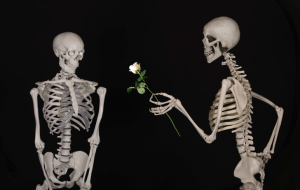
skeleton handing rose to another skeleton (pixabay)
Fortunately, it’s not only bad behaviour that spreads in this fashion. The researchers also showed that if your spouse quits smoking, you are 65% less likely to smoke. Even if a friend quits, you are 36% less likely to smoke.
Some good news then, but I still found these cold numbers chilling. To learn that decisions which we view as “independently taken” are so strongly influenced by the behaviour of friends and family was unnerving. So I took a moment to consider the automotive habits of my peer network.
I don’t know anyone who doesn’t own a car.
EXTERNAL FORCES PART II: THE IMMEDIATE SITUATION
The behaviour of our established peer network is not the only hidden force at work. There is also the influence of the immediate situation we find ourselves in. I will likely strike up conversation with a stranger at a rock concert in the park on a sunny day. This is less likely at 2am in a dark alley in an unfamiliar part of town. A sinister situation overrides an outgoing personality.
In fact, one of the cornerstone principles of social psychology is that the immediate situation we find ourselves exerts a huge influence on our behaviour. A famous 1973 Princeton study, sometimes known as The Good Samaritan Experiment, demonstrated this clearly. People’s willingness to stop and help a stranger-in-need depended significantly more on how much of a hurry they happened to be in, rather than how they had scored for “religiosity” on a personality assessment. Again, a subtle element of the immediate situation trumps an internal personality trait.
Now I didn’t buy my Mazda at 2am in a dark alley, but I began to wonder how else my everyday decisions were at the mercy of hidden external factors. I run a project called Evidence-Based Wisdom. We translate scientific wisdom research into understandable and helpful resources for the public. So, I am of course interested in how we might make wiser decisions in our daily lives – buying a Mazda, moving to a new city, or even deciding where to mark my cross on the ballot paper come election time.
Wisdom has typically been considered a characteristic that either you have or don’t. We can all cite examples of classic wise figures – Socrates, Gandhi, Martin Luther King.
Surely something as timeless and weighty as wisdom doesn’t depend on trivial aspects of our immediate environment, does it?
A recent 2017 study tells quite a different story. The lead scientist was Igor Grossmann, Director of The Wisdom and Culture Lab. He is a leading light in the emerging field of wisdom research, and also a former student of Richard Nisbett.
His paper indicated that, when it comes to wise reasoning over the course of a single day, there is more variability within people than there is between people. This means, it’s not that some of us are always wise and some are always not. It’s that all of us are sometimes wise, and all of us are sometimes not.
As psychologists would say, wisdom appears to concern specific “states,” rather than solely “traits.” It would seem that even our wisdom varies greatly depending on the immediate situation.
If wisdom varies so much, when are we are at our wisest? A 2016 study from Grossmann’s lab shows that, perhaps surprisingly, we take wiser decisions when in company rather than when alone.
Grossmann had already demonstrated in 2014 that we are wiser when reflecting on our own problems as if they were someone else’s problems. Getting some distance from ourselves can help us make wiser choices, but this can be quite challenging when we are alone. This is where company can help. Grossmann explained: “This third-person perspective on the self is likely encouraged when in the presence of friends.”
So, although the bad habits of others may be toxic to their entire network in the long term, having friends around may lead to better immediate decisions. It seems that our friends, rather than being enemies of wisdom, might in fact be its guardians.
This has turned my thinking on its head. I had previously been very much one for taking important decisions only after many hours of scribbling in my notebook, alone, in a coffee shop. I have now changed my tune, and seek out the company of trusted friends who can steer me through the perilous rocks of my own biases, towards much wiser decisions.
Had friends been present when I reached for those jangling keys, my woeful parallel parking skills would still be a secret to this day.
PRACTICAL ACTIONS
ACTION 1: Choose your peers wisely – they will influence your behaviour, so spend time with people whose behavior you are happy to be influenced by.
ACTION 2: Take important decisions in the presence of others.
QUESTIONS
- When you observe your friends’ behaviours and habits, are you comfortable with the knowledge that you are likely to adopt these same behaviours and habits over time?
- Can you think of times when you have been surprised by a decision you took? Can you think of any external factors that may have been at play?
- If you tend to take important decisions alone, might you start to bounce ideas off of friends and colleagues to increase your chance of making a wiser call?
__________________________________________________________________
Connect with Dr. Gleb Tsipursky on Twitter, on Facebook, and on LinkedIn, and follow his RSS feed and newsletter.
Previous Post
July 3, 2017
Being A Weird American on Independence Day
Next Post
July 18, 2017 Political Precommitment without Evidence: How Worldview Undermines Reason
Browse Our Archives
Select a Category Alternative Facts Behavioral Science Cognitive Bias Debates Deception Decision Making Donald Trump Effective giving Fake news Leadership Meaning and Purpose Personal Politics Post-Truth Pro-Truth Pro-Truth Pledge Psychology Rationality Secular Spirituality Uncategorized Wise decision Making
Select a Month October 2026 September 2026 August 2026 July 2026 June 2026 May 2026 April 2026 March 2026 February 2026 January 2026 December 2025 November 2025 October 2025 August 2025 July 2025 June 2025 May 2025 April 2025 March 2025 February 2025 January 2025 December 2024 November 2024 October 2024 September 2024 June 2024 May 2024 April 2024 March 2024 February 2024 January 2024 December 2023 November 2023 October 2023 September 2023 August 2023 July 2023 June 2023 May 2023 April 2023 March 2023 January 2023 December 2022 October 2022 September 2022 August 2022 July 2022 June 2022 May 2022 April 2022 March 2022 January 2022 December 2021 November 2021 October 2021 September 2021 August 2021 July 2021 June 2021 May 2021 April 2021 March 2021 February 2021 January 2021 December 2020 November 2020 October 2020 September 2020 August 2020 July 2020 June 2020 May 2020 April 2020 March 2020 February 2020 January 2020 December 2019 November 2019 October 2019 September 2019 September 2018 August 2018 July 2018 January 2018 December 2017 November 2017 October 2017 September 2017 August 2017 July 2017 June 2017 May 2017 April 2017 March 2017
Follow Us!
TAKE THE
Religious Wisdom Quiz
How was Haman punished for his plot?
Select your answer to see how you score.
He was exiled He was turned into a pillar of salt He was beheaded He was hanged on the gallows he built
Related posts from Intentional Insights

Here’s Why Many Gen AI Projects Are Doomed...
Transforming Industry Through Gen AI Agents

Smart Strategies for Gen AI in Law Firms

Adapting RTO Strategies to Meet Diverse Demographic Needs
TRENDING AT PATHEOS Nonreligious

The Problem with False Prophets
Miller’s Station UMC| 10/18/26| Anchor Verse: Jeremiah 23: 1, 9-23 I...

Emotion in Early Christianity by Andrew Crislip
Andrew Crislip’s Emotion in Early Christianity examines an often overlooked dimension of...

16 Spiritual Touchstones for a More Grounded Life
After decades of spiritual study, here are 16 principles I try...

Catholic Evangelization: Sharing Your Faith Every Day
Welcome back to the Graceful Awakening mini-series called, “From Faith to Mission.” ...

The Pillar of the Boatmen: the Ancient Monument...
The Pillar of the Boatmen is a Romano-Gaulish sculpture that dates from...

In one sense walking into Westminster Abbey is like walking down the...
view all Nonreligious blogs
Ad-Free & Subscriber Log-In Subscription Support
- About Us
- 2026 Calendar
- Videos
- Podcasts
- Library of World Religions
- Faith In Media Tracker
- Advertise With Us
- Write for Us
- Privacy Policy
- Terms of Service
- Do Not Sell My Data
- Contact Us
- Radiant Digital
- Manage Newsletter Subscriptions
- Unsubscribe From Notifications
- Sitemap
Copyright 2008-2026, Patheos. All rights reserved.
Subscription Support Ad-Free & Subscriber Log-In
Follow Patheos