
BuddhistCatholicContemplativeEvangelicalGeneral ChristianHinduJewishLatter-day SaintMuslimNew VisionsProgressive Christian
Beliefs
- Buddhist
- Catholic
- Contemplative
- Evangelical
- General Christian
- Hindu
- Jewish
- Latter-day Saint
- More Voices
- Muslim
- New Visions
- Pagan
- Progressive Christian
Topics
- Religion News
- Food and Religion
- Sports and Religion
- Religious Art
- Religious Music and Entertainment
- Religious Events
- History and Religion
- Style and Religion
- Politics and Religion
- Women in Religion
- Recreation Outdoors and Religion
- Business Finance and Religion
- Careers Workplace and Religion
- Education and Religion
- Family Parenting and Religion
- Health Fitness and Religion
- Home and Religion
- Relationships and Religion
- Technology and Religion
- Travel and Religion
Columnists
- Buddhist Columnists
- Business Finance and Religion Columnists
- Careers Workplace and Religion Columnists
- Catholic Columnists
- Contemplative Columnists
- Education and Religion Columnists
- Evangelists Columnists
- Family Parenting and Religion Columnists
- General Christian Columnists
- Health Fitness and Religion Columnists
- Hindu Columnists
- History and Religion Columnists
- Home and Religion Columnists
- Jewish Columnists
- More Voices Columnists
- Latter Day Columnists
- Muslim Columnists
- New Visions Columnists
- Nonreligious Columnists
- Pagan Columnists
- Politics and Religion Columnists
- Progressive Columnists
- Recreation Outdoors and Religion Columnists
- Relationships and Religion Columnists
- Religion News Columnists
- Religious Art Columnists
- Religious Events Columnists
- Religious Music and Entertainment Columnists
- Sports and Religion Columnists
- Style and Religion Columnists
- Technology and Religion Columnists
- Travel and Religion Columnists
- Women in Religion Columnists
Resource Library
- 2026 Calendar
- Library of World Religions
- The 100 Most Holy Places on Earth
- Patheos Answers
- Podcasts
- Videos
- Faith Leaders Database
- Anglican Episcopalian
- Bahai
- Baptist
- Buddhism
- Christianity
- Confucianism
- Eastern Orthodoxy
- Hinduism
- Holiness and Pentecostal
- ISKCON
- Islam
- Judaism
- Lutheran
- Methodist
- The Church of Jesus Christ of Latter-day Saints
- New Age
- Paganism
- Presbytarian and Reformed
- Protestantism
- Religion Behind the Scenes
- Roman Catholic
- Scientology
- Shia Islam
- Sikhism
- Sufism
- Sunni Islam
- Taoism
- Zen
- See all religions
Research Tools
 Ad-Free & Subscriber Log-In Subscription Support
Ad-Free & Subscriber Log-In Subscription Support
Follow Patheos 

- Trending:
- Forgiveness
- |
- Marriage
- |
- Consciousness
- |
- Death Penalty
- |
- Election
- |
- Halloween

- Home
- Nonreligious
- Careers, Workplace and Religion
- The Danger to Atheists of Political Irrationality
The Danger to Atheists of Political Irrationality
Last updated on: April 22, 2017 at 8:10 pm by Gleb Tsipursky
The Danger to Atheists of Political Irrationality 2017-04-22T20:10:30-04:00 Gleb Tsipursky
Patheos Explore the world's faith through different perspectives on religion and spirituality! Patheos has the views of the prevalent religions and spiritualities of the world.
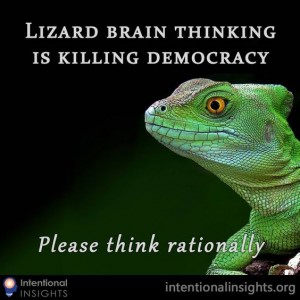
Caption: Meme created by Ed Coolidge for Intentional Insights (Used with permission)
Atheists in the U.S. cover the entire spectrum of political views, despite the assumption that to be an Atheist means to be a left-wing liberal. No matter who you voted for or how much you were impressed or disgusted by the tactics used by the Trump and Clinton campaigns, there was a troubling amount of irrationality that was given wings early on and has now taken flight. If we let this go unchecked, the wall of church/state separation will be gone before the midterm elections because the Trump Administration appears determined to tear it down, as we can see from Trump’s announcement at the National Prayer Breakfast that he’s determined to remove the prohibition on churches endorsing political candidates.
For as tempting as it might be to not dwell on the divisiveness in this country, we must take stock now and reflect on how to deal with the irrationality that is perhaps the worst problem in American politics today. Although we Atheists consider ourselves inherently rational by virtue of not believing in the supernatural, we are just as likely to be irrational in other areas of life.
Rationality is the ability to assess reality accurately and thereby make wise decisions to reach one’s goals. This election has been a testament to the current inability of many voters to make correct assessments of reality, which leads them to make decisions that are directly opposed to their own best interests.
Research in psychology, cognitive neuroscience, and behavioral economics shows that we make these irrational assessments and poor decisions because of thinking errors. We tend to see ourselves as rational creatures who form opinions based on logical facts. But in reality, our brains are wired in such a way that emotions play a much larger role in influencing our beliefs than we intuitively perceive. David Kahneman’s Thinking, Fast and Slow (2011) is one book written for a general audience that explains some of this research and its findings.
Politicians skilled in the psychology of persuasion, as described in books such as Robert Cialdini’s 1984 classic, Influence: The Psychology of Persuasion, can take advantage of our thinking errors to manipulate us. Unless we are paying attention, we are highly likely to be influenced by their appeals to these flawed patterns of feeling and thinking and then make biased political decisions as a result.
For example, polls showed that most voters on the eve of the election perceived Donald Trump as more trustworthy than Hillary Clinton, despite quantitative information provided by nonpartisan fact-checkers that proves Trump lies much more often than Clinton.[i] This false perception came from the Trump campaign’s success in manipulating many voters into believing that Clinton is less honest, even though the reverse is true.
The Trump campaign did so through the illusory truth effect, a thinking error in our minds that happens when false statements are repeated many times. When this happens, we begin to see them as true, despite the evidence to the contrary. When something is repeated often enough, we are prone to agreeing with it more—regardless of whether it is objectively true or not. I’d like to stop here for a moment and have you notice that the previous sentence says the same thing as the one before it. It provided no additional information. Ask yourself if it caused you to agree with my claim more than you did after reading just the first sentence.
The illusory truth effect was used extensively by Trump throughout the campaign. Consider his relentless repetition of the claim that NAFTA is the “worst deal ever signed” and cost Americans “millions of jobs.” Despite the fact that expert opinions on all sides widely differ on NAFTA’s impact on the U.S. job market, Trump has successfully convinced millions that NAFTA is nothing but bad for American workers.
The illusory truth effect from Christian right-wing demagogues is a common tool for discrimination against atheists. Consider the statements made by Bill Donohue, president of the Catholic League. He repeatedly denounces atheists with variations on an ad-hominem attack. An early version was lobbed directly at David Silverman and American Atheists, Inc., when he said that Atheists “believe in nothing, they stand for nothing, they think they came from nothing.”[ii][iii] This defamation has since become more perverse. Instead of thinking that they came from nothing, Atheists now “stand for nothing, believe in nothing, and many of them are good for nothing.”[iv]
No wonder atheists are among the least trusted and liked minorities. For instance, atheists get around the same negative “likability” ratings as Muslims.[v] Another study showed that atheists are also less trusted than Muslims and are at about the same level of trust granted to rapists. Yes, rapists.[vi] Additional studies also show the distrust and dislike toward atheists felt by the U.S. public, thanks in part to the thinking errors to which demagogues like Donohue appeal.[vii]
Donohue also joins legions of other pundits and politicians alike who employ the illusory truth effect when he says that “everyone knows… that we are a Christian nation.”[viii] This false claim is the perfect example of the power of the illusory truth effect. How many times have you come across that statement, or a variation of it, such as our Constitution being based on biblical values? It’s probably as many times as I have, which is more than you can count. But in addition to hearing it in the media, we can easily find it among our own acquaintances. If you haven’t done so already, ask around and see how many people assume that “under God” has always been a part of the Pledge of Allegiance, or that “In God We Trust” has always been on U.S. currency.
Another example of Trump playing to our thinking errors was his proposed ban on any Muslim entering the U.S. The proposal was then reduced to an extreme vetting of them, along with a focus on policing Muslim neighborhoods and monitoring mosques. Today, terrorism is one of the biggest worries for the U.S. population. Yet for the past ten years, the people who died in the attacks on American soil were killed by terrorists who were either U.S. citizens or legal permanent residents. Trump’s policy proposal is therefore irrational because it does not respond to a realistic assessment of the threat of terrorism. Instead, it appeals to the horns effect, an error in thinking where negative emotions about one topic—in this case, terrorism perpetrated by radical Islamists—are applied to all Muslims.
And what about monitoring American Muslims since the attacks were, after all, carried out by citizens and permanent residents? Let’s take a look at the numbers. According to JohnstonArchive.net, the seven terrorist acts committed in the United States between January 1, 2015, and December 31, 2015 were carried out by a total of nine people. Six of the nine were motivated by Muslim beliefs.[ix] A 2011 survey estimated that the adult Muslim population in the United States to be 1.8 million.[x] Dividing the number of Muslim adults by the six who committed terrorist acts gives you a one in 300,000 chance that any Muslim you see would commit a terrorist act in one year. That’s like picking out a terrorist randomly from the number of people in several football stadiums. Applying this sort of probabilistic thinking is a research-based way to deal with any form of fear. It allows us to see whether the anxious thoughts are realistic. We can see that merely being Muslim is a very poor statistical indicator of whether someone is a terrorist, making the fear of all Muslims irrational.
These facts do not, in any way, imply that religion is not at the heart of the problem. Although the vast majority of Muslims are not terrorists, it is the case that in 2015, six of nine terrorists in the U.S. were of the Islamic faith. Yet the other three terrorists were motivated by radical Christian and right-wing beliefs, especially the November 2015 shooting at the Planned Parenthood clinic in Colorado Springs, Colorado. Today, there are more radicals in Islam than in other religions, but the focus needs to be on radical behavior as much as religion itself.
Though it was to a much lesser extent, the Clinton campaign also appealed to human irrationality, mostly in response to the Trump campaign’s success with it. Consider the comment by Clinton that half of Trump’s supporters belong in the “basket of deplorables” and are “irredeemable” by their sexism, racism, and homophobia. This choice of words appeals to the horns effect by associating “deplorable” with a large portion of the U.S. population. Yet consider someone who was convinced by Trump’s rhetoric that Muslims are to be feared. This person has developed irrationally racist beliefs, but does this make the person inherently deplorable or irredeemable? Certainly not! At least she apologized for this comment, yet such rhetoric represents the perspectives of many liberals.
Fortunately, we are not doomed to this fate of irrationality. Recent scholarship by Dan and Chip Heath in Decisive: How to Make Better Choices in Life and Work (2013) shows that we can become more rational in our voting and in how we assess politics in general. Doing so requires only four things.
- It’s necessary, but not at all difficult, to learn about typical thinking errors.
- We have to notice when they are potentially impacting us, and then resist this influence.
- We must call out those politicians—and their spokespeople—who appeal to such thinking errors.
- We need to learn how to engage meaningfully with others when we see that they are falling for such manipulation.
Many will claim that this unrealistic and that U.S. citizens are inherently irrational in their politics. I beg to differ. Over the last few months, I have published many articles and appeared on a number of TV and radio programs to talk about how to make politics more rational.[xi] I did so as part of my service as the volunteer president of Intentional Insights, a non-profit devoted to spreading rational thinking and wise decision-making in politics and other areas of life.
Many people have emailed me to express gratitude for the chance to learn about how politicians try to manipulate them. Some of them have asked how they can most effectively learn how to make rational political assessments. Plenty among them now donate their time and money to support the mission of Intentional Insights.
While these people cover the entire spectrum of political views, from the most conservative to the most liberal, they all care first and foremost about the truth. Making politics less irrational by helping people make accurate assessments of reality is a bipartisan issue. Everyone wins by having more rational citizens—except those politicians who rely on misleading and manipulative rhetoric to sway voters.
Unfortunately, this election cycle showed how easy and effective it is to appeal to human irrationality. The future is dark for Atheists’ rights if we do not focus our efforts on addressing this problem in our political system. After all, it’s up to our elected officials and appointed judges to uphold church/state separation, which is in grave danger now that Trump has made it clear that he wants churches and religious organizations to be able to endorse political candidates—something that hasn’t been allowed since the passage of the Johnson Amendment in 1954. This will be a long, difficult fight because most members of Congress wear their religious faith proudly on their sleeves. They do this because it sways voters as effectively as misleading rhetoric does.
[i] https://www.washingtonpost.com/news/the-fix/wp/2016/11/02/donald-trump-hasnt-told-the-truth-repeatedly-in-this-campaign-voters-still-think-he-is-more-honest-than-hillary-clinton/?utm_term=.9e6574d10ec5
[iii] http://www.catholicleague.org/adopt-an-atheist-campaign-begins/
[iv]
[v] http://www.pewforum.org/2014/07/16/how-americans-feel-about-religious-groups/
[vi] https://www.ncbi.nlm.nih.gov/pubmed/22059841
[vii] https://www.scientificamerican.com/article/in-atheists-we-distrust/
[viii] http://www.catholicleague.org/land-diversity-dishonesty
[ix] http://www.johnstonsarchive.net/terrorism/wrjp255a.html
[x] http://www.people-press.org/2011/08/30/section-1-a-demographic-portrait-of-muslim-americans/
[xi] http://glebtsipursky.com/about/
_______________________________________________________________
P.S. Take the Pro-Truth Pledge to show your commitment to the truth in politics and other life areas!
Connect with Dr. Gleb Tsipursky on Twitter, on Facebook, and on LinkedIn, and follow his RSS feed and newsletter. Help him do more writing through supporting his work on Patreon!
Previous Post
April 16, 2017
A Weird American in Trump's Post-Truth America
Next Post
April 29, 2017 The Brain Science of Political Deception in the 2016 Election
Browse Our Archives
Select a Category Alternative Facts Behavioral Science Cognitive Bias Debates Deception Decision Making Donald Trump Effective giving Fake news Leadership Meaning and Purpose Personal Politics Post-Truth Pro-Truth Pro-Truth Pledge Psychology Rationality Secular Spirituality Uncategorized Wise decision Making
Select a Month October 2026 September 2026 August 2026 July 2026 June 2026 May 2026 April 2026 March 2026 February 2026 January 2026 December 2025 November 2025 October 2025 August 2025 July 2025 June 2025 May 2025 April 2025 March 2025 February 2025 January 2025 December 2024 November 2024 October 2024 September 2024 June 2024 May 2024 April 2024 March 2024 February 2024 January 2024 December 2023 November 2023 October 2023 September 2023 August 2023 July 2023 June 2023 May 2023 April 2023 March 2023 January 2023 December 2022 October 2022 September 2022 August 2022 July 2022 June 2022 May 2022 April 2022 March 2022 January 2022 December 2021 November 2021 October 2021 September 2021 August 2021 July 2021 June 2021 May 2021 April 2021 March 2021 February 2021 January 2021 December 2020 November 2020 October 2020 September 2020 August 2020 July 2020 June 2020 May 2020 April 2020 March 2020 February 2020 January 2020 December 2019 November 2019 October 2019 September 2019 September 2018 August 2018 July 2018 January 2018 December 2017 November 2017 October 2017 September 2017 August 2017 July 2017 June 2017 May 2017 April 2017 March 2017
Follow Us!
TAKE THE
Religious Wisdom Quiz
Blessed is the one who perseveres under trial because, having stood the test, that person will receive the ____ of life that the Lord has promised to those who love him.
Select your answer to see how you score.
Reward Crown Gift Blessing
Related posts from Intentional Insights

Discovering the Formula for Hybrid Work
How Global Elites Can Address Misinformation
The Keys to Avoid “Failing at Other Minds”
The Pro-Truth Pledge prompts truthful behavior, according to...
TRENDING AT PATHEOS Nonreligious

When Halloween Unmasks Married Hearts
Written by Dr. David K. Ewen from Eternal Truth Bible College Behind...

Aristotle. He’s been called the father of logic, the father of the...

Methodist Central Hall and Westminster Abbey
Situated on the same square is Methodist Central Hall and Westminster Abbey. ...

57th Dove Awards Honor Dolly Parton, Crown New...
On gospel music’s biggest night, the 57th annual GMA Dove Awards honored...

The First Eucharistic Controversy: Christ’s Real Presence
For Catholics, the Eucharist is the source and summit of the Christian...

What a Stop Sign Can Teach Us About...
How to Make a Decision When You Can't Hear God Main point:...
view all Nonreligious blogs
Ad-Free & Subscriber Log-In Subscription Support
- About Us
- 2026 Calendar
- Videos
- Podcasts
- Library of World Religions
- Faith In Media Tracker
- Advertise With Us
- Write for Us
- Privacy Policy
- Terms of Service
- Do Not Sell My Data
- Contact Us
- Radiant Digital
- Manage Newsletter Subscriptions
- Unsubscribe From Notifications
- Sitemap
Copyright 2008-2026, Patheos. All rights reserved.
Subscription Support Ad-Free & Subscriber Log-In
Follow Patheos