
BuddhistCatholicContemplativeEvangelicalGeneral ChristianHinduJewishLatter-day SaintMuslimNew VisionsProgressive Christian
Beliefs
- Buddhist
- Catholic
- Contemplative
- Evangelical
- General Christian
- Hindu
- Jewish
- Latter-day Saint
- More Voices
- Muslim
- New Visions
- Pagan
- Progressive Christian
Topics
- Religion News
- Food and Religion
- Sports and Religion
- Religious Art
- Religious Music and Entertainment
- Religious Events
- History and Religion
- Style and Religion
- Politics and Religion
- Women in Religion
- Recreation Outdoors and Religion
- Business Finance and Religion
- Careers Workplace and Religion
- Education and Religion
- Family Parenting and Religion
- Health Fitness and Religion
- Home and Religion
- Relationships and Religion
- Technology and Religion
- Travel and Religion
Columnists
- Buddhist Columnists
- Business Finance and Religion Columnists
- Careers Workplace and Religion Columnists
- Catholic Columnists
- Contemplative Columnists
- Education and Religion Columnists
- Evangelists Columnists
- Family Parenting and Religion Columnists
- General Christian Columnists
- Health Fitness and Religion Columnists
- Hindu Columnists
- History and Religion Columnists
- Home and Religion Columnists
- Jewish Columnists
- More Voices Columnists
- Latter Day Columnists
- Muslim Columnists
- New Visions Columnists
- Nonreligious Columnists
- Pagan Columnists
- Politics and Religion Columnists
- Progressive Columnists
- Recreation Outdoors and Religion Columnists
- Relationships and Religion Columnists
- Religion News Columnists
- Religious Art Columnists
- Religious Events Columnists
- Religious Music and Entertainment Columnists
- Sports and Religion Columnists
- Style and Religion Columnists
- Technology and Religion Columnists
- Travel and Religion Columnists
- Women in Religion Columnists
Resource Library
- 2026 Calendar
- Library of World Religions
- The 100 Most Holy Places on Earth
- Patheos Answers
- Podcasts
- Videos
- Faith Leaders Database
- Anglican Episcopalian
- Bahai
- Baptist
- Buddhism
- Christianity
- Confucianism
- Eastern Orthodoxy
- Hinduism
- Holiness and Pentecostal
- ISKCON
- Islam
- Judaism
- Lutheran
- Methodist
- The Church of Jesus Christ of Latter-day Saints
- New Age
- Paganism
- Presbytarian and Reformed
- Protestantism
- Religion Behind the Scenes
- Roman Catholic
- Scientology
- Shia Islam
- Sikhism
- Sufism
- Sunni Islam
- Taoism
- Zen
- See all religions
Research Tools
 Ad-Free & Subscriber Log-In Subscription Support
Ad-Free & Subscriber Log-In Subscription Support
Follow Patheos 

- Trending:
- Forgiveness
- |
- Marriage
- |
- Consciousness
- |
- Death Penalty
- |
- Election
- |
- Halloween
 Samuel D. James
- Home
- Evangelical
- How RFRA Helps Us Love Our Neighbors
How RFRA Helps Us Love Our Neighbors
Last updated on: April 7, 2015 at 10:08 am by Samuel James
How RFRA Helps Us Love Our Neighbors 2015-04-07T10:08:54-04:00 Samuel James
Patheos Explore the world's faith through different perspectives on religion and spirituality! Patheos has the views of the prevalent religions and spiritualities of the world.
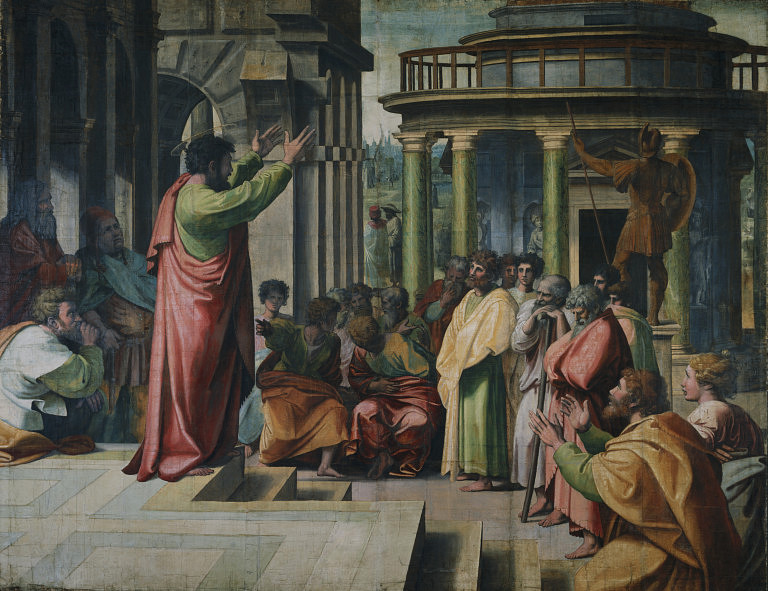
“St. Paul Preaching in Athens,” Raphael
In the sincere hope, dear reader, that soon we may speak of other things, let me linger just a while longer on religious freedom, liberalism, and public conscience. I’m compelled to do so now by Conor Friedersdorf, who writes with insight and clarity about the differences of perceptions in two cultural communities: The LGBT community and the religious traditionalists.
Friedersdorf perceives that in each camp there are particular fears and motivations that stem from two different historical contexts. The LGBT community, advocating national same-sex marriage and the demise of RFRA laws, speaks from a vantage point of historical isolation and discrimination that continues in some degree today, specifically among gay youths. On the other hand, the traditional religious community feels genuinely vulnerable to coercive law and cultural orthodoxy, a feeling accelerated recently by multiple court cases in which Christian businesses were told to pay “the price of citizenship” by offering service to gay and lesbian weddings. Both the gay and religious communities have real narratives, historical and contemporary, that color their perspectives and provide the sense of urgency often felt on either side of the culture war.
Friedersdorf’s main point is that this narrative disparity–which makes true empathy difficult–is part and parcel of the American experiment. “What everyone ought to be able to understand,” he writes, “is why some members of both groups feel under siege—and why members of both groups understandably don’t always empathize with one another.”
It is due to the fact that there is no such thing as a fully shared American culture: Life here is an amalgam of lots of subcultures that only partially overlap. People pay disproportionate attention to what affects them personally.
Americans receive different upbringings in different families of different faiths, while living in different neighborhoods of different cities in different regions, and are then thrown onto the same social-media platforms. These platforms afford an illusion of a single culture, as if public controversies are grounded in common experiences and assumptions. But Americans have never understood one another…
Were you a manager at a tech firm in San Francisco or San Jose, it would be much easier to be gay, out, and post photos from a pride rally than it would be to openly practice orthodox Christianity and post photos from a pro-life rally…Were you gay, driving cross-country, and stopping for the night in Walkerton, Indiana, you might be unsure about the local vibe and nervous about openly holding your partner’s hand. “Will that get us harassed by the cops or beat up by a local in this neighborhood?” There are lots of neighborhoods in America where you’d be at risk of being insulted or even assaulted, something the typical straight person never considers before holding their partner’s hand.
This argument is of course a kind of obvious, Atticus Finch “Walk in Another Man’s Shoes” one, but it still strikes me as poignant. Maybe that fact actually proves his larger point. Empathy is so difficult for us now that we need to be reminded it even exists.
Empathy is indeed a crucial part of relationships. It is the foundation of good faith, which I’ve previously argued is what makes authentic debate possible. Friedersdorf is right to remind both sides of this culture war of this. But what I think is missing from Friedersdforf’s piece is a contextually wide perspective. Without establishing why social conservatives in particular see their public security threatened, we can only produce a half-hearted empathy, a reactive faux-therapy that loses its luster as soon as the Supreme Court docket is announced again.
The first thing we need to acknowledge is that same-sex marriage advocates and the traditional religious community don’t just disagree on policy and they don’t just misunderstand each other; rather, they have entirely different interpretations of our current political backdrop. Friedersdorf perhaps illustrates this point in the way he contrasts the narratives of the LGBT and Christian communities. Whereas, as Friedersdorf says, the latter is concerned mainly about their livelihoods and public liberty, the former group is asking questions about physical safety and legal persecution. That’s not an unfair summary, but it is incomplete.
The physical, emotional, and communal hardships of gay Americans are certainly realities, but they’re not realities that comfortably comport with either the collective American conscience or the current legal landscape. Almost all of the nation’s influential media companies are explicitly pro-LGBT and pro same-sex marriage. I know of no public school curriculum that refers to homosexuality as anything other than an honorable expression of identity. Friedersdorf mentions that coming out as a traditional Christian would be difficult in southern California and that coming out as gay would be difficult in Walkerton, Indiana. Both statements are probably true, of course, but the difference is that Walkerton is consuming the culture of southern California, not vice versa. The only way one can honestly wonder which ideas are steering American thought and which are not is to tune out.
Traditionalist Christians find themselves in a much different situation. To understand this, you must comprehend what it meant for the CEO of the world’s most profitable and most famous technology company to publicly accuse state lawmakers in Indiana of hiding homophobia behind a religious liberty bill, a bill that was modeled after a federal law that liberals created. The Indiana RFRA has, like both its religious advocates and its LGBT dissidents, a significant historical context. Several recent court cases have resulted in Christian business owners being forced out of their livelihoods because they did not believe that participating in a same-sex ceremony was right. When Tim Cook compared the motivations behind the RFRA to the Jim Crow South, traditionalist Christians heard the point loud and clear: You must choose between religious convictions and a place in the American public.
The reason empathy between the same-sex marriage community and traditional Christians is so difficult is that they define the conversation so differently. LGBT citizens see Elaine Photography and Barronelle Stutzman as institutions of discrimination that need to be hurdled, both legally and culturally. Religious conservatives see the results of those cases as clarion signs that government is demanding public demonstration of conformity on homosexuality. Impasse. What can we do?
Actually, we can pass RFRAs.
The Religious Freedom Restoration Act that was signed by President Clinton emerged out of a legal context of deep empathy. You can read the details of the actual Supreme Court case yourself, but in brief, the law was the creation of Congressional Democrats who saw a need to grant empathy and good faith to those whose religious beliefs collided with laws. The main principle of RFRA and its statewide counterparts is simple: Empathy with religious beliefs should characterize enforcement of laws, and only a demonstrated “compelling interest,” established in a court, can override it.
RFRA is the kind of legislation that a culture struggling to empathize needs. That’s why it has sat so comfortably in federal code for over 20 years. By placing the compelling interest test on government–ALL government, not just government created in a particular season of culture–RFRA creates a balanced “crossroads” where religious conviction and jurisprudence meet. Further, the language of RFRA does not prevent the evolution of public opinion or the legal manifestation of such evolution. As the spoils of the culture war are distributed to the victors through legislation, RFRA is a good faith measure to ensure that unpopular does not become synonymous with illegal.
Empathy is not an autonomous thing. It belongs to Love. We empathize out of love for neighbor and a desire to do, as best we are able, the right thing by them. Friedersdorf is exactly correct: What the debate over sexuality, marriage, and religious liberty needs is empathy. LGBT and same-sex marriage advocacy have considerable legal, political, commercial and cultural momentum. Many conservatives accept it. As the power and influence in American life is redistributed, will we still try to understand one another? Will we still grant good faith even in our deepest disagreements? If nothing else, RFRA is accountability that our government needs to endure in that task.
Previous Post

April 4, 2015
Do Christians Mean What They Say? A response to Frank Bruni
Next Post
April 9, 2015 What's a Conscience Worth?
Browse Our Archives
Select a Category abortion bible books Christianity Current events DVD of the Week education Essays Ethics Fun Liberal Christianity life Mailbag Monday media Movies My Essential Movies philosophy Politics pop culture Quotes religion Southern Baptist Convention sports theology Uncategorized video Weekend Roundup
Select a Month October 2015 September 2015 August 2015 July 2015 June 2015 May 2015 April 2015 March 2015 February 2015 January 2015 December 2014 November 2014 October 2014 September 2014 August 2014 July 2014 June 2014 May 2014 April 2014 March 2014 February 2014 November 2013
Follow Us!
TAKE THE
Religious Wisdom Quiz
What was the primary trade good in Biblical times?
Select your answer to see how you score.
Purple cloth Spices Wheat Olive oil
Related posts from Samuel D. James

Loving Our Movies Well In the Golden Age...

Russell Moore on Evangelicals and Donald Trump

Going to Church, Skipping Donald Trump

TRENDING AT PATHEOS Evangelical

The REST of Your Life: A Creative Wrestles...
This week I had a conversation with a good friend from church....

How the author of the world's best hymn...
I've been working with John Newton for a while now. This makes...

Long before this Lectio Divina, Psalm 130 - the song - started...

What About the Trees? Another Living Parable
After I finished writing the last article about falling leaves as a...

Why Classical Education Is a Conversation, Not a...
Come and Read: Joy in Classical Education When I was a little...

Cornell University has received a great deal of negative publicity and intense...
view all Evangelical blogs
Ad-Free & Subscriber Log-In Subscription Support
- About Us
- 2026 Calendar
- Videos
- Podcasts
- Library of World Religions
- Faith In Media Tracker
- Advertise With Us
- Write for Us
- Privacy Policy
- Terms of Service
- Do Not Sell My Data
- Contact Us
- Radiant Digital
- Manage Newsletter Subscriptions
- Unsubscribe From Notifications
- Sitemap
Copyright 2008-2026, Patheos. All rights reserved.
Subscription Support Ad-Free & Subscriber Log-In
Follow Patheos