
BuddhistCatholicContemplativeEvangelicalGeneral ChristianHinduJewishLatter-day SaintMuslimNew VisionsProgressive Christian
Beliefs
- Buddhist
- Catholic
- Contemplative
- Evangelical
- General Christian
- Hindu
- Jewish
- Latter-day Saint
- More Voices
- Muslim
- New Visions
- Pagan
- Progressive Christian
Topics
- Religion News
- Food and Religion
- Sports and Religion
- Religious Art
- Religious Music and Entertainment
- Religious Events
- History and Religion
- Style and Religion
- Politics and Religion
- Women in Religion
- Recreation Outdoors and Religion
- Business Finance and Religion
- Careers Workplace and Religion
- Education and Religion
- Family Parenting and Religion
- Health Fitness and Religion
- Home and Religion
- Relationships and Religion
- Technology and Religion
- Travel and Religion
Columnists
- Buddhist Columnists
- Business Finance and Religion Columnists
- Careers Workplace and Religion Columnists
- Catholic Columnists
- Contemplative Columnists
- Education and Religion Columnists
- Evangelists Columnists
- Family Parenting and Religion Columnists
- General Christian Columnists
- Health Fitness and Religion Columnists
- Hindu Columnists
- History and Religion Columnists
- Home and Religion Columnists
- Jewish Columnists
- More Voices Columnists
- Latter Day Columnists
- Muslim Columnists
- New Visions Columnists
- Nonreligious Columnists
- Pagan Columnists
- Politics and Religion Columnists
- Progressive Columnists
- Recreation Outdoors and Religion Columnists
- Relationships and Religion Columnists
- Religion News Columnists
- Religious Art Columnists
- Religious Events Columnists
- Religious Music and Entertainment Columnists
- Sports and Religion Columnists
- Style and Religion Columnists
- Technology and Religion Columnists
- Travel and Religion Columnists
- Women in Religion Columnists
Resource Library
- 2026 Calendar
- Library of World Religions
- The 100 Most Holy Places on Earth
- Patheos Answers
- Podcasts
- Videos
- Faith Leaders Database
- Anglican Episcopalian
- Bahai
- Baptist
- Buddhism
- Christianity
- Confucianism
- Eastern Orthodoxy
- Hinduism
- Holiness and Pentecostal
- ISKCON
- Islam
- Judaism
- Lutheran
- Methodist
- The Church of Jesus Christ of Latter-day Saints
- New Age
- Paganism
- Presbytarian and Reformed
- Protestantism
- Religion Behind the Scenes
- Roman Catholic
- Scientology
- Shia Islam
- Sikhism
- Sufism
- Sunni Islam
- Taoism
- Zen
- See all religions
Research Tools
 Ad-Free & Subscriber Log-In Subscription Support
Ad-Free & Subscriber Log-In Subscription Support
Follow Patheos 

- Trending:
- Forgiveness
- |
- Marriage
- |
- Consciousness
- |
- Death Penalty
- |
- Election
- |
- Halloween
 Samuel D. James
- Home
- Evangelical
- Why the Caged Birdman Sings
Why the Caged Birdman Sings
Last updated on: March 10, 2015 at 12:37 pm by Samuel James
Why the Caged Birdman Sings 2015-03-10T12:37:30-04:00 Samuel James
Patheos Explore the world's faith through different perspectives on religion and spirituality! Patheos has the views of the prevalent religions and spiritualities of the world.
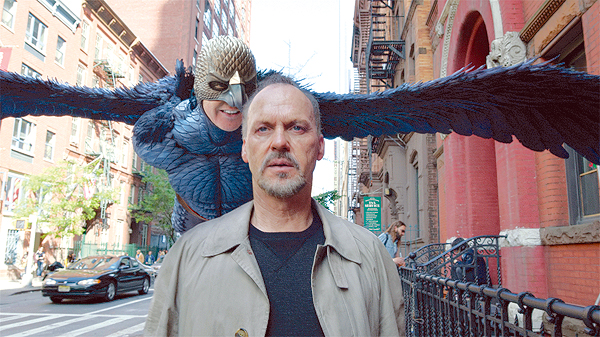
Henry David Thoreau once said, “The mass of men live lives of quiet desperation.” He was thinking about men like Riggan Thomson, the protagonist of Birdman: Or, the Unexpected Virtue of Ignorance, which won the Academy Award for Best Picture just a few weeks ago. I finally watched it. It’s a very funny film, particularly if the viewer knows a thing or two about actor culture or the current dilapidated state of Hollywood. More than satire, though, Birdman is a contemplation–no less serious for being witty–on the inner life of a man who at age 60 is determined to not go gentle into that good night of public irrelevance.
Riggan (played to perfection by Michael Keaton) lives for three things. First is his tepid relationship with his daughter Sam who has also felt irrelevant, not to the public but to her image-obsessed father. Second is a voice Riggan hears, the voice of Birdman–the character he played years ago for three worldwide blockbuster films. It was through Birdman that Riggan became significant and loved in the world. Nowadays Birdman mocks and berates Riggan, and warns him that the only way to find meaning again is to embrace the character once again. Lastly is Riggan’s play, the driving force of the film’s plot. In an attempt to stage a comeback into public life, Riggan writes, directs, and stars in his adaptation of Ray Carver’s What We Talk About When We Talk About Love. The play consumes his energy, becoming an obsession and, of course, beset with all kinds of hilarious problems.
Birdman reminded me of another Oscar-winning picture about man’s search for relevance. American Beauty, directed by Sam Mendes, won Best Picture in 1999. It’s a dark, deeply postmodern story about a middle aged man who upends his marriage, family, and career to protest his own insignificance. Like Riggan Thomson, Lester Burnham (Kevin Spacey) fears the loss of youth, respect, and meaning. He quits his job, blackmails his boss, buys a sportscar and lusts after his daughter’s classmate. He wants a rebirth, a second go around at the optimism and joy that he’s lost in his adulthood.
Hope is the unseen protagonist of both Birdman and American Beauty. Lester and Riggan rage against the belief that their lives are ultimately irrelevant by holding out hope in either critical adoration (Riggan) or sexual confidence (Lester). One reason I find Birdman to be a more compelling film than American Beauty is that Riggan’s behavior is more consistent with how men try to manipulate their lives to magnify their personal worth. For those without vast safety nets of wealth, quitting work and making advances toward a minor has a low cost-benefit ratio. By contrast, Riggan sees meaning only in his work and the praise others might give it. He structures his entire worldview of self around how an audience responds to him. There are men in my office who have far more in common with Riggan than they’d admit.
In Ecclesiastes, Solomon despairs of the irrelevance of life. Not even the power of the throne, the wealth of nations or the pleasure of a harem can actually make what Solomon does meaningful. “All is vanity and striving after wind,” he writes. What is done will be undone, then done again. Solomon concludes that the only reality that isn’t futile is God. God never leaves and returns. God is the Real, the Lasting, the only one of whom it cannot be said, “This too shall pass.” That’s why the end of Ecclesiastes ends on a distinctly pious note: “The end of the matter…fear God and keep his commandments.”
The ending of Birdman strongly hints that there was much more to who Riggan was than people knew. Without spoiling, I could even say that the ending hints that Riggan might not even be quite who we think he is, and his suffering may not have been merely a cry for public relevance. It suggests that Riggan’s real struggle was living in denial of who he really was. Embracing his real identity is his path to fulfillment and peace.
Consider Birdman a parable about the vanity of life apart from knowing who we really are. For Solomon, our identity is bound up with God’s. That God is really there and really speaking is the gravitational center of our existence. If God is real, and speaking to us, then our lives do indeed mean something rather than nothing. Riggan’s true identity spoke to him throughout the story, reminding him that he was not ultimately not a washed up, broken actor but something much greater. When he finally believed, he was finally free.
Image: Copyright 2014 Fox Searchlight. Source: Clevescene.com.
Previous Post

March 6, 2015
In Addiction, But Not Of It
Next Post
March 13, 2015 Why I'm Joining the ERLC
Browse Our Archives
Select a Category abortion bible books Christianity Current events DVD of the Week education Essays Ethics Fun Liberal Christianity life Mailbag Monday media Movies My Essential Movies philosophy Politics pop culture Quotes religion Southern Baptist Convention sports theology Uncategorized video Weekend Roundup
Select a Month October 2015 September 2015 August 2015 July 2015 June 2015 May 2015 April 2015 March 2015 February 2015 January 2015 December 2014 November 2014 October 2014 September 2014 August 2014 July 2014 June 2014 May 2014 April 2014 March 2014 February 2014 November 2013
Follow Us!
TAKE THE
Religious Wisdom Quiz
What does "Hosanna" mean in Hebrew?
Select your answer to see how you score.
Praise be to God Holy One Save us now The Lord reigns
Related posts from Samuel D. James

New Trailer for Documentary About Kermit Gosnell

Loving Our Movies Well In the Golden Age...

Russell Moore on Evangelicals and Donald Trump

TRENDING AT PATHEOS Evangelical

The REST of Your Life: A Creative Wrestles...
This week I had a conversation with a good friend from church....

How the author of the world's best hymn...
I've been working with John Newton for a while now. This makes...

Long before this Lectio Divina, Psalm 130 - the song - started...

What About the Trees? Another Living Parable
After I finished writing the last article about falling leaves as a...

Why Classical Education Is a Conversation, Not a...
Come and Read: Joy in Classical Education When I was a little...

Cornell University has received a great deal of negative publicity and intense...
view all Evangelical blogs
Ad-Free & Subscriber Log-In Subscription Support
- About Us
- 2026 Calendar
- Videos
- Podcasts
- Library of World Religions
- Faith In Media Tracker
- Advertise With Us
- Write for Us
- Privacy Policy
- Terms of Service
- Do Not Sell My Data
- Contact Us
- Radiant Digital
- Manage Newsletter Subscriptions
- Unsubscribe From Notifications
- Sitemap
Copyright 2008-2026, Patheos. All rights reserved.
Subscription Support Ad-Free & Subscriber Log-In
Follow Patheos