
BuddhistCatholicContemplativeEvangelicalGeneral ChristianHinduJewishLatter-day SaintMuslimNew VisionsProgressive Christian
Beliefs
- Buddhist
- Catholic
- Contemplative
- Evangelical
- General Christian
- Hindu
- Jewish
- Latter-day Saint
- More Voices
- Muslim
- New Visions
- Pagan
- Progressive Christian
Topics
- Religion News
- Food and Religion
- Sports and Religion
- Religious Art
- Religious Music and Entertainment
- Religious Events
- History and Religion
- Style and Religion
- Politics and Religion
- Women in Religion
- Recreation Outdoors and Religion
- Business Finance and Religion
- Careers Workplace and Religion
- Education and Religion
- Family Parenting and Religion
- Health Fitness and Religion
- Home and Religion
- Relationships and Religion
- Technology and Religion
- Travel and Religion
Columnists
- Buddhist Columnists
- Business Finance and Religion Columnists
- Careers Workplace and Religion Columnists
- Catholic Columnists
- Contemplative Columnists
- Education and Religion Columnists
- Evangelists Columnists
- Family Parenting and Religion Columnists
- General Christian Columnists
- Health Fitness and Religion Columnists
- Hindu Columnists
- History and Religion Columnists
- Home and Religion Columnists
- Jewish Columnists
- More Voices Columnists
- Latter Day Columnists
- Muslim Columnists
- New Visions Columnists
- Nonreligious Columnists
- Pagan Columnists
- Politics and Religion Columnists
- Progressive Columnists
- Recreation Outdoors and Religion Columnists
- Relationships and Religion Columnists
- Religion News Columnists
- Religious Art Columnists
- Religious Events Columnists
- Religious Music and Entertainment Columnists
- Sports and Religion Columnists
- Style and Religion Columnists
- Technology and Religion Columnists
- Travel and Religion Columnists
- Women in Religion Columnists
Resource Library
- 2026 Calendar
- Library of World Religions
- The 100 Most Holy Places on Earth
- Patheos Answers
- Podcasts
- Videos
- Faith Leaders Database
- Anglican Episcopalian
- Bahai
- Baptist
- Buddhism
- Christianity
- Confucianism
- Eastern Orthodoxy
- Hinduism
- Holiness and Pentecostal
- ISKCON
- Islam
- Judaism
- Lutheran
- Methodist
- The Church of Jesus Christ of Latter-day Saints
- New Age
- Paganism
- Presbytarian and Reformed
- Protestantism
- Religion Behind the Scenes
- Roman Catholic
- Scientology
- Shia Islam
- Sikhism
- Sufism
- Sunni Islam
- Taoism
- Zen
- See all religions
Research Tools
 Ad-Free & Subscriber Log-In Subscription Support
Ad-Free & Subscriber Log-In Subscription Support
Follow Patheos 

- Trending:
- Forgiveness
- |
- Marriage
- |
- Consciousness
- |
- Death Penalty
- |
- Election
- |
- Halloween
 Samuel D. James
- Home
- Evangelical
- In Addiction, But Not Of It
In Addiction, But Not Of It
Last updated on: March 6, 2015 at 11:34 am by Samuel James
In Addiction, But Not Of It 2015-03-06T11:34:30-04:00 Samuel James
Patheos Explore the world's faith through different perspectives on religion and spirituality! Patheos has the views of the prevalent religions and spiritualities of the world.
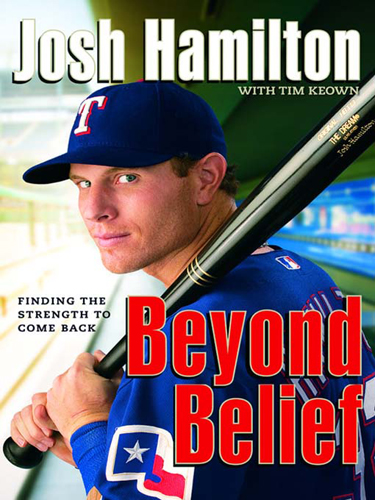
Josh Hamilton’s book “Beyond Belief”
Los Angeles Angels slugger Josh Hamilton is in the news again after the former American League MVP confessed to Major League Baseball of another drug relapse.
Hamilton’s struggle with drug and alcohol addiction is well-documented. In 2007 ESPN Magazine published a powerful piece by Hamilton in which he attributed recent sobriety to faith in Christ. However, since then Hamilton has publicly relapsed at least three times. Hamilton continues to speak openly of his Christian life, telling the press after a relapse in 2009 that he had “gotten away from” his relationship with God and recommitting to faithfulness. Hamilton’s continued failures, though, suggest that he needs more prayer, more spiritual encouragement and possibly less celebrity.
Sportswriter Richie Whitt believes that Hamilton is enjoying more dignity and sympathy than other morally lapsed athletes. Whitt especially thinks NFL wide receiver Josh Gordon, who has failed multiple drug tests since entering the league, is unfairly dismissed as “hopeless” and a “thug” while sports culture empathizes with Hamilton’s “struggles” and “frailty.” Whitt concludes that this is yet another demonstration that “Caucasian + Christian = immunity.”
Yet Hamilton is America’s most beloved crackhead, a man who trashed his middle-class upbringing by admitting to drunken driving, getting high and not having the faintest idea what he might have done or where he might have done it on countless foggy last nights… But, hallelujah, you can still buy his autobiography – Beyond Belief – and read about his inspirational sobriety.
Gordon, on the other hand, went to a Baptist school – Baylor – but refuses to call his mistakes anything more than what they are – bad decisions. In a letter to his critics, he wrote, “I am not a drug addict … nor am I a victim.” After a cobblestone childhood in which his parents divorced and he was forced to move eight times before the 9th grade, he was busted for drugs at Baylor, arrested for a DUI while with the Browns and is currently suspended for the entire 2015 season after violating a prior suspension with alcohol use.
Both have laundry lists of drug-addled gaffes tucked into their considerable baggage. But with seemingly neither the right skin nor the right wing to shield him, Gordon is treated much less favorably than Hamilton.
Whitt accuses Hamilton of using Christianity to cover his hypocrisy, saying he “shoves ‘I Am Second’ down our throats but ultimately puts his selfish cravings first.” (“I Am Second” refers to a book and social media campaign featuring celebrities with Christian testimonies). For Whitt, Gordon and Hamilton are essentially the same person, separated in the court of public opinion by race and social privilege.
Is Whitt correct? I do agree that Gordon is spoken of dismissively in a way that Hamilton isn’t. But by scoffing at Hamilton’s faith, Whitt misunderstands both the essential nature of addiction and the real moral dilemma faced by each athlete.
Whitt classifies both Gordon and Hamilton’s addictions as “drug-addled gaffes.” But in Christianity, sin is much more than a small error or a misstep. It is sin—our sin—that led Jesus to the cruel cross of Calvary. Understanding addiction of any kind not as a small blip on our existential wellness but as a damnable mechanism of cosmic treason and spiritual destruction is crucial to understanding how believers in the Gospel respond to it. The obedient Christian response to personal sin is not self-justification but an appeal to the mercy and character of God in helping us repent. For that reason, Christians like Josh Hamilton are right to appeal to their relationship with Christ when confessing personal sin.
The difference between Hamilton and Gordon is not one of moral superiority but of honesty. Despite his failures, Hamilton acknowledges that he needs help. By contrast, Whitt seems to admire Gordon’s insistence that he does not have a drug problem. Indeed, Gordon’s “letter to critics” is replete with stern rebukes to media pundits for

Josh Gordon (Source: Wikimedia Commons)
judging him and failing to acknowledge his personal obstacles. Gordon is articulate and earnestly pleads his case, but there’s no missing his dismissive attitude toward his problems or his expectation that others simply stop telling him how to live.
Honesty about indwelling sin is commanded in Scripture with a strikingly severe warning: “If we say we have no sin, we deceive ourselves and the truth is not in us.” Repentance requires confession. Gordon’s doubling down on his merits mirrors our culture’s self-justifying attitude towards sin in general. Our generation can easily sidestep moral clarity with the aid of obfuscating social categories. People are not “lustful,” they’re just “polyamorous.” Murderers are no longer murderers but “unbalanced minds.” At every turn, we reach for categories that absolve us from true moral accountability. Television hosts anesthetize us to profanity through humor; sports magazines give us “tasteful” pornography. TED Talks encourage us to become more self-aware, as long as our findings are flattering. Our culture’s air is thick with moral chamomile.
The epistle to the Hebrews warns believers to exhort one another so that no one in the church may be “hardened by the deceitfulness of sin.” If there’s any good definition of addiction, that might be it. Addiction is self-deception, the belief that we are in control of something when in fact we are being controlled by it. Many of us can empathize with Josh Hamilton because we too have reached out for divine grace in conquering temptation and are still feeling the burden of failure, shame, and frustration. Hope for believers is found in the knowledge that we are saved by Christ’s merits rather than our own, and that the Spirit of Christ is actually working in us every day and does not fail even when we do. In this way, Christians struggling with addictions might be thought of as being in addiction but not of it. Those with the spirit of Jesus do not struggle the same way those without Him do.
Josh Hamilton and Josh Gordon are indeed alike. They are like me, sinners desperately in need of grace. Josh Hamilton has publicly reached out for such grace and experienced its redeeming power in his life. What he needs is resilience in his fight and courage in remembering the resurrection power of the Gospel. My prayer for Josh Gordon is that he realizes that a life enslaved to anything is not just a “gaffe” but a life without the joy and freedom he was created to know. Richie Whitt is correct about one thing: Hamilton and Gordon have more in common with each other, and with us, than we admit.
Previous Post

March 2, 2015
4 Responses a Non-Scientist Christian Can Give to Science-Based Atheism
Next Post
March 10, 2015 Why the Caged Birdman Sings
Browse Our Archives
Select a Category abortion bible books Christianity Current events DVD of the Week education Essays Ethics Fun Liberal Christianity life Mailbag Monday media Movies My Essential Movies philosophy Politics pop culture Quotes religion Southern Baptist Convention sports theology Uncategorized video Weekend Roundup
Select a Month October 2015 September 2015 August 2015 July 2015 June 2015 May 2015 April 2015 March 2015 February 2015 January 2015 December 2014 November 2014 October 2014 September 2014 August 2014 July 2014 June 2014 May 2014 April 2014 March 2014 February 2014 November 2013
Follow Us!
TAKE THE
Religious Wisdom Quiz
Who was Jesus' legal father?
Select your answer to see how you score.
Jacob Heli Joseph Matthat
Related posts from Samuel D. James

Loving Our Movies Well In the Golden Age...

Russell Moore on Evangelicals and Donald Trump


Wanted: Journalists Not Beholden to Planned Parenthood
TRENDING AT PATHEOS Evangelical

The REST of Your Life: A Creative Wrestles...
This week I had a conversation with a good friend from church....

How the author of the world's best hymn...
I've been working with John Newton for a while now. This makes...

Long before this Lectio Divina, Psalm 130 - the song - started...

What About the Trees? Another Living Parable
After I finished writing the last article about falling leaves as a...

Why Classical Education Is a Conversation, Not a...
Come and Read: Joy in Classical Education When I was a little...

Cornell University has received a great deal of negative publicity and intense...
view all Evangelical blogs
Ad-Free & Subscriber Log-In Subscription Support
- About Us
- 2026 Calendar
- Videos
- Podcasts
- Library of World Religions
- Faith In Media Tracker
- Advertise With Us
- Write for Us
- Privacy Policy
- Terms of Service
- Do Not Sell My Data
- Contact Us
- Radiant Digital
- Manage Newsletter Subscriptions
- Unsubscribe From Notifications
- Sitemap
Copyright 2008-2026, Patheos. All rights reserved.
Subscription Support Ad-Free & Subscriber Log-In
Follow Patheos