
BuddhistCatholicContemplativeEvangelicalGeneral ChristianHinduJewishLatter-day SaintMuslimNew VisionsProgressive Christian
Beliefs
- Buddhist
- Catholic
- Contemplative
- Evangelical
- General Christian
- Hindu
- Jewish
- Latter-day Saint
- More Voices
- Muslim
- New Visions
- Pagan
- Progressive Christian
Topics
- Religion News
- Food and Religion
- Sports and Religion
- Religious Art
- Religious Music and Entertainment
- Religious Events
- History and Religion
- Style and Religion
- Politics and Religion
- Women in Religion
- Recreation Outdoors and Religion
- Business Finance and Religion
- Careers Workplace and Religion
- Education and Religion
- Family Parenting and Religion
- Health Fitness and Religion
- Home and Religion
- Relationships and Religion
- Technology and Religion
- Travel and Religion
Columnists
- Buddhist Columnists
- Business Finance and Religion Columnists
- Careers Workplace and Religion Columnists
- Catholic Columnists
- Contemplative Columnists
- Education and Religion Columnists
- Evangelists Columnists
- Family Parenting and Religion Columnists
- General Christian Columnists
- Health Fitness and Religion Columnists
- Hindu Columnists
- History and Religion Columnists
- Home and Religion Columnists
- Jewish Columnists
- More Voices Columnists
- Latter Day Columnists
- Muslim Columnists
- New Visions Columnists
- Nonreligious Columnists
- Pagan Columnists
- Politics and Religion Columnists
- Progressive Columnists
- Recreation Outdoors and Religion Columnists
- Relationships and Religion Columnists
- Religion News Columnists
- Religious Art Columnists
- Religious Events Columnists
- Religious Music and Entertainment Columnists
- Sports and Religion Columnists
- Style and Religion Columnists
- Technology and Religion Columnists
- Travel and Religion Columnists
- Women in Religion Columnists
Resource Library
- 2026 Calendar
- Library of World Religions
- The 100 Most Holy Places on Earth
- Patheos Answers
- Podcasts
- Videos
- Faith Leaders Database
- Anglican Episcopalian
- Bahai
- Baptist
- Buddhism
- Christianity
- Confucianism
- Eastern Orthodoxy
- Hinduism
- Holiness and Pentecostal
- ISKCON
- Islam
- Judaism
- Lutheran
- Methodist
- The Church of Jesus Christ of Latter-day Saints
- New Age
- Paganism
- Presbytarian and Reformed
- Protestantism
- Religion Behind the Scenes
- Roman Catholic
- Scientology
- Shia Islam
- Sikhism
- Sufism
- Sunni Islam
- Taoism
- Zen
- See all religions
Research Tools
 Ad-Free & Subscriber Log-In Subscription Support
Ad-Free & Subscriber Log-In Subscription Support
Follow Patheos 

- Trending:
- Forgiveness
- |
- Marriage
- |
- Consciousness
- |
- Death Penalty
- |
- Election
- |
- Halloween
 Samuel D. James
- Home
- Evangelical
- My Essential Movies: “Schindler’s List” (1993)
My Essential Movies: “Schindler’s List” (1993)
Last updated on: January 26, 2015 at 3:06 pm by Samuel James
My Essential Movies: “Schindler’s List” (1993) 2015-01-26T15:06:04-04:00 Samuel James
Patheos Explore the world's faith through different perspectives on religion and spirituality! Patheos has the views of the prevalent religions and spiritualities of the world.
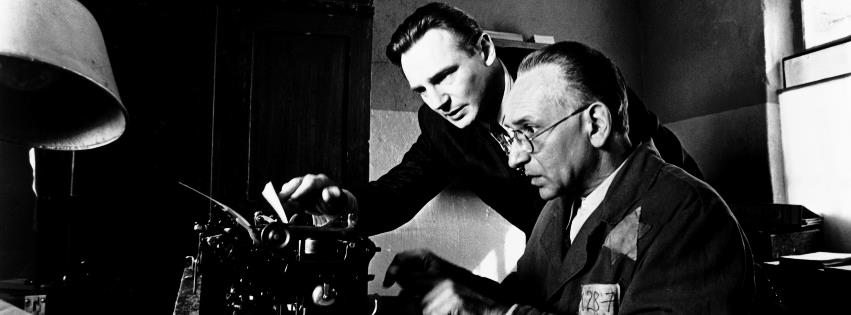
Image: Universal Pictures (1993)
Oskar Schindler was the greatest con artist in history. Most conmen fail. The successful ones manage to swindle a few people and make a few dollars. The greatest cons swindle more people and make more dollars. Oskar Schindler didn’t con 10, 50, or even 100 people; he conned the entire Nazi Party. He made a fortune, and then spent it all–becoming destitute by the war’s end– to keep his con working. And at the end, there were 1,100 Polish Jews who escaped Auschwitz because of him.
All of the great films tell great stories, but a few of them have stories of their own. One day in 1980 the novelist Thomas Keneally entered, by pure chance, a Beverly Hills store owned by an old Jew named Leopold. Learning that his customer was a writer, Leopold told Keneally that his real name was Poldek Pffeferberg and that he survived World War II in Poland because a German named Schindler had hired Jews to work in his factories. After much pleading, Keneally agreed to write Pffeferberg’s story, and published Schindler’s Ark (it was retitled Schindler’s List in the States) in 1982.
Steven Spielberg read Keneally’s book and knew it had to be filmed, but didn’t want to do it himself. Only after Martin Scorsese and Roman Polanski both told Spielberg they couldn’t make it did he decide it had to be him (Polanski would make The Pianist ten years after Schindler’s List released). It proved to be one of the landmark decisions of his legendary career. No one could have made Schindler’s List the way Spielberg made it.
There are so many great scenes in Schindler’s List, so many moments of purity and transcendence and horror that it is tempting to merely dub it “great art” and esteem it the way we might a Renaissance painting or a Handel composition. But it is Spielberg’s great gift of storytelling that prevents us from doing so. We must confront the history, the events, the people, and the places. Schindler’s List is art, yes, but it is also fact, and must be received as such. It’s not easy.
Perhaps that explains then why Schindler’s List seems to be fading from cultural consciousness. It appears only very rarely on television, owing to Spielberg’s inflexible rule that it broadcast unedited. It comes up frequently on lists like the IMDB Top 10 films of all time, but I’m consistently surprised at how many people admit to not having seen it. It’s true that films like The Godfather and Gone With the Wind are such fixtures of culture that many feel like they have seen them even if they haven’t. Is that the case with Schindler’s List? I doubt it. More likely it is being slowly forgotten. It deserves better.
These days Liam Neeson has successfully styled himself as an action hero. His fans owe it to themselves to watch him carefully in this film. He plays Oskar Schindler like a man totally in control. The film’s second scene shows Schindler throwing money at waiters at an upscale SS dinner party like a soldier hands out cigarettes. We get the iconic moving close-up of Schindler as he identifies who among the Nazi guests should be schmoozed. Later on, in one Neeson’s best scenes, he rescues his accountant Izthak Stern (Ben Kingsley) from deportation by intimidating the officers in charge. We watch and might be tempted to dismiss Schindler’s persona as implausible, until we remember that Nazism won Germany in large part because of one man’s charisma. Those who believe they’re in charge often are.
Later, Schindler bribes the commander of Auschwitz after his workers are mistakenly taken there. Spielberg and his editor Michael Kahn, who won the Oscar, place this conversation immediately after the well-known “shower scene.” Our emotions reeling, we watch as Schindler seems to grow and the Nazi seems to shrink. “I’m not judging you, but in the coming months we all are going to need portable wealth,” Schindler says, unveiling a bag of diamonds. The commander threatens to have him arrested. “I’m protected by powerful friends,” Schindler replies, showing not the slightest bit of concern. A few minutes later, Spielberg gives us one of Schindler’s List’s most powerful shots: A shorn and terrified group of women leave the camp and enter safety with Schindler himself in their midst, towering over them like a protective shelter.
Schindler’s enemy is not Nazism but one of its manifestations, the work camp commandant Amon Goethe. It is said that some Jewish survivors on Spielberg’s set cried out in terror when they saw Ralph Fiennes in full costume. Just as Neeson gives Schindler a cocksure CEO persona, so Fiennes plays Goethe as a man with insatiable bloodlust and possible insanity. He falls in his love with his Jewish housemaid but beats her savagely to atone for it. From his villa overlooking the work camp he uses Jews for target practice. Spielberg makes no attempt to shield his audience from the psychotic randomness of the Holocaust’s evil.
In his essay on the film Roger Ebert asked whether it would have been better if Goethe had not been portrayed as a psychopath but as a man living out his ideals consistently and obediently. That’s a good question. My instinct says that it was precisely Goethe’s instability that gave Schindler an opportunity to master him. A sharper and more principled man might have called Schindler’s bluff or at least resisted all those bribes. In a way, Goethe’s madness draws comparisons to the Reich’s downfall; there is only so much pure evil you can imbibe without stumbling.
Spielberg contrasts these two men explicitly. Three important shots send the message: A scene early that cuts back and forth between the two men shaving; a confrontation over the ghetto massacre that puts both men on either side of the frame and shadow between; and Schindler’s offer to purchase his workers from Goethe in exchange for their lives. Screenwriter Steve Zallian is flawless in that last scene: “You want these people?” Goethe asks. “They’re MY people, I want my people. “Who are you, Moses?” It’s not the first or the last time Goethe speaks beyond his comprehension.
How did Goethe never catch on? As if to insult his intelligence, Schindler orders a hose to spray water into train cars filled with Jews right in front of him. Goethe cackles, “You’re giving them hope! That’s cruel, you shouldn’t do that!” I love the way Neeson smiles in response. He knows Goethe cannot stop him because he cannot fathom him.
Oh, how much more can be said! A little girl with a red coat, a typewriter creating salvation with every keystroke, and a candle burning quietly and fiercely against the night–so many timeless images that Spielberg created. There’s a tender hand in every relentless shot of terror. If it is true at all that art can reach into our souls, then Schindler’s List does exactly that.
The Holocaust is unfilmable. No movie can capture what genocide of six million people actually means. Some have objected to Spielberg’s film because it has a happy ending. I’m not sure that survival is always the same as happy, and even if it is, so what? The memory of the six million lives in the testimony of the 1,100. It is their story that Spielberg tells, and tells with grace and truth. That is the test of a great filmmaker and a great film. Wherever Oskar Schindler’s name is remembered, Steven Spielberg’s movie will be remembered too.
International Holocaust Remembrance Day is January 27
Previous Post

January 23, 2015
The Proud Single-Issue Voter
Next Post
January 27, 2015 C.S. Lewis On Why You Shouldn't Dump Doctrine for More Friends
Browse Our Archives
Select a Category abortion bible books Christianity Current events DVD of the Week education Essays Ethics Fun Liberal Christianity life Mailbag Monday media Movies My Essential Movies philosophy Politics pop culture Quotes religion Southern Baptist Convention sports theology Uncategorized video Weekend Roundup
Select a Month October 2015 September 2015 August 2015 July 2015 June 2015 May 2015 April 2015 March 2015 February 2015 January 2015 December 2014 November 2014 October 2014 September 2014 August 2014 July 2014 June 2014 May 2014 April 2014 March 2014 February 2014 November 2013
Follow Us!
TAKE THE
Religious Wisdom Quiz
Who said, "You intended to harm me, but God intended it for good"?
Select your answer to see how you score.
Joseph David Solomon Job
Related posts from Samuel D. James

New Trailer for Documentary About Kermit Gosnell

Loving Our Movies Well In the Golden Age...

How the Oscars and Elitism Help America
TRENDING AT PATHEOS Evangelical

The REST of Your Life: A Creative Wrestles...
This week I had a conversation with a good friend from church....

How the author of the world's best hymn...
I've been working with John Newton for a while now. This makes...

Long before this Lectio Divina, Psalm 130 - the song - started...

What About the Trees? Another Living Parable
After I finished writing the last article about falling leaves as a...

Why Classical Education Is a Conversation, Not a...
Come and Read: Joy in Classical Education When I was a little...

Cornell University has received a great deal of negative publicity and intense...
view all Evangelical blogs
Ad-Free & Subscriber Log-In Subscription Support
- About Us
- 2026 Calendar
- Videos
- Podcasts
- Library of World Religions
- Faith In Media Tracker
- Advertise With Us
- Write for Us
- Privacy Policy
- Terms of Service
- Do Not Sell My Data
- Contact Us
- Radiant Digital
- Manage Newsletter Subscriptions
- Unsubscribe From Notifications
- Sitemap
Copyright 2008-2026, Patheos. All rights reserved.
Subscription Support Ad-Free & Subscriber Log-In
Follow Patheos