
BuddhistCatholicContemplativeEvangelicalGeneral ChristianHinduJewishLatter-day SaintMuslimNew VisionsProgressive Christian
Beliefs
- Buddhist
- Catholic
- Contemplative
- Evangelical
- General Christian
- Hindu
- Jewish
- Latter-day Saint
- More Voices
- Muslim
- New Visions
- Pagan
- Progressive Christian
Topics
- Religion News
- Food and Religion
- Sports and Religion
- Religious Art
- Religious Music and Entertainment
- Religious Events
- History and Religion
- Style and Religion
- Politics and Religion
- Women in Religion
- Recreation Outdoors and Religion
- Business Finance and Religion
- Careers Workplace and Religion
- Education and Religion
- Family Parenting and Religion
- Health Fitness and Religion
- Home and Religion
- Relationships and Religion
- Technology and Religion
- Travel and Religion
Columnists
- Buddhist Columnists
- Business Finance and Religion Columnists
- Careers Workplace and Religion Columnists
- Catholic Columnists
- Contemplative Columnists
- Education and Religion Columnists
- Evangelists Columnists
- Family Parenting and Religion Columnists
- General Christian Columnists
- Health Fitness and Religion Columnists
- Hindu Columnists
- History and Religion Columnists
- Home and Religion Columnists
- Jewish Columnists
- More Voices Columnists
- Latter Day Columnists
- Muslim Columnists
- New Visions Columnists
- Nonreligious Columnists
- Pagan Columnists
- Politics and Religion Columnists
- Progressive Columnists
- Recreation Outdoors and Religion Columnists
- Relationships and Religion Columnists
- Religion News Columnists
- Religious Art Columnists
- Religious Events Columnists
- Religious Music and Entertainment Columnists
- Sports and Religion Columnists
- Style and Religion Columnists
- Technology and Religion Columnists
- Travel and Religion Columnists
- Women in Religion Columnists
Resource Library
- 2026 Calendar
- Library of World Religions
- The 100 Most Holy Places on Earth
- Patheos Answers
- Podcasts
- Videos
- Faith Leaders Database
- Anglican Episcopalian
- Bahai
- Baptist
- Buddhism
- Christianity
- Confucianism
- Eastern Orthodoxy
- Hinduism
- Holiness and Pentecostal
- ISKCON
- Islam
- Judaism
- Lutheran
- Methodist
- The Church of Jesus Christ of Latter-day Saints
- New Age
- Paganism
- Presbytarian and Reformed
- Protestantism
- Religion Behind the Scenes
- Roman Catholic
- Scientology
- Shia Islam
- Sikhism
- Sufism
- Sunni Islam
- Taoism
- Zen
- See all religions
Research Tools
 Ad-Free & Subscriber Log-In Subscription Support
Ad-Free & Subscriber Log-In Subscription Support
Follow Patheos 

- Trending:
- Forgiveness
- |
- Marriage
- |
- Consciousness
- |
- Death Penalty
- |
- Election
- |
- Halloween
 Samuel D. James
- Home
- Evangelical
- The Heretic Huck Finn
The Heretic Huck Finn
Last updated on: October 21, 2014 at 5:46 pm by Samuel James
The Heretic Huck Finn 2014-10-21T17:46:27-04:00 Samuel James
Patheos Explore the world's faith through different perspectives on religion and spirituality! Patheos has the views of the prevalent religions and spiritualities of the world.
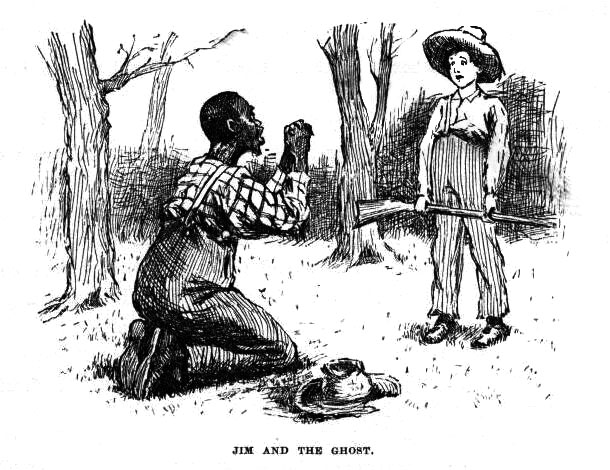
B.D. McClay continues the conversation about A.O. Scott’s essay on the death of adulthood. The accompanying illustration itself is worth a reading of the post. McClay aims to clarify further what is meant by the word “adult.” He spots a promising literary example in Huck Finn, and contemplates that the real test of adulthood is awareness and execution of moral agency:
Fiedler (and Scott) both focus on the great refusers of American literature, particularly Huck Finn, who decides to go to Hell rather than turn in his friend Jim, the escaped slave. But his refusal to hand Jim over isn’t a refusal to become an adult; it is a decision that shows he is one. He’s become a real moral actor. He doesn’t simply do what he is told, and he accepts the consequences of his choices.
Huck’s adulthood is made obvious when Tom Sawyer appears at the end of the novel. Tom sees only a potential adventure in Jim’s plight, and unnecessarily draws out Jim’s hopes of freedom—ultimately for no reason at all. Tom isn’t intentionally cruel, but he’s still a child and cannot understand the stakes. Huck may remain a vagrant, or at least an outsider, while Tom is likely to settle down, marry, and become a productive citizen. Yet Huck is, and will likely remain, the more adult of the two.
While I’m not quite sold on that last line, I think McClay has a solid illustration in Huck. I want to tilt the conversation a little bit away from the definition of “adult” for a minute though.
The “Alright, I’ll go to hell” passage is something I’ve seen appealed to quite a bit by those who argue that religious dogma and authority is naturally thrown aside by a mature moral consciousness. It’s at this moment that Huck realizes that the moral language that he’s been raised with–in this case, about Negroes–is untenable. Note that I didn’t say “false,” since the power of the narrative is not in Huck’s sudden moral knowledge but in his willingness to be accursed for the sake of his friend. Secular and religiously leftward commenters hold this moment up as an example of the liberating power of common morality over traditional dogma; thus, it is said, we need to be careful to orient ourselves like Huck, willing always to discard traditional or received notions the moment they conflict with our social and sexual experiences.
Huck is the modern heretic, the mind that is liberated from tradition by knowledge and experience. Joining back up with McClay, we see that Huck’s emergence into adulthood occurs simultaneously with his willingness to be damned. Put differently: Huck’s desire to be holy is replaced with a desire to be humane. And this, some say, is the quintessential American adulthood: The leaving behind of authority structures and journeying towards self-actualization.
Now McClay is referring merely to Huck’s moral agency. Without authority’s hovering him, Huck makes a decision and vows to live with the (potentially eternal) consequences. That, for McClay, is the essence of adulthood. And yet, McClay concludes with this paragraph, which suggests that the spiritual dimension is not entirely disconnected:
Being an adult in America, even aspirationally, has more to do with being a self-governing citizen than with leaving the family nest. Casting off childhood comes in recognizing oneself as a responsible moral actor. Maybe looking around and noticing that “no one is in charge” is not a sign that there are no adults—but, instead, a sign that you are one.
The phrase in quotation is taken from Scott’s essay, where he observes that contemporary cultural output is one that “imagines a world where no one is in charge.” From Huck’s perspective, deciding not to return Jim to a life of slavery might offend God, but if so, that’s OK. It might be a stretch to say that “no one is charge” in Huck’s new moral universe, but it’s probably safe to say the old guard has washed out.
Lest I be accused of over-reading McClay’s post, yes, I do know that McClay’s point is not that Huck’s adulthood is his heresy. But I do think the evaporation of authority, the flattening of information and the demise of experts all have something very important to do with Scott’s observations about adulthood. The example of Huck Finn is a doubly appropriate one, since not only does Huck transition into adulthood via moral acting, but said transition has a definite departing point, namely, trust in tradition and taught principles. It could be that our modern idea that adulthood entails a conscious tossing aside of received tradition and authority hasn’t actually created a more adult society. It could be that, even as (according to McClay) leaving the “nest” physically isn’t a reliable indicator of adulthood, neither is leaving it metaphorically. Perhaps “owning one’s beliefs” might be invested with more significance than it really deserves.
None of this, by the way, should be construed as saying that Huck’s decision was wrong. The illusion of the non-humanity of slaves was burst violently by Huck’s friendship (it is also obliterated by Christian Scripture). The point is that the ritual of casting off what one has been taught is probably not the pivot into adulthood that we might, even subconsciously, believe. Receiving and following and treasuring tradition might carry the risk of perpetuating injustice, true. That is why moral codes that transcend mere custom are necessary in the first place. But when faced with a culture that lacks real sense of growing up, we should ask whether aspiring to be a heretic alongside Huck is the right decision. Perhaps in taking so much pleasure in remaking ourselves every generation, we have simply created an endless childhood.
Previous Post

October 20, 2014
David Brooks On Everybody's "2 Adams"
Next Post

October 24, 2014 Speaking To the Age of Fear
Browse Our Archives
Select a Category abortion bible books Christianity Current events DVD of the Week education Essays Ethics Fun Liberal Christianity life Mailbag Monday media Movies My Essential Movies philosophy Politics pop culture Quotes religion Southern Baptist Convention sports theology Uncategorized video Weekend Roundup
Select a Month October 2015 September 2015 August 2015 July 2015 June 2015 May 2015 April 2015 March 2015 February 2015 January 2015 December 2014 November 2014 October 2014 September 2014 August 2014 July 2014 June 2014 May 2014 April 2014 March 2014 February 2014 November 2013
Follow Us!
TAKE THE
Religious Wisdom Quiz
Who was the Roman governor that sentenced Jesus to be crucified?
Select your answer to see how you score.
Felix Herod Caesar Augustus Pontius Pilate
Related posts from Samuel D. James

Loving Our Movies Well In the Golden Age...

Russell Moore on Evangelicals and Donald Trump

Going to Church, Skipping Donald Trump

TRENDING AT PATHEOS Evangelical

The REST of Your Life: A Creative Wrestles...
This week I had a conversation with a good friend from church....

How the author of the world's best hymn...
I've been working with John Newton for a while now. This makes...

Long before this Lectio Divina, Psalm 130 - the song - started...

What About the Trees? Another Living Parable
After I finished writing the last article about falling leaves as a...

Why Classical Education Is a Conversation, Not a...
Come and Read: Joy in Classical Education When I was a little...

Cornell University has received a great deal of negative publicity and intense...
view all Evangelical blogs
Ad-Free & Subscriber Log-In Subscription Support
- About Us
- 2026 Calendar
- Videos
- Podcasts
- Library of World Religions
- Faith In Media Tracker
- Advertise With Us
- Write for Us
- Privacy Policy
- Terms of Service
- Do Not Sell My Data
- Contact Us
- Radiant Digital
- Manage Newsletter Subscriptions
- Unsubscribe From Notifications
- Sitemap
Copyright 2008-2026, Patheos. All rights reserved.
Subscription Support Ad-Free & Subscriber Log-In
Follow Patheos