
BuddhistCatholicContemplativeEvangelicalGeneral ChristianHinduJewishLatter-day SaintMuslimNew VisionsProgressive Christian
Beliefs
- Buddhist
- Catholic
- Contemplative
- Evangelical
- General Christian
- Hindu
- Jewish
- Latter-day Saint
- More Voices
- Muslim
- New Visions
- Pagan
- Progressive Christian
Topics
- Religion News
- Food and Religion
- Sports and Religion
- Religious Art
- Religious Music and Entertainment
- Religious Events
- History and Religion
- Style and Religion
- Politics and Religion
- Women in Religion
- Recreation Outdoors and Religion
- Business Finance and Religion
- Careers Workplace and Religion
- Education and Religion
- Family Parenting and Religion
- Health Fitness and Religion
- Home and Religion
- Relationships and Religion
- Technology and Religion
- Travel and Religion
Columnists
- Buddhist Columnists
- Business Finance and Religion Columnists
- Careers Workplace and Religion Columnists
- Catholic Columnists
- Contemplative Columnists
- Education and Religion Columnists
- Evangelists Columnists
- Family Parenting and Religion Columnists
- General Christian Columnists
- Health Fitness and Religion Columnists
- Hindu Columnists
- History and Religion Columnists
- Home and Religion Columnists
- Jewish Columnists
- More Voices Columnists
- Latter Day Columnists
- Muslim Columnists
- New Visions Columnists
- Nonreligious Columnists
- Pagan Columnists
- Politics and Religion Columnists
- Progressive Columnists
- Recreation Outdoors and Religion Columnists
- Relationships and Religion Columnists
- Religion News Columnists
- Religious Art Columnists
- Religious Events Columnists
- Religious Music and Entertainment Columnists
- Sports and Religion Columnists
- Style and Religion Columnists
- Technology and Religion Columnists
- Travel and Religion Columnists
- Women in Religion Columnists
Resource Library
- 2026 Calendar
- Library of World Religions
- The 100 Most Holy Places on Earth
- Patheos Answers
- Podcasts
- Videos
- Faith Leaders Database
- Anglican Episcopalian
- Bahai
- Baptist
- Buddhism
- Christianity
- Confucianism
- Eastern Orthodoxy
- Hinduism
- Holiness and Pentecostal
- ISKCON
- Islam
- Judaism
- Lutheran
- Methodist
- The Church of Jesus Christ of Latter-day Saints
- New Age
- Paganism
- Presbytarian and Reformed
- Protestantism
- Religion Behind the Scenes
- Roman Catholic
- Scientology
- Shia Islam
- Sikhism
- Sufism
- Sunni Islam
- Taoism
- Zen
- See all religions
Research Tools
 Ad-Free & Subscriber Log-In Subscription Support
Ad-Free & Subscriber Log-In Subscription Support
Follow Patheos 

- Trending:
- Forgiveness
- |
- Marriage
- |
- Consciousness
- |
- Death Penalty
- |
- Election
- |
- Halloween
 Samuel D. James
- Home
- Evangelical
- Book Review: The Pastor’s Kid
Book Review: The Pastor’s Kid
Last updated on: July 7, 2014 at 10:44 pm by Samuel James
Book Review: The Pastor’s Kid 2014-07-07T22:44:21-04:00 Samuel James
Patheos Explore the world's faith through different perspectives on religion and spirituality! Patheos has the views of the prevalent religions and spiritualities of the world.
“Once a PK, always a PK. It is an indelible mark.” So says Barnabas Piper in his wonderful new book The Pastor’s Kid: Finding Your Own Faith and Identity. Being a pastor’s kid (PK) is something that nobody chooses, many dislike and many more completely misunderstand. One person who gets it is Barnabas Piper. You may or may not know who he is but the odds are very good you know his dad, John Piper, who served as senior pastor of Bethlehem Baptist Church in Minnesota for many years before stepping down last year.
I’ve never met Barnabas but I felt camaraderie with him throughout The Pastor’s Kid. Both of us are lifelong PKs whose pastor-dads are recently stepped down from the pulpit. More importantly, each of us met Jesus in our 20s only after realizing that the faith of our fathers was not our own. I resonated deeply with many parts of The Pastor’s Kid, but none so intensely as Barnabas’s story of being brought to a personal knowledge of Christ as an adult after years in a minister’s home. That’s my story too, and I suspect many have similar tales. This book will meet many PKs where they are, which is what makes it a volume to treasure.
At barely over 150 pages, The Pastor’s Kid is an honest, plain-speaking look at the struggles that befall children of pastors. A word of warning: If you’re looking for salacious anecdotes from the Piper household, do not buy this book. Barnabas Piper is not looking to air dirty laundry or even make sense of his own childhood. Rather, his book is an unflinchingly authentic call for pastors and churches to realize that pastor’s kids are just that—kids. They’re not little pastors or mini celebrities, but children who need the grace of Jesus to overcome the pitfalls of having public ministers as parents.
PKs are, above anything else, normal. Piper wants us to realize from the outset that PKs are not closer to God or less prone to sin by virtue of their lineage (25). This normalcy means that PKs are in the unenviable position of participating in ministry not because of calling but because of Dad:
A child doesn’t know the call of his pastor father. All he knows is the effects it has on his life. He doesn’t feel moved to ministry, because he’s not. Yes, it is the call of the child to honor his parents, but that is not the same as a call to vocational ministry. The call of the father is not the call of the child, but the ministry of the father creates an anvil-like weight on the child. He just feels the pressure of it. Even the best pastoral parents can’t protect their kids from this. And it is this pressure, in part, that drives so many PKs to break.
Where do PKs feel pressure? Piper gives us several examples, and my personal experience resonated with all of them. PKs are often held to extra-biblical behavioral standards to which the “regular” church kids are not held (47). As if that were not daunting enough, church members tend to expect PKs to fall in step behind Dad in each aspect of life. Describing it as a pressure to “stay in the lane,” Piper says that expectations about biblical knowledge, interest in theology and even lifestyle mount up on PKs and summon them to look just like their parents: “The constant pressure to be something, do something and believe something creates enormous confusion for PKs.” (60) Piper makes it clear that he’s not discussing the desire of pastors for their children to be Christians but the cultural expectation that the children replicate the parents in all meaningful phases of life.
Reading this section I remembered episodes from my own life in which I could sense the pressure. When my musical tastes began to grow discontent with contemporary Christian radio, my parents took my interest in “secular music” in stride and encouraged discernment and not legalistic avoidance. But I can recall being admonished to not share my findings with the kids in youth group, since anything I recommended would come back on the pastor as *his* recommendation. Though this pressure was rare in my home, church life was different. I had to be “above reproach” alongside my elder father.
Being a pastor’s kid often means having to assume an identity that isn’t real. A pressure or even just desire to not reflect poorly on the pastor can result in frustrating years. It is a sobering thing to think back on all those years of bible drills, VBS, Fuge camps and even leading worship and realize that I was phoning it in to maintain the peaceable status quo. As Piper says, PKs know the “tricks of the trade” to being the pastor’s child.
The key to relieving this often hurtful life of failed expectation and outsourced identity is true knowledge of the grace of Jesus. PKs need to have their innate sense of not measuring up exploded by the reality of God’s atoning love in Christ: “Only when Jesus becomes real to a PK can she begin to figure out what she is, who she is.” (74) In an achingly beautiful section Piper writes that it is only grace that can overcome the hopelessness and loneliness faced by so many PKs. (93)
Piper’s words cut to my soul since for years I knew that who I was on the inside was a gross pall on my incredibly godly Dad. I too felt hopeless, doubtful that change could ever happen to one who had been given so much and done so little with it. But that was only because I was looking for my savior in the wrong places. My hope was not dependent on
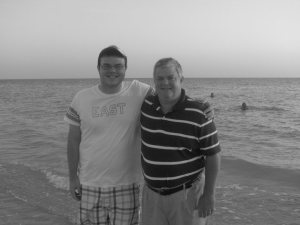
Me and dad
how proud I could make my pastor dad but on nothing less than Jesus blood and righteousness. Once my Hope met me in person and no longer by proxy, I was set free from the tyranny of false expectation and outsourced identity.
The Pastor’s Kid is a book that will hit where it hurts. But it is also brimming with grace and light. If nothing else, every pastor should read the chapter “Pastor and Child.” Piper pleads with pastor-dads to be fathers first, not preachers. I can hear a tinge of regret as Piper reflects that “to this day, I still yearn to have a shared hobby with my father, something as simple as golf or hiking.” (111) Piper writes with the tender voice of a son when he exhorts that pastor-dads find a way (at the expense of their ministry, if necessary) to identify with their kids. The pastor’s identity as a preacher or scholar is always secondary to the identity of a father.
I identified strongly with the last chapter, entitled “PKs: What Are They Good For.” Piper closes his book by meditating on the blessings and opportunities that come with being a PK. For me, those benefits were legion: I was given an incredibly gentle and kind and loving childhood that was filled with Scripture, love of the church and treasuring of the Gospel. All of those were daily realities in my home, not just Sunday routines. Such an environment cannot save the souls of children, of course, but my home was an instrument by which my soul was made tenderer and more receptive to the reality of Jesus.
I should say here that The Pastor’s Kid will not be of much benefit to readers looking to justify themselves, their parenting or their bitterness towards the church. This is not a book for those eager to hear how right they were about their kids or their parents. There are no diatribes, long testimonials or “How To” lists. Those who can come to this book with ears ready to hear will see that The Pastor’s Kid is a grace filled call for the church to minister more faithfully to the children of pastors.
Who should read The Pastor’s Kid? It is a must-read for PKs and their parents. It also is an invaluable guide for church members that will gently correct some misconceptions about how to minister to PKs. Barnabas Piper speaks with the heart of not just a PK but a parent who is seeking to love his own children well. The Pastor’s Kid deeply resonated with my memories of growing up as a PK and encouraged me that my feelings and journeys were not wasted.
Barnabas, from one PK to another: Thank you!
Previous Post

June 24, 2014
Two Weeks
Next Post
July 9, 2014 Hobby Lobby and the Rage of the Liberal Machine
Browse Our Archives
Select a Category abortion bible books Christianity Current events DVD of the Week education Essays Ethics Fun Liberal Christianity life Mailbag Monday media Movies My Essential Movies philosophy Politics pop culture Quotes religion Southern Baptist Convention sports theology Uncategorized video Weekend Roundup
Select a Month October 2015 September 2015 August 2015 July 2015 June 2015 May 2015 April 2015 March 2015 February 2015 January 2015 December 2014 November 2014 October 2014 September 2014 August 2014 July 2014 June 2014 May 2014 April 2014 March 2014 February 2014 November 2013
Follow Us!
TAKE THE
Religious Wisdom Quiz
What is the Christian attitude toward one's enemies?
Select your answer to see how you score.
Mock them Fight them Ignore them Love them
Related posts from Samuel D. James

Russell Moore on Evangelicals and Donald Trump


Tinder Mercies--Or, How Porn Destroyed Sex
TRENDING AT PATHEOS Evangelical

The REST of Your Life: A Creative Wrestles...
This week I had a conversation with a good friend from church....

How the author of the world's best hymn...
I've been working with John Newton for a while now. This makes...

Long before this Lectio Divina, Psalm 130 - the song - started...

What About the Trees? Another Living Parable
After I finished writing the last article about falling leaves as a...

Why Classical Education Is a Conversation, Not a...
Come and Read: Joy in Classical Education When I was a little...

Cornell University has received a great deal of negative publicity and intense...
view all Evangelical blogs
Ad-Free & Subscriber Log-In Subscription Support
- About Us
- 2026 Calendar
- Videos
- Podcasts
- Library of World Religions
- Faith In Media Tracker
- Advertise With Us
- Write for Us
- Privacy Policy
- Terms of Service
- Do Not Sell My Data
- Contact Us
- Radiant Digital
- Manage Newsletter Subscriptions
- Unsubscribe From Notifications
- Sitemap
Copyright 2008-2026, Patheos. All rights reserved.
Subscription Support Ad-Free & Subscriber Log-In
Follow Patheos