
BuddhistCatholicContemplativeEvangelicalGeneral ChristianHinduJewishLatter-day SaintMuslimNew VisionsProgressive Christian
Beliefs
- Buddhist
- Catholic
- Contemplative
- Evangelical
- General Christian
- Hindu
- Jewish
- Latter-day Saint
- More Voices
- Muslim
- New Visions
- Pagan
- Progressive Christian
Topics
- Religion News
- Food and Religion
- Sports and Religion
- Religious Art
- Religious Music and Entertainment
- Religious Events
- History and Religion
- Style and Religion
- Politics and Religion
- Women in Religion
- Recreation Outdoors and Religion
- Business Finance and Religion
- Careers Workplace and Religion
- Education and Religion
- Family Parenting and Religion
- Health Fitness and Religion
- Home and Religion
- Relationships and Religion
- Technology and Religion
- Travel and Religion
Columnists
- Buddhist Columnists
- Business Finance and Religion Columnists
- Careers Workplace and Religion Columnists
- Catholic Columnists
- Contemplative Columnists
- Education and Religion Columnists
- Evangelists Columnists
- Family Parenting and Religion Columnists
- General Christian Columnists
- Health Fitness and Religion Columnists
- Hindu Columnists
- History and Religion Columnists
- Home and Religion Columnists
- Jewish Columnists
- More Voices Columnists
- Latter Day Columnists
- Muslim Columnists
- New Visions Columnists
- Nonreligious Columnists
- Pagan Columnists
- Politics and Religion Columnists
- Progressive Columnists
- Recreation Outdoors and Religion Columnists
- Relationships and Religion Columnists
- Religion News Columnists
- Religious Art Columnists
- Religious Events Columnists
- Religious Music and Entertainment Columnists
- Sports and Religion Columnists
- Style and Religion Columnists
- Technology and Religion Columnists
- Travel and Religion Columnists
- Women in Religion Columnists
Resource Library
- 2026 Calendar
- Library of World Religions
- The 100 Most Holy Places on Earth
- Patheos Answers
- Podcasts
- Videos
- Faith Leaders Database
- Anglican Episcopalian
- Bahai
- Baptist
- Buddhism
- Christianity
- Confucianism
- Eastern Orthodoxy
- Hinduism
- Holiness and Pentecostal
- ISKCON
- Islam
- Judaism
- Lutheran
- Methodist
- The Church of Jesus Christ of Latter-day Saints
- New Age
- Paganism
- Presbytarian and Reformed
- Protestantism
- Religion Behind the Scenes
- Roman Catholic
- Scientology
- Shia Islam
- Sikhism
- Sufism
- Sunni Islam
- Taoism
- Zen
- See all religions
Research Tools
 Ad-Free & Subscriber Log-In Subscription Support
Ad-Free & Subscriber Log-In Subscription Support
Follow Patheos 

- Trending:
- Forgiveness
- |
- Marriage
- |
- Consciousness
- |
- Death Penalty
- |
- Election
- |
- Halloween
 Inebriate Me
- Home
- Catholic
- The Religion-Gospel Dichotomy
The Religion-Gospel Dichotomy
Last updated on: April 23, 2015 at 1:40 pm by Pascal-Emmanuel Gobry
The Religion-Gospel Dichotomy 2015-04-23T13:40:53+01:00 Pascal-Emmanuel Gobry
Patheos Explore the world's faith through different perspectives on religion and spirituality! Patheos has the views of the prevalent religions and spiritualities of the world.
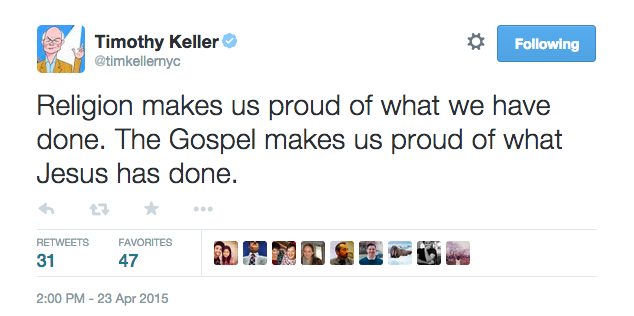
I’ve often resisted writing about this, because what can be written about Karl Barth’s religion-Gospel dichotomy other than the obvious?
Namely, that like all dichotomies based on semantics, it is inherently vacuous?
Namely, that while it’s already ridiculous to, in any but the most cursory way, lump together arguably the most profound, the most complex, the most variegated, the richest set of human experiences and cultural institutions under the label “religion”, it is ridiculous-squared to then give that label such a procrustean definition as Barth does?
Namely, that the religion-Gospel dichotomy is based not only on a false reading of human experience and history, but of the Christian Scriptures themselves, since the Gospel is not a repudiation of Judaism–which, in this view, falls squarely under the label “religion”; and which, after all, takes up a good chunk of the Bible–but a redefinition of it, and so the dichotomy is at best a form of Marcionism Lite? (Of course, this is contentious terrain, since once you realize this you realize that the entire Reformation is based on bad exegesis of a couple verses, but, hey, I’m not the one doing the reductio ad absurdum, Barth is.)
Namely, that it’s just so despairing and meh to see all human religious experience (all!) clumped under the heading of Medieval and post-Medieval Reformation theology of “How do I get saved?” and “How do I get justified?” at the exclusion of everything else, as if that was the only thing that religion–Christian or non-Christian–was about?
Namely, that the vacuity and fruitlessness of this dichotomy is the logical endpoint of Barth’s monomania about natural theology and the analogy of Being. Of course, all men have in them a natural desire for God, because they have been created with that desire (“Lord, you made us for Yourself…”), this is only one of the most basic orthodox Christian doctrines, and so of course, natural religion is simply man’s natural response to this inborn attraction to the transcendent, some aspects of which can be glimpsed–by the grace of God, which is always bigger than our imagination–and perhaps grasped even through natural religion. I’ve always thought that it’s a very ungracious kind of Christian who refuses to notice the profound truths and beauties that are often to be found in natural religion, and who fails to rejoice at them as evidence of the supererogatory character of God’s grace. And, yes, equally of course, apart from special revelation, natural religion can be distorted by man’s fallen nature (not to mention, Paul is right to warn us, evil spirits) and certainly cannot reach the fullness of truth, goodness and beauty that the true religion does. But granting this in no way justifies the dichotomy.
Namely, that you think you’re so clever evangelizing post-Modern, post-Christian folk by telling them “You think Christianity is religion, but no, true Christianity isn’t religion, because religion is this thing over there, and true Christianity is TEH GOSPEL!!!1” but really you’re just making yourself look like an insecure guy at the bar trying too hard to impress.
If we’re really going play this game and assign a definition to “religion” and ponder whether and how Christianity fits under this, one way of looking at it that I would call attention to is Joseph Ratzinger’s in his Introduction to Christianity, where he contrasts philosophy and creed. Philosophy really is (or at least, the claim is much more defensible than for “religion”) man’s attempt to rise towards the transcendent by his own powers. But a creed, by its very nature, comes down to us from, so to speak, the Beyond. What is more, a creed by its nature fashions a people, because if I say the creed, and you say the creed, then all of a sudden we have something absolutely fundamental in common. The creed, in other words, *binds us together–*which is of course what the Latin word religio means–in a way that philosophy does not.
Christianity, in the end, isn’t “the Gospel” in that narrow Calvinistic sense, nor is it a set of doctrines, or a morality, or even (important as that is) a “personal relationship with Christ”, it is God’s own action (perfectly free, perfectly gracious) to redeem His Good Creation fallen prey to sin and death. And the Bible always speaks of this action not in terms of a private experience of “salvation”, but in terms of God forming a people in his own likeness to spread his blessings. That is what Christianity is: God’s forming of his people, God’s binding them, to him and to each other (hence the Covenant), with Christ at their head, to redeem His Good Creation through them.
In that sense, then, of course Christianity is a religion, the divine work that binds us together to the work of discipleship and to the process of theosis and of redivinization of the Universe.
Just in case you were wondering.
Previous Post
April 20, 2015
How To Rebuild Your Life In One Simple Step
Next Post

May 26, 2015 When All Earthly Hopes Fade, That Old-Time Religion Can Be A Lifeline
Browse Our Archives
Select a Category Elsewhere Mary New Distributism Parish of PEG Synod for the Famiy Theology of Women Uncategorized What I'm Reading
Select a Month June 2015 May 2015 April 2015 March 2015 February 2015 January 2015 December 2014 November 2014 October 2014 September 2014 August 2014 July 2014 June 2014 May 2014 April 2014 March 2014
Follow Us!
TAKE THE
Religious Wisdom Quiz
Which prophet spoke of a 'new covenant' in the Old Testament?
Select your answer to see how you score.
Jeremiah Malachi Ezekiel Isaiah
Related posts from Inebriate Me


A Quick Note About What An Anathema Does...
When All Earthly Hopes Fade, That Old-Time Religion...
How To Rebuild Your Life In One Simple...
TRENDING AT PATHEOS Catholic

Creation, Preservation, and Teleology in Catholic Theology
As I write this, it is very early Monday morning. Like millions...

The Parable Of The Sower And The Word...
One of Christ’s most famous parables is that of the sower who...

Rejecting Doom: Christian Hope And Human Action
Christianity is a religion of hope. We are to have hope and...

Why I Choose the Eucharist Over the Sermon
Choose the Eucharist, Not the Sermon What are we supposed to get...

5 Design Elements Found in Spiritually Rooted Homes
Putting Spirituality Into Home Decor Our homes are more than our living...

Credo: A Story of God Told with the...
About 10 years ago, I began to imagine a personal "Credo" that...
view all Catholic blogs
Ad-Free & Subscriber Log-In Subscription Support
- About Us
- 2026 Calendar
- Videos
- Podcasts
- Library of World Religions
- Faith In Media Tracker
- Advertise With Us
- Write for Us
- Privacy Policy
- Terms of Service
- Do Not Sell My Data
- Contact Us
- Radiant Digital
- Manage Newsletter Subscriptions
- Unsubscribe From Notifications
- Sitemap
Copyright 2008-2026, Patheos. All rights reserved.
Subscription Support Ad-Free & Subscriber Log-In
Follow Patheos