
BuddhistCatholicContemplativeEvangelicalGeneral ChristianHinduJewishLatter-day SaintMuslimNew VisionsProgressive Christian
Beliefs
- Buddhist
- Catholic
- Contemplative
- Evangelical
- General Christian
- Hindu
- Jewish
- Latter-day Saint
- More Voices
- Muslim
- New Visions
- Pagan
- Progressive Christian
Topics
- Religion News
- Food and Religion
- Sports and Religion
- Religious Art
- Religious Music and Entertainment
- Religious Events
- History and Religion
- Style and Religion
- Politics and Religion
- Women in Religion
- Recreation Outdoors and Religion
- Business Finance and Religion
- Careers Workplace and Religion
- Education and Religion
- Family Parenting and Religion
- Health Fitness and Religion
- Home and Religion
- Relationships and Religion
- Technology and Religion
- Travel and Religion
Columnists
- Buddhist Columnists
- Business Finance and Religion Columnists
- Careers Workplace and Religion Columnists
- Catholic Columnists
- Contemplative Columnists
- Education and Religion Columnists
- Evangelists Columnists
- Family Parenting and Religion Columnists
- General Christian Columnists
- Health Fitness and Religion Columnists
- Hindu Columnists
- History and Religion Columnists
- Home and Religion Columnists
- Jewish Columnists
- More Voices Columnists
- Latter Day Columnists
- Muslim Columnists
- New Visions Columnists
- Nonreligious Columnists
- Pagan Columnists
- Politics and Religion Columnists
- Progressive Columnists
- Recreation Outdoors and Religion Columnists
- Relationships and Religion Columnists
- Religion News Columnists
- Religious Art Columnists
- Religious Events Columnists
- Religious Music and Entertainment Columnists
- Sports and Religion Columnists
- Style and Religion Columnists
- Technology and Religion Columnists
- Travel and Religion Columnists
- Women in Religion Columnists
Resource Library
- 2026 Calendar
- Library of World Religions
- The 100 Most Holy Places on Earth
- Patheos Answers
- Podcasts
- Videos
- Faith Leaders Database
- Anglican Episcopalian
- Bahai
- Baptist
- Buddhism
- Christianity
- Confucianism
- Eastern Orthodoxy
- Hinduism
- Holiness and Pentecostal
- ISKCON
- Islam
- Judaism
- Lutheran
- Methodist
- The Church of Jesus Christ of Latter-day Saints
- New Age
- Paganism
- Presbytarian and Reformed
- Protestantism
- Religion Behind the Scenes
- Roman Catholic
- Scientology
- Shia Islam
- Sikhism
- Sufism
- Sunni Islam
- Taoism
- Zen
- See all religions
Research Tools
 Ad-Free & Subscriber Log-In Subscription Support
Follow Patheos 

- Trending:
- Advent
- |
- Forgiveness
- |
- Thanksgiving
- |
- Election
- |
- Seasonal Holidays
- |
- Marriage
 Inebriate Me
- Home
- Catholic
- Book Review: C.S. Lewis’ Space Trilogy
Book Review: C.S. Lewis’ Space Trilogy
Last updated on: February 23, 2015 at 3:00 pm by Pascal-Emmanuel Gobry
Book Review: C.S. Lewis’ Space Trilogy 2015-02-23T15:00:37+01:00 Pascal-Emmanuel Gobry
Patheos Explore the world's faith through different perspectives on religion and spirituality! Patheos has the views of the prevalent religions and spiritualities of the world.
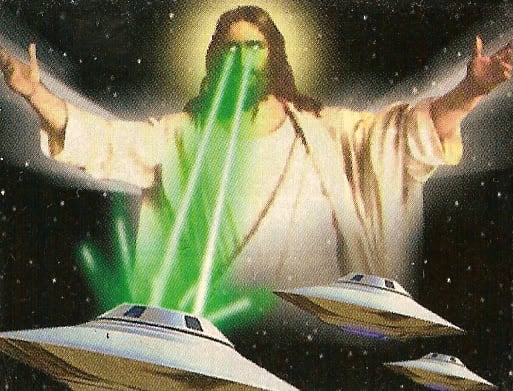
Google “Jesus in space.” Go ahead, I dare you.
(No copyright because this is one of those eternal internet memes whose author is untraceable.)
Some of you who have been following me on Twitter for a while know that I’ve had misgivings about C.S. Lewis. The Narnia stories never attracted me and his non-fiction work seemed like middlebrow popularization of basic theology–not that there’s anything wrong with that, quite to the contrary (I sometimes think we need that more than we need academic theology) but not something I felt any urgent need to read. And if I’m honest I’ll admit that there might have been a bit of anti-Protestant prejudice.
But then I was clued in that his academic work on literature is excellent. And an even more dangerous thing happened: when I read The Allegory of Love I was exposed to Lewis’s utterly excellent prose. And it’s a very dangerous thing for me to know that an author is not only smart but an outstanding prose writer because then I might just buy and read a book of his–any book–on impulse just for the pleasure of reading it. Kindle is very efficient in that way.
Plus I’ve always felt that it was and is criminal that we don’t have more Christian science-fiction. Plus I’d always had a nagging feeling that one day I would have to read Lewis’ fiction myself to know for sure what it was worth, but I didn’t want to commit myself for Narnia.
All of which is a long-winded way of saying that I bought and read C.S. Lewis’ Space Trilogy over the weekend. And since it’s over 700 pages that alone will tell you that I liked it.
Some thoughts (it’s probably a misnomer to call it a review).
Out of the Silent Planet: this is clearly a masterpiece, and in my view it can only be as a result of prejudice that it’s not mentioned in the same breath as other towering SF classics as Foundation and Dune. The plot, the imagination, the setting, the characters, the weaving in of Christian themes, the “big reveal” of what the whole thing is about, all of it is clearly outstanding.
Perelandra: This was the most disappointing of the three, by far. I think I’ll just quote my tweets in reaction:
- “Out of the Silent Planet” was Christian art; “Perelandra” was a catechetical lecture disguised as art.
- Two chapters of boring & absurd action; two chapters of expository dialogue. And on and on.
- Also maybe the word “presently” needs to be used more sparingly than once per page.
- (Consequence of the Fall: every author has tics, and once you’ve noticed one you can’t unnotice it, and each time you see it you flinch.)
- There were also many good things to the book. The planet itself mainly. But, as I said, a letdown.
- If I hadn’t read the first book this one would have confirmed my prejudice of Lewis as a middlebrow auteur of thinly-disguised propaganda.
- I don’t want to be too harsh: I did stay glued to the book well past my bedtime.
I don’t know that I can say much more without spoiling the book. It was just very disappointing.
That Hideous Strength: this is clearly the strangest of the three. I really liked it. But it’s just not science-fiction. Apart from the fact that it occurs in the near future (relative to the time when it was written) and takes for granted the SF-y aspects of the previous book, there is nothing of SF in it. Almost everything out-of-the-ordinary that happens does so because of magic or other supernatural forces, and not whiz-bang technology; the entire action occurs within a twenty-mile radius in the middle of England. Of course, in some sense this is an artificial distinction–with few exceptions, the technology in SF books is about as “realistic” as wizards and dragons. Fair enough. But genre conventions do exist, and here Lewis abandons them with all-but the most perfunctory nod. (As he did not in Out of the Silent Planet: there is a spaceship, creatures encountered on the other planet have their characteristics as a result of evolution, and with one exception they have natural, not supernatural powers, and so on.)
Now, I don’t condemn the book for that reason. I can’t begrudge Lewis for writing the book he wanted to write rather than the book I wanted to read; I must take the book on its own terms and let it succeed or fail on that basis, and on its own terms it succeeds quite well. I dare even say that in pure literary terms it’s the best of the three: it’s certainly the one with the deepest, most complex and best-drawn characters; the plot, with its many interlocking subplots, is carried perfectly and strains belief only slightly and rarely. But it’s still nonetheless strange to expect spaceships and to be given a story about the knights of the round table (and not even the knights of the round table in space!).
The overall impression is that Lewis’s heart was never into science-fiction. He decided to get into it for some reason–maybe he perceived the same lack as I did, maybe he wanted a challenge, maybe he lost a bet–and poured all his ideas and energy into the first book (and it is a testament to his talent that it worked so well) and found out that he was completely out of steam by the end, unable to write another page of science-fiction. But, being British, he kept calm and carried on, and wrote an allegory for book #2 and a fantasy tale for book #3.
I guess what I’m trying to say is that these are good books, even occasionally books with greatness, but that apart from Out of the Silent Planet they do little to alleviate our sad lack of good Christian SF.
Next Post
February 23, 2015 Is Science In Mortal Danger?
Browse Our Archives
Select a Category Elsewhere Mary New Distributism Parish of PEG Synod for the Famiy Theology of Women Uncategorized What I'm Reading
Select a Month June 2015 May 2015 April 2015 March 2015 February 2015 January 2015 December 2014 November 2014 October 2014 September 2014 August 2014 July 2014 June 2014 May 2014 April 2014 March 2014
Follow Us!
TAKE THE
Religious Wisdom Quiz
What happened to the prison doors when Paul and Silas were praying and singing hymns?
Select your answer to see how you score.
An earthquake shook the prison and the doors flew open They miraculously unlocked An angel opened them A guard opened them
Related posts from Inebriate Me


A Quick Note About What An Anathema Does...
When All Earthly Hopes Fade, That Old-Time Religion...

TRENDING AT PATHEOS Catholic

The Kingdom Of God In Ordinary Life And...
The kingdom of God is all around us; it is in us...

How Discretion Guides Us Away From Extremes
Prudence is an important virtue for all of us. While we should...

If Baptism Washes Away Sin, Why Do Catholics...
The seven sacraments stand as the foundation of Catholic ecclesial life. The...

The Power of Setting a Good Example
Remember last August when the Chicago White Sox hosted a "Pope Hat...

A Catholic Critique of Biblical Unitarianism
If the statistics are to be believed, Unitarianism is rising worldwide. Although...

How Grandma Tourism Helps Grandparents Live Their Vocation
Grandma, The New Travel Influencer What started as a nostalgia-inspired social media...
view all Catholic blogs
Ad-Free & Subscriber Log-In Subscription Support
- About Us
- 2026 Calendar
- Videos
- Podcasts
- Library of World Religions
- Faith In Media Tracker
- Advertise With Us
- Write for Us
- Privacy Policy
- Terms of Service
- Do Not Sell My Data
- Contact Us
- Radiant Digital
- Manage Newsletter Subscriptions
- Unsubscribe From Notifications
- Sitemap
Copyright 2008-2026, Patheos, part of the Radiant Digital network of media brands. All rights reserved.
Subscription Support Ad-Free & Subscriber Log-In
Follow Patheos