
BuddhistCatholicContemplativeEvangelicalGeneral ChristianHinduJewishLatter-day SaintMuslimNew VisionsProgressive Christian
Beliefs
- Buddhist
- Catholic
- Contemplative
- Evangelical
- General Christian
- Hindu
- Jewish
- Latter-day Saint
- More Voices
- Muslim
- New Visions
- Pagan
- Progressive Christian
Topics
- Religion News
- Food and Religion
- Sports and Religion
- Religious Art
- Religious Music and Entertainment
- Religious Events
- History and Religion
- Style and Religion
- Politics and Religion
- Women in Religion
- Recreation Outdoors and Religion
- Business Finance and Religion
- Careers Workplace and Religion
- Education and Religion
- Family Parenting and Religion
- Health Fitness and Religion
- Home and Religion
- Relationships and Religion
- Technology and Religion
- Travel and Religion
Columnists
- Buddhist Columnists
- Business Finance and Religion Columnists
- Careers Workplace and Religion Columnists
- Catholic Columnists
- Contemplative Columnists
- Education and Religion Columnists
- Evangelists Columnists
- Family Parenting and Religion Columnists
- General Christian Columnists
- Health Fitness and Religion Columnists
- Hindu Columnists
- History and Religion Columnists
- Home and Religion Columnists
- Jewish Columnists
- More Voices Columnists
- Latter Day Columnists
- Muslim Columnists
- New Visions Columnists
- Nonreligious Columnists
- Pagan Columnists
- Politics and Religion Columnists
- Progressive Columnists
- Recreation Outdoors and Religion Columnists
- Relationships and Religion Columnists
- Religion News Columnists
- Religious Art Columnists
- Religious Events Columnists
- Religious Music and Entertainment Columnists
- Sports and Religion Columnists
- Style and Religion Columnists
- Technology and Religion Columnists
- Travel and Religion Columnists
- Women in Religion Columnists
Resource Library
- 2026 Calendar
- Library of World Religions
- The 100 Most Holy Places on Earth
- Patheos Answers
- Podcasts
- Videos
- Faith Leaders Database
- Anglican Episcopalian
- Bahai
- Baptist
- Buddhism
- Christianity
- Confucianism
- Eastern Orthodoxy
- Hinduism
- Holiness and Pentecostal
- ISKCON
- Islam
- Judaism
- Lutheran
- Methodist
- The Church of Jesus Christ of Latter-day Saints
- New Age
- Paganism
- Presbytarian and Reformed
- Protestantism
- Religion Behind the Scenes
- Roman Catholic
- Scientology
- Shia Islam
- Sikhism
- Sufism
- Sunni Islam
- Taoism
- Zen
- See all religions
Research Tools
 Ad-Free & Subscriber Log-In Subscription Support
Ad-Free & Subscriber Log-In Subscription Support
Follow Patheos 

- Trending:
- Forgiveness
- |
- Marriage
- |
- Consciousness
- |
- Death Penalty
- |
- Election
- |
- Halloween
 Inebriate Me
- Home
- Catholic
- The Theophany And The God Who Wants To Be Laid Hands On
The Theophany And The God Who Wants To Be Laid Hands On
Last updated on: January 14, 2015 at 10:46 am by Pascal-Emmanuel Gobry
The Theophany And The God Who Wants To Be Laid Hands On 2015-01-14T10:46:32+01:00 Pascal-Emmanuel Gobry
Patheos Explore the world's faith through different perspectives on religion and spirituality! Patheos has the views of the prevalent religions and spiritualities of the world.
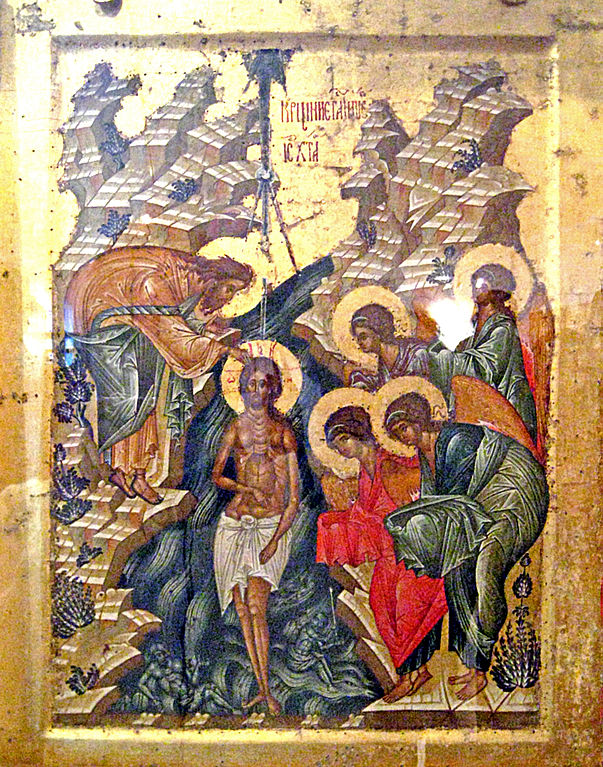
I wanted to write this earlier in the week but the Charlie Hebdo events have made it harder for me to write… It’s still the week of the Baptism of our Lord so it’s okay!
According to Hans Urs von Balthasar, who Karl Barth thought was the theologian who best understood him, Barth’s objection to Catholicism can be summed up like this: Catholicism, through its claims of infallibility, through the ex opere operato working of the sacraments, through the analogia Entis, represents an attempt “to lay hands on God”, the God who cannot be constrained. (At this point, even the irenic and scrupulously fair Balthasar cannot help a bit of snark: what does the Protestant doctrine of assurance of salvation represent, he wonders, if not an attempt to “lay hands on God”?)
Our Orthodox brethren call the feast of the Baptism of the Lord “the Theophany”, which means the (self-)revelation of God. And it is obvious why: during the baptism, as recorded in the Gospel, we hear Jesus described by God as his Son, and we see a revelation of the Trinity, with the Father blessing the Son in the descent of the Spirit. But there is a more profound meaning: the story of the Baptism doesn’t just tell us about the that of God, but the who. The events of the Baptism reveal to us not just “brute facts” about God (Jesus is the Incarnate Word; God is Father, Son and Spirit) but it also tells us about the “character” of God, what “kind” of God he is.
And the God incarnate in Jesus Christ revealed at the Baptism is a God who wants to be laid hands on, quite literally. John the Baptist balked, but Jesus insisted. He insisted in all his meekness and humility. (I love the short reflection Fr Martin, SJ offered on Twitter: “Think about it. God waited in line.”)
The standard line about Jesus’ Baptism is that he chose to be baptized even though he didn’t need to be in order to express his solidarity with sinful humanity. That is certainly true, but it only scratches the surface of the mystery of this astonishing event. We cannot contemplate this enough. Jesus, the Second Person of the Holy Trinity, the Logos through whom everything was made and without whom nothing was made, the Incarnate Deity, submitted to an earthly authority, a Jewish Prophet, asking for water baptism. This is the mystery of the Theophany, which is the mystery of the Gospel and of the Incarnation: God’s condescension, God’s self-abasement for our sakes.
Any metaphysically coherent creator God is transcendent, ineffable, unutterable, incomprehensible, and of course all Christians affirm these classical attributes of God. But the uniqueness of God’s self-revelation in Jesus Christ is precisely what it says about God on top of those classical attributes, and how this self-revelation redefines these classical attributes. The Christian focus is not on the attributes that God shares with the God of the other great theistic faiths or the God of the philosophers. Of course God is incomprehensible–but he made himself comprehensible. Of course God cannot be laid hands on–and yet he wants to be laid hands on, and makes it possible. God’s incomprehensibility is not an arbitrariness, since God himself has told us that He is the Logos and so cannot but act according to reason and the unconditioned good. The Divine Liturgy asks us to see the Lord’s Baptism within the context of the Isaianic prophecies of the renewal of the Covenant: God’s meekness opens the door to a new way of life, characterized precisely by this same humility and loving-kindness.
This Theophany–and Barth’s balking–remind me of nothing so much than the washing of the feet. Which I believe is no coincidence, since the greatest Theophany, God’s most self-revealing act, is the Paschal mystery. Here, so to speak, the contradictions are heightened even further. God does not just stand in line. God does not just submit to Baptism. He wants to wash our feet. And Peter balks, like Barth. We do not want to lay hands on God, however much he wants us to. It is too much. “You call me Teacher and Lord—and you are right, for that is what I am.” And yet he washed our feet. It is because of these classical attributes of God that the Christian difference is so striking. Later: “I do not call you slaves any longer, because the slave does not know what the master is doing; but I have called you friends, because I have made known to you everything that I have heard from my Father.” Friends! Friends! The slave does not know what the master is doing. But he has made known to us everything.
This is the self-same God who wants to be laid hands on who says to the eleven apostles “All authority in heaven and on earth has been given to me. Go therefore and make disciples of all nations, baptizing them in the name of the Father and of the Son and of the Holy Spirit, and teaching them to obey everything that I have commanded you.” and “If you forgive the sins of any, they are forgiven them; if you withhold forgiveness from any, it is withheld.” and “Peter, you are Peter, and on this rock I shall build my Church” and “Saul, why are you persecuting me?” and “Whosoever eats my flesh and drinks my blood abides in me, and I in them”; a God who rolls the dice of salvation history, who gives radical trust to us, to human beings, and therefore to the Church, and gives it authority; the Emmanuel God who never stopped dwelling among us, whose body the Church, and whose body the Eucharist, is not some docetic abstraction but an actual body, who speaks, recognizably present in time and space.
Let me tell you a story. Here’s how I understood papal infallibility when I was a small child. The Pope could stand in front of the mirror and say “I hereby ex cathedra declare that God is not Triune” and everything would simply blink out of existence; since God has given the Pope the authority to define the truth, and since God can only be Triune, He would have no choice but to stop existing, like a computer crashed by a divide by zero error, and so would the Universe he sustains into existence. God gave the Church authority to make things so. I wouldn’t defend that proposition today, but I will certainly defend the sentiment it was based on: God’s radical trust in humanity, in human beings, the radical humility of the Biblical God who works through his creatures.
There is a frightful and seemingly unstoppable tendency within Protestantism, at least Calvinistic. Since everything is about justification (the Church stands or falls!) and since everything is about “grace”, since everything is brought down to that one-dimensional spectrum, there is a perverse rhetoric that unfolds. The more depraved and rebellious and sinful man is, the more astonishing grace is. The more distant and unapproachable and incomprehensible and righteously wrathful God is, the more astonishing grace is. God cannot be laid hands on because then that one-dimensional picture would be revealed as multi-dimensional. This is the dreadful paradox. Calvin’s merciless pseudo-logic creates an anti-Biblical monster who actively predestines people to Hell for no reason other than he wants to, a God whose salvific blood is only for the elect (because otherwise it wouldn’t be “grace”!). If God wanted to be laid hands on, if there was this wonderful symphonic and covenantal play of co-working with grace, if we could be friends and not slaves to God, in the freedom of our Imago Dei which is participation in the absolute divine freedom, then, from the point of view of the Calvinistic zero-sum game, “grace” is threatened. Perfectly consistent, perfectly absurd, perfectly incongruent with Biblical Revelation and the God revealed in Jesus Christ.
Yes, Catholicism lays hands on God, because the God revealed in Jesus Christ, the Lamb of God, gave commission to do so.
Previous Post

January 13, 2015
Listen to Leah Libresco Pick Fights In Good Faith
Next Post
January 14, 2015 Meister Eckhart And The Noble Man
Browse Our Archives
Select a Category Elsewhere Mary New Distributism Parish of PEG Synod for the Famiy Theology of Women Uncategorized What I'm Reading
Select a Month June 2015 May 2015 April 2015 March 2015 February 2015 January 2015 December 2014 November 2014 October 2014 September 2014 August 2014 July 2014 June 2014 May 2014 April 2014 March 2014
Follow Us!
TAKE THE
Religious Wisdom Quiz
Who said, "Am I not sending you?"
Select your answer to see how you score.
Jesus Moses Elijah God
Related posts from Inebriate Me


A Quick Note About What An Anathema Does...

When All Earthly Hopes Fade, That Old-Time Religion...

TRENDING AT PATHEOS Catholic

Creation, Preservation, and Teleology in Catholic Theology
As I write this, it is very early Monday morning. Like millions...

The Parable Of The Sower And The Word...
One of Christ’s most famous parables is that of the sower who...

Rejecting Doom: Christian Hope And Human Action
Christianity is a religion of hope. We are to have hope and...

Why I Choose the Eucharist Over the Sermon
Choose the Eucharist, Not the Sermon What are we supposed to get...

5 Design Elements Found in Spiritually Rooted Homes
Putting Spirituality Into Home Decor Our homes are more than our living...

Credo: A Story of God Told with the...
About 10 years ago, I began to imagine a personal "Credo" that...
view all Catholic blogs
Ad-Free & Subscriber Log-In Subscription Support
- About Us
- 2026 Calendar
- Videos
- Podcasts
- Library of World Religions
- Faith In Media Tracker
- Advertise With Us
- Write for Us
- Privacy Policy
- Terms of Service
- Do Not Sell My Data
- Contact Us
- Radiant Digital
- Manage Newsletter Subscriptions
- Unsubscribe From Notifications
- Sitemap
Copyright 2008-2026, Patheos. All rights reserved.
Subscription Support Ad-Free & Subscriber Log-In
Follow Patheos