
BuddhistCatholicContemplativeEvangelicalGeneral ChristianHinduJewishLatter-day SaintMuslimNew VisionsProgressive Christian
Beliefs
- Buddhist
- Catholic
- Contemplative
- Evangelical
- General Christian
- Hindu
- Jewish
- Latter-day Saint
- More Voices
- Muslim
- New Visions
- Pagan
- Progressive Christian
Topics
- Religion News
- Food and Religion
- Sports and Religion
- Religious Art
- Religious Music and Entertainment
- Religious Events
- History and Religion
- Style and Religion
- Politics and Religion
- Women in Religion
- Recreation Outdoors and Religion
- Business Finance and Religion
- Careers Workplace and Religion
- Education and Religion
- Family Parenting and Religion
- Health Fitness and Religion
- Home and Religion
- Relationships and Religion
- Technology and Religion
- Travel and Religion
Columnists
- Buddhist Columnists
- Business Finance and Religion Columnists
- Careers Workplace and Religion Columnists
- Catholic Columnists
- Contemplative Columnists
- Education and Religion Columnists
- Evangelists Columnists
- Family Parenting and Religion Columnists
- General Christian Columnists
- Health Fitness and Religion Columnists
- Hindu Columnists
- History and Religion Columnists
- Home and Religion Columnists
- Jewish Columnists
- More Voices Columnists
- Latter Day Columnists
- Muslim Columnists
- New Visions Columnists
- Nonreligious Columnists
- Pagan Columnists
- Politics and Religion Columnists
- Progressive Columnists
- Recreation Outdoors and Religion Columnists
- Relationships and Religion Columnists
- Religion News Columnists
- Religious Art Columnists
- Religious Events Columnists
- Religious Music and Entertainment Columnists
- Sports and Religion Columnists
- Style and Religion Columnists
- Technology and Religion Columnists
- Travel and Religion Columnists
- Women in Religion Columnists
Resource Library
- 2026 Calendar
- Library of World Religions
- The 100 Most Holy Places on Earth
- Patheos Answers
- Podcasts
- Videos
- Faith Leaders Database
- Anglican Episcopalian
- Bahai
- Baptist
- Buddhism
- Christianity
- Confucianism
- Eastern Orthodoxy
- Hinduism
- Holiness and Pentecostal
- ISKCON
- Islam
- Judaism
- Lutheran
- Methodist
- The Church of Jesus Christ of Latter-day Saints
- New Age
- Paganism
- Presbytarian and Reformed
- Protestantism
- Religion Behind the Scenes
- Roman Catholic
- Scientology
- Shia Islam
- Sikhism
- Sufism
- Sunni Islam
- Taoism
- Zen
- See all religions
Research Tools
 Ad-Free & Subscriber Log-In Subscription Support
Ad-Free & Subscriber Log-In Subscription Support
Follow Patheos 

- Trending:
- Forgiveness
- |
- Marriage
- |
- Consciousness
- |
- Death Penalty
- |
- Election
- |
- Halloween
 Inebriate Me
- Home
- Catholic
- The Real Problem In Apologetics
The Real Problem In Apologetics
Last updated on: January 30, 2015 at 7:05 pm by Pascal-Emmanuel Gobry
The Real Problem In Apologetics 2015-01-30T19:05:45+01:00 Pascal-Emmanuel Gobry
Patheos Explore the world's faith through different perspectives on religion and spirituality! Patheos has the views of the prevalent religions and spiritualities of the world.
Forget about history, philosophy and theology for a moment.
Think instead about people’s basic, social, everyday commonsense experience.
I step outside my front door, and I see cars. I see tall buildings. I see concrete. I have been on planes. I have been in hospitals, waiting in anxiety on a medical doctor’s judgement. I have seen loved ones receive routine treatments for ailments that would have killed them a hundred years ago. My home has heating, running water, electricity, the internet. My main problem with regard to food is trying not to get too fat. I have seen video streamed live from space.
The reason why all these things are true is because the scientific revolution happened. “Science”–I am speaking extremely generally, here–has accomplished an enormous amount. When I put my family on a plane, I am trusting science with my life and the life of those whom I love most dearly to accomplish the nearly-unthinkable feat of very reliably lifting and maintaining hundreds of tons of steel into the air at tremendous speeds. And I don’t think even twice about it. That’s how much I trust “science.”
And “science” hasn’t found evidence of God. Nevermind that it’s outside its epistemological remit–I am talking about basic, common sense experience of every day people. Science hasn’t found evidence of God, and it works just as well without the God hypothesis. And science just works. It just works, man! I flip on the light switch, and light comes on. I am writing this on a computer connected to the internet. All that stuff works. Science makes these incredible claims, and it just delivers on them, man. And while I may know that science may not require or indeed even be compatible with a doctrinaire materialism, it certainly has a tendency to lead the only-casually-thinking mind more towards immanentism than towards (say) platonism.
Now, what about Christianity? Well, it makes claims about God, and about the life, death and resurrection of Jesus Christ, but those are pretty remote from my everyday experience. Not everyone walks around with a mystical awareness of the presence of God in them; not everyone has the time to read The Resurrection of the Son of God and Jesus and the Eyewitnesses.
How else could I know Christianity is true, at the everyday experience level? Well, the Gospel of John gives me a standard by which to judge that: “By this everyone will know that you are my disciples, if you have love for one another.”
Is the supererogatory love of Christians really that obvious? Am I bombarded by evidence the holiness of Christians and of the Holy Spirit in the same way that I am bombarded, all day, every day, everywhere I look, by the evidence of the world-bestriding success of science?
People, yes, do form beliefs on the basis of reason, and grace. But people also form beliefs on the basis of the cumulative impact of countless experiences, of the sort of “background noise” of life that gives rise to particular inclinations of common sense that make some worldviews seem more plausible than others, some more attractive than others.
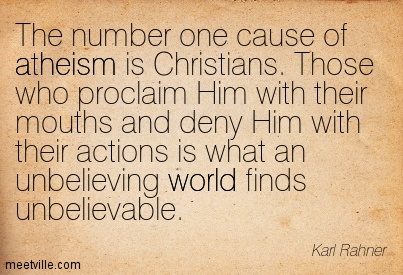
Just like evidence for “science” is not just in a lecture on physics but in the fact that nobody even thinks about it when they turn on the light, the evidence for “Christianity” is not just in the Gospels and the cosmological argument, it is also in, well, actually existing Christianity. Christianity is made plausible–perhaps more than anything else–when people see in Christians the manifestation of something, well, otherworldly, something so extraordinary that it begs for a supernatural explanation. Are we really delivering on that promise? On that divine command?
Science said it can put a man on the Moon. Christianity said it could make men Christlike. Who has the better track record?
This, this, is our real challenge in apologetics. And increasingly, I fear that much of the work that is being done in apologetics and perhaps even theology generally is meant to distract us from this much more fundamental, much more arduous problem.
Previous Post

January 30, 2015
What's Right About Rights
Next Post
January 31, 2015 If Catholics Want To Play Politics, They Should Learn The Chicago Way
Browse Our Archives
Select a Category Elsewhere Mary New Distributism Parish of PEG Synod for the Famiy Theology of Women Uncategorized What I'm Reading
Select a Month June 2015 May 2015 April 2015 March 2015 February 2015 January 2015 December 2014 November 2014 October 2014 September 2014 August 2014 July 2014 June 2014 May 2014 April 2014 March 2014
Follow Us!
TAKE THE
Religious Wisdom Quiz
Which book of the Bible ends with the word 'Amen'?
Select your answer to see how you score.
Philippians Jude Romans Revelation
Related posts from Inebriate Me


A Quick Note About What An Anathema Does...

When All Earthly Hopes Fade, That Old-Time Religion...

TRENDING AT PATHEOS Catholic

Rejecting Doom: Christian Hope And Human Action
Christianity is a religion of hope. We are to have hope and...

It’s What Comes From Within Which Matters
One of the most difficult things for us to understand is why...

Why I Choose the Eucharist Over the Sermon
Choose the Eucharist, Not the Sermon What are we supposed to get...

5 Design Elements Found in Spiritually Rooted Homes
Putting Spirituality Into Home Decor Our homes are more than our living...

Credo: A Story of God Told with the...
About 10 years ago, I began to imagine a personal "Credo" that...

The Anatomy of Divine Revelation in Catholic Thought
The claim that God has made Himself known to human beings is...
view all Catholic blogs
Ad-Free & Subscriber Log-In Subscription Support
- About Us
- 2026 Calendar
- Videos
- Podcasts
- Library of World Religions
- Faith In Media Tracker
- Advertise With Us
- Write for Us
- Privacy Policy
- Terms of Service
- Do Not Sell My Data
- Contact Us
- Radiant Digital
- Manage Newsletter Subscriptions
- Unsubscribe From Notifications
- Sitemap
Copyright 2008-2026, Patheos. All rights reserved.
Subscription Support Ad-Free & Subscriber Log-In
Follow Patheos