
BuddhistCatholicContemplativeEvangelicalGeneral ChristianHinduJewishLatter-day SaintMuslimNew VisionsProgressive Christian
Beliefs
- Buddhist
- Catholic
- Contemplative
- Evangelical
- General Christian
- Hindu
- Jewish
- Latter-day Saint
- More Voices
- Muslim
- New Visions
- Pagan
- Progressive Christian
Topics
- Religion News
- Food and Religion
- Sports and Religion
- Religious Art
- Religious Music and Entertainment
- Religious Events
- History and Religion
- Style and Religion
- Politics and Religion
- Women in Religion
- Recreation Outdoors and Religion
- Business Finance and Religion
- Careers Workplace and Religion
- Education and Religion
- Family Parenting and Religion
- Health Fitness and Religion
- Home and Religion
- Relationships and Religion
- Technology and Religion
- Travel and Religion
Columnists
- Buddhist Columnists
- Business Finance and Religion Columnists
- Careers Workplace and Religion Columnists
- Catholic Columnists
- Contemplative Columnists
- Education and Religion Columnists
- Evangelists Columnists
- Family Parenting and Religion Columnists
- General Christian Columnists
- Health Fitness and Religion Columnists
- Hindu Columnists
- History and Religion Columnists
- Home and Religion Columnists
- Jewish Columnists
- More Voices Columnists
- Latter Day Columnists
- Muslim Columnists
- New Visions Columnists
- Nonreligious Columnists
- Pagan Columnists
- Politics and Religion Columnists
- Progressive Columnists
- Recreation Outdoors and Religion Columnists
- Relationships and Religion Columnists
- Religion News Columnists
- Religious Art Columnists
- Religious Events Columnists
- Religious Music and Entertainment Columnists
- Sports and Religion Columnists
- Style and Religion Columnists
- Technology and Religion Columnists
- Travel and Religion Columnists
- Women in Religion Columnists
Resource Library
- 2026 Calendar
- Library of World Religions
- The 100 Most Holy Places on Earth
- Patheos Answers
- Podcasts
- Videos
- Faith Leaders Database
- Anglican Episcopalian
- Bahai
- Baptist
- Buddhism
- Christianity
- Confucianism
- Eastern Orthodoxy
- Hinduism
- Holiness and Pentecostal
- ISKCON
- Islam
- Judaism
- Lutheran
- Methodist
- The Church of Jesus Christ of Latter-day Saints
- New Age
- Paganism
- Presbytarian and Reformed
- Protestantism
- Religion Behind the Scenes
- Roman Catholic
- Scientology
- Shia Islam
- Sikhism
- Sufism
- Sunni Islam
- Taoism
- Zen
- See all religions
Research Tools
 Ad-Free & Subscriber Log-In Subscription Support
Ad-Free & Subscriber Log-In Subscription Support
Follow Patheos 

- Trending:
- Forgiveness
- |
- Marriage
- |
- Consciousness
- |
- Death Penalty
- |
- Election
- |
- Halloween
 Inebriate Me
- Home
- Catholic
- Clearing Up The Most Common Two Misconceptions About Transubstantiation
Clearing Up The Most Common Two Misconceptions About Transubstantiation
Last updated on: December 1, 2014 at 1:31 pm by Pascal-Emmanuel Gobry
Clearing Up The Most Common Two Misconceptions About Transubstantiation 2014-12-01T13:31:20+01:00 Pascal-Emmanuel Gobry
Patheos Explore the world's faith through different perspectives on religion and spirituality! Patheos has the views of the prevalent religions and spiritualities of the world.
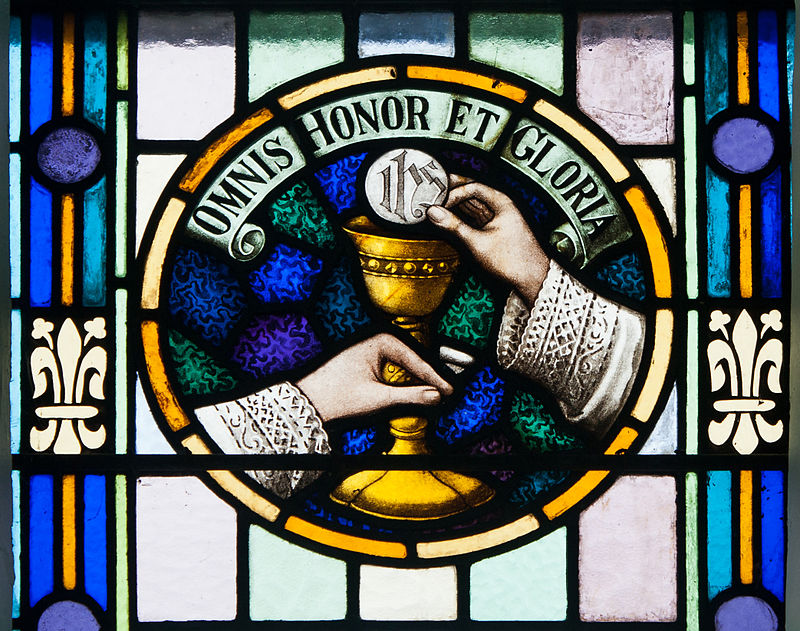
You often see silly things said or written about the doctrine of the transubstantiation of bread and wine into the flesh of our Lord, so I want to clear up what seem to me to be the two most common misconceptions. Instead of what you might read,
1. Transubstantiation Is Just Another Word For The Real Presence
The doctrine of transubstantiation does not say anything that was not said in the Patristic era, and indeed in the New Testament, about the Eucharist: that the bread and wine really do become the body and blood of Jesus Christ (“is” means “is”), and that while nothing is changed of the physical attributes or elements or “accidents” of the eucharistic bread and wine, there is a change in nature or “substance.” This is the apostolic teaching, which we find in the Synoptic Passover narratives, in John 6, in First Corinthians, in the Didache, in Ignatius of Antioch, in Justin Martyr, and so on. The doctrine of transubstantiation merely uses Aristotelian language to express the same thing that the Bible and the Fathers say. It’s always baffling to me to see so much confusion on this point, which ought to be obvious if you actually understand the doctrine: it really says nothing else, and to pretend that it does seems to me to can come only from confusion or willful misreading.
2. Transubstantiation Is Not The Only Catholic Doctrine Of The Real Presence
The Trent Fathers were well aware that the Fathers did not use the word transubstantiation, and the Council of Trent’s teaching on transubstantiation (as on pretty much everything else) is much more nuanced than most critics give it credit for.
Here is the ascetic economy of Chapter IV of Session XIII:
And because that Christ, our Redeemer, declared that which He offered under the species of bread to be truly His own body, therefore has it ever been a firm belief in the Church of God, and this holy Synod doth now declare it anew, that, by the consecration of the bread and of the wine, a conversion is made of the whole substance of the bread into the substance of the body of Christ our Lord, and of the whole substance of the wine into the substance of His blood; which conversion is, by the holy Catholic Church, suitably and properly called Transubstantiation.
The word “conversion”, or “change,” is the typical Patristic expression, and the only thing that this says is that it is “suitable” and “proper” to call this transubstantiation.
Notice what it doesn’t say: it doesn’t say that it’s the only way you can talk about the Real Presence; it doesn’t even say it’s the best way; it only says that if you say transubstantiation is wrong, you’re wrong. You can be a perfectly faithful Catholic and never talk about transubstantiation, never think about it, never discuss it (as indeed countless have and perhaps still do), use completely different language to talk about the Real Presence (which would be speculative if this language is not Patristic, but there is certainly no a priori ban on non-transubstantiation language). Transubstantiation is not “the” Catholic teaching on the Eucharist, it is “a” teaching–one which is valid, one which is “suitable” and “proper”, but it is certainly not, to coin a phrase, the article on which the Catholic doctrine of the Eucharist stands or falls.
For my part, I tend to think that undue focus on transubstantiation is basically a distraction. Again, as a restatement of the classical apostolic faith, if understood–if the categories it uses are neither confused nor reified–, it can be clarifying, and I embrace it wholeheartedly. But–as Aquinas emphasized–it is a restatement of a teaching on a mystery which is fundamentally incomprehensible, and of such beauty and goodness and truth that all flesh should really fall silent.
And, really, if you have a problem with the doctrine of the Real Presence, there is only one good remedy for you: Eucharistic Adoration. No, seriously. Go, go.
Previous Post

November 27, 2014
Was Ayn Rand A Secret Altruist?
Next Post
December 2, 2014 Book Review(ish): David Bentley Hart, "The Beauty of the Infinite"
Browse Our Archives
Select a Category Elsewhere Mary New Distributism Parish of PEG Synod for the Famiy Theology of Women Uncategorized What I'm Reading
Select a Month June 2015 May 2015 April 2015 March 2015 February 2015 January 2015 December 2014 November 2014 October 2014 September 2014 August 2014 July 2014 June 2014 May 2014 April 2014 March 2014
Follow Us!
TAKE THE
Religious Wisdom Quiz
What is the Bible's teaching on contentment?
Select your answer to see how you score.
Complain Always want more Never rest Be content with what you have
Related posts from Inebriate Me


A Quick Note About What An Anathema Does...

When All Earthly Hopes Fade, That Old-Time Religion...

TRENDING AT PATHEOS Catholic

Rejecting Doom: Christian Hope And Human Action
Christianity is a religion of hope. We are to have hope and...

It’s What Comes From Within Which Matters
One of the most difficult things for us to understand is why...

Why I Choose the Eucharist Over the Sermon
Choose the Eucharist, Not the Sermon What are we supposed to get...

5 Design Elements Found in Spiritually Rooted Homes
Putting Spirituality Into Home Decor Our homes are more than our living...

Credo: A Story of God Told with the...
About 10 years ago, I began to imagine a personal "Credo" that...

The Anatomy of Divine Revelation in Catholic Thought
The claim that God has made Himself known to human beings is...
view all Catholic blogs
Ad-Free & Subscriber Log-In Subscription Support
- About Us
- 2026 Calendar
- Videos
- Podcasts
- Library of World Religions
- Faith In Media Tracker
- Advertise With Us
- Write for Us
- Privacy Policy
- Terms of Service
- Do Not Sell My Data
- Contact Us
- Radiant Digital
- Manage Newsletter Subscriptions
- Unsubscribe From Notifications
- Sitemap
Copyright 2008-2026, Patheos. All rights reserved.
Subscription Support Ad-Free & Subscriber Log-In
Follow Patheos