
BuddhistCatholicContemplativeEvangelicalGeneral ChristianHinduJewishLatter-day SaintMuslimNew VisionsProgressive Christian
Beliefs
- Buddhist
- Catholic
- Contemplative
- Evangelical
- General Christian
- Hindu
- Jewish
- Latter-day Saint
- More Voices
- Muslim
- New Visions
- Pagan
- Progressive Christian
Topics
- Religion News
- Food and Religion
- Sports and Religion
- Religious Art
- Religious Music and Entertainment
- Religious Events
- History and Religion
- Style and Religion
- Politics and Religion
- Women in Religion
- Recreation Outdoors and Religion
- Business Finance and Religion
- Careers Workplace and Religion
- Education and Religion
- Family Parenting and Religion
- Health Fitness and Religion
- Home and Religion
- Relationships and Religion
- Technology and Religion
- Travel and Religion
Columnists
- Buddhist Columnists
- Business Finance and Religion Columnists
- Careers Workplace and Religion Columnists
- Catholic Columnists
- Contemplative Columnists
- Education and Religion Columnists
- Evangelists Columnists
- Family Parenting and Religion Columnists
- General Christian Columnists
- Health Fitness and Religion Columnists
- Hindu Columnists
- History and Religion Columnists
- Home and Religion Columnists
- Jewish Columnists
- More Voices Columnists
- Latter Day Columnists
- Muslim Columnists
- New Visions Columnists
- Nonreligious Columnists
- Pagan Columnists
- Politics and Religion Columnists
- Progressive Columnists
- Recreation Outdoors and Religion Columnists
- Relationships and Religion Columnists
- Religion News Columnists
- Religious Art Columnists
- Religious Events Columnists
- Religious Music and Entertainment Columnists
- Sports and Religion Columnists
- Style and Religion Columnists
- Technology and Religion Columnists
- Travel and Religion Columnists
- Women in Religion Columnists
Resource Library
- 2026 Calendar
- Library of World Religions
- The 100 Most Holy Places on Earth
- Patheos Answers
- Podcasts
- Videos
- Faith Leaders Database
- Anglican Episcopalian
- Bahai
- Baptist
- Buddhism
- Christianity
- Confucianism
- Eastern Orthodoxy
- Hinduism
- Holiness and Pentecostal
- ISKCON
- Islam
- Judaism
- Lutheran
- Methodist
- The Church of Jesus Christ of Latter-day Saints
- New Age
- Paganism
- Presbytarian and Reformed
- Protestantism
- Religion Behind the Scenes
- Roman Catholic
- Scientology
- Shia Islam
- Sikhism
- Sufism
- Sunni Islam
- Taoism
- Zen
- See all religions
Research Tools
 Ad-Free & Subscriber Log-In Subscription Support
Ad-Free & Subscriber Log-In Subscription Support
Follow Patheos 

- Trending:
- Forgiveness
- |
- Marriage
- |
- Consciousness
- |
- Death Penalty
- |
- Election
- |
- Halloween
 Inebriate Me
- Home
- Catholic
- In Defense Of Flagellation
In Defense Of Flagellation
Last updated on: November 14, 2014 at 12:00 pm by Pascal-Emmanuel Gobry
In Defense Of Flagellation 2014-11-14T12:00:47+01:00 Pascal-Emmanuel Gobry
Patheos Explore the world's faith through different perspectives on religion and spirituality! Patheos has the views of the prevalent religions and spiritualities of the world.
Fellow Patheosi Billy Kangas is a co-founder of the excellent theology website Theologues and its podcast Roundtable. I am listening to this episode, which deals with the “problem passages” of the Bible. This is not what this post is about.
During the podcast, the guests made several in-passing negative references to the monastic practice of self-flagellation, which were never challenged. In particular, they made a couple points: the first is that God, being fundamentally non-violent and opposed to suffering, could not condone such a practice; second, that monks who engage(d) in such a practice were trying to earn holiness. Yet we find that many great saints, who were in no dangers of such spiritual aberrations, nonetheless undertook this practice.
I would want to say a couple things, here.
The first is that, of course, today we have a very great awareness of the psychological harm caused by self-abuse (except for one kind of self-abuse, amirite) and masochism, and this is indeed something of which we should be aware, and indeed all the great Catholic spiritual writers emphasize that self-mortification should only happen within the context of wise, discerning spiritual guidance. So, absolutely, it is possible for flagellation to be the product of psychological disorder (or, indeed, just everyday pride), and awareness of this is necessary.
That being said, though, one aspect of human nature of which we recently have much less awareness is the need for us to discipline our passions through asceticism. Though we were washed of the stain of original sin by baptism, we remain concupiscent creatures, marred by the consequences of sin, and are called to engage in a lifelong process of healing from these, and to greater holiness. Though our bodies are indeed good, our flesh, that is, those aspects of our nature that tempt us to sin, are not. And in order to be truly free, that is to say, truly alive, that is to say, in the image of God, we need to engage in spiritual warfare against the flesh. Christians are called on the path to self-mastery, and it is not possible to walk that path without a confrontation with the flesh. We are called to discipline our appetites, to discipline and mortify our flesh, and ascetic practices undertaken with that goal in mind are virtuous–indeed, necessary.
We must always keep in mind that the Christian way is that where sin abounds, grace superabounds. In other words, asceticism must always be undertaken out of love and for love, and most spiritual warfare against the passions will be a kind of indirect warfare, that of strengthening the good and the true and the beautiful within us so as to “squeeze out” or suffocate the appetites of the flesh. That being said, it is unrealistic to think that direct confrontation can or indeed should always be avoided.
Undertaken within the right context, and with the right goals, then, mortification of the flesh, can usefully remind us of our mortality, of our bodily and creaturely nature, and be a useful weapon in spiritual warfare. Catholicism–Christianity–is a religion of the real, of the Earth, of incarnation, of the tactile. For us the crucifix, not the bare cross. The nails. The crown of thorns. The battered body. These are realities, not abstractions. “Blood of Christ, inebriate me; Water from the side of Christ, wash me; Within Thy wounds, hide me.”
I would say another very important thing: flagellation is typically undertaken as a kind of penance. Within Catholic theology, penance is not undertaken as a way to “earn” forgiveness, but rather as a sacrifice of thanksgiving for the forgiveness graciously and undeservedly granted.
And penance finds its wonderful place within the great Christian symphony, because it is a way for us to conform ourselves to Christ. Christ suffered for our sakes, and suffered as a thanksgiving sacrifice to the Father, thereby smashing the power of sin and death, overwhelming them with an invincible flood of divine love. Christ, the new Adam, the true man, is our brother, and we receive the merits of his Passion and Cross because he is in solidarity with us and us with him. Thus, when we suffer in solidarity with his Passion and Cross, when we are scourged as he was scourged, in a true spirit of faith, we receive graces, not in the sense that we earn benefits, but in the sense that grace is what perfects nature, and that when we are, by the Spirit, more conformed to Christ, our nature is perfected. Christ, the true man, did not regard his equality with God as a thing to be cherished, but rather emptied himself, taking the form of a slave. Thus to be true men, we need to be emptied, emptied of pride, emptied of self-regard, emptied of vanity, so that we can be free of the slavery to the flesh into the true freedom which is slavery to love. Christians are not called to flee from suffering, as Christ did not, but rather to embrace it, to take it on, and thereby turn it into good.
While we Catholics have often misused or misunderstood our spiritual heritage, we are very often liable to be prisoners to an ethnocentric spirit of the age that simply assumes that it knows better than previous generations. The fact of the sensus fidelium and our need of the sentire cum Ecclesia compels us to look beyond our modern offense and spiritual practices we might sometimes like to forget and instead carefully discern what it is that men and women holier than us saw there. (Or to put it more shortly: “If Dan Brown disdains it, it’s probably good” is a good rule of thumb.)
With all these truths properly in mind, then, while it remains very easy for me to see how flagellation can be spiritually and psychologically harmful, it also becomes impossible for me to say that there are no people for whom it can be beneficial, and no cases where it can be spiritually beneficial.
(NB: In case anyone wonders, though it’s none of your business, I don’t practice self-flagellation.)
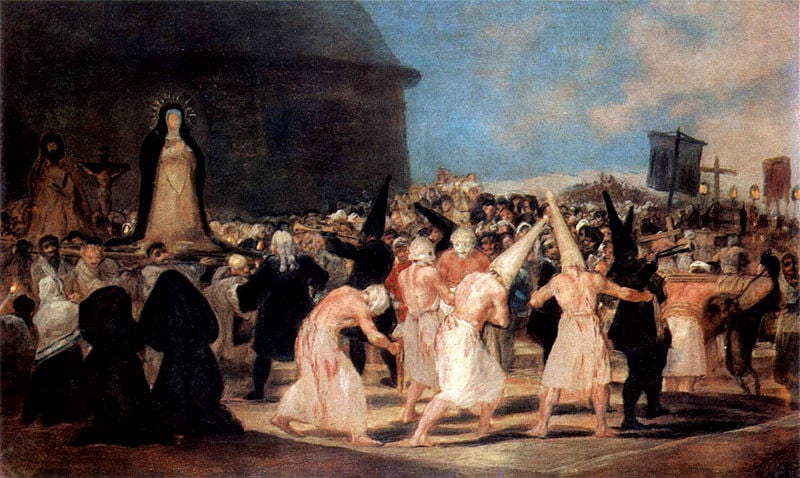
Illustration: Francisco Goya, A Procession of Flagellants, Public domain, via Wikimedia Commons

Previous Post

November 13, 2014
It's Not The Benedict Option, It's The Benedict Options
Next Post
November 14, 2014 The Rosary As Bible Study
Browse Our Archives
Select a Category Elsewhere Mary New Distributism Parish of PEG Synod for the Famiy Theology of Women Uncategorized What I'm Reading
Select a Month June 2015 May 2015 April 2015 March 2015 February 2015 January 2015 December 2014 November 2014 October 2014 September 2014 August 2014 July 2014 June 2014 May 2014 April 2014 March 2014
Follow Us!
TAKE THE
Religious Wisdom Quiz
What animal did Peter see in vision?
Select your answer to see how you score.
Sheep Lions Clean and unclean animals Goats
Related posts from Inebriate Me


A Quick Note About What An Anathema Does...

When All Earthly Hopes Fade, That Old-Time Religion...

TRENDING AT PATHEOS Catholic

Rejecting Doom: Christian Hope And Human Action
Christianity is a religion of hope. We are to have hope and...

It’s What Comes From Within Which Matters
One of the most difficult things for us to understand is why...

Why I Choose the Eucharist Over the Sermon
Choose the Eucharist, Not the Sermon What are we supposed to get...

5 Design Elements Found in Spiritually Rooted Homes
Putting Spirituality Into Home Decor Our homes are more than our living...

Credo: A Story of God Told with the...
About 10 years ago, I began to imagine a personal "Credo" that...

The Anatomy of Divine Revelation in Catholic Thought
The claim that God has made Himself known to human beings is...
view all Catholic blogs
Ad-Free & Subscriber Log-In Subscription Support
- About Us
- 2026 Calendar
- Videos
- Podcasts
- Library of World Religions
- Faith In Media Tracker
- Advertise With Us
- Write for Us
- Privacy Policy
- Terms of Service
- Do Not Sell My Data
- Contact Us
- Radiant Digital
- Manage Newsletter Subscriptions
- Unsubscribe From Notifications
- Sitemap
Copyright 2008-2026, Patheos. All rights reserved.
Subscription Support Ad-Free & Subscriber Log-In
Follow Patheos