
BuddhistCatholicContemplativeEvangelicalGeneral ChristianHinduJewishLatter-day SaintMuslimNew VisionsProgressive Christian
Beliefs
- Buddhist
- Catholic
- Contemplative
- Evangelical
- General Christian
- Hindu
- Jewish
- Latter-day Saint
- More Voices
- Muslim
- New Visions
- Pagan
- Progressive Christian
Topics
- Religion News
- Food and Religion
- Sports and Religion
- Religious Art
- Religious Music and Entertainment
- Religious Events
- History and Religion
- Style and Religion
- Politics and Religion
- Women in Religion
- Recreation Outdoors and Religion
- Business Finance and Religion
- Careers Workplace and Religion
- Education and Religion
- Family Parenting and Religion
- Health Fitness and Religion
- Home and Religion
- Relationships and Religion
- Technology and Religion
- Travel and Religion
Columnists
- Buddhist Columnists
- Business Finance and Religion Columnists
- Careers Workplace and Religion Columnists
- Catholic Columnists
- Contemplative Columnists
- Education and Religion Columnists
- Evangelists Columnists
- Family Parenting and Religion Columnists
- General Christian Columnists
- Health Fitness and Religion Columnists
- Hindu Columnists
- History and Religion Columnists
- Home and Religion Columnists
- Jewish Columnists
- More Voices Columnists
- Latter Day Columnists
- Muslim Columnists
- New Visions Columnists
- Nonreligious Columnists
- Pagan Columnists
- Politics and Religion Columnists
- Progressive Columnists
- Recreation Outdoors and Religion Columnists
- Relationships and Religion Columnists
- Religion News Columnists
- Religious Art Columnists
- Religious Events Columnists
- Religious Music and Entertainment Columnists
- Sports and Religion Columnists
- Style and Religion Columnists
- Technology and Religion Columnists
- Travel and Religion Columnists
- Women in Religion Columnists
Resource Library
- 2026 Calendar
- Library of World Religions
- The 100 Most Holy Places on Earth
- Patheos Answers
- Podcasts
- Videos
- Faith Leaders Database
- Anglican Episcopalian
- Bahai
- Baptist
- Buddhism
- Christianity
- Confucianism
- Eastern Orthodoxy
- Hinduism
- Holiness and Pentecostal
- ISKCON
- Islam
- Judaism
- Lutheran
- Methodist
- The Church of Jesus Christ of Latter-day Saints
- New Age
- Paganism
- Presbytarian and Reformed
- Protestantism
- Religion Behind the Scenes
- Roman Catholic
- Scientology
- Shia Islam
- Sikhism
- Sufism
- Sunni Islam
- Taoism
- Zen
- See all religions
Research Tools
 Ad-Free & Subscriber Log-In Subscription Support
Ad-Free & Subscriber Log-In Subscription Support
Follow Patheos 

- Trending:
- Forgiveness
- |
- Marriage
- |
- Consciousness
- |
- Death Penalty
- |
- Election
- |
- Halloween
 Inebriate Me
- Home
- Catholic
- Very Short And Partial Commentary On The Creed
Very Short And Partial Commentary On The Creed
Last updated on: July 16, 2014 at 4:27 pm by Pascal-Emmanuel Gobry
Very Short And Partial Commentary On The Creed 2014-07-16T16:27:24+01:00 Pascal-Emmanuel Gobry
Patheos Explore the world's faith through different perspectives on religion and spirituality! Patheos has the views of the prevalent religions and spiritualities of the world.
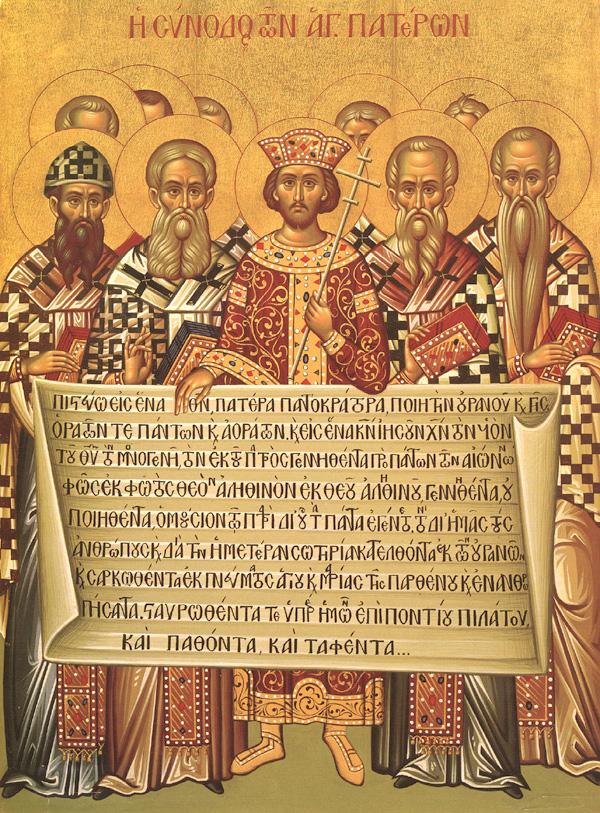
(The Nicene, of course.)
Is it possible to say the creed too much? I find myself praying it at all times, singing it in my head as I go about my daily tasks.
Credo in unum Deum,
The first word of the Creed is already a bombshell: “I believe.” This is a religious revolution, so profound that it takes it for granted. The new Christian religion is not an orthopraxy, it is an orthodoxy: you are a Christian because of what you believe, not what you do or where you were born or who your parents were. And the fundamental unit of the Christian religion is the individual. To be Christian, it is the individual who must respond to the prompting of the Holy Spirit with faith. Religion is the free choice of the individual, not social superstructure. The Credo starts from the individual to rise towards God. Credo, two syllables, to light the word on fire!
“in unum Deum”: again, the radicality, in the Pagan Mediterranean world. There is a stress, here: “Deum” is already a singular, but the Fathers emphasized it, hitting the nail as far as it will go. Christians are radical monotheists. We believe in one God.
Patrem omnipoténtem,
After his existence, and his oneness, what do we learn about this God? That He is Father. Father! All Christians must make theirs the cry of Jesus, “Abba, Father!” (“Abba” is even closer to “Daddy.”) And again it is revolutionary–the Fatherhood of God makes succinct appearances in the Old Testament, but it is Jesus who makes it central. Such richness in this imagery–which is not merely imagery, but dogmatic reality. God really is Father; it is human fatherhood which is a pale image of God’s perfect fatherhood. But we can always trust in God’s perfect fatherhood.
This makes God’s omnipotence a particular kind of omnipotence, because it is a fatherly omnipotence. In the classical ontology of God as expressed by figures such as Aquinas, God is not a capricious super-alien Overlord who can do whatever he wants. He acts only in accordance with his supreme goodness. Obviously, much, much, much more could be said. I recommend The Humility of God, by Fr. Varillon, SJ.
Factórem cæli et terræ,
Visibílium ómnium et invisibílium.
I am fascinated by this line of the “visibilium omnium et invisibilium.” The concept of omnium here is key. What is referred to here is not merely “all things” but a created order. The Universe is a cathedral, properly ordered by God. And this omnium has visible and invisible aspects. Or, if you prefer, there is an entire invisibilium omnium, as “big” and important as the material Universe.
From the contemporary perspective there is a natural boldness here which is quite refreshing. Note the Fathers don’t even ask you to believe in this invisible world: they would have taken it for granted; the question at issue is who created it. Even the pagans took for granted the invisibilium omnium. I am reminded of he great lapidary phrase from the First Vatican Council: “If anyone is so bold as to assert that there exists nothing besides matter: let him be anathema.” If anyone is so bold as to be a materialist! Indeed it is boldness, folly even, although it is obscured these days.
Et in unum Dóminum Iesum Christum,
Fílium Dei Unigénitum,
Et ex Patre natum ante ómnia sæcula.
i.e. “Thanks, John, for that Gospel! Really helpful!”
What is there to say, here? Either books or falling silent before the mysterium Christi.
Deum de Deo, lumen de lúmine, Deum verum de Deo vero,
I love this verse; especially in the Missa de Angelis Gregorian version, it soars with lyrical beauty, rising and lingering on the last words. What poetry! It is striking and revealing in itself that a formal Creed voted upon by an Ecumenical Council makes room for poetry, which is what this is (yes, it’s also there to say “Nyah nyah, Arians! Take this! And this!”), which itself tells you something about the nature of Christian truth. Alliteration, rhythm, transcendent beauty, this verse has everything. Transcendent beauty.
Génitum, non factum, consubstantiálem Patri:
More Arian-bashing. Those Fathers would have loved today’s blog-fights.
Per quem ómnia facta sunt.
Qui propter nos hómines et propter nostram salútem
Descéndit de cælis.
Et incarnátus est de Spíritu Sancto
Ex María Vírgine, et homo factus est.
Even when I’m singing the Creed to myself while doing the dishes, I bend on those last words. In the ordinary form of the Mass, we bow at “homo factus est”, and in the extraordinary form, we kneel for a bit longer. This is deep wisdom. Here is the deepest mystery, here is the most central truth of the Christian faith, the one on which everything else turns: the infinitely transcendent became the infinitely near.
Crucifíxus étiam pro nobis sub Póntio Piláto;
Passus, et sepúltus est,
Et resurréxit tértia die, secúndum Scriptúras,
Et ascéndit in cælum, sedet ad déxteram Patris.
This hits perfectly at every note. Jesus was crucified sub Pontio Pilato, meaning this really happened, in historical time, under these historical circumstances. It really happened. It is a fact, and we have documentation, and we believe that this is a historical fact; we do not believe in a spiritual or conceptual Jesus, but a man who lived and breathed and walked and died and rose again.
And he rose secundum Scripturas. (Take that, Marcion.) The entire testimony of Israel leads to and through Jesus (Jn 5:39)
More poetry: there is no literal “seat” “to the right” of the Father. The Creed combines historical assertion with poetic evocation. This is the Christian way.
Et íterum ventúrus est cum glória,
Iudicáre vivos et mórtuos,
Cuius regni non erit finis.
From Sr Ruth Burrows, OCD: “He is ‘judge of the living and the dead’ not in the sense that he assumes the role of a judge appraising the conduct of our lives, but in the sense that our only value lies in our likeness to him.”
Et in Spíritum Sanctum, Dóminum et vivificántem:
Qui ex Patre Filióque procédit.
Qui cum Patre et Fílio simul adorátur et conglorificátur:
Qui locútus est per prophétas.
One reason why I like the Nicene Creed so much over the Apostles Creed is because it tells us stuff about the Holy Spirit! The great unnoticed Person of the Trinity!
The Spirit is Lord and giver of life. Put that on your business card. At least, meditate on it. Lord and giver of life! He is everywhere, and everywhere he does good. Dominum et Vivificantem, by the way, is a great encyclical by St John Paul II which I recommend. He spoke through the prophets: he is everywhere in the Bible.
(Nope, not saying anything about the Filioque thing.)
Et unam, sanctam, cathólicam et apostólicam Ecclésiam.
One of my favorite parts of the Creed. Again, the Missa de angelis version has great musicality here, and there is great poetic rhythm to the phrase.
We are saved through the Church, which is the Body of Christ and our mother, and it is beautiful. The Church is indeed necessary for salvation (which means it is a key part of the plan of salvation), it was established by Jesus Christ our Lord himself for just this purpose, with hierarchy, dogma, constitution, doctrine visible unity, sacraments, and all the rest. It is the greatest thing that by the grace of God men made.
(It also never fails to remind me of Pope Boniface VIII’s excellent bull Unam Sanctam.)
And yes, I never stop being astonished that so many Protestants believe they can say the Nicene Creed, given what it says about the nature of the Church. You can lawyer your way out of “one” and “catholic” all you want, but there is no way to understand apostolicity as anything else than what, well, the apostolic churches believe it means. Anyone who knows a bit of Church history certainly knows that this is how the authors of the Creed themselves understood it.
Confíteor unum baptísma in remissiónem peccatorum.
Et expecto resurrectionem mortuorum,
Et vitam ventúri sæculi. Amen.
The life of the centuries to come! Jesus has come that we may have life, and have it to the full! Gloria Dei homo vivens!
Previous Post

July 15, 2014
On Bonaventure Day, A Sketch Of A Franciscan Theology Of Modernity
Next Post
July 17, 2014 #TrollSoHard Pastoring
Browse Our Archives
Select a Category Elsewhere Mary New Distributism Parish of PEG Synod for the Famiy Theology of Women Uncategorized What I'm Reading
Select a Month June 2015 May 2015 April 2015 March 2015 February 2015 January 2015 December 2014 November 2014 October 2014 September 2014 August 2014 July 2014 June 2014 May 2014 April 2014 March 2014
Follow Us!
TAKE THE
Religious Wisdom Quiz
Buy a field while the enemy besieges the city? I did this to demonstrate that houses and fields would again be bought in this land. Where was this property?
Select your answer to see how you score.
Jerusalem Bethlehem Shiloh Anathoth
Related posts from Inebriate Me


A Quick Note About What An Anathema Does...

When All Earthly Hopes Fade, That Old-Time Religion...

TRENDING AT PATHEOS Catholic

Rejecting Doom: Christian Hope And Human Action
Christianity is a religion of hope. We are to have hope and...

It’s What Comes From Within Which Matters
One of the most difficult things for us to understand is why...

Why I Choose the Eucharist Over the Sermon
Choose the Eucharist, Not the Sermon What are we supposed to get...

5 Design Elements Found in Spiritually Rooted Homes
Putting Spirituality Into Home Decor Our homes are more than our living...

Credo: A Story of God Told with the...
About 10 years ago, I began to imagine a personal "Credo" that...

The Anatomy of Divine Revelation in Catholic Thought
The claim that God has made Himself known to human beings is...
view all Catholic blogs
Ad-Free & Subscriber Log-In Subscription Support
- About Us
- 2026 Calendar
- Videos
- Podcasts
- Library of World Religions
- Faith In Media Tracker
- Advertise With Us
- Write for Us
- Privacy Policy
- Terms of Service
- Do Not Sell My Data
- Contact Us
- Radiant Digital
- Manage Newsletter Subscriptions
- Unsubscribe From Notifications
- Sitemap
Copyright 2008-2026, Patheos. All rights reserved.
Subscription Support Ad-Free & Subscriber Log-In
Follow Patheos