
BuddhistCatholicContemplativeEvangelicalGeneral ChristianHinduJewishLatter-day SaintMuslimNew VisionsProgressive Christian
Beliefs
- Buddhist
- Catholic
- Contemplative
- Evangelical
- General Christian
- Hindu
- Jewish
- Latter-day Saint
- More Voices
- Muslim
- New Visions
- Pagan
- Progressive Christian
Topics
- Religion News
- Food and Religion
- Sports and Religion
- Religious Art
- Religious Music and Entertainment
- Religious Events
- History and Religion
- Style and Religion
- Politics and Religion
- Women in Religion
- Recreation Outdoors and Religion
- Business Finance and Religion
- Careers Workplace and Religion
- Education and Religion
- Family Parenting and Religion
- Health Fitness and Religion
- Home and Religion
- Relationships and Religion
- Technology and Religion
- Travel and Religion
Columnists
- Buddhist Columnists
- Business Finance and Religion Columnists
- Careers Workplace and Religion Columnists
- Catholic Columnists
- Contemplative Columnists
- Education and Religion Columnists
- Evangelists Columnists
- Family Parenting and Religion Columnists
- General Christian Columnists
- Health Fitness and Religion Columnists
- Hindu Columnists
- History and Religion Columnists
- Home and Religion Columnists
- Jewish Columnists
- More Voices Columnists
- Latter Day Columnists
- Muslim Columnists
- New Visions Columnists
- Nonreligious Columnists
- Pagan Columnists
- Politics and Religion Columnists
- Progressive Columnists
- Recreation Outdoors and Religion Columnists
- Relationships and Religion Columnists
- Religion News Columnists
- Religious Art Columnists
- Religious Events Columnists
- Religious Music and Entertainment Columnists
- Sports and Religion Columnists
- Style and Religion Columnists
- Technology and Religion Columnists
- Travel and Religion Columnists
- Women in Religion Columnists
Resource Library
- 2026 Calendar
- Library of World Religions
- The 100 Most Holy Places on Earth
- Patheos Answers
- Podcasts
- Videos
- Faith Leaders Database
- Anglican Episcopalian
- Bahai
- Baptist
- Buddhism
- Christianity
- Confucianism
- Eastern Orthodoxy
- Hinduism
- Holiness and Pentecostal
- ISKCON
- Islam
- Judaism
- Lutheran
- Methodist
- The Church of Jesus Christ of Latter-day Saints
- New Age
- Paganism
- Presbytarian and Reformed
- Protestantism
- Religion Behind the Scenes
- Roman Catholic
- Scientology
- Shia Islam
- Sikhism
- Sufism
- Sunni Islam
- Taoism
- Zen
- See all religions
Research Tools
 Ad-Free & Subscriber Log-In Subscription Support
Ad-Free & Subscriber Log-In Subscription Support
Follow Patheos 

- Trending:
- Forgiveness
- |
- Marriage
- |
- Consciousness
- |
- Death Penalty
- |
- Election
- |
- Halloween
 Inebriate Me
- Home
- Catholic
- Why Is Montessori Different From All Other Education Methods?
Why Is Montessori Different From All Other Education Methods?
Last updated on: June 18, 2014 at 1:44 pm by Pascal-Emmanuel Gobry
Why Is Montessori Different From All Other Education Methods? 2014-06-18T13:44:59+01:00 Pascal-Emmanuel Gobry
Patheos Explore the world's faith through different perspectives on religion and spirituality! Patheos has the views of the prevalent religions and spiritualities of the world.
My esteemed Patheos co-blogger and talented artist Sam Rocha may be one of the most important Catholic intellectuals today. Education is one of the principal missions of the Church, in the school and outside, and Sam and I agree (“This man is smart, he agrees with me!”) that the way the Church typically views education has been infected by Modern and secular ideas in ways that should not go unquestioned. It is high time for a renaissance of Catholic education, and we cannot do it without intense theological and philosophical spadework, and I suspect in time history and Tradition will record Sam as one of the heralds of a new springtime.
This fatuous prolegomena to say this post is a response to Sam’s gentle and very smart critique which he wrote after a multi-threaded Twitter conversation that followed my sketching out an idea for a liberal arts program for high schoolers. (I’m writing this while listening to Sam’s excellent album.)
Sam flags problems he sees with Classical, Great Books and Montessori programs.
I’m very interested in his critique of the Great Books programs and I wish he’d flesh it out a little bit. I agree with him that such programs can lead to a fetishization of the Book, and that this can be problematic because it doesn’t integrate the full human person. My response would be that such a program would have to take place within a context where there are different modes of education, and that while wrestling with books-qua-books cannot be seen as the summum bonum of education, probably(?) it should be a part of it. One way to look at it: the monastic motto is Ora et Labora. The monks spent lots of time praying, lots of time tilling the fields–and lots of time sitting reading books. The history of monasticism shows how the physical, spiritual and intellectual components of the Christian life can be properly integrated.
That being said, I want to focus more specifically on his critique of Montessori, because it gets at a very common misunderstanding about Montessori–and about education curricula in general. I suspect, but can’t know, that this is a critique that gets at the heart of our respective views on education in an interesting way, because I suspect that while Sam and I would tend to really like what Montessori does we might disagree about what it is and why.
Here’s what Sam writes:
Montessori is more difficult to critique, since it directly refers to a person, Maria Montessori. Suffice it to say that, unlike the other two, there is an even stronger ideological temptation in a Montessori curriculum that can only be resisted by a thorough and critical study of her sources.
I am fascinated by the rather beautiful combination of Romanticism and Catholicism to be found in a Montessori curriculum, but there is also a step further that easily becomes prescriptive and programmatic about Montessori that is foreign to, for instance, Rousseau (who insists that his ideas in Emile are not to be implemented or imitated willy-nilly).
I really do think this stems from a fundamental misunderstanding, a misunderstanding which I don’t blame on Sam, but which is everywhere. Very few people (including, I wouldn’t be surprised to found out, among most Montessori parents and educators) understand why the Montessori curriculum is fundamentally different from other curricula.
The important thing to know about Dr. Maria Montessori was that she was a scientist. She was the first female physician in Italy; she was admitted to Rome’s medical faculty thanks to some nudging by Pope Leo XIII (she had already taken degrees in mathematics and biology and so was eminently qualified; she would later specialize in pediatrics and earn degrees in, if memory serves, psychology, anthropology and philosophy), and she graduated at the top of her class. She started what eventually grew to be known as the Montessori Method to help poor, mentally handicapped children (what you did to the least of these…the stone the builders rejected…). She did it somewhat haphazardly, because at the same time she was setting up what would become the first Montessori classroom, she was the head of pediatrics at a hospital, a medical school professor, ran her private medical practice, studied–and went to daily Mass. She basically had assistants try out various things on her instructions, and record findings.
Now, here’s the key thing. Dr. Montessori never referred to her own method as “the Montessori Method.” She referred to it as “the scientific method.” The Montessori Method was developed using the experimental method, incrementally, over decades, eventually on many continents with children of nearly every cultural and socioeconomic background. And this is the, key difference between the Montessori method and every other education method: every other education method starts with an abstract conceptual model of the child, and infers a curriculum from that abstract model; the Montessori method started from experimental data on what works, and developed an abstract model of the child based on scientific experimentation. (And it just so happens that more recent scientific inquiry into the mind of the child confirms basically everything Montessori said.)
Why is Montessori “better”? Fundamentally, not because it has this view of the child or that view, fundamentally, it is better because it works. On every dimension. On average, Montessori kids read and write sooner and are better at math, and are also more independent and free-thinking and more disciplined. The RFTs are only starting, and we should have them, but the results have been so striking, and so consistent, for basically 100 years now, that we can take them for granted. If someone is in terminal cancer and you give him a pill and he’s healed overnight, yeah, you should still run medical trials, but you should still go ahead and assume the pill cures cancer.
So, yeah. A Montessori classroom is a very detailed environment. Montessori is a whole package. You either do the whole curriculum in this very specific way, or it’s not Montessori. But here’s the thing. The reason why this cube has to be precisely this size, and precisely this material, and precisely this color, is because it works. It’s because every other type of cube (and sphere, and whatever) has been tried on children all over the world over decades and this cube is the one that works at what it’s supposed to do.
So when Sam writes that he recoils at the “prescriptive and programmatic” aspect of Montessori, on one level, it’s certainly a healthy instinct, but on the other level, it’s missing the point. There is a very “prescriptive and programmatic” aspect to a pre-flight checklist. You know why? Because if you don’t follow the checklist to a T, everyone dies. Montessori is “prescriptive and programmatic” because when you do it that way it works. Rousseau wasn’t prescriptive and programmatic, but he was also an insane Pelagian who opened his book on the social contract by writing “let us first disregard all the facts.” You can view L’Emile as either a send-up of authoritarian, Lockean education, or an involuntary reductio ad absurdum of philosophical Pelagianism, but in some sense it doesn’t matter. No, Montessori’s “sources” aren’t Locke, or Rousseau–her sources is reality.
I obviously don’t want to take this too far. If you’ve read anything by me, you know I’m not exactly the kind of guy to just jump up and down and scream “SCIENCE!!!1!1!1” There are some philosophical approaches where “let us first disregard all the facts” is valuable. There is no actual program which is purely “scientific” and is not, in some way or another, laden with value judgements. And the field of education is one where the causal density is extremely thick, so we should always have epistemic humility. All of these caveats are true and important.
That said, I often feel like we’re in the early 1900’s discussing various designs for airplanes, and talking about the assumptions behind the design, and about how beautiful the plane is, and what perspective the designer took when she designed the plane, but nobody points out that one of the planes flies, and the others don’t.
And, of course, this is all intensely Catholic. One of the key Thomistic-Biblical ideas is that God inscribed his law in nature and that by making man in his image, endowed with a rational mind, he gave him the mission of using these rational faculties to read God’s law in nature. This is what Dr. Montessori did for education, and it just so happens that what she discovered about the child through her scientific investigation is deeply, painfully consonant with what classical Catholic theological anthropology says about human nature (unlike what is practiced by most “Catholic” schools out there). Political pundits argue about whether reality has a conservative or a liberal bias; if one thing’s for sure, it’s that reality has a Roman Catholic bias (as Fr. Lemaître SJ well knew). And so the immanent met the transcendent; the Montessori curriculum, drawn from experimental experimentation, just so happens to masterfully accord philosophically with Catholic theology on human nature.
I increasingly get the sense that we live at a pivotal time in education. Technology is accelerating things. An increasing number of people are finally understanding that the problem is not how you pay or fire teachers but the school itself. And the Silicon Valley guys are hard at work, and they understand empirical iteration better than anybody. And I increasingly get the sense that these guys, with DI and computers and all the rest, will give us schools that make kids that are really good at math but not so good at the other aspects of human nature that need to flourish and that Montessori (and the life of faith) so enables.
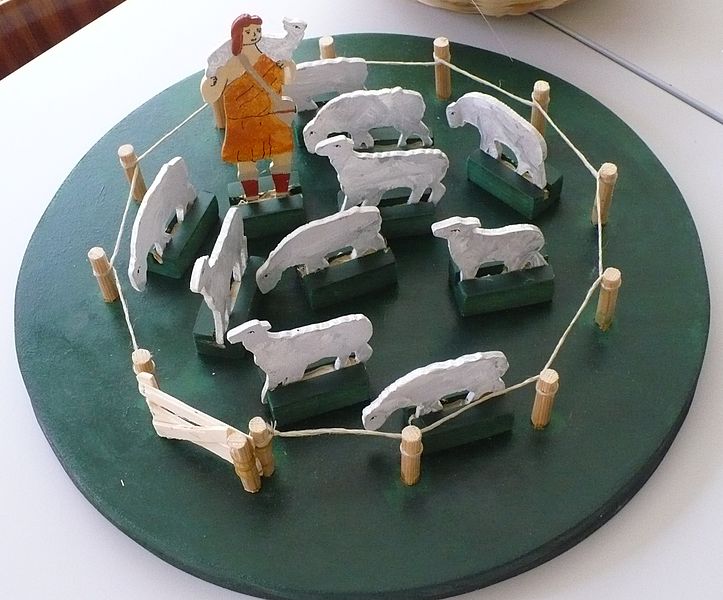
Meanwhile, the Catholic Church is in crisis on so many different dimensions. And it will be reborn through education or it will not be reborn. In the Modern world, we need an adult faith, and that means a properly-educated faith (no, it’s not a coincidence that this post is illustrated with a Good Shepherd Catechesis photo), and in the Modern world we need a Church that is a sign of contradiction and a ruthlessly efficient Army of God, and right now, by and large, we’re neither. The Church must produce saints, and to do that we need to take ’em young and give them a love of the Eucharist and of the faith and of the Gospel of Jesus Christ. And because this is a fallen world where heroes don’t scale, we need methods and not just philosophical questioning.
Previous Post

June 17, 2014
Theology Of The Imperfect Body
Next Post

June 21, 2014 Where The Catholicism Meets The Road
Browse Our Archives
Select a Category Elsewhere Mary New Distributism Parish of PEG Synod for the Famiy Theology of Women Uncategorized What I'm Reading
Select a Month June 2015 May 2015 April 2015 March 2015 February 2015 January 2015 December 2014 November 2014 October 2014 September 2014 August 2014 July 2014 June 2014 May 2014 April 2014 March 2014
Follow Us!
TAKE THE
Religious Wisdom Quiz
Who was the major prophet during King Hezekiah's reign in Judah?
Select your answer to see how you score.
Daniel Isaiah Ezekiel Jeremiah
Related posts from Inebriate Me


A Quick Note About What An Anathema Does...

When All Earthly Hopes Fade, That Old-Time Religion...

TRENDING AT PATHEOS Catholic

Rejecting Doom: Christian Hope And Human Action
Christianity is a religion of hope. We are to have hope and...

It’s What Comes From Within Which Matters
One of the most difficult things for us to understand is why...

Why I Choose the Eucharist Over the Sermon
Choose the Eucharist, Not the Sermon What are we supposed to get...

5 Design Elements Found in Spiritually Rooted Homes
Putting Spirituality Into Home Decor Our homes are more than our living...

Credo: A Story of God Told with the...
About 10 years ago, I began to imagine a personal "Credo" that...

The Anatomy of Divine Revelation in Catholic Thought
The claim that God has made Himself known to human beings is...
view all Catholic blogs
Ad-Free & Subscriber Log-In Subscription Support
- About Us
- 2026 Calendar
- Videos
- Podcasts
- Library of World Religions
- Faith In Media Tracker
- Advertise With Us
- Write for Us
- Privacy Policy
- Terms of Service
- Do Not Sell My Data
- Contact Us
- Radiant Digital
- Manage Newsletter Subscriptions
- Unsubscribe From Notifications
- Sitemap
Copyright 2008-2026, Patheos. All rights reserved.
Subscription Support Ad-Free & Subscriber Log-In
Follow Patheos