
BuddhistCatholicContemplativeEvangelicalGeneral ChristianHinduJewishLatter-day SaintMuslimNew VisionsProgressive Christian
Beliefs
- Buddhist
- Catholic
- Contemplative
- Evangelical
- General Christian
- Hindu
- Jewish
- Latter-day Saint
- More Voices
- Muslim
- New Visions
- Pagan
- Progressive Christian
Topics
- Religion News
- Food and Religion
- Sports and Religion
- Religious Art
- Religious Music and Entertainment
- Religious Events
- History and Religion
- Style and Religion
- Politics and Religion
- Women in Religion
- Recreation Outdoors and Religion
- Business Finance and Religion
- Careers Workplace and Religion
- Education and Religion
- Family Parenting and Religion
- Health Fitness and Religion
- Home and Religion
- Relationships and Religion
- Technology and Religion
- Travel and Religion
Columnists
- Buddhist Columnists
- Business Finance and Religion Columnists
- Careers Workplace and Religion Columnists
- Catholic Columnists
- Contemplative Columnists
- Education and Religion Columnists
- Evangelists Columnists
- Family Parenting and Religion Columnists
- General Christian Columnists
- Health Fitness and Religion Columnists
- Hindu Columnists
- History and Religion Columnists
- Home and Religion Columnists
- Jewish Columnists
- More Voices Columnists
- Latter Day Columnists
- Muslim Columnists
- New Visions Columnists
- Nonreligious Columnists
- Pagan Columnists
- Politics and Religion Columnists
- Progressive Columnists
- Recreation Outdoors and Religion Columnists
- Relationships and Religion Columnists
- Religion News Columnists
- Religious Art Columnists
- Religious Events Columnists
- Religious Music and Entertainment Columnists
- Sports and Religion Columnists
- Style and Religion Columnists
- Technology and Religion Columnists
- Travel and Religion Columnists
- Women in Religion Columnists
Resource Library
- 2026 Calendar
- Library of World Religions
- The 100 Most Holy Places on Earth
- Patheos Answers
- Podcasts
- Videos
- Faith Leaders Database
- Anglican Episcopalian
- Bahai
- Baptist
- Buddhism
- Christianity
- Confucianism
- Eastern Orthodoxy
- Hinduism
- Holiness and Pentecostal
- ISKCON
- Islam
- Judaism
- Lutheran
- Methodist
- The Church of Jesus Christ of Latter-day Saints
- New Age
- Paganism
- Presbytarian and Reformed
- Protestantism
- Religion Behind the Scenes
- Roman Catholic
- Scientology
- Shia Islam
- Sikhism
- Sufism
- Sunni Islam
- Taoism
- Zen
- See all religions
Research Tools
 Ad-Free & Subscriber Log-In Subscription Support
Ad-Free & Subscriber Log-In Subscription Support
Follow Patheos 

- Trending:
- Forgiveness
- |
- Marriage
- |
- Consciousness
- |
- Death Penalty
- |
- Election
- |
- Halloween
 Inebriate Me
- Home
- Catholic
- Where The Catholicism Meets The Road
Where The Catholicism Meets The Road
Last updated on: June 21, 2014 at 12:42 pm by Pascal-Emmanuel Gobry
Where The Catholicism Meets The Road 2014-06-21T12:42:25+01:00 Pascal-Emmanuel Gobry
Patheos Explore the world's faith through different perspectives on religion and spirituality! Patheos has the views of the prevalent religions and spiritualities of the world.

Over the Paschal Triduum this year, if you recall, I read all four Gospels straight through. I had read the Gospels more than once before of course, but never all four of them straight in quick succession. If you haven’t done it I really recommend it, because a bunch of things shine through that you hadn’t noticed before. (For example, the thunderingly recurring theme of damnation really gave a cold shower to my flirtation with Universalism.)
One of the things that particularly struck me that’s relevant to my ongoing discussion with the great Sam Rocha is that in the Gospels, most people don’t follow Jesus because of his teachings. More often than not, his teachings make people balk and run away and no, it’s not “just the Pharisees” (Jn 6 is particularly striking on this), not that it would matter since one of the important themes is that we’re all “the Pharisees”. One thing that the Gospels come back to over and over and over again is that people followed Jesus because he healed them. Jesus would heal people, and then the crowds would follow him; and then he would teach them, and more often than not people were scandalized, but the reason people followed him was because he healed them. Even the apostles. Jesus healed Peter’s mother-in-law and Peter followed him, and by the grace of the Spirit Peter recognized Jesus as the Son of God, but it’s clear that until Easter morning he had no idea what that actually meant. “Yeshua” means “God saves” not “God teaches.”
If you’ve read me at all you know I care deeply about orthodoxy and theology. It’s about caritas in veritate, and both sides of that phrase matter a great deal. But the probably-apocryphal “preach the Gospel; with words if necessary” phrase has deep, deep wisdom. “If I do not have love…”
All of which brings me to Sam’s critique of the practical method. It’s a very interesting discussion in and of itself, particularly because it’s a discussion where we come down in favor of the same ideas–Sam and I both like Montessori a great deal–but for very different reasons. The fact that we can have this sort of debate is itself a very great thing.
My argument for Montessori stars with–does not end, but starts with, and views it as decisive–with “it. just. works.”
As I noted, and as Sam acknowledges, “it. just. works.” cannot be the end. There is no method that is not either implicitly or explicitly rooted in philosophical and even metaphysical assumptions, and those should be questioned.
Sam also lands a blow when he notes that “it. just. works.” can lead to stultification. Indeed, from the very self-understanding of Montessori as “the scientific method” (as opposed to “the Montessori method”), it cannot be a fixed method, once and for all. Dr. Montessori built her curriculum based on empirical experimentation, and that means it can change. Dr. Montessori was very affected by World War II and died shortly thereafter–if she had lived longer, the Montessori curriculum we now have would be different. The stewards of Montessori insist on not changing the method. I think that in practice this is salutary, because almost every “iteration” I’ve seen on Montessori makes it worse, not better. But this is nonetheless long-run unhealthy. For example, every Montessori educator I’ve encountered disparages electronics, computers and television. From Dr. Montessori’s writings about the wonders of the machine age and the man-machine symbiosis, I suspect that she would have a more nuanced view of computers as educational devices. That we cannot know, but “What would Montessori look like if Dr. Montessori had gotten started in the computer age?” is, I think, a very interesting question. But it is a question that can only be discovered through empirical investigation, not abstract thinking.
Indeed, as I wrote in my previous post, from the standpoint of the most orthodox Catholic Tradition, “it. just. works.” is and should be a decisive argument. From the standpoint of Catholic theology, God as the logos has a rational mind, or at least incorporates pure reason; He has inscribed His law in the Created Order, which is good; part of the Imago Dei embodied by man is a rational mind, and part of our vocation as image-bearing creatures is to use our rational faculties to understand the world we live in and thereby understand God. This makes “it. just. works.” decisive, precisely because from a Catholic perspective, “it. just. works.” can never be a coincidence. And “it. just. works.” cannot ever be summarized to testable results on metrics like literacy and math, although we cannot ever think of it as unimportant, but on broader metrics–as, indeed, Montessori does. And indeed it is not a coincidence that what Dr. Montessori found out about the child from her empirical investigation just happens to line up perfectly with what Catholic theological anthropology tells us about human nature. In the New Israel, the immanent is never far from the transcendent. This is, in the words of N.T. Wright, “Kingdom work.”
Politely, Sam hints, but does not quite say, that becoming a Montessorian can feel a little bit like joining a cult. There is a new worldview, in many ways diametrally opposed from the World. There is a particular language. There are strange rites. There is a subculture, and an insistence on doing things in a particular way, and a missionary urge combined with an anxious sense that the outsiders just don’t get it and that if they did, everything would be immeasurably better. You know what else is like that? Catholicism.
Of course, in Catholicism there is a both/and. Yes, submission is required, but it is never a blind submission; it is sincere submission through the education of conscience, which must be followed, by the grace of the Spirit. Faith and doubt are always in dialogue, we are born again every day. Just like Montessori frozen in amber is not, ultimately, true Montessori.
I’m going to go back to themes that I’ve broached before. A great Catholic hospital is, yes, a hospital which is not just a hospital, it is a hospital that is about souls. But a great Catholic hospital is also one that actually heals your broken arm. Good medicine–scientific medicine–is not the end, but it is the beginning. That step cannot be skipped. We should take it for granted that a Catholic hospital which does not take scientific medicine is anti-Catholic just as much as we take it for granted that a hospital that performs abortions as anti-Catholic.
There are many things which are astonishing about the cathedrals the Church built; not least among them is the fact that they stand. The world’s most beautiful cathedral is useless if it does not stand.
The Church is not, or should not be, a social club where we hang out and have all of these fascinating intellectual debates, and maybe even runs soup kitchens. The Church is an Army. When you join the Marine Corps, you don’t sign up on a dotted line and then go on with your life the way it used to be. You’re grabbed by the collar and dragged into this great big machine which breaks you down and then builds you back up and you come out of its giant digestive tract a new man. There are all these strange and unfamiliar rules which must be obeyed even though they don’t seem to make sense. These rules have theoretical, philosophical, and even theological underpinnings, and these can and should be discussed by the people whose job is to discuss them. But the ultimate metric by which those rules are judged is do they lead to victory in the battlefield, which is perhaps the starkest empirical test.
The Church has a job to do. This job is to produce saints. The master gave his steward a lot of talents, and now he expects a return on his investment. He does not expect a long, fascinating, true even, speech about the nature of investment. He expects results. To produce these results we do have to think and theologize and philosophize. Again, this is the Catholic Thing; both/and. But ultimately we will be told–or not–“Well done thou good and faithful servant.”
One of Sam’s preoccupations–a very true one and a very important one–is that we not confuse “education” and “schooling.” Thankfully, neither does Montessori. Yes, the Montessori curriculum takes place in a classroom. But once you see the world through a Montessori lens, it carries over everything you do as a parent and educator. Montessori is not just a classroom (just read Montessori blogs–no, really, do). My daughter starts Montessori school in the Fall, but she’s already a Montessori child. Catholic education must not be just about what goes on in a classroom, whether it is a school classroom or a catechesis classroom. Catholic education must start with educating parents.
Here’s a final point about method: the Church is a big, big animal. One beeeeellion people. More, in fact. And growing at an astonishing rate. And most of the people the Church has to educate (inside and outside the classroom), as Sam well knows, do not live in the kind of comfortable Western world we do. The Church is meant to embrace the entire world. And you cannot do that without methods, because only methods scale. And scaling is a holy duty.
The rosary is a method. The Liturgy of the Hours is a method. The Spiritual Exercises are a method. The liturgy itself is a method. The liturgical calendar is a method. The sacraments are a method. Growth in virtue and holiness is (or, rather, should be) a method. The Rule of Benedict is a method. The first monks went into the desert without a method, under the Spirit, and they were saints. But monasticism scaled because it put together a method–very much joining empiricism and theology in its elaboration. And because monasticism had a method, it could scale, and because it scaled, monasticism saved Western civilization and rebuilt it and magnified it, and produced countless saints. Method without the Spirit; method without questioning, is no method at all (as the history of monasticism also shows). Catholicism is wealthy because of its methods–just ask a low-church Protestant convert some time. The problem with education in the Church is that it does not have a method. It has plenty of good intentions, and plenty of good people, and plenty of talented thinkers, but what it doesn’t have is a method. And it is because it does not have a method that it either copies the secular world or just muddles through. Catholic teachers in Congo, and harried Catholic parents in Peoria, do not have time to be theologians and philosophers, and the Church fails them if it expects them to do all the intellectual spadework and reinvent the wheel. The work ahead is massive. We have to light the world on fire with the Gospel of Jesus Christ. Montessori is a method. Catechesis of the Good Shepherd is a method. It is a method that scales. It is a method faithful to Catholic Tradition. It is a method that works. These aspects cannot, must not be ignored.
If I was named the Church’s Minister of Education tomorrow (hint, hint, @Pontifex!), would Catholic education twenty years from now look like what Montessori looks like today? Almost certainly not. But would we start with Montessori? Absolutely, yes. Why? Because it is a method that works. From an orthodox Catholic perspective, that is absolutely a good place to start; in fact, the place to start.
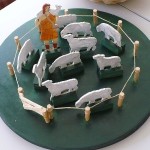
“Montessori Kugeln“. Licensed under CC BY-SA 3.0 via Wikimedia Commons.

Previous Post
June 18, 2014
Why Is Montessori Different From All Other Education Methods?
Next Post

June 24, 2014 Peter Thiel And The Cathedral
Browse Our Archives
Select a Category Elsewhere Mary New Distributism Parish of PEG Synod for the Famiy Theology of Women Uncategorized What I'm Reading
Select a Month June 2015 May 2015 April 2015 March 2015 February 2015 January 2015 December 2014 November 2014 October 2014 September 2014 August 2014 July 2014 June 2014 May 2014 April 2014 March 2014
Follow Us!
TAKE THE
Religious Wisdom Quiz
Who led the animals onto the ark?
Select your answer to see how you score.
Isaac Noah Moses Jacob
Related posts from Inebriate Me


A Quick Note About What An Anathema Does...

When All Earthly Hopes Fade, That Old-Time Religion...

TRENDING AT PATHEOS Catholic

Rejecting Doom: Christian Hope And Human Action
Christianity is a religion of hope. We are to have hope and...

It’s What Comes From Within Which Matters
One of the most difficult things for us to understand is why...

Why I Choose the Eucharist Over the Sermon
Choose the Eucharist, Not the Sermon What are we supposed to get...

5 Design Elements Found in Spiritually Rooted Homes
Putting Spirituality Into Home Decor Our homes are more than our living...

Credo: A Story of God Told with the...
About 10 years ago, I began to imagine a personal "Credo" that...

The Anatomy of Divine Revelation in Catholic Thought
The claim that God has made Himself known to human beings is...
view all Catholic blogs
Ad-Free & Subscriber Log-In Subscription Support
- About Us
- 2026 Calendar
- Videos
- Podcasts
- Library of World Religions
- Faith In Media Tracker
- Advertise With Us
- Write for Us
- Privacy Policy
- Terms of Service
- Do Not Sell My Data
- Contact Us
- Radiant Digital
- Manage Newsletter Subscriptions
- Unsubscribe From Notifications
- Sitemap
Copyright 2008-2026, Patheos. All rights reserved.
Subscription Support Ad-Free & Subscriber Log-In
Follow Patheos