
BuddhistCatholicContemplativeEvangelicalGeneral ChristianHinduJewishLatter-day SaintMuslimNew VisionsProgressive Christian
Beliefs
- Buddhist
- Catholic
- Contemplative
- Evangelical
- General Christian
- Hindu
- Jewish
- Latter-day Saint
- More Voices
- Muslim
- New Visions
- Pagan
- Progressive Christian
Topics
- Religion News
- Food and Religion
- Sports and Religion
- Religious Art
- Religious Music and Entertainment
- Religious Events
- History and Religion
- Style and Religion
- Politics and Religion
- Women in Religion
- Recreation Outdoors and Religion
- Business Finance and Religion
- Careers Workplace and Religion
- Education and Religion
- Family Parenting and Religion
- Health Fitness and Religion
- Home and Religion
- Relationships and Religion
- Technology and Religion
- Travel and Religion
Columnists
- Buddhist Columnists
- Business Finance and Religion Columnists
- Careers Workplace and Religion Columnists
- Catholic Columnists
- Contemplative Columnists
- Education and Religion Columnists
- Evangelists Columnists
- Family Parenting and Religion Columnists
- General Christian Columnists
- Health Fitness and Religion Columnists
- Hindu Columnists
- History and Religion Columnists
- Home and Religion Columnists
- Jewish Columnists
- More Voices Columnists
- Latter Day Columnists
- Muslim Columnists
- New Visions Columnists
- Nonreligious Columnists
- Pagan Columnists
- Politics and Religion Columnists
- Progressive Columnists
- Recreation Outdoors and Religion Columnists
- Relationships and Religion Columnists
- Religion News Columnists
- Religious Art Columnists
- Religious Events Columnists
- Religious Music and Entertainment Columnists
- Sports and Religion Columnists
- Style and Religion Columnists
- Technology and Religion Columnists
- Travel and Religion Columnists
- Women in Religion Columnists
Resource Library
- 2026 Calendar
- Library of World Religions
- The 100 Most Holy Places on Earth
- Patheos Answers
- Podcasts
- Videos
- Faith Leaders Database
- Anglican Episcopalian
- Bahai
- Baptist
- Buddhism
- Christianity
- Confucianism
- Eastern Orthodoxy
- Hinduism
- Holiness and Pentecostal
- ISKCON
- Islam
- Judaism
- Lutheran
- Methodist
- The Church of Jesus Christ of Latter-day Saints
- New Age
- Paganism
- Presbytarian and Reformed
- Protestantism
- Religion Behind the Scenes
- Roman Catholic
- Scientology
- Shia Islam
- Sikhism
- Sufism
- Sunni Islam
- Taoism
- Zen
- See all religions
Research Tools
 Ad-Free & Subscriber Log-In Subscription Support
Ad-Free & Subscriber Log-In Subscription Support
Follow Patheos 

- Trending:
- Forgiveness
- |
- Marriage
- |
- Consciousness
- |
- Death Penalty
- |
- Election
- |
- Halloween
 Inebriate Me
- Home
- Catholic
- Diocesan Ombuds(wo)men
Diocesan Ombuds(wo)men
Last updated on: June 2, 2014 at 3:31 pm by Pascal-Emmanuel Gobry
Diocesan Ombuds(wo)men 2014-06-02T15:31:06+01:00 Pascal-Emmanuel Gobry
Patheos Explore the world's faith through different perspectives on religion and spirituality! Patheos has the views of the prevalent religions and spiritualities of the world.
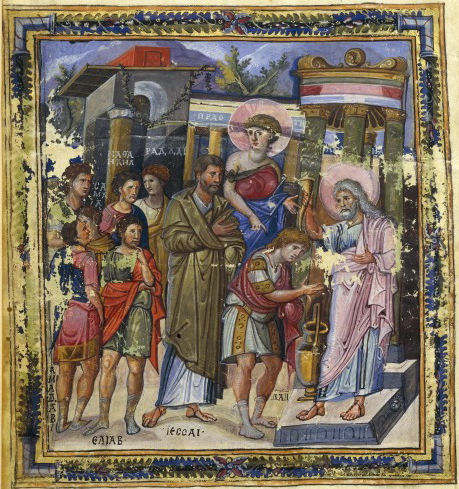
The Church has a monarchical structure, quite explicitly. In our ecclesiology, the Pope is the King of the Church, the bishop is the king of his diocese, and the parish priest is king of his parish and the husband king of the family.
This dates back to the beginnings of the Church: the images that Jesus uses to install Peter at the head of the college of the Apostles are regnal images. The “rock” refers to Abraham, the rock of Israel; the “keys” are the keys of the King’s steward, who has the full powers of the King until His return; the shepherd’s role refers to David, the Root of Jesse, Shepherd of Israel. The Pope is patriarch under the New Covenant as Israel had patriarchs under the Old Covenant; and patriarchs are, for better and worse, autocrats. Biblical leaders did not waste time on due process.
As the Western Empire fell, driven by necessity, the Church replaced the Empire, with admirable restraint (the Pope never made himself Emperor, which, if you think about it, was not unimaginable), but administratively quite explicitly. De facto, local bishops replaced the Roman Prefects as local administrators. Canon law incorporated Roman law and in turn became the template for the West’s legal systems. The Inquisition, we often forget on account of its later corruption, originally arose to replace the pagan institution of the trial by ordeal and bring a measure of sanity to the judicial process–and many of its innovations are still found in the judicial process of advanced countries. To this day, many dioceses in Western Europe still have the shape of the Roman administrative provinces they replaced fifteen hundred years ago.
Then, in the golden age of divine-right absolute monarchy and the last throes of the Conciliar Movement, the Papacy asserted itself as the divine-right absolute monarchy par excellence, the “perfect society” on which other regimes should be modeled.
Post-Vatican II, we don’t use this kind of language so much anymore, but our ecclesiology is still inevitably rooted in it. Vatican City State is still, explicitly, a divine-right absolute monarchy, the last in Europe. The in-many-cases wonderful examples of trying to restore synodality and collegiality to the daily life of the Church find their expression within the context of the monarchical structure of the Church. The upcoming Synod of Bishops, for example, will make a bunch of very interesting recommendations but the Pope, ultimately, retains final say.
And it seems to me to be something that the Church cannot change. One of the four marks of the Church enshrined by the Nicene Creed is its apostolic character and–as my Eastern friends will be quick to point out–the diocesan office cannot be understood without the context of the leadership of a eucharistic community.
Once all this is said, given what we are today highly (and rightly) aware of, concerning the corrupting influence of solitary unchecked power, and the necessity of accountability in the exercise of power, I think the best judgement that can be leveled is this: this is a structure that makes no sense at all–unless one believes in the Holy Spirit.
We live in such a democratic age that we’ve forgotten that the democratic ethos is one that enshrines mediocrity. If all kings were “enlightened despots”, monarchy would work a heckuva lot better than democracy–it is only because enlightened despots are so rare that democracy wins, so to speak, by default. Modern, checks-and-balances democracy is explicitly designed to prevent the worst of despotism by also preventing the best.
Again–in the political realm, this is all to the good. But the life and Spirit of the Church is, or ought to be, allergic to mediocrity. What the Church is, its nature, is a call to holiness. Just as God took a risk by making Adam King of Creation, the Church takes a risk on its shepherds by making them kings, for better and–as we are all of us too painfully aware–worse.
England expects that every man will do his duty, and the Church expects that its members will be saints, and it is–we must believe–good.
The comparison with corporate governance might be enlightening here, at least for me who works in the entrepreneurial economy. In the corporate world, autocracy typically has disastrous results; but every once in a while, great CEOs, or great founder-entrepreneurs, come along–and when they do, you want their company to be autocratic. Professional managers are the coin of mediocrity, but visionary CEOs are the coin of greatness. Leadership is a charism like any other, and charisms must be given full berth to express themselves, even, perhaps especially, when the king is a boy, as in the case of e.g. Mark Zuckerberg. In the political realm it’s too dangerous, as the Romans did, to simply make people dictators in times of crisis, but in the corporate realm it tends to work. With some exceptions, democratic governance in the corporation is usually a disaster.
In my own country, the late and, in my view, saintly Jean-Marie Lustiger, Cardinal Archbishop of Paris, was nicknamed “le Bulldozer” for his energetic leadership style. He was appointed by John Paul II to lead a diocese adrift in the wake of Vatican II, in a country that probably had the most progressive, “Spirit of Vatican II” episcopate in Western Europe. He was reviled by progressives for his orthodoxy and by traditionalists for his Jewish identity (even as he constantly reached out to them), and by his brother bishops for his frankness, behind closed doors as well as in public. He fired a bunch of people and made a bunch of malcontents. He also probably did more than anyone else in France to revitalize the French Church, and this already-long post is too short for the list of his accomplishments. A great bishop is a wonderful blessing indeed.
The point is that we must, in the face of sometimes seemingly-overwhelming evidence and despite our largely healthy Western, democratic priors, view the monarchical structure of the Church as a blessing. It is a structure that says “You must be saints” and “Be perfect like your Heavenly Father is perfect” and “I will vomit the lukewarm.” It is a structure that takes after the radical summary of the Gospel, “If you don’t love you’re dead, and if you love, they’ll kill you.”
Now, with all that being said, we do have to take account of the Fall. We do have to take into account the fact that, realistically, most of our bishops are going to be mediocrities (if any bishop is reading this–no, not you, of course, Your Excellency). The Roman Catholic Church at present has more than five thousand bishops, a positively astonishing number. If one thing is certain–I often contemplate this–, it is that the 1% most holy must be most holy indeed, and the 1% most corrupt must be most corrupt indeed. But it would truly be a New Pentecost if all five thousand were saints.
All of this is a long prolegomenon to a suggestion of a reform of the Church that, while leaving the monarchical episcopal structure of the Church unchanged, might indeed bring a measure of accountability to the aristocracy of our pilgrim people of sinners.
In the world of the divine-right monarchy, one sometimes vital institution was the institution of the Court Fool. The Fool who, because he was a Fool, was the only one allowed to speak truth to power–to, in the proverbial phrase, shout that the King is naked.
Today, in the Modern world, we have a bit of a similar institution: the ombudsman. The ombudsman has no formal or legal power over the structure she is a part of, but she does have a lot of informal power–the power of mediation, and the power of the bully pulpit.
There is even a precedent in the Papacy itself: the Preacher of the Papal Household. The job of the Preacher of the Papal Household is to, literally, preach truth to power. Such Preachers are typically Capuchins because that order’s great focus on poverty is thought to be a welcome contrast with the pomp and circumstance that inevitably surrounds the Petrine See. (And, of course, the Church invented the Devil’s Advocate.)
So here’s the suggestion for reform I would like to at least throw out there for discussion: that each diocese have such an ombudsman, or diocesan preacher. Someone who has no power, but whose job is explicitly to publicly critique the bishop in charity.
I think these ombudsmen should be women religious. Women, because then it becomes a constituent of the office that the holder will not be a “political rival” to the bishop for the job. Religious, because it would be a 24/7 job that requires a grounding in a life of prayer.
Now, I think we can all imagine ways in which this could go awry. But we also all know all-too-well the ways in which our current structure does go awry.
And there are unanswered questions–how would such persons be appointed? I don’t know.
And it would not be a cure-all. Original sin is original sin. In the most common telling of the fable of the Naked Emperor, once the child cries that the Emperor is naked, the scales fall off everyone’s eyes. But in Andersen’s original, more pessimistic, more realistic version, everyone does go on as if they hadn’t heard anything.
But I do think it’s an idea worth at least exploring. And another good thing is that, as far as I know, such an office does not require, at least at first, a change in canon law or a decision for reform from Rome. Any bishop can decide to set up such an office in his diocese, appointing the requisite holy person, if only informally. And if enough bishops do so, we will be able to see if it is a blessing or a curse.
What do y’all think?
“The Unction of David“. Licensed under Public domain via Wikimedia Commons.

Previous Post
May 31, 2014
Male Headship in the Catholic Tradition
Next Post

June 3, 2014 Book Review: Andy Crouch, "Playing God"
Browse Our Archives
Select a Category Elsewhere Mary New Distributism Parish of PEG Synod for the Famiy Theology of Women Uncategorized What I'm Reading
Select a Month June 2015 May 2015 April 2015 March 2015 February 2015 January 2015 December 2014 November 2014 October 2014 September 2014 August 2014 July 2014 June 2014 May 2014 April 2014 March 2014
Follow Us!
TAKE THE
Religious Wisdom Quiz
What does "Maranatha" mean?
Select your answer to see how you score.
Praise Him Come, Lord Be joyful It is finished
Related posts from Inebriate Me


A Quick Note About What An Anathema Does...

When All Earthly Hopes Fade, That Old-Time Religion...

TRENDING AT PATHEOS Catholic

Rejecting Doom: Christian Hope And Human Action
Christianity is a religion of hope. We are to have hope and...

It’s What Comes From Within Which Matters
One of the most difficult things for us to understand is why...

Why I Choose the Eucharist Over the Sermon
Choose the Eucharist, Not the Sermon What are we supposed to get...

5 Design Elements Found in Spiritually Rooted Homes
Putting Spirituality Into Home Decor Our homes are more than our living...

Credo: A Story of God Told with the...
About 10 years ago, I began to imagine a personal "Credo" that...

The Anatomy of Divine Revelation in Catholic Thought
The claim that God has made Himself known to human beings is...
view all Catholic blogs
Ad-Free & Subscriber Log-In Subscription Support
- About Us
- 2026 Calendar
- Videos
- Podcasts
- Library of World Religions
- Faith In Media Tracker
- Advertise With Us
- Write for Us
- Privacy Policy
- Terms of Service
- Do Not Sell My Data
- Contact Us
- Radiant Digital
- Manage Newsletter Subscriptions
- Unsubscribe From Notifications
- Sitemap
Copyright 2008-2026, Patheos. All rights reserved.
Subscription Support Ad-Free & Subscriber Log-In
Follow Patheos