
BuddhistCatholicContemplativeEvangelicalGeneral ChristianHinduJewishLatter-day SaintMuslimNew VisionsProgressive Christian
Beliefs
- Buddhist
- Catholic
- Contemplative
- Evangelical
- General Christian
- Hindu
- Jewish
- Latter-day Saint
- More Voices
- Muslim
- New Visions
- Pagan
- Progressive Christian
Topics
- Religion News
- Food and Religion
- Sports and Religion
- Religious Art
- Religious Music and Entertainment
- Religious Events
- History and Religion
- Style and Religion
- Politics and Religion
- Women in Religion
- Recreation Outdoors and Religion
- Business Finance and Religion
- Careers Workplace and Religion
- Education and Religion
- Family Parenting and Religion
- Health Fitness and Religion
- Home and Religion
- Relationships and Religion
- Technology and Religion
- Travel and Religion
Columnists
- Buddhist Columnists
- Business Finance and Religion Columnists
- Careers Workplace and Religion Columnists
- Catholic Columnists
- Contemplative Columnists
- Education and Religion Columnists
- Evangelists Columnists
- Family Parenting and Religion Columnists
- General Christian Columnists
- Health Fitness and Religion Columnists
- Hindu Columnists
- History and Religion Columnists
- Home and Religion Columnists
- Jewish Columnists
- More Voices Columnists
- Latter Day Columnists
- Muslim Columnists
- New Visions Columnists
- Nonreligious Columnists
- Pagan Columnists
- Politics and Religion Columnists
- Progressive Columnists
- Recreation Outdoors and Religion Columnists
- Relationships and Religion Columnists
- Religion News Columnists
- Religious Art Columnists
- Religious Events Columnists
- Religious Music and Entertainment Columnists
- Sports and Religion Columnists
- Style and Religion Columnists
- Technology and Religion Columnists
- Travel and Religion Columnists
- Women in Religion Columnists
Resource Library
- 2026 Calendar
- Library of World Religions
- The 100 Most Holy Places on Earth
- Patheos Answers
- Podcasts
- Videos
- Faith Leaders Database
- Anglican Episcopalian
- Bahai
- Baptist
- Buddhism
- Christianity
- Confucianism
- Eastern Orthodoxy
- Hinduism
- Holiness and Pentecostal
- ISKCON
- Islam
- Judaism
- Lutheran
- Methodist
- The Church of Jesus Christ of Latter-day Saints
- New Age
- Paganism
- Presbytarian and Reformed
- Protestantism
- Religion Behind the Scenes
- Roman Catholic
- Scientology
- Shia Islam
- Sikhism
- Sufism
- Sunni Islam
- Taoism
- Zen
- See all religions
Research Tools
 Ad-Free & Subscriber Log-In Subscription Support
Ad-Free & Subscriber Log-In Subscription Support
Follow Patheos 

- Trending:
- Forgiveness
- |
- Marriage
- |
- Consciousness
- |
- Death Penalty
- |
- Election
- |
- Halloween
 Inebriate Me
- Home
- Catholic
- For Honest Ecumenism
For Honest Ecumenism
Last updated on: April 11, 2014 at 8:00 pm by Pascal-Emmanuel Gobry
For Honest Ecumenism 2014-04-11T20:00:05+01:00 Pascal-Emmanuel Gobry
Patheos Explore the world's faith through different perspectives on religion and spirituality! Patheos has the views of the prevalent religions and spiritualities of the world.
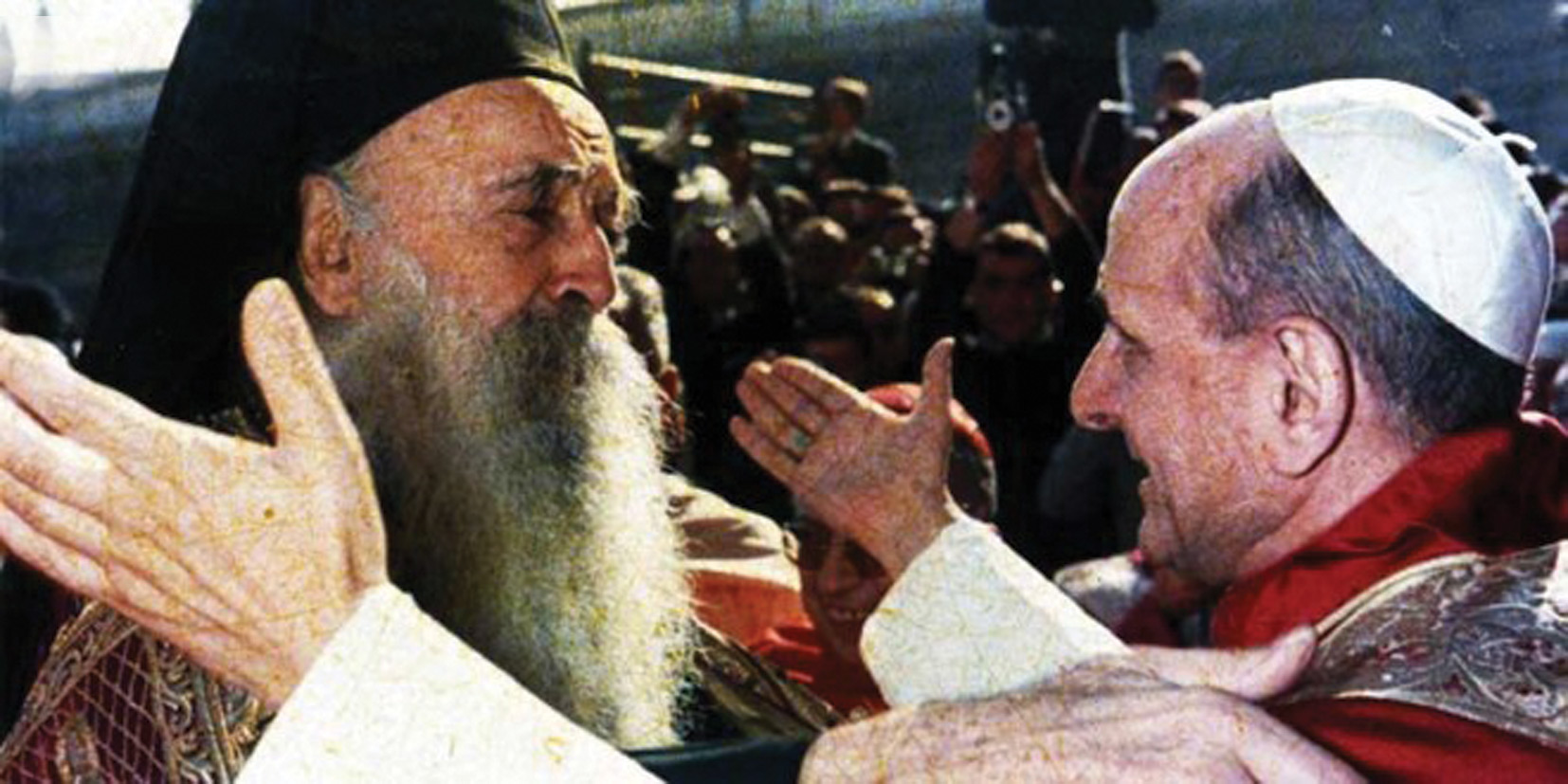
When I was growing up, with the exception of some family and some priests, the people I knew who were serious about their religion were not Catholic, and the Catholics I knew were nominal Catholics. It was through arguing with non-Catholics that I discovered that people could love each other, yet disagree on fundamental points, yet talk respectfully and joyfully about the Most Important Things.
One thing I like about deeply religious (non-fundamentalist) people is that disagreeing with them is, perhaps paradoxically, often easier and friendlier. To the secular materialist, the idea that someone could tell him that he is Wrong about the Fundamental Things is the greatest possible insult there is; anything but their supposed neutralism is oppressive, and (inconsistently) to tell them that they are Wrong is the worst insult. But I have no problem hearing from an Evangelical sister that I’m Wrong–because I think she is, too! And, of course, disagreeing with fellow Christians is made easier by the fact that we do agree on the most important thing of all.
I view the ecumenical dialogue of the 20th century as one of the most important developments in all of world and religious history. The time when Christians of different stripes dialogued with steel is not that far removed. To me, the ecumenism of the 20th century had many blessings:
- It got rid of hostility, myth, and fear-mongering; no, Catholics do not worship Mary; no, Protestants do not hate Rome;
- It accomplished a in-retrospect-obvious but fundamental hermeneutical breakthrough: that denominations can use different words to mean the same thing (and, sometimes, the same words to say different things); and in this way, we have finally discovered–again, in-retrospect-obvious but we were blinded to it–that we agree on so, so much more than we disagree on;
- It has been very good at differentiating between true doctrinal problems and what an Orthodox friend of mine called “beard problems”: differences that are really cultural/historical in nature but are all too easy to mistake for fundamental differences;
And the ecumenical movement has achieved some real breakthroughs. The joint Catholic-Lutheran statement on justification is, I believe, one of the most important documents of the past 500 years. Other significant (and astonishing in the light of the history of previous centuries) breakthroughs include the Orthodox recognition of the primacy of the Petrine See–and the Catholic declaration that the “procession” of the Spirit from the Father to the Son is different from the “procession” from the Son to the Father.
And most importantly, ecumenism (along with pluralism and, perhaps, the rising challenge of secularism) has created a true détente, in the French meaning of the word, a relaxation, a détente of the hearts. We now, at least in the main and as much as can be expected of lowly sinners, really behave like brothers and sisters to one another. We don’t agree on everything, but we are still a family united by love.
All these tremendous accomplishments are really, really wonderful blessings and must be in no way diminished. The ecumenical movement is one of many reasons why I will never be a Traditionalist and cherish the “opening of the doors and windows” of Vatican II. But, perhaps precisely because it has been so successful, it seems to me that 20th century ecumenism is now a foundation to build upon, rather than an endpoint.
To use C.S. Lewis’ famous analogy, ecumenism is like a meeting hall, and it is wonderful that we have this meeting hall, and that we can talk in a civilized way there, and even more importantly love each other there, but the meeting hall is not the point. Jesus wants us to be one–which does not preclude from taking the best of several rooms that open into the meeting hall, or rearranging the furniture in the meeting hall where we do end up.
It is wonderful–really, truly–that we have come to realize how much we truly agree on, and what a treasure that is. But, at the end of the day, we also disagree on some things. Nevermind talk of “love in truth”, it is about respect and friendship. Any true dialogue must be based on respect, and a dialogue where one of us pretends to be something he’s not is a lie.
Or, as my friend and Christian brother Alan Jacobs put it, defending Pope Benedict after he (mildly) critiqued the ecumenical movement:
Benedict was stressing a point that he has been making for a very long time: that the whole ecumenical movement of the twentieth century — which was originally focused on creating better understanding among various Christian groups but later morphed into “interreligious dialogue” — has never made much progress, and has never made much progress because it has assumed that the way you have to talk about people you disagree with is by talking largely, or wholly, about points of agreement. “Can we agree that Jesus is the only Son of God? Ummmm, okay . . . Well, can we agree that Jesus is important? Can we agree that there is a God? Wow . . . um, let’s see: Can we agree to support the U.N. Millennium Development Goals? Moved, seconded, passed!”
Benedict, having watched all this going on for many fruitless decades, wonders if we shouldn’t try holding the stick at the other end: what if we try talking about where we don’t agree, and see where that leads us? This violates every tenet — or perhaps the only tenet — of the ecumenical movement, so it’s not going to gain any traction among the professional ecumenists, but still, it’s an interesting and hopeful gesture.
As you see, Alan is, if anything, harder on the ecumenical movement than I am. But I think that, overall, the point is correct. There are things that we do disagree on, and these things are also important. And precisely because we do agree on so much–including, at least, for me, the importance of capital-T Truth–and because now, thanks to the ecumenical movement, we can be expected to (insofar as sinners are able) talk to each other in a civilized and even charitable manner.
Let me put it as clearly as I can: I believe that Jesus Christ, Son of the Living God, founded a Church which is His Body; that this Church “subsists in” the Roman Catholic Church; that He has given to this Church the apostolic teaching authority and has prevented her from error on matters of faith; that where opinions directly contradict what has been definitively taught by the Church they are in error; and that He wants all of his children to be part of His Body. Those are things I believe and will continue to believe. And they are pretty important.
I can be even more pointed: I believe that “Sola Scriptura” is a self-contradictory, self-evidently absurd hermeneutic in blinding contradiction with the Biblical logic of a living, covenantal God who is active in history and works through men; that an ecclesiology of a confederation of national churches structurally renders to Cesar what is God’s; that the Calvinistic hostility to the cult of saints, the liturgy, ecclesiastical art and beauty, monasticism, the most holy treasure of the Eucharist and the central Biblical theme of human free will is the intellectual and theological equivalent of the steppe barbarian who goes around a Roman city smashing statues and burning books because they are beautiful and civilized (as, indeed, many Radical Reformers did) and then, once sitting on the emperor’s throne, wonders why taxes owed no longer reach the Treasury’s coffers; that Anglicanism is designed as a Voltairian caricature of what Christianity without the Gospel looks like, built out of my stolen property by one of the most transparently Devil-possessed figures of history as a country club staffed by petty functionaries where the pleasing aroma of petits fours hardly masks the stench of the blood and guts of holy Catholic martyrs, an “ecclesiological” formula which can only produce what it has produced, namely a doctrinal blob whose only ironclad precept seems to be “don’t rock the boat”.
I believe these things. I also believe that I am a sinner responsible for all the sins of the world and that I am not better than anybody. I believe that there are many saints outside the visible Catholic Church, and I believe that there is much we can learn from non-Catholics, and that often (so often!) they teach us what it truly is to be Christian. I believe that the one, holy, catholic and apostolic Church is guilty, a thousand times guilty; guilty of all of it; guilty of the excesses of the Inquisition, of the Crusades, of Caesaropapism, of putting Galileo under house arrest, of not enough Canossas, of anti-Semitism, of cowardice, of worldliness, of power-hungriness, of legalism, of clericalism, of forgetting herself and the promises of her baptism, of rigidity, of formalism, of spectacular incompetence, of tribalism, of burying her treasure, of poor catechesis, of maintaining terrible schools and worse of thinking that they are good schools, of lack of mercy and lack of charity, of not protecting her children, of tolerating what ought not to be tolerated and not tolerating what ought to be, of piss-poor liturgy, of pseudo-Pelagianism, of “pray, pay and obey,” of Romanism and Gallicanism and Anglicanism, of homophobia, of sexism, of racism, of war, of liberalism, of oppression, of progressivism, of traditionalism, of intellectualism, of overconfidence and underconfidence, of solipsism, of complacency, of tepidity, of necessary evils, of corrupt Popes, and corrupt bishops, and corrupt priests, and corrupt laity, myself very much included, of burning Joan of Arc and celebrating Marcial Maciel, of meanness and pettiness, of–Lord have mercy–of self-satisfaction, and, worst of all, guilty of pride, including pride in herself, and pride in her own Truth, perhaps the worst sin, the sin of the perversion of the good, the sin that Our Lord did not commit even though He alone can boast of being the Truth, of seeing it as a cudgel to beat the infidel with or worse an irrelevancy and not the Good News that sets us all free. I am a member of a Church that has been made steward of the greatest treasure known to man and who spits on it every day, and I spit as good as anybody, and I too yell “Crucify Him!” of my Lord and God.
Phew. That felt good.
Now, this might be a little too polemical. But I hope you’ll see the point as taken. But the real point is this: I believe all these things but I also believe we can be friends and even brothers and have arguments in good faith. If you’re a fellow Christian, you shouldn’t have to be offended that I believe these things, because you probably believe the reverse, and that’s fine. I like that you have serious faith commitments. And we are on a pilgrimage together, to Calvary, or perhaps to Emmaus.
I often take digs at Protestantism on Twitter, but I hope everybody realizes that it’s all in good fun, and I think that’s the way it’s been taken. And if not I apologize. I’m Catholic. I don’t know how not to be Catholic. If we’re honest with ourselves, we have to realize: we are brothers and sinners, called to love one another; there is much on which we agree; there are also some things on which we disagree; if we must move forward, we have to talk about all these things in a charitable, and also honest way.
At least I think so. I may be wrong.

Next Post

April 13, 2014 Short Meditation on Palm Sunday
Browse Our Archives
Select a Category Elsewhere Mary New Distributism Parish of PEG Synod for the Famiy Theology of Women Uncategorized What I'm Reading
Select a Month June 2015 May 2015 April 2015 March 2015 February 2015 January 2015 December 2014 November 2014 October 2014 September 2014 August 2014 July 2014 June 2014 May 2014 April 2014 March 2014
Follow Us!
TAKE THE
Religious Wisdom Quiz
How did Saul die?
Select your answer to see how you score.
Killed by Philistines Fell on his own sword Died of old age Stoned by Israelites
Related posts from Inebriate Me


A Quick Note About What An Anathema Does...

When All Earthly Hopes Fade, That Old-Time Religion...

TRENDING AT PATHEOS Catholic

Rejecting Doom: Christian Hope And Human Action
Christianity is a religion of hope. We are to have hope and...

It’s What Comes From Within Which Matters
One of the most difficult things for us to understand is why...

Why I Choose the Eucharist Over the Sermon
Choose the Eucharist, Not the Sermon What are we supposed to get...

5 Design Elements Found in Spiritually Rooted Homes
Putting Spirituality Into Home Decor Our homes are more than our living...

Credo: A Story of God Told with the...
About 10 years ago, I began to imagine a personal "Credo" that...

The Anatomy of Divine Revelation in Catholic Thought
The claim that God has made Himself known to human beings is...
view all Catholic blogs
Ad-Free & Subscriber Log-In Subscription Support
- About Us
- 2026 Calendar
- Videos
- Podcasts
- Library of World Religions
- Faith In Media Tracker
- Advertise With Us
- Write for Us
- Privacy Policy
- Terms of Service
- Do Not Sell My Data
- Contact Us
- Radiant Digital
- Manage Newsletter Subscriptions
- Unsubscribe From Notifications
- Sitemap
Copyright 2008-2026, Patheos. All rights reserved.
Subscription Support Ad-Free & Subscriber Log-In
Follow Patheos