
BuddhistCatholicContemplativeEvangelicalGeneral ChristianHinduJewishLatter-day SaintMuslimNew VisionsProgressive Christian
Beliefs
- Buddhist
- Catholic
- Contemplative
- Evangelical
- General Christian
- Hindu
- Jewish
- Latter-day Saint
- More Voices
- Muslim
- New Visions
- Pagan
- Progressive Christian
Topics
- Religion News
- Food and Religion
- Sports and Religion
- Religious Art
- Religious Music and Entertainment
- Religious Events
- History and Religion
- Style and Religion
- Politics and Religion
- Women in Religion
- Recreation Outdoors and Religion
- Business Finance and Religion
- Careers Workplace and Religion
- Education and Religion
- Family Parenting and Religion
- Health Fitness and Religion
- Home and Religion
- Relationships and Religion
- Technology and Religion
- Travel and Religion
Columnists
- Buddhist Columnists
- Business Finance and Religion Columnists
- Careers Workplace and Religion Columnists
- Catholic Columnists
- Contemplative Columnists
- Education and Religion Columnists
- Evangelists Columnists
- Family Parenting and Religion Columnists
- General Christian Columnists
- Health Fitness and Religion Columnists
- Hindu Columnists
- History and Religion Columnists
- Home and Religion Columnists
- Jewish Columnists
- More Voices Columnists
- Latter Day Columnists
- Muslim Columnists
- New Visions Columnists
- Nonreligious Columnists
- Pagan Columnists
- Politics and Religion Columnists
- Progressive Columnists
- Recreation Outdoors and Religion Columnists
- Relationships and Religion Columnists
- Religion News Columnists
- Religious Art Columnists
- Religious Events Columnists
- Religious Music and Entertainment Columnists
- Sports and Religion Columnists
- Style and Religion Columnists
- Technology and Religion Columnists
- Travel and Religion Columnists
- Women in Religion Columnists
Resource Library
- 2026 Calendar
- Library of World Religions
- The 100 Most Holy Places on Earth
- Patheos Answers
- Podcasts
- Videos
- Faith Leaders Database
- Anglican Episcopalian
- Bahai
- Baptist
- Buddhism
- Christianity
- Confucianism
- Eastern Orthodoxy
- Hinduism
- Holiness and Pentecostal
- ISKCON
- Islam
- Judaism
- Lutheran
- Methodist
- The Church of Jesus Christ of Latter-day Saints
- New Age
- Paganism
- Presbytarian and Reformed
- Protestantism
- Religion Behind the Scenes
- Roman Catholic
- Scientology
- Shia Islam
- Sikhism
- Sufism
- Sunni Islam
- Taoism
- Zen
- See all religions
Research Tools
 Ad-Free & Subscriber Log-In Subscription Support
Ad-Free & Subscriber Log-In Subscription Support
Follow Patheos 

- Trending:
- Forgiveness
- |
- Marriage
- |
- Consciousness
- |
- Death Penalty
- |
- Election
- |
- Halloween
 Imago Christi
- Home
- Evangelical
- Not the God of Human Expectation
Not the God of Human Expectation
Last updated on: March 24, 2015 at 10:17 pm by Kenneth Tanner
Not the God of Human Expectation 2015-03-24T22:17:10-04:00 Kenneth Tanner
Patheos Explore the world's faith through different perspectives on religion and spirituality! Patheos has the views of the prevalent religions and spiritualities of the world.
The Cross is our murder of God. This needs to be said first. The Cross is what we do when God shows up.
Yet the Cross is, paradoxically, a blessing we invoke on ourselves. Remember the chant of the crowds: “His blood be upon us and upon our children.”
Here is an unexpected mercy. This God takes the curse right out of our mouths and makes our treacherous breath an infinite blessing.
That is the sort of thing this God always does. This is the character of the One we nail to the tree.
This God enters our suffering world; the good Creator of all things impoverishes himself. He suffers with everyone; groans along with his creation.
He bows his head in grief, makes himself of no account, so we might learn that extreme humility—serving and sustaining all things on bended knee, with a towel wrapped around the waist—is the essence of the divine life, and of human life as God intended.
This is not the god of human expectation. Two thousand years after the Cross, this God is not always the god of Christian expectation.
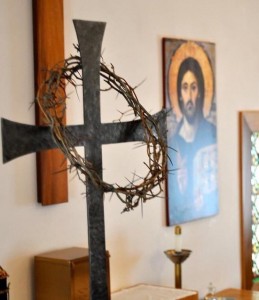
The first word out of this God’s mouth—and the mouths of his divine messengers—is so often “Do not be afraid.” His majesty is not founded on fear. His love inspires reverence.
The Cross is the greatest crime humanity has committed in the name of religion and politics: nailing Jesus, the holy one of God, to an instrument of torture and execution.
The one person who is at once true God and the only true man, mocked, beaten, crowned, pierced and slain by our contempt for love. We should not fear God; we should fear ourselves.
And yet—and yet—by the Cross Jesus, true God and truest man, tramples down death by death. What we meant for evil—crucify him, crucify him!—God converts and blesses.
God knew the Cross was going to happen. Long before the earth existed he sought to transfigure our ugly evil into a beautiful plan; a brilliant design to rescue humanity and the captive cosmos by transfiguring our treachery.
God has nothing whatsoever to do with the crime. He has everything to do with its transfiguration. His love predestined our evil for good. This is what his transforming love always does.
The dark powers and humanity kill the Son, the heir of the owner of the vineyard. We spill his blood. And he gives his blood for us, freely. Like a transfusion, his donated blood becomes our life.
The great mystery is that God accepts our dastardly, cowardly act as a propitiation for all and raises Christ from the dead, and with Christ all of us.
This is the pattern inscribed in all the post-Pentecost sermons: We kill the Son, the Father raises him by the Spirit. My God, what a God this is!
When from the Cross Jesus prays to the Father “forgive them,” he is praying (singing) the Father’s heart back to him…the heart the sacred three share from all eternity.
Jesus is not trying to appease the Father. His prayer is not a negotiation. He is not trying to change the Father’s disposition toward humanity. Jesus only and always prays the changeless will of the Father.
Jesus is not a different God than the Creator (as some early dualisms claimed) but the same God. Jesus prays the divine will he shares with the Father even at the desperate margins of his tortured humanity, as life slips from his body.
And there is yet another beautiful mystery at work here: Jesus, as the one sinless human, prays that prayer also as one of us, for us, the only one of us worthy to pray these words on humanity’s behalf.
His human and divine wills in concert, Jesus prayers for his brothers and sisters with whom he shares the human predicament without sin: “Yes, Father, after all I’ve experienced of this race we made, living among them as one of them, let’s bless them with our pardon—make them worthy of forgiveness and adoption into our divine family—through my human prayer.”
The Father’s desire to embrace all prodigals is ratified by the suffering of the Son.
And that desire is that no one perish; that everyone come to eternal life now and always by the entire movement of Christ’s humility from cradle to Cross. All of Christ’s life among us, including the healing, restoring, death-conquering Cross, reveals one thing: how deep the Father’s love for us goes. It is unfathomable.
We can (and we too often do) reduce the Cross to accounting terms—for example, by it Jesus pays for our sins—but it’s just not reducible like that. The cross is not a transaction but a great mystery.
In the church we don’t use the word mystery to describe something we don’t know anything about. When we are encountered by a mystery, we know something has happened, yet every time we draw close to the event—every time we think we know what it’s all about and have seen it whole—its meaning is revealed as deeper and larger than we thought we knew. Its full measure escapes us.
The cross transcends our every description, including this attempt.
The cross is a sign planted deep in the heart of the world by Jesus that reads: “Do not be afraid. I am the First and the Last. I am the living one. I died, but look—I am alive forever and ever! And I hold the keys of death and the grave.”
God “canceled the record of the charges against us and took it away by nailing it to the cross” and by the cross Christ “stripped all the spiritual tyrants in the universe of their sham authority” and “marched them naked through the streets.”
And the Cross is ten thousand things besides.
God knew what we would do with the heir of the vineyard and he transforms our crime into the defeat of the evil powers, our sins, and of death itself, his final enemy.
On this Cross that we constructed God works to reconcile us to himself by deconstructing death all the way down to hell and back. “God was in Christ Jesus reconciling the world to himself, not counting men’s sins against them.”
God alone in Jesus Christ dies the only death that saves. All other death has meaning only by participation in this death. The death of Jesus means that resurrection is the end of all things. It means the death of death.
It’s time for us to expect a very different God to show up and do what he always does, not what we expect him to do.
We don’t know all the “hows” of the Cross but we do know the “why”: “God sent his Son into the world not to judge the world, but to save the world through him.”
Previous Post
March 20, 2015
Why We Fast (27 Days In)
Next Post
March 25, 2015 Incarnate Love and the Wrath of God
Browse Our Archives
Select a Category Apologetics Uncategorized
Select a Month September 2015 August 2015 April 2015 March 2015 November 2014 October 2014 September 2014
Follow Us!
TAKE THE
Religious Wisdom Quiz
What does "Ebenezer" mean in Hebrew?
Select your answer to see how you score.
House of the Lord City of Refuge Stone of Help Gift from God
Related posts from Imago Christi


God's Radical "Yes" to Humanity
Not the God of Traditionalists or Progressives
TRENDING AT PATHEOS Evangelical

The REST of Your Life: A Creative Wrestles...
This week I had a conversation with a good friend from church....

How the author of the world's best hymn...
I've been working with John Newton for a while now. This makes...

Long before this Lectio Divina, Psalm 130 - the song - started...

What About the Trees? Another Living Parable
After I finished writing the last article about falling leaves as a...

Why Classical Education Is a Conversation, Not a...
Come and Read: Joy in Classical Education When I was a little...

Cornell University has received a great deal of negative publicity and intense...
view all Evangelical blogs
Ad-Free & Subscriber Log-In Subscription Support
- About Us
- 2026 Calendar
- Videos
- Podcasts
- Library of World Religions
- Faith In Media Tracker
- Advertise With Us
- Write for Us
- Privacy Policy
- Terms of Service
- Do Not Sell My Data
- Contact Us
- Radiant Digital
- Manage Newsletter Subscriptions
- Unsubscribe From Notifications
- Sitemap
Copyright 2008-2026, Patheos. All rights reserved.
Subscription Support Ad-Free & Subscriber Log-In
Follow Patheos