
BuddhistCatholicContemplativeEvangelicalGeneral ChristianHinduJewishLatter-day SaintMuslimNew VisionsProgressive Christian
Beliefs
- Buddhist
- Catholic
- Contemplative
- Evangelical
- General Christian
- Hindu
- Jewish
- Latter-day Saint
- More Voices
- Muslim
- New Visions
- Pagan
- Progressive Christian
Topics
- Religion News
- Food and Religion
- Sports and Religion
- Religious Art
- Religious Music and Entertainment
- Religious Events
- History and Religion
- Style and Religion
- Politics and Religion
- Women in Religion
- Recreation Outdoors and Religion
- Business Finance and Religion
- Careers Workplace and Religion
- Education and Religion
- Family Parenting and Religion
- Health Fitness and Religion
- Home and Religion
- Relationships and Religion
- Technology and Religion
- Travel and Religion
Columnists
- Buddhist Columnists
- Business Finance and Religion Columnists
- Careers Workplace and Religion Columnists
- Catholic Columnists
- Contemplative Columnists
- Education and Religion Columnists
- Evangelists Columnists
- Family Parenting and Religion Columnists
- General Christian Columnists
- Health Fitness and Religion Columnists
- Hindu Columnists
- History and Religion Columnists
- Home and Religion Columnists
- Jewish Columnists
- More Voices Columnists
- Latter Day Columnists
- Muslim Columnists
- New Visions Columnists
- Nonreligious Columnists
- Pagan Columnists
- Politics and Religion Columnists
- Progressive Columnists
- Recreation Outdoors and Religion Columnists
- Relationships and Religion Columnists
- Religion News Columnists
- Religious Art Columnists
- Religious Events Columnists
- Religious Music and Entertainment Columnists
- Sports and Religion Columnists
- Style and Religion Columnists
- Technology and Religion Columnists
- Travel and Religion Columnists
- Women in Religion Columnists
Resource Library
- 2026 Calendar
- Library of World Religions
- The 100 Most Holy Places on Earth
- Patheos Answers
- Podcasts
- Videos
- Faith Leaders Database
- Anglican Episcopalian
- Bahai
- Baptist
- Buddhism
- Christianity
- Confucianism
- Eastern Orthodoxy
- Hinduism
- Holiness and Pentecostal
- ISKCON
- Islam
- Judaism
- Lutheran
- Methodist
- The Church of Jesus Christ of Latter-day Saints
- New Age
- Paganism
- Presbytarian and Reformed
- Protestantism
- Religion Behind the Scenes
- Roman Catholic
- Scientology
- Shia Islam
- Sikhism
- Sufism
- Sunni Islam
- Taoism
- Zen
- See all religions
Research Tools
 Ad-Free & Subscriber Log-In Subscription Support
Ad-Free & Subscriber Log-In Subscription Support
Follow Patheos 

- Trending:
- Forgiveness
- |
- Marriage
- |
- Consciousness
- |
- Death Penalty
- |
- Election
- |
- Halloween

- Home
- Evangelical
- Relationships and Religion
- Anxiety and Combat Veterans
Anxiety and Combat Veterans
Last updated on: October 3, 2023 at 12:58 pm by Beverly R. Green
Anxiety and Combat Veterans 2023-10-03T12:58:53-04:00 Beverly R. Green
Patheos Explore the world's faith through different perspectives on religion and spirituality! Patheos has the views of the prevalent religions and spiritualities of the world.
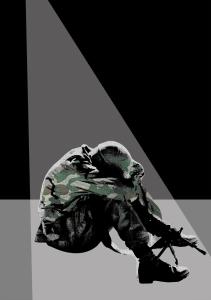
image by Alf-Marty
It is Mental Health Awareness Week. The theme for the week is Anxiety. Although most people deal with anxiety on some level, I wish to focus on anxiety in the military which often leads to further complications such as PTSD. The following is an article by my husband, Martin Green, which became the introduction for the book Into the Valley of the Shadow: A Soldier’s Military Journey and His Battle With PTSD by Joseph William Haynes (Hellgate, 2019). From his personal experience as a soldier who spent his entire career in US Army Special Operations based in the United States and in Germany, Green offers a very insightful look at the anxiety faced by many combat veterans as a result of their chosen profession.
Anxiety and Combat Veterans: Telling the Story
The memoirs of a military veteran are very special to both the veteran who writes them and the unit with which he served. Even the shortest of military tours evokes a feeling of pride and honor within the veteran. Every veteran has a unique story to tell, and with over 18.2 million military veterans still alive, that’s a lot of stories. Most will never be written down. Perhaps the individual does not have the opportunity or the necessary literary skills, or they lack a publicist who is willing to assist them in this process. So how will these stories be told?
The real problem here is not how to tell the story, but that the veterans do not always feel there is an audience to whom they can tell their stories, especially if that individual is a combat veteran. How is this a problem, you ask? Despite all the books and movies about war, the average citizen who has never experienced war can not relate, understand, or accept the agony, shame, and atrocities our soldiers face. They can not fully appreciate the amount of training and sacrifice the soldier must endure just to get to combat. Furthermore, to paraphrase Jack Nicholson’s character in A Few Good Men, “words like duty, honor, country, commitment, patriotism, and brotherhood” do not register in the hearts of the average civilian the way they do to a veteran. Unless you fully understand the concept of those ideals, you can’t understand what drives and motivates a soldier to be able to endure what he must in combat.
Combat Veterans’ Stories and Many Issues to Consider
As a combat veteran myself, I hear this all the time: “Why don’t you like to talk about your combat experiences?” I don’t because unless you walked in my boots on the same terrain with the same load under the same conditions, you could not understand exactly what I would tell you. It could not have the same meaning to you that it does to me. It also sets me (or any other veteran) up for your judgment, and if you weren’t there, you have not earned the right to make judgments. That does not make me a better person than you, or you a lesser person than me. It just means that to truly understand combat, you must experience it, and most combat veterans are happier not to expose you, or someone else for that matter, to the rigors and horrors of combat action.
Also, not all military experiences are meant for public knowledge due to Operational Security (OPSEC) protocol. I, personally, would not feel comfortable relating certain details of my military experience even though I have been retired for over twenty years because not everyone has a need to know. This is embedded in me. So the dilemma is that our veterans must carry many of their experiences within themselves, even though they would prefer to be able to tell their stories and be properly understood. This makes the average combat veteran particularly susceptible to anxiety disorders such as Post-Traumatic Stress Disorder (PTSD).
Our armed forces have been given the task to take sweet, innocent boys and girls and transform them into integral components of the most devastating war machine on this planet. They leave their homes and enter a world that is totally foreign to them. The cadre tear the recruits down and rebuild them to be lethal weapons; however, upon graduation from basic training, they don’t have all the skills they need to master proficiency in their chosen area of expertise. They are sent to their units where they are drilled night and day until their particular job skills become second nature. Both the officers and the non-commissioned officers (NCOs) of their units enact this with precision. Only then are the new soldiers sent out into the most hostile environments imaginable to meet the enemies of our country.
Combat Veterans and Many Battles to Fight
The climate and terrain alone would be hardship enough on the average person. Added to that is the weight and bulk of individual equipment that must be worn or carried. In addition, they must learn the customs of the host nation along with some basic language skills. Then there is the fact of seeing civilian populations living in the most disgusting conditions imaginable, in constant physical danger from both hostile and friendly forces, with minimal food, water, shelter, and medical supplies–true poverty. Daily, they encounter civilians and children who beg and plead for candy or pocket change or just a little attention; daily, the civilians and children, some of whom have become familiar, turn and attack with small arms or improvised explosive devices (TEDs). They hear of the attacks on their comrades and of the friendly casualties and deaths, always, always, always knowing somewhere deep inside that today could be their last day alive.
Gathering up the courage to get up every day and face these facts of life could challenge even the strongest of service men and women, but they do it willingly and with pride. They do it for love of country and for the love of their brothers and sisters in arms. Living this life for months at a time (six to twelve months on average), would be enough to scar them permanently. Add actual combat actions into the mix and you have the perfect recipe to ruin one’s emotional well-being.
It has been said that combat brings out the very worst and the very best of the individual, and at times, simultaneously. Fortunately for most, their training takes control of their minds and bodies, and with the heightened awareness brought on by adrenaline, the world begins to move in slow motion as their bodies continue on auto-pilot, responding to what was rigorously trained into them until the combat action is over.
Imagine, If You Dare
Imagine, if you can, the fear you would experience with all that fire power aimed at you. Imagine the shame you would feel for just feeling afraid when so many others are depending on your strength and courage. Imagine the loneliness you would feel at times with the weight of that responsibility on your shoulders because you are not only responsible for your own life, but the lives of your comrades, as well. Imagine the guilt you would feel over taking another human’s life–someone you never met or had a personal issue with, possibly someone you could have actually been friends with in another situation. Imagine the loss and sadness you would feel over the casualties taken by your unit. Imagine the horror you would feel as you contemplated becoming one of those casualties–Who will take care of my family? Who will console my loved ones? What will become of me if I am permanently disabled?
Combat Veterans and the Old Crisis
Does the average combat veteran have an outlet on which to unload this? Not always. Our combatants are trained to be “hard core.” Sometimes they are ashamed to admit to their brothers and sisters that they are afraid. They don’t want to let them down or leave doubts in their team members’ minds as to their reliability. They dare not show any weakness, so they learn to be “stuffers.” They stuff those “unacceptable” feelings away into their inner psyche where they wear away at the individual’s internal stability, making it hard to function at times.
Some, however, find positive outlets into which they can release this negative energy (coping skills), hopefully finding balance. Others may be lucky enough to have a sympathetic ear to hear them out without judgment or disapproval and without fear of being “ratted out” to their peers.
Unfortunately, some have no other choice than to continue to stuff until they can’t stuff any more, at which time they either mentally explode or shut down and become combat casualties because of their mental health.
In years past, PTSD did not receive the attention that it is receiving now. Combat veterans suffering from “shell shock” or “combat fatigue” were viewed as cowards or weaklings and were whisked away unceremoniously so they would not contaminate their brothers and sisters in arms. In most cases, they did not receive adequate care and were sent home for their families and communities to deal with them.
Combat Veterans and the Current Crisis
Today, psychiatrists and psychologists are able to treat this disorder with medications and counseling, treatments designed specifically to restore the patient’s quality of life, but it is up to the combat veteran to choose whether they want to be treatment warriors and learn ways to go on with their lives or to be victims and become emotionally crippled. The best advice I was given came from a VietNam veteran who told me, “You have to learn to live despite the baggage you carry. You choose to get on with your life or become permanently disabled.”
Some are ashamed of the stigma that used to be attached to mental health treatment and refuse to seek the help that is available to them. Others may not realize that they have a disorder or may try to ignore it, putting themselves and others at risk. Still others may be afraid of the cost of treatment. Sadly, some consider suicide their only option.
Hope!
There is hope. The Veterans Administration, community mental health facilities or hospitals, and organizations such as Wounded Warriors are available to provide services for veterans. They only need to seek out this help or be assisted to get to these services by their family members or support network.
Help is available both medically and financially. We must learn to protect our own and to aid and encourage them to get the help they need.
–Martin Green U.S. Army Special Operations, Retired
God bless you. Please pray for our troops and our veterans.
General Christian
Health, Fitness and Religion
Previous Post

September 30, 2023
A Strange Miracle
Next Post

October 6, 2023 Anxiety Due to Lack of Sleep: GenZennials at Risk
Recent Comments
Browse Our Archives
Select a Category Uncategorized
Select a Month October 2026 September 2026 August 2026 July 2026 June 2026 May 2026 April 2026 March 2026 February 2026 January 2026 December 2025 November 2025 October 2025 September 2025 August 2025 July 2025 June 2025 May 2025 April 2025 March 2025 February 2025 January 2025 December 2024 November 2024 October 2024 September 2024 August 2024 July 2024 June 2024 May 2024 April 2024 March 2024 February 2024 January 2024 December 2023 November 2023 October 2023 September 2023 August 2023 July 2023 June 2023 May 2023
Follow Us!
TAKE THE
Religious Wisdom Quiz
How many times is Jesus directly quoted in the book of Acts?
Select your answer to see how you score.
10 6 1 4
Related posts from I Chase Sunsets


The Saturday Evening Musings of a "Mean Teacher"

The Former Rain, the Latter Rain, and the...

Jehovah Nissi: The Meaning of "The Lord Is...
TRENDING AT PATHEOS Evangelical

Letters on Living the Faith by C.S. Lewis
Most of us met C.S. Lewis as a public intellectual. Mere Christianity....

When Halloween Unmasks Married Hearts
Written by Dr. David K. Ewen from Eternal Truth Bible College Behind...

Aristotle. He’s been called the father of logic, the father of the...

Methodist Central Hall and Westminster Abbey
Situated on the same square is Methodist Central Hall and Westminster Abbey. ...

57th Dove Awards Honor Dolly Parton, Crown New...
On gospel music’s biggest night, the 57th annual GMA Dove Awards honored...

The First Eucharistic Controversy: Christ’s Real Presence
For Catholics, the Eucharist is the source and summit of the Christian...
view all Evangelical blogs
Ad-Free & Subscriber Log-In Subscription Support
- About Us
- 2026 Calendar
- Videos
- Podcasts
- Library of World Religions
- Faith In Media Tracker
- Advertise With Us
- Write for Us
- Privacy Policy
- Terms of Service
- Do Not Sell My Data
- Contact Us
- Radiant Digital
- Manage Newsletter Subscriptions
- Unsubscribe From Notifications
- Sitemap
Copyright 2008-2026, Patheos. All rights reserved.
Subscription Support Ad-Free & Subscriber Log-In
Follow Patheos