
BuddhistCatholicContemplativeEvangelicalGeneral ChristianHinduJewishLatter-day SaintMuslimNew VisionsProgressive Christian
Beliefs
- Buddhist
- Catholic
- Contemplative
- Evangelical
- General Christian
- Hindu
- Jewish
- Latter-day Saint
- More Voices
- Muslim
- New Visions
- Pagan
- Progressive Christian
Topics
- Religion News
- Food and Religion
- Sports and Religion
- Religious Art
- Religious Music and Entertainment
- Religious Events
- History and Religion
- Style and Religion
- Politics and Religion
- Women in Religion
- Recreation Outdoors and Religion
- Business Finance and Religion
- Careers Workplace and Religion
- Education and Religion
- Family Parenting and Religion
- Health Fitness and Religion
- Home and Religion
- Relationships and Religion
- Technology and Religion
- Travel and Religion
Columnists
- Buddhist Columnists
- Business Finance and Religion Columnists
- Careers Workplace and Religion Columnists
- Catholic Columnists
- Contemplative Columnists
- Education and Religion Columnists
- Evangelists Columnists
- Family Parenting and Religion Columnists
- General Christian Columnists
- Health Fitness and Religion Columnists
- Hindu Columnists
- History and Religion Columnists
- Home and Religion Columnists
- Jewish Columnists
- More Voices Columnists
- Latter Day Columnists
- Muslim Columnists
- New Visions Columnists
- Nonreligious Columnists
- Pagan Columnists
- Politics and Religion Columnists
- Progressive Columnists
- Recreation Outdoors and Religion Columnists
- Relationships and Religion Columnists
- Religion News Columnists
- Religious Art Columnists
- Religious Events Columnists
- Religious Music and Entertainment Columnists
- Sports and Religion Columnists
- Style and Religion Columnists
- Technology and Religion Columnists
- Travel and Religion Columnists
- Women in Religion Columnists
Resource Library
- 2026 Calendar
- Library of World Religions
- The 100 Most Holy Places on Earth
- Patheos Answers
- Podcasts
- Videos
- Faith Leaders Database
- Anglican Episcopalian
- Bahai
- Baptist
- Buddhism
- Christianity
- Confucianism
- Eastern Orthodoxy
- Hinduism
- Holiness and Pentecostal
- ISKCON
- Islam
- Judaism
- Lutheran
- Methodist
- The Church of Jesus Christ of Latter-day Saints
- New Age
- Paganism
- Presbytarian and Reformed
- Protestantism
- Religion Behind the Scenes
- Roman Catholic
- Scientology
- Shia Islam
- Sikhism
- Sufism
- Sunni Islam
- Taoism
- Zen
- See all religions
Research Tools
 Ad-Free & Subscriber Log-In Subscription Support
Ad-Free & Subscriber Log-In Subscription Support
Follow Patheos 

- Trending:
- Forgiveness
- |
- Marriage
- |
- Consciousness
- |
- Death Penalty
- |
- Election
- |
- Halloween
 Home Waters
- Home
- Latter-day Saint
- Literature and the Art of Friendship
Literature and the Art of Friendship
Last updated on: March 18, 2016 at 1:48 pm by georgehandley
Literature and the Art of Friendship 2016-03-18T13:48:02-06:00 georgehandley
Patheos Explore the world's faith through different perspectives on religion and spirituality! Patheos has the views of the prevalent religions and spiritualities of the world.
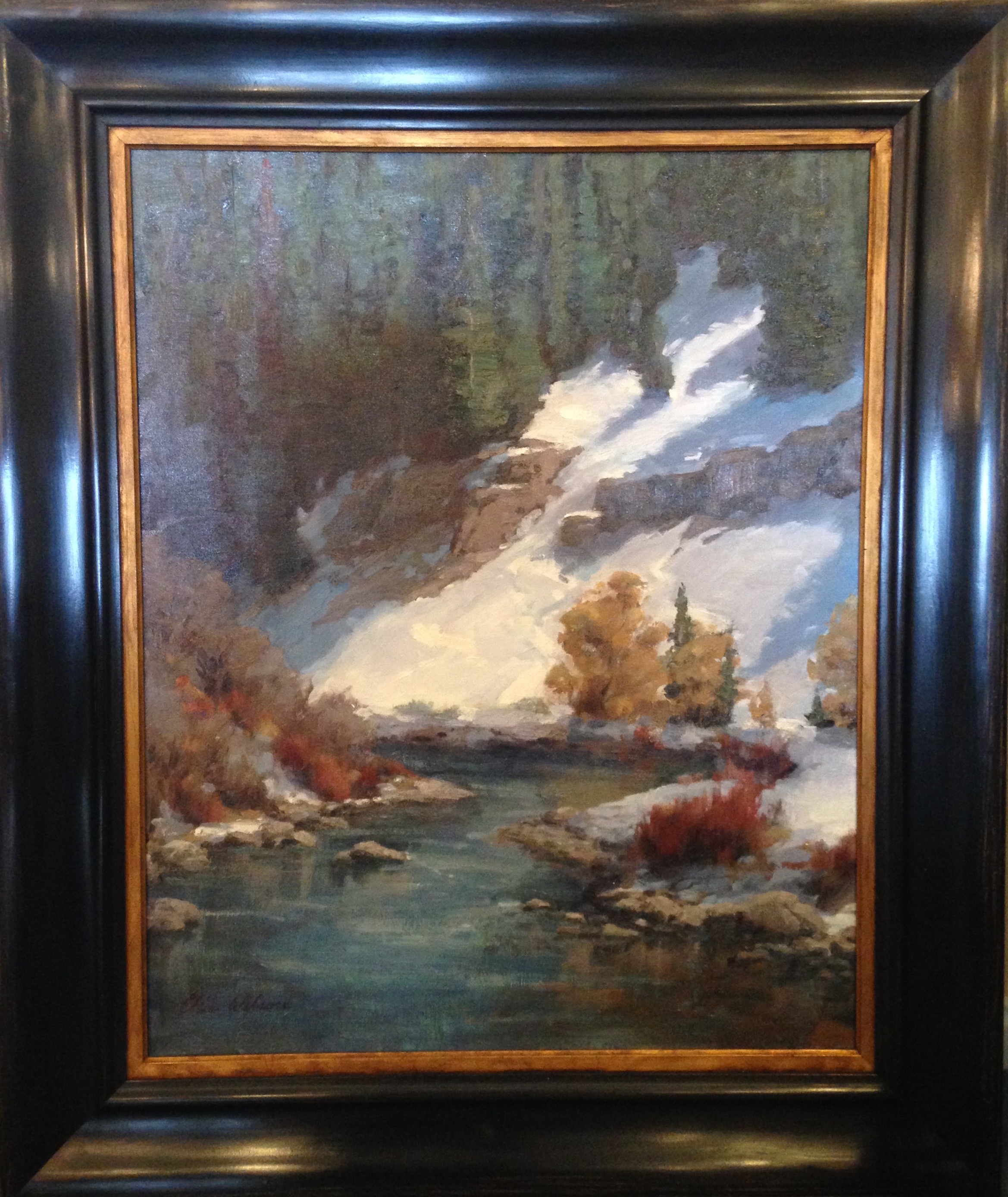
The Provo River, by Ellie Wilson
I didn’t ever expect that in 2016 we would be struggling as a nation with the very idea of the universal brotherhood of God’s family. Of course, I expected that we would still have difficulty rising up to the standards such an idea implies, but we are seeing such naked and bald assertions of hatred of late and many of us understandably are recoiling in a state of shock. Let us not recoil. If we wish to stand for something, let us stand for kindness, decency, and the courage to model civil disagreement. Let us remember how good we have been and still can be. Let us celebrate those moments of light when the idea of the familial nature of all human relationships shines brightly.
I recently read these powerful words in Marilynne Robinson’s new book of essays, The Givenness of Things. “Say that the one earthly thing God did not put under our feet was our own essential nature. The one great corrective to our tendency toward depredation would be recognition of our abiding sacredness, since we are both, and often simultaneously, victim and villain. The divine image in us, despite all, is an act of God, immune to our sacrilege, apparent in the loveliness that never ceases to shine out in incalculable instances of beauty and love and imagination that make the dire assessment of our character, however solidly grounded in our history and our prospects, radically untrue.” What she suggests here is that despite our errors, despite what great damage we are capable of doing to one another, there is still something in us that remains lovely and divine and that something is most readily evident in our capacity to imagine.
One such moment of shining happened recently at BYU during the visit of Alireza Taghdarreh from Iran. Ali is a man of great affection and wonder, someone who has humbly emerged from his own particular origins to become a voice of hope and peace. You can read about him here. Without anything but the informal education he could obtain from books and from conversations with distant colleagues across the great gulf that separates Iran from the United States, Ali spent 15 years first teaching himself English and then working on the translation of Henry David Thoreau’s Walden into Persian. When an opportunity presented itself for Ali to visit the United States, to visit the beloved pond of one of our greatest environmental minds, and to visit universities across our country, Ali jumped at the chance.
I heard from a friend about his impending visit, and we were able to arrange his visit to Utah. He spoke at BYU, and you can listen to his presentation here. Something he said in the lecture has stuck with me ever since. He spoke of a dream he had, an image of possibility and of peace, regarding our two nations. He had learned a great deal about the English language and about Thoreau over the course of his work in this translation project, but he had perhaps more importantly learned about the universal brotherhood of humankind, something his religious faith taught him from the time he was young. This was apparent to him because of the ways in which the sensibilities of a young transcendentalist in a country far away resembled the yearnings and the wisdom of one of his culture’s greatest souls, Rumi the great poet of the 13th century. But it was also clear that Thoreau’s words spoke to Ali’s particular circumstances in the 21st century. Thoreau’s small cabin spoke to his soul in a small room a world away where he and his family began their life together. Thoreau’s words made his room the world and made his own humble belongings feel like an embarrassment of riches.
He concluded his presentation with these unforgettable words: “I am convinced from my experience of reading Walden with so many American scholars over the course of a decade that hostility, anger, and misunderstanding would be unknown between our nations, if we picked up books and read them with each other, the way I did, I and my American friends, for ten years. Let us allow Thoreau to sharpen our eyes on the value of love and friendship.”
This is a profound insight, one that I believe with all of my heart and one that informs all worthy endeavors in the humanities. It is certainly central to the work of Utah Humanities, a wonderful organization for which I am proud to serve as a board member. I have elsewhere (here and here, for example) written about my belief that the arts and the humanities are essential teachers of the meaning of community and essential enablers of our capacity to forge community in practice with those who are different from us. Community is meaningless if it doesn’t extend beyond the very real differences that separate us, differences of nationality, religious belief, of political persuasion, of language, economic status, gender, race or sexuality. I do not see how anyone can adhere to a religion that proclaims the idea of the universal human family and not feel chastened, almost daily, by the clear evidence of our failures to live up to the high ideals implied by this concept.
While I believe that I have known an Iranian or two in my life, I have never had an Iranian friend and I have certainly never felt so connected to one as I feel to Ali. When he was here, I thought I should give him a copy of my book, Home Waters, as a gift.

Ali and I at BYU
I remember traveling to Chile for the first time and it seemed that every Chilean I met had written poetry. Many gave me copies of their work, and I thought nothing seemed to express the hope of solidarity more powerfully than the gift of literature produced from one’s own heart. I feel the same way about the other arts. I recently obtained a painting by a former student, Ellie Wilson, of my beloved Provo River and because of our shared loved for this place and our shared experience as teacher and student, the painting seems to me without price (it is the image at the top of this essay). It is also the reason a work of stained glass of the Provo River (seen here below) hangs in my office, a work done by one of the my former students who recently passed away tragically as a young mother, Sarah Walker Judson.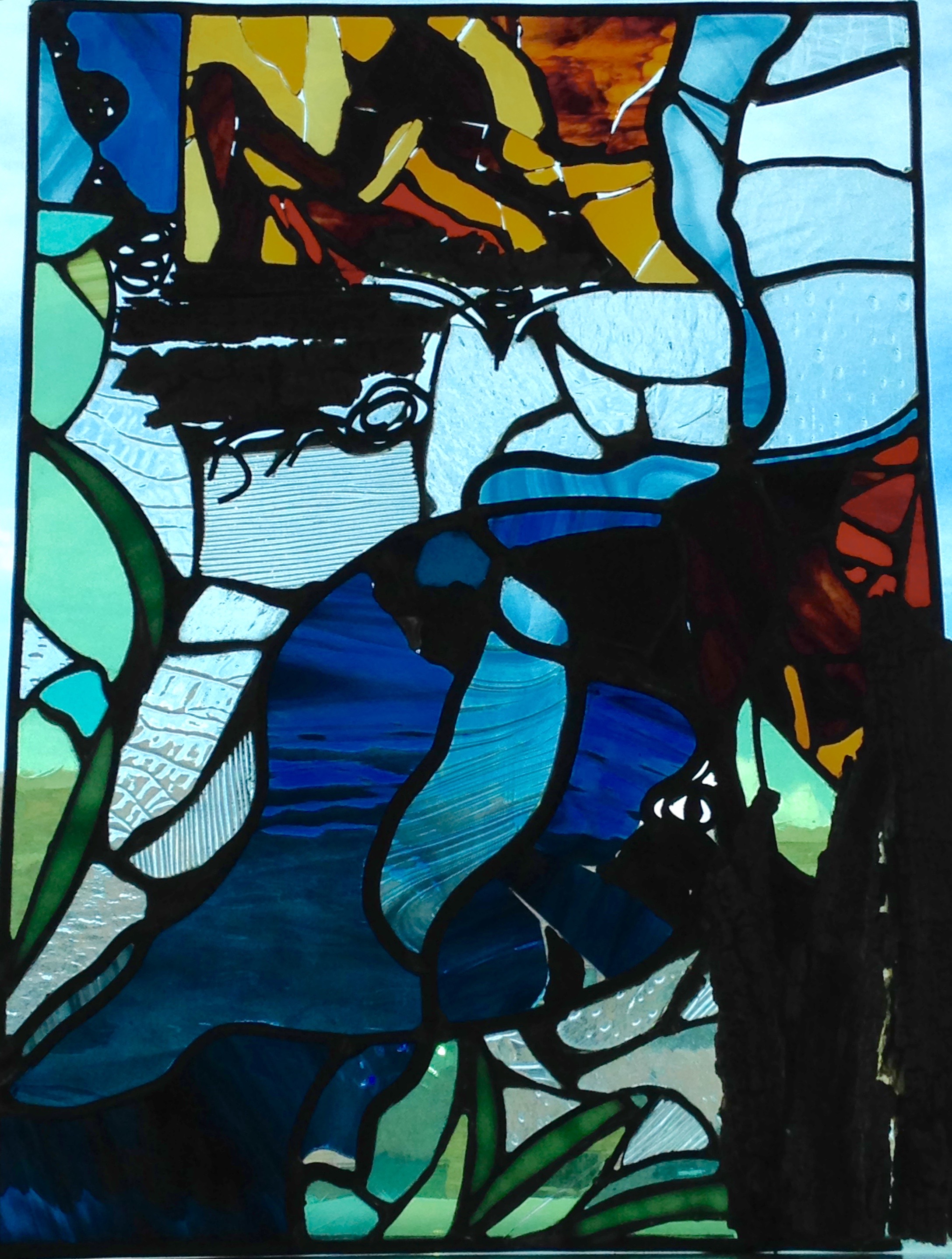
I explained to Ali that my book was my local attempt at developing a stronger sense of place here in Utah. Not that I intentionally departed my home for the woods as did Thoreau, but that I too tried to live deliberately in relation to the environment where I live, trying to understand the meaning of my nearest watershed and its place in our economic, cultural, and spiritual lives as a community. My book does involve a small cabin, too, I explained to him, but it also involves the very suburban reality in which I live. Ali took the book into his hands with a reverence that moved me. He recently wrote me after his return to Iran:
“Tomorrow I am going to meet with a principal of a school in a nearby province who is interested to hear the story of my trip to the US. All the teachers and staff of the school will all be present in the meeting. There are other schools who would like to see me too. People believe that I am taking the whole United States with me there in friendship. I will take your book and the memory of our short, but lasting meeting to them. I want them to touch your book in their hands and taste it with their mind. There are words in this book that I think they will enjoy to read very much.
I sacrificed a lot of years of my life only to be able to read your books and bring my heart to you through your poets and writers. I closed my eyes to a lot of life’s comforts in order to study your language and literature alone while I was excluded from our academic circles. In my dreams I see many Iranians and Americans who share their love of poetry and literature and enrich each other’s life with friendship.”
He concluded by saying, “Please do share my dream with your friends and tell them that in my dream I see the peoples of the world sharing their knowledge of their favorite books with each other in love and friendship.” And so I do here.
When I was writing Home Waters, I imagined readers of different kinds. I imagined my family and immediate neighbors and my Mormon community, of course, especially since they figured into the story I was telling, but I also imagined people in my community and in my state who did not share my faith or my story. I felt after their stories and hoped that I would speak across whatever divides us. And I thought too of readers elsewhere in the country for whom Utah is a strange land of an odd history. How I wanted everyone to see themselves and to see others more clearly. I wanted us to see our common humanity. I can’t pretend to know for sure if I succeeded, but I certainly never imagined a reader in Iran, of Islamic faith and sensibility whose language and customs and reality are so different from my own but with whom I would feel as familiar as I do with my own brother. This is, I suppose, the magic and power of language. Words are cheap and they are so often misused or lazily tossed about; they can do immense harm. But when they are rooted in the particulars of one life, when those words are given the care and attention that come with any serious desire for earnest communication and are then carried across the divide to readers who, through the work of charitable and loving interpretation and translation, render that world into an imagined reality in which they can see themselves, communion becomes possible. Communion can happen through shared experience, of course, but that limits us only to the people we know or with whom we share our lives. But a communion of readers is a communion pieced together by symbols and hence both metaphysical and transcendent, something that touches that which lies beneath or behind words, something that bespeaks our true belonging to and with all people. In this season of tawdry, vulgar, and vicious language, I find great solace in this experience with Ali because of its reminder of the reasons for the hope that is within me.
Previous Post

February 6, 2016
On Disagreements at Church
Next Post

May 7, 2016 Obedience as Gratitude
Browse Our Archives
Select a Category Uncategorized
Select a Month May 2016 March 2016 February 2016 December 2015 November 2015 October 2015 August 2015 July 2015 June 2015 March 2015 January 2015 December 2014 November 2014 October 2014 September 2014 August 2014 July 2014 June 2014 May 2014 April 2014 March 2014 February 2014 January 2014 December 2013 November 2013 October 2013 September 2013 August 2013 July 2013 June 2013 May 2013 April 2013 March 2013 February 2013 January 2013 December 2012 November 2012 October 2012 September 2012 August 2012 July 2012 June 2012 May 2012 April 2012 March 2012
Follow Us!
TAKE THE
Religious Wisdom Quiz
Who saw the vision of the valley of dry bones?
Select your answer to see how you score.
Ezekiel Isaiah Jeremiah Daniel
Related posts from Home Waters


My Journey as a Scholar of Faith, Part...
TRENDING AT PATHEOS Latter-day Saint

Did Prayer Cure His Cancer? Or Was It...
At 4 AM one morning, Joshua W. Brown’s wife awoke to a...

8 Ways a Near-Death Experience Rewires the Soul
Does Consciousness Survive Physical Death? After 50 Years of Research, Dr. Raymond...

Holy Longing: What Our Restlessness Is Telling Us
“One can find so many pains when the rain is falling.” -John...

What this is NOT about. This blog is definitely not about...

Who said the Israelites were God’s chosen? That’s right, they did. Who...

The Spirit World Is the Real World: God...
A Monk’s Wisdom on Body and Spirit I sit with Brother Martin...
view all Latter-day Saint blogs
Ad-Free & Subscriber Log-In Subscription Support
- About Us
- 2026 Calendar
- Videos
- Podcasts
- Library of World Religions
- Faith In Media Tracker
- Advertise With Us
- Write for Us
- Privacy Policy
- Terms of Service
- Do Not Sell My Data
- Contact Us
- Radiant Digital
- Manage Newsletter Subscriptions
- Unsubscribe From Notifications
- Sitemap
Copyright 2008-2026, Patheos. All rights reserved.
Subscription Support Ad-Free & Subscriber Log-In
Follow Patheos