
BuddhistCatholicContemplativeEvangelicalGeneral ChristianHinduJewishLatter-day SaintMuslimNew VisionsProgressive Christian
Beliefs
- Buddhist
- Catholic
- Contemplative
- Evangelical
- General Christian
- Hindu
- Jewish
- Latter-day Saint
- More Voices
- Muslim
- New Visions
- Pagan
- Progressive Christian
Topics
- Religion News
- Food and Religion
- Sports and Religion
- Religious Art
- Religious Music and Entertainment
- Religious Events
- History and Religion
- Style and Religion
- Politics and Religion
- Women in Religion
- Recreation Outdoors and Religion
- Business Finance and Religion
- Careers Workplace and Religion
- Education and Religion
- Family Parenting and Religion
- Health Fitness and Religion
- Home and Religion
- Relationships and Religion
- Technology and Religion
- Travel and Religion
Columnists
- Buddhist Columnists
- Business Finance and Religion Columnists
- Careers Workplace and Religion Columnists
- Catholic Columnists
- Contemplative Columnists
- Education and Religion Columnists
- Evangelists Columnists
- Family Parenting and Religion Columnists
- General Christian Columnists
- Health Fitness and Religion Columnists
- Hindu Columnists
- History and Religion Columnists
- Home and Religion Columnists
- Jewish Columnists
- More Voices Columnists
- Latter Day Columnists
- Muslim Columnists
- New Visions Columnists
- Nonreligious Columnists
- Pagan Columnists
- Politics and Religion Columnists
- Progressive Columnists
- Recreation Outdoors and Religion Columnists
- Relationships and Religion Columnists
- Religion News Columnists
- Religious Art Columnists
- Religious Events Columnists
- Religious Music and Entertainment Columnists
- Sports and Religion Columnists
- Style and Religion Columnists
- Technology and Religion Columnists
- Travel and Religion Columnists
- Women in Religion Columnists
Resource Library
- 2026 Calendar
- Library of World Religions
- The 100 Most Holy Places on Earth
- Patheos Answers
- Podcasts
- Videos
- Faith Leaders Database
- Anglican Episcopalian
- Bahai
- Baptist
- Buddhism
- Christianity
- Confucianism
- Eastern Orthodoxy
- Hinduism
- Holiness and Pentecostal
- ISKCON
- Islam
- Judaism
- Lutheran
- Methodist
- The Church of Jesus Christ of Latter-day Saints
- New Age
- Paganism
- Presbytarian and Reformed
- Protestantism
- Religion Behind the Scenes
- Roman Catholic
- Scientology
- Shia Islam
- Sikhism
- Sufism
- Sunni Islam
- Taoism
- Zen
- See all religions
Research Tools
 Ad-Free & Subscriber Log-In Subscription Support
Ad-Free & Subscriber Log-In Subscription Support
Follow Patheos 

- Trending:
- Forgiveness
- |
- Marriage
- |
- Consciousness
- |
- Death Penalty
- |
- Election
- |
- Halloween
 Home Waters
- Home
- Latter-day Saint
- Ecospirituality Workshop (Day #2)
Ecospirituality Workshop (Day #2)
Last updated on: August 19, 2012 at 8:29 am by georgehandley
Ecospirituality Workshop (Day #2) 2012-08-19T08:29:31-06:00 georgehandley
Patheos Explore the world's faith through different perspectives on religion and spirituality! Patheos has the views of the prevalent religions and spiritualities of the world.
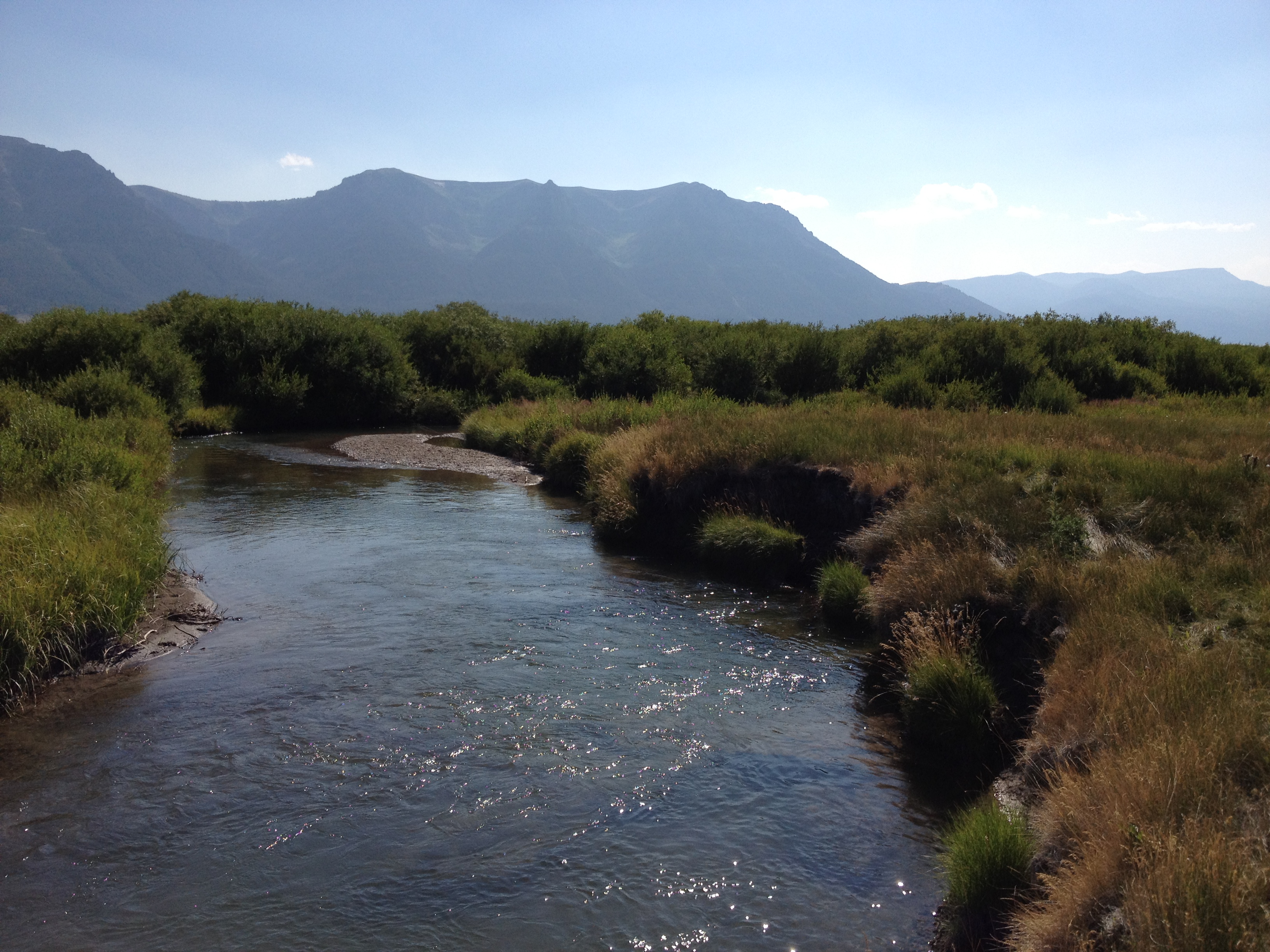 We began the second day discussing the art of nature writing. Tom had asked the day before, “Who do you think you are?” I asked: “Where do you think you are?” I suggested that nature writing is a kind of reconnaissance, an exercise in inhabitation, or as Annie Dillard puts it, an exploration of the neighborhood. Of course other art forms work to this end as well, but nature writing is a terrific way to literally ground your thinking and build some specific content into your growing affections for a place. It makes love of place less of a theoretical or vague idea and more of a committed relationship. And this is no mere exploration of a few streets or hiking trails. It has cosmological significance. So I brought in my favorite quote from the novelist, Marilynne Robinson, from an interview I did with her 8 years ago. She said:
“There’s probably nothing stranger than the fact that we exist on a planet. Very odd. Who does not feel the oddness of this? I mean, stop and think about where we actually are in the larger sense. It seems to me as if every local landscape is a version of the cosmic mystery, that it is very strange that we’re here, and that it is very strange that we are what we are. In a certain sense the mystery of the physical reality of the human being is expressed in any individual case by the mystery of a present landscape. The landscape is ours in the sense that it is the landscape that we query. So, we’re created in the fact of ourselves answering to a particular sense of amazement.”
Robinson’s point seems to be that fundamental to our experience of being human is the experience of amazement and awe. The weight of awe is sometimes too much for us, so we grow lazy and prefer instead to keep our relationship to our surroundings on a superficial level to the point of boredom. But all great literature and art are born of a sense of surprised and unanticipated wonder. And what is especially remarkable is that great art is rarely about exotic or foreign landscapes but about the most intimately known landscapes of home. It is as if art defamiliarizes the familiar and allows us to see what has been seen many times before, as if for the first time. In this sense, artistic ways of seeing nature remake the world and help to remake us, to bring us into the world again with fresh eyes. Seeing nature should never be a cliché or a monotonous routine.
We had read Wallace Stegner’s essay, “A Sense of Place,” and discussed three aspects of how to establish a deeper sense of belonging in the landscapes we occupy. We began first with the need for a sense of history. It is vital that we learn our local history, our local lore, that we know key landmarks, legends, and stories so that we can see all human citizens of a place through as much human time as a place has. This changes the way we see what is before us. A parking lot or a nondescript street corner could very well be the site of important historical events and beginnings to a community. And we need to find a way to tie our own story into the broader human history of our home. We read the poem, “History” by Wendell Berry as an example, where he describes eating fruit of his garden, knowing that in the soil of the place is contained the entirety of its human history.
Secondly, we need a sense of ecology. We need to know as much as we can about the ecological conditions, the interdependencies, and the flora and fauna of the region. We need to know our watersheds, our climate’s tendencies, and the place’s vulnerabilities. The ecological story of a place situates its history in even deeper time and challenges our imagination to be inclusive of an even broader more-than-human community. We read a Mary Oliver poem, “The Chance to Love Everything,” that describes her sense of ecological wonder in the community of animals in which she finds herself.
Finally, I suggested that we need a sense of spirituality. We need to find a purpose, a calling, a sense of responsibility toward where we live. We need to identify what is sacred and guard and protect it. We need to recognize the ways in which our home witnesses the divine and then seek ways to bear testimony to that divinity. As an example, we read the poem, “The Grandeur of God” by Gerard Manley Hopkins.
I challenged the participants to spend that afternoon at Elk Lake and Hidden Lake on the west side of the valley contemplating and then writing what they saw. I suggested that mere imitation of the landscape through description would be a good place to start and that with time they can begin to find a way to narrate how their own story merges with the story of land. I didn’t expect too much, since this isn’t a writing workshop, but in my next entry I will describe something of the marvelous writing that emerged. The lakes were wonderful, enjoyed on kayaks and on the shores, as the afternoon breezes picked up on an otherwise warm day.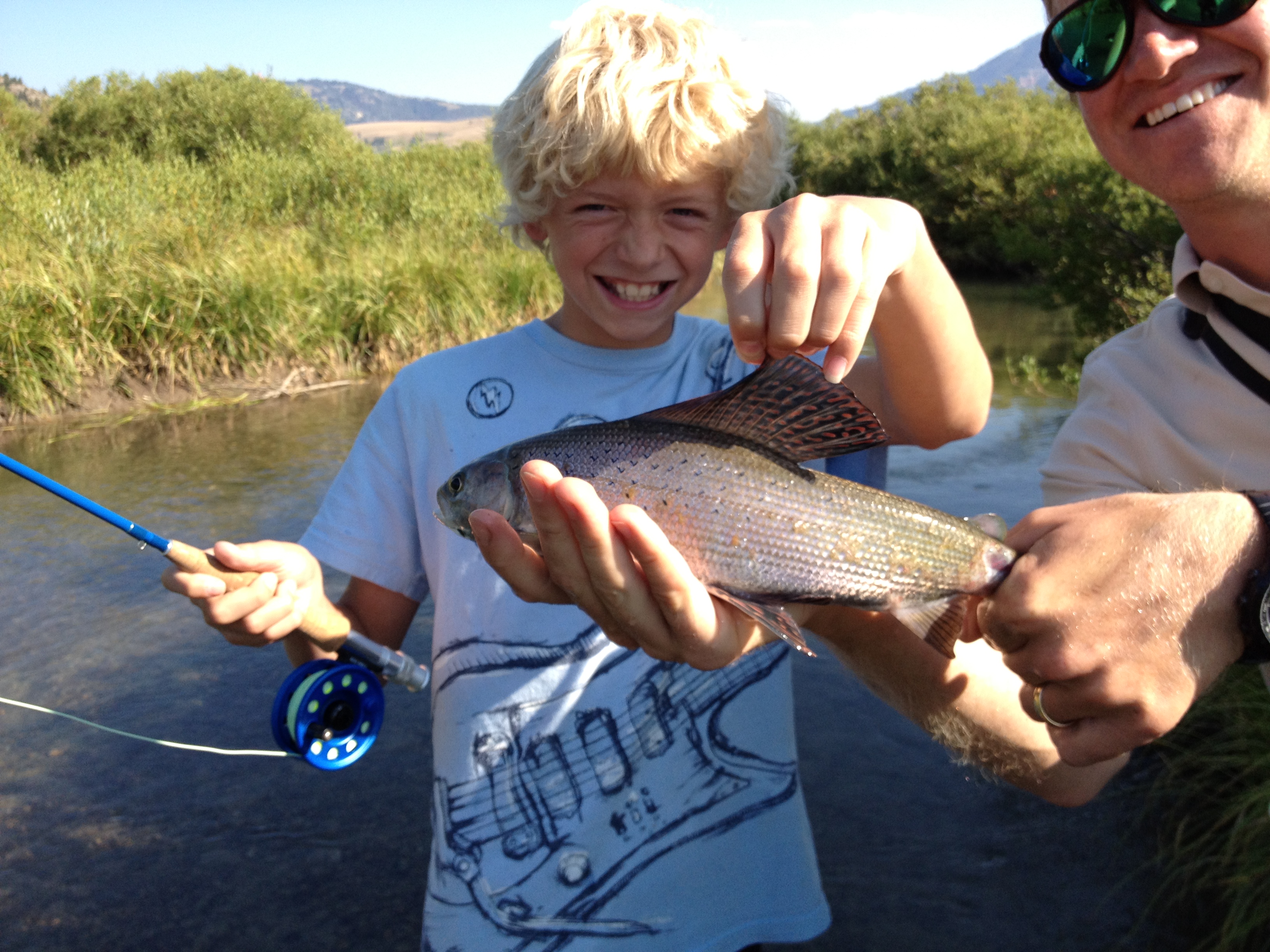
Afterwards, Sam and I joined Frank Carter for a few hours of fishing on Red Rock Creek nearby. It was a long and muddy slog through moose country to get far enough down the creek where the best fish were. Frank was a great guide for Sam, helping him to spot fish and to improve his cast. We caught several fish each, mostly large Artic Graylings, from about 14 to 19 inches in length, and one large cutthroat trout. The Graylings are surprisingly beautiful. They don’t have the variety of color on their sides like the trout, but their silver skin is complemented by splashes of rust colors on the fins and iridescent blue spots as well on their dorsal fins which fan out like a sun fish. Sam managed a few catches all by himself, and he walked back to our car when it was all over with an immense sense of satisfaction. Frank earned my profound gratitude for helping advance my son’s confidence in fishing.
That evening we listened to John Taft talk to us about how Providence guided him to find this property and to purchase it, which launched him on his journey to preserve this valley. I won’t recount the whole story, but it boiled down to a very long and fruitless search for a special place he hoped would be somewhere in the West. And when he finally pled to God in a vocal prayer, asking for help, he felt he heard a voice that said, “So you still believe in me after all these years?” And almost immediately he was led to the right person who could sell him the property he wanted, against odds and after a series of rapid and serendipitous circumstances. He heard the voice again: “Was that fast enough for you?” He is an endearing and funny man, someone who has a hint of Jimmy Stewart about him, a dignified elderly man, with a tender and loving granddaughter at his side who aspires to help carry on his environmental cause into the future. He was so glad to have us here, and we were fortunate to experience his magnanimity.
Previous Post
August 18, 2012
Ecospirituality Workshop (Day #1)
Next Post

August 20, 2012 Ecospirituality Workshop (Day #3)
Browse Our Archives
Select a Category Uncategorized
Select a Month May 2016 March 2016 February 2016 December 2015 November 2015 October 2015 August 2015 July 2015 June 2015 March 2015 January 2015 December 2014 November 2014 October 2014 September 2014 August 2014 July 2014 June 2014 May 2014 April 2014 March 2014 February 2014 January 2014 December 2013 November 2013 October 2013 September 2013 August 2013 July 2013 June 2013 May 2013 April 2013 March 2013 February 2013 January 2013 December 2012 November 2012 October 2012 September 2012 August 2012 July 2012 June 2012 May 2012 April 2012 March 2012
Follow Us!
TAKE THE
Religious Wisdom Quiz
Who was healed of leprosy after washing seven times in the Jordan River?
Select your answer to see how you score.
Ben-hadad Naaman Hezekiah Hazael
Related posts from Home Waters


Literature and the Art of Friendship


TRENDING AT PATHEOS Latter-day Saint

Did Prayer Cure His Cancer? Or Was It...
At 4 AM one morning, Joshua W. Brown’s wife awoke to a...

8 Ways a Near-Death Experience Rewires the Soul
Does Consciousness Survive Physical Death? After 50 Years of Research, Dr. Raymond...

Holy Longing: What Our Restlessness Is Telling Us
“One can find so many pains when the rain is falling.” -John...

What this is NOT about. This blog is definitely not about...

Who said the Israelites were God’s chosen? That’s right, they did. Who...

The Spirit World Is the Real World: God...
A Monk’s Wisdom on Body and Spirit I sit with Brother Martin...
view all Latter-day Saint blogs
Ad-Free & Subscriber Log-In Subscription Support
- About Us
- 2026 Calendar
- Videos
- Podcasts
- Library of World Religions
- Faith In Media Tracker
- Advertise With Us
- Write for Us
- Privacy Policy
- Terms of Service
- Do Not Sell My Data
- Contact Us
- Radiant Digital
- Manage Newsletter Subscriptions
- Unsubscribe From Notifications
- Sitemap
Copyright 2008-2026, Patheos. All rights reserved.
Subscription Support Ad-Free & Subscriber Log-In
Follow Patheos