
BuddhistCatholicContemplativeEvangelicalGeneral ChristianHinduJewishLatter-day SaintMuslimNew VisionsProgressive Christian
Beliefs
- Buddhist
- Catholic
- Contemplative
- Evangelical
- General Christian
- Hindu
- Jewish
- Latter-day Saint
- More Voices
- Muslim
- New Visions
- Pagan
- Progressive Christian
Topics
- Religion News
- Food and Religion
- Sports and Religion
- Religious Art
- Religious Music and Entertainment
- Religious Events
- History and Religion
- Style and Religion
- Politics and Religion
- Women in Religion
- Recreation Outdoors and Religion
- Business Finance and Religion
- Careers Workplace and Religion
- Education and Religion
- Family Parenting and Religion
- Health Fitness and Religion
- Home and Religion
- Relationships and Religion
- Technology and Religion
- Travel and Religion
Columnists
- Buddhist Columnists
- Business Finance and Religion Columnists
- Careers Workplace and Religion Columnists
- Catholic Columnists
- Contemplative Columnists
- Education and Religion Columnists
- Evangelists Columnists
- Family Parenting and Religion Columnists
- General Christian Columnists
- Health Fitness and Religion Columnists
- Hindu Columnists
- History and Religion Columnists
- Home and Religion Columnists
- Jewish Columnists
- More Voices Columnists
- Latter Day Columnists
- Muslim Columnists
- New Visions Columnists
- Nonreligious Columnists
- Pagan Columnists
- Politics and Religion Columnists
- Progressive Columnists
- Recreation Outdoors and Religion Columnists
- Relationships and Religion Columnists
- Religion News Columnists
- Religious Art Columnists
- Religious Events Columnists
- Religious Music and Entertainment Columnists
- Sports and Religion Columnists
- Style and Religion Columnists
- Technology and Religion Columnists
- Travel and Religion Columnists
- Women in Religion Columnists
Resource Library
- 2026 Calendar
- Library of World Religions
- The 100 Most Holy Places on Earth
- Patheos Answers
- Podcasts
- Videos
- Faith Leaders Database
- Anglican Episcopalian
- Bahai
- Baptist
- Buddhism
- Christianity
- Confucianism
- Eastern Orthodoxy
- Hinduism
- Holiness and Pentecostal
- ISKCON
- Islam
- Judaism
- Lutheran
- Methodist
- The Church of Jesus Christ of Latter-day Saints
- New Age
- Paganism
- Presbytarian and Reformed
- Protestantism
- Religion Behind the Scenes
- Roman Catholic
- Scientology
- Shia Islam
- Sikhism
- Sufism
- Sunni Islam
- Taoism
- Zen
- See all religions
Research Tools
 Ad-Free & Subscriber Log-In Subscription Support
Follow Patheos 

- Trending:
- Advent
- |
- Forgiveness
- |
- Thanksgiving
- |
- Election
- |
- Seasonal Holidays
- |
- Marriage
 Home Waters
- Home
- Latter-day Saint
- Lessons from Doc: #6 Learn to like work and enjoy the satisfaction of doing your job as well as it can be done
Lessons from Doc: #6 Learn to like work and enjoy the satisfaction of doing your job as well as it can be done
Last updated on: June 21, 2012 at 7:59 am by georgehandley
Lessons from Doc: #6 Learn to like work and enjoy the satisfaction of doing your job as well as it can be done 2012-06-21T07:59:00-06:00 georgehandley
Patheos Explore the world's faith through different perspectives on religion and spirituality! Patheos has the views of the prevalent religions and spiritualities of the world.
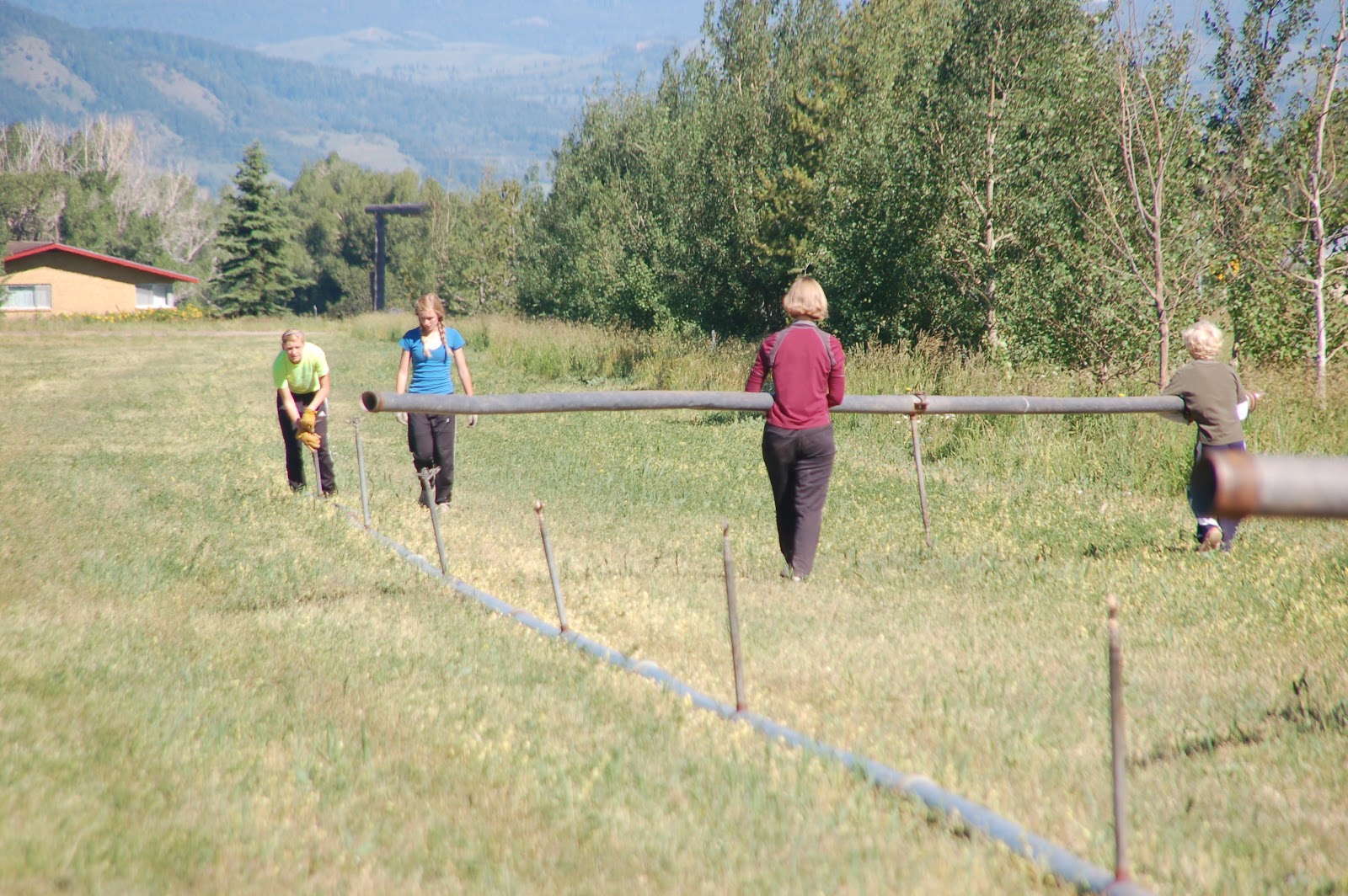
Doc founded the Teton Valley Boys Ranch in the 1960s on the idea that work was inherently valuable and that boys needed to learn to like it. I don’t know why girls were not included in his objectives. He never spoke about this, as far as I know. Certainly there was only so much he could do with one ranch and one idea, but his successor and one of my heroes, Dick Jacobsen, bought the property years later and reinstituted the boys ranch and then created a girls and family ranch on the other side of Teton Valley that my own daughter and then our whole family recently had the privilege of attending. No doubt somewhere Doc is smiling.
Doc had written a dissertation on the philosophy of Max Weber and was, I suppose, attracted to the notion of the Protestant work ethic. Because of my exposure to Doc’s ranch, many years later as I read Wendell Berry’s devastating critique of the denigration of work and of the body in The Unsettling of America, I instinctively recognized this as the sermon Doc had been giving, almost without words, at the ranch. And what was the work? Usually it involved a variety of tasks of hard physical labor, starting with the construction of the camp itself and its facilities in the early years and continuing with the work of upkeep of a large forest—including cutting down and skinning trees for fence posts—planting and weeding a large garden, service projects for needy widows in Teton Valley, work for local ranchers, and the upkeep of the Boys Ranch itself—laundry, cooking, shopping, repairs.
Doc never said much about whether he attached a particularly Mormon spin to the idea of work, but it is not hard to imagine that Doc saw work as redemptive. I know he used to say that prisoners ought to work and serve, not as punishment, but as opportunities to experience empowerment and selflessness. He never wanted to give up on people, which is why he also opposed capital punishment. The most religious idea associated with work I remember Doc teaching was from the Bhagavad Gita: “To action alone hast thou a right, not to its fruits.” This is heretical to the dogma of the American Dream, of course. Doc meant by this that it was hubris to expect specific consequences from my labors—there was wisdom and humility in accepting the fact that consequences had less to do with me and more with circumstance, grace, serendipity perhaps, and certainly the collective work of others. I think I hear echoes of Doc’s thinking in Massachusetts Senatorial candidate Elizabeth Warren when she reminds us that the so-called “self-made man” is more dependent on the labor of others than he would like us to believe. In its emphasis on the holiness of the body, the holiness of physical experience, and the divine potential of all human endeavors, LDS belief is about as work- and body-friendly as beliefs come, but it is also true that the seductions of capitalism have led us to neglect the communitarian work ethic of the beehive with which the LDS religion began. Work, for Doc, had to have a purpose beyond self-interest; its greatest objective was to forget oneself on behalf of others and on behalf of something larger than oneself.
Doc never used the language of getting ahead, pulling oneself up by the bootstraps, or becoming the self-made man. I heard plenty of that from my own grandfather, a man whom I loved intensely but to whose philosophy I ultimately could not subscribe. He was a peer of Doc’s and knew him, but I often sensed he didn’t quite understand all of the admiration for him. He had grown up a somewhat destitute farmer and brick mason in Salt Lake valley only to become an MBA and a successful banker in New York City in the middle of the Great Depression. My grandfather certainly knew how to work physically hard and appreciated others who did as well, but he was more typically American than Doc in his view that the overall objective of American progress was to leave most needs for manual work behind. He did have a garden, and he was an excellent gardener, but he saw the world in hierarchical terms and mainly admired those who were trying to work themselves out of their circumstances. I never heard admiration for those who preferred simple, low-paying professions, artistic production and education, or working with their hands, and least of all for those who appeared unable to extract themselves from a blue collar world.
For Doc, the value of work was in the act of submission to a process of making that consumed us and that enjoined us to one another and to the world, as well as forged a union of body and spirit. For Doc, every job required skills and every job done well required an accomplishment akin to art. You knew you were succeeding in the task when you found yourself gaining aptitude and efficiency as you lost a consciousness of the difficulty of the work and let instinct take over. This is when you found yourself falling into a kind of rhythm with the tools and materials in your hands. And this was not usually achieved on an individual basis merely; work was a collective effort and it was always valuable in a relational context. As I think back on those years at the ranch, I knew something was happening when a group of boys would begin making up songs, jokes, or legends associated with the work in question and when they began to see themselves as working as a collective whole. Eventually a kind of internally driven but shared competitiveness would take over, just for the pride and pleasure of seeing how well the work could be done. And as the summer wore on, our bodies as well as our environments were mutually transformed.
I wasn’t exactly a city slicker, even though that was what one of the local ranchers liked to call us, but I had been living in a well-heeled bedroom community in Connecticut that knew little of subsistence labor, the need for fundamental service, or the value of sweat brought on by something other than exercise. I suppose my friends wondered if I had done something wrong to deserve to be sent off to the wilds of Idaho to work on a ranch. What they didn’t know was the best kept secret of the camp. We had to work twenty hours a week, every week morning for four hours, and the rest of the time was spent in Teton Valley—one of the most beautiful places in America—hiking, fishing, jumping on the trampoline, horseback riding, and holding evening discussions, debates, and skits—learning to like all the other things Doc spoke of. And we got a pay check at the end of the summer for our labors. It didn’t matter that the $50 I received at the conclusion of the summer was not a lot of money, only $.63 an hour as I now calculate it; I have never experienced quite the same sense of satisfaction in earning so little.
We were put on different work crews, usually for an entire week, and this gave us an opportunity to learn new skills, to work with a different set of boys and counselors. I yearned for the chance to weed with Doc in the garden, but once I did, I discovered he was not much for conversation. He was normally not all that talkative, but in the garden he focused almost zen-like on the tasks at hand. So it turned me away from my ever busy imagination and helped me to learn to forget myself and forget my dreams of what Adam Miller, in his wonderful essay on “Groundhog Day,” has called a “frictionless” world. Miller writes:
“Heaven? Where people are still married, still work, still have children, still change diapers, still share casseroles? Heaven, for Mormons, is what seals our union with the mundane rather than terminates it. Leave it to Mormonism to see the nihilistic claim that there is nothing but the aching specificity of this repetition and raise it to the power of infinity. Leave it to Mormonism to claim that even in heaven we’ll have to button and unbutton our shirts, show all our work, suffer paper cuts, and—of course, forever and ever gain—breathe.”
I know Doc used to say that as he grew closer to death, he was less interested in heaven and salvation and more interested in simply continuing the work he had already begun. I might have winced hearing him say this, because at that point in my life heaven was just beginning to become a real desire of my heart. But I now see that Doc didn’t mean anything heretical by this. Quite the opposite, because he understood that heaven’s use to us is to get our heads up from the trough of life long enough to see that earth work is what we should most desire. To paraphrase Robert Frost’s peerless poem, “Birches,” sometimes we need to get away from life for a while only to discover that earth’s the right place for us. What Christianity for so long thought signaled our alienation from God—our bodies and the messy conditions of this world that require sweat and pain and sorrow and effort—were all along the means of our salvation and the very substance of our heaven.
Next Post

June 21, 2012 On My Marriage
Browse Our Archives
Select a Category Uncategorized
Select a Month May 2016 March 2016 February 2016 December 2015 November 2015 October 2015 August 2015 July 2015 June 2015 March 2015 January 2015 December 2014 November 2014 October 2014 September 2014 August 2014 July 2014 June 2014 May 2014 April 2014 March 2014 February 2014 January 2014 December 2013 November 2013 October 2013 September 2013 August 2013 July 2013 June 2013 May 2013 April 2013 March 2013 February 2013 January 2013 December 2012 November 2012 October 2012 September 2012 August 2012 July 2012 June 2012 May 2012 April 2012 March 2012
Follow Us!
TAKE THE
Religious Wisdom Quiz
True or False: The parable of the Prodigal Son appears only in Luke's Gospel.
Select your answer to see how you score.
TRUE FALSE
Related posts from Home Waters


Literature and the Art of Friendship


TRENDING AT PATHEOS Latter-day Saint

Did Prayer Cure His Cancer? Or Was It...
At 4 AM one morning, Joshua W. Brown’s wife awoke to a...

8 Ways a Near-Death Experience Rewires the Soul
Does Consciousness Survive Physical Death? After 50 Years of Research, Dr. Raymond...

Holy Longing: What Our Restlessness Is Telling Us
“One can find so many pains when the rain is falling.” -John...

What this is NOT about. This blog is definitely not about...

Who said the Israelites were God’s chosen? That’s right, they did. Who...

The Spirit World Is the Real World: God...
A Monk’s Wisdom on Body and Spirit I sit with Brother Martin...
view all Latter-day Saint blogs
Ad-Free & Subscriber Log-In Subscription Support
- About Us
- 2026 Calendar
- Videos
- Podcasts
- Library of World Religions
- Faith In Media Tracker
- Advertise With Us
- Write for Us
- Privacy Policy
- Terms of Service
- Do Not Sell My Data
- Contact Us
- Radiant Digital
- Manage Newsletter Subscriptions
- Unsubscribe From Notifications
- Sitemap
Copyright 2008-2026, Patheos, part of the Radiant Digital network of media brands. All rights reserved.
Subscription Support Ad-Free & Subscriber Log-In
Follow Patheos