
BuddhistCatholicContemplativeEvangelicalGeneral ChristianHinduJewishLatter-day SaintMuslimNew VisionsProgressive Christian
Beliefs
- Buddhist
- Catholic
- Contemplative
- Evangelical
- General Christian
- Hindu
- Jewish
- Latter-day Saint
- More Voices
- Muslim
- New Visions
- Pagan
- Progressive Christian
Topics
- Religion News
- Food and Religion
- Sports and Religion
- Religious Art
- Religious Music and Entertainment
- Religious Events
- History and Religion
- Style and Religion
- Politics and Religion
- Women in Religion
- Recreation Outdoors and Religion
- Business Finance and Religion
- Careers Workplace and Religion
- Education and Religion
- Family Parenting and Religion
- Health Fitness and Religion
- Home and Religion
- Relationships and Religion
- Technology and Religion
- Travel and Religion
Columnists
- Buddhist Columnists
- Business Finance and Religion Columnists
- Careers Workplace and Religion Columnists
- Catholic Columnists
- Contemplative Columnists
- Education and Religion Columnists
- Evangelists Columnists
- Family Parenting and Religion Columnists
- General Christian Columnists
- Health Fitness and Religion Columnists
- Hindu Columnists
- History and Religion Columnists
- Home and Religion Columnists
- Jewish Columnists
- More Voices Columnists
- Latter Day Columnists
- Muslim Columnists
- New Visions Columnists
- Nonreligious Columnists
- Pagan Columnists
- Politics and Religion Columnists
- Progressive Columnists
- Recreation Outdoors and Religion Columnists
- Relationships and Religion Columnists
- Religion News Columnists
- Religious Art Columnists
- Religious Events Columnists
- Religious Music and Entertainment Columnists
- Sports and Religion Columnists
- Style and Religion Columnists
- Technology and Religion Columnists
- Travel and Religion Columnists
- Women in Religion Columnists
Resource Library
- 2026 Calendar
- Library of World Religions
- The 100 Most Holy Places on Earth
- Patheos Answers
- Podcasts
- Videos
- Faith Leaders Database
- Anglican Episcopalian
- Bahai
- Baptist
- Buddhism
- Christianity
- Confucianism
- Eastern Orthodoxy
- Hinduism
- Holiness and Pentecostal
- ISKCON
- Islam
- Judaism
- Lutheran
- Methodist
- The Church of Jesus Christ of Latter-day Saints
- New Age
- Paganism
- Presbytarian and Reformed
- Protestantism
- Religion Behind the Scenes
- Roman Catholic
- Scientology
- Shia Islam
- Sikhism
- Sufism
- Sunni Islam
- Taoism
- Zen
- See all religions
Research Tools
 Ad-Free & Subscriber Log-In Subscription Support
Ad-Free & Subscriber Log-In Subscription Support
Follow Patheos 

- Trending:
- Forgiveness
- |
- Marriage
- |
- Consciousness
- |
- Death Penalty
- |
- Election
- |
- Halloween
 Holy Writ
- Home
- Evangelical
- Can the Pope Change the Bible?
Can the Pope Change the Bible?
Last updated on: December 18, 2017 at 10:03 am by Dillon Burroughs
Can the Pope Change the Bible? 2017-12-18T10:03:32-05:00 Dillon Burroughs
Patheos Explore the world's faith through different perspectives on religion and spirituality! Patheos has the views of the prevalent religions and spiritualities of the world.
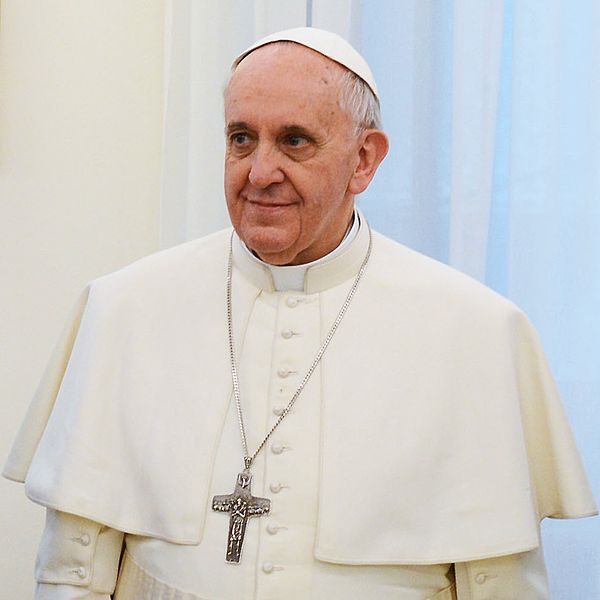
Pope Francis recently stated on Italian television that the line Lord’s Prayer, “Do not lead us into temptation” (Matthew 6:13), “is not a good translation because it speaks of a God who induces temptation.” He instead argued the verse should be understood, “Do not let us fall into temptation.”
This suggestion by the Roman Catholic Church’s top leader has led to much discussion regarding the true understanding of this phrase in the Lord’s Prayer. Have translators really been wrong all these years?
Looking at the original Greek text of Matthew 6:13, the verb translated “lead” is an aorist active subjunctive (εἰσενέγκῃς) with a negative particle. This simply mean “do not lead” is the originally intended meaning.
The Pope wants it to mean “do not let” because he does not want people to think God is actively leading us into temptation. While this does fit James 1:13 (When tempted, no one should say, “God is tempting me.” For God cannot be tempted by evil, nor does he tempt anyone), this subtle change overlooks another important perspective found in Matthew’s Gospel.
A quick look at Matthew 4:1 shows, “Then Jesus was led by the Spirit into the wilderness to be tempted by the devil.” Just two chapters before the Lord’s Prayer teaches to pray “lead us not into temptation,” Jesus was led into a time of temptation. New Testament scholar Dr. Daniel Wallace notes:
Immediately after Jesus’ baptism, we are told that he “was led up into the wilderness by the Spirit to be tempted by the devil” (Matthew 4.1). The Greek text indicates that the purpose of the Spirit’s leading Jesus into the wilderness was so that he would be tempted by the devil (“to be tempted” [πειρασθῆναι] is an infinitive of purpose, giving the purpose of the Spirit’s leading). Mark words this even more starkly: “Immediately the Spirit drove him into the wilderness” (Mark 1.13).
Evidently, there is a sense in which Jesus was delivered into the hands of the evil one, by the Holy Spirit himself, to be tempted. But the Greek here makes an interesting point about who is responsible for what. Two passive verbs are used in Matt 4.1— ἀνήχθη (“he was led”) and πειρασθῆναι (“to be tempted”). The agents are listed with identical prepositions: ὑπό. This is the preposition used especially for ultimate agent. It is rare to see ὑπό followed by πνεύματος (“Spirit”) in the NT (only five passages). Doing so here, Matthew shows that the Spirit is not subordinate to the devil but is the agent ultimately responsible for leading Jesus into the wilderness, while the devil is the ultimate agent of the temptation. The Spirit is not responsible for that. The Spirit did not tempt Jesus, but he did lead him to be tempted. The balance is intentional: leading into temptation is not the same as tempting. God the Holy Spirit led Jesus into temptation, but he did not tempt him. Wrestling with the implications of this requires more than a little reflection.
Wallace rightly connects the temptation of Jesus with the teaching of Jesus regarding the Lord’s Prayer in Matthew 6:13. God does not tempt us, but he may lead us into a time of temptation, just as Jesus experienced for 40 days in the wilderness.
While such times of temptation are not enjoyable, they may sometimes serve as part of God’s sovereign plan. Further, we are called to pray for God not to lead us into temptation, but to deliver us from evil. In doing so, we also connect with the well-known Psalm 23 that teaches, “Even though I walk through the darkest valley, I will fear no evil, for you are with me.”
Even when we do face temptation and evil, God is with us and can protect us. This is the message of the Lord’s Prayer. We do not need to change it; we need to pray it–and live it.
+++
Dillon Burroughs is the author and coauthor of numerous books and blogs about his experiences of handwriting the Bible at the Holy Writ Project on Patheos.com. Find out more about Dillon at Facebook or Twitter.
Handwritten copies of the Bible
Previous Post

December 11, 2017
Christmas Mythbusters
Next Post

December 15, 2017 Can We Celebrate Christmas Without Christ? A Growing Number Do
Browse Our Archives
Select a Category handwrite the entire bible handwritten bible Handwritten copies of the Bible transcribe the bible
Select a Month July 2018 April 2018 February 2018 January 2018 December 2017 September 2013 August 2013 July 2013 June 2013 May 2013 April 2013 March 2013 February 2013 January 2013 December 2012 November 2012 October 2012 September 2012 August 2012 July 2012 June 2012 May 2012 April 2012 March 2012 February 2012 January 2012 December 2011 November 2011 October 2011 September 2011 August 2011 July 2011 June 2011 May 2011 April 2011 March 2011 February 2011 January 2011
TAKE THE
Religious Wisdom Quiz
What king of Judah found the Book of the Law during Temple repairs?
Select your answer to see how you score.
Josiah Manasseh Hezekiah Jehoshaphat
Related posts from Holy Writ

It's Only Impossible Until It's Done
A Handwritten Bible in Progress: The Work of...
The Great Bible of Mainz: The Story of...

Modern Examples of Handwritten English Bibles
TRENDING AT PATHEOS Evangelical

The REST of Your Life: A Creative Wrestles...
This week I had a conversation with a good friend from church....

How the author of the world's best hymn...
I've been working with John Newton for a while now. This makes...

Long before this Lectio Divina, Psalm 130 - the song - started...

What About the Trees? Another Living Parable
After I finished writing the last article about falling leaves as a...

Why Classical Education Is a Conversation, Not a...
Come and Read: Joy in Classical Education When I was a little...

Cornell University has received a great deal of negative publicity and intense...
view all Evangelical blogs
Ad-Free & Subscriber Log-In Subscription Support
- About Us
- 2026 Calendar
- Videos
- Podcasts
- Library of World Religions
- Faith In Media Tracker
- Advertise With Us
- Write for Us
- Privacy Policy
- Terms of Service
- Do Not Sell My Data
- Contact Us
- Radiant Digital
- Manage Newsletter Subscriptions
- Unsubscribe From Notifications
- Sitemap
Copyright 2008-2026, Patheos. All rights reserved.
Subscription Support Ad-Free & Subscriber Log-In
Follow Patheos