
BuddhistCatholicContemplativeEvangelicalGeneral ChristianHinduJewishLatter-day SaintMuslimNew VisionsProgressive Christian
Beliefs
- Buddhist
- Catholic
- Contemplative
- Evangelical
- General Christian
- Hindu
- Jewish
- Latter-day Saint
- More Voices
- Muslim
- New Visions
- Pagan
- Progressive Christian
Topics
- Religion News
- Food and Religion
- Sports and Religion
- Religious Art
- Religious Music and Entertainment
- Religious Events
- History and Religion
- Style and Religion
- Politics and Religion
- Women in Religion
- Recreation Outdoors and Religion
- Business Finance and Religion
- Careers Workplace and Religion
- Education and Religion
- Family Parenting and Religion
- Health Fitness and Religion
- Home and Religion
- Relationships and Religion
- Technology and Religion
- Travel and Religion
Columnists
- Buddhist Columnists
- Business Finance and Religion Columnists
- Careers Workplace and Religion Columnists
- Catholic Columnists
- Contemplative Columnists
- Education and Religion Columnists
- Evangelists Columnists
- Family Parenting and Religion Columnists
- General Christian Columnists
- Health Fitness and Religion Columnists
- Hindu Columnists
- History and Religion Columnists
- Home and Religion Columnists
- Jewish Columnists
- More Voices Columnists
- Latter Day Columnists
- Muslim Columnists
- New Visions Columnists
- Nonreligious Columnists
- Pagan Columnists
- Politics and Religion Columnists
- Progressive Columnists
- Recreation Outdoors and Religion Columnists
- Relationships and Religion Columnists
- Religion News Columnists
- Religious Art Columnists
- Religious Events Columnists
- Religious Music and Entertainment Columnists
- Sports and Religion Columnists
- Style and Religion Columnists
- Technology and Religion Columnists
- Travel and Religion Columnists
- Women in Religion Columnists
Resource Library
- 2026 Calendar
- Library of World Religions
- The 100 Most Holy Places on Earth
- Patheos Answers
- Podcasts
- Videos
- Faith Leaders Database
- Anglican Episcopalian
- Bahai
- Baptist
- Buddhism
- Christianity
- Confucianism
- Eastern Orthodoxy
- Hinduism
- Holiness and Pentecostal
- ISKCON
- Islam
- Judaism
- Lutheran
- Methodist
- The Church of Jesus Christ of Latter-day Saints
- New Age
- Paganism
- Presbytarian and Reformed
- Protestantism
- Religion Behind the Scenes
- Roman Catholic
- Scientology
- Shia Islam
- Sikhism
- Sufism
- Sunni Islam
- Taoism
- Zen
- See all religions
Research Tools
 Ad-Free & Subscriber Log-In Subscription Support
Ad-Free & Subscriber Log-In Subscription Support
Follow Patheos 

- Trending:
- Forgiveness
- |
- Marriage
- |
- Consciousness
- |
- Death Penalty
- |
- Election
- |
- Halloween
 Holy Writ
- Home
- Evangelical
- Deuteronomy 31: The Public Reading of Scripture
Deuteronomy 31: The Public Reading of Scripture
Last updated on: September 12, 2012 at 10:32 am by Dillon Burroughs
Deuteronomy 31: The Public Reading of Scripture 2012-09-12T10:32:30-04:00 Dillon Burroughs
Patheos Explore the world's faith through different perspectives on religion and spirituality! Patheos has the views of the prevalent religions and spiritualities of the world.
“12 Assemble the people—men, women and children, and the foreigners residing in your towns—so they can listen and learn to fear the Lord your God and follow carefully all the words of this law. 13 Their children, who do not know this law, must hear it and learn to fear the Lord your God as long as you live in the land you are crossing the Jordan to possess.” -Deuteronomy 31:12-13
The public reading of Scripture has become a lost art in today’s churches. Rather than a reading of the text, the focus has shifted to technology, utilizing screens, videos, storytelling and other forms of communication to present sermons. While technology has many positive uses, the corresponding de-emphasis on the public reading of the Bible has taken its toll.
Despite the fact that most Americans own one or more Bibles, only a minority read them. Even many sermons contain only a brief mention of the verses used to communicate the day’s principles. Yet the tradition begun by Moses was one emphasized much later in one of the apostle Paul’s last letters when writing to Timothy. He wrote to the young church leader, “Until I come, devote yourself to the public reading of Scripture, to preaching and to teaching (1 Timothy 4:13). The public reading of Scripture (primarily concerning the Old Testament writings at that time) were to serve as the basis of all preaching and teaching.
If you are a church leader reading these words today, let me encourage and challenge you: Never teach or preach a sermon without clearly and publicly reading the words from the biblical text you intend to present. Do not assume others will read it in their own copies of the Bible or that you will cover it at some point in your sermon. Read the words. Join the ancient tradition of Moses, Paul, and others who used the Scriptures themselves as the basis for their spoken communication.
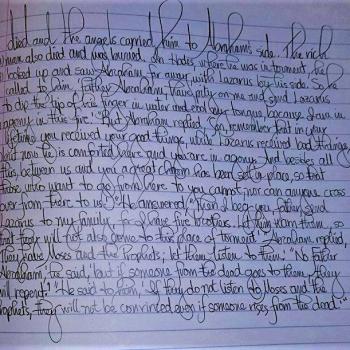
Let’s talk about it on Facebook! Share your thoughts, pictures, or videos on handwriting Scripture.
+++
Dillon Burroughs is the author and coauthor of numerous books and is handwriting a copy of all 31,173 verses of the Bible at HolyWritProject.com. Find out more about Dillon at Facebook.com/readdB or readdB.com.
Handwritten copies of the Bible
handwritten copies of the Bible
Previous Post

September 11, 2012
Deuteronomy 30: Choose Life
Next Post
September 13, 2012 Deuteronomy 32: Take to Heart
Browse Our Archives
Select a Category handwrite the entire bible handwritten bible Handwritten copies of the Bible transcribe the bible
Select a Month July 2018 April 2018 February 2018 January 2018 December 2017 September 2013 August 2013 July 2013 June 2013 May 2013 April 2013 March 2013 February 2013 January 2013 December 2012 November 2012 October 2012 September 2012 August 2012 July 2012 June 2012 May 2012 April 2012 March 2012 February 2012 January 2012 December 2011 November 2011 October 2011 September 2011 August 2011 July 2011 June 2011 May 2011 April 2011 March 2011 February 2011 January 2011
TAKE THE
Religious Wisdom Quiz
Multitudes of locusts came in waves—the cutting, swarming, hopping, and destroying locusts. What did this plague foreshadow?
Select your answer to see how you score.
An invasion God's wrath The day of the Lord A famine
Related posts from Holy Writ

It's Only Impossible Until It's Done
A Handwritten Bible in Progress: The Work of...
The Great Bible of Mainz: The Story of...
Modern Examples of Handwritten English Bibles
TRENDING AT PATHEOS Evangelical

The REST of Your Life: A Creative Wrestles...
This week I had a conversation with a good friend from church....

How the author of the world's best hymn...
I've been working with John Newton for a while now. This makes...

Long before this Lectio Divina, Psalm 130 - the song - started...

What About the Trees? Another Living Parable
After I finished writing the last article about falling leaves as a...

Why Classical Education Is a Conversation, Not a...
Come and Read: Joy in Classical Education When I was a little...

Cornell University has received a great deal of negative publicity and intense...
view all Evangelical blogs
Ad-Free & Subscriber Log-In Subscription Support
- About Us
- 2026 Calendar
- Videos
- Podcasts
- Library of World Religions
- Faith In Media Tracker
- Advertise With Us
- Write for Us
- Privacy Policy
- Terms of Service
- Do Not Sell My Data
- Contact Us
- Radiant Digital
- Manage Newsletter Subscriptions
- Unsubscribe From Notifications
- Sitemap
Copyright 2008-2026, Patheos. All rights reserved.
Subscription Support Ad-Free & Subscriber Log-In
Follow Patheos