
BuddhistCatholicContemplativeEvangelicalGeneral ChristianHinduJewishLatter-day SaintMuslimNew VisionsProgressive Christian
Beliefs
- Buddhist
- Catholic
- Contemplative
- Evangelical
- General Christian
- Hindu
- Jewish
- Latter-day Saint
- More Voices
- Muslim
- New Visions
- Pagan
- Progressive Christian
Topics
- Religion News
- Food and Religion
- Sports and Religion
- Religious Art
- Religious Music and Entertainment
- Religious Events
- History and Religion
- Style and Religion
- Politics and Religion
- Women in Religion
- Recreation Outdoors and Religion
- Business Finance and Religion
- Careers Workplace and Religion
- Education and Religion
- Family Parenting and Religion
- Health Fitness and Religion
- Home and Religion
- Relationships and Religion
- Technology and Religion
- Travel and Religion
Columnists
- Buddhist Columnists
- Business Finance and Religion Columnists
- Careers Workplace and Religion Columnists
- Catholic Columnists
- Contemplative Columnists
- Education and Religion Columnists
- Evangelists Columnists
- Family Parenting and Religion Columnists
- General Christian Columnists
- Health Fitness and Religion Columnists
- Hindu Columnists
- History and Religion Columnists
- Home and Religion Columnists
- Jewish Columnists
- More Voices Columnists
- Latter Day Columnists
- Muslim Columnists
- New Visions Columnists
- Nonreligious Columnists
- Pagan Columnists
- Politics and Religion Columnists
- Progressive Columnists
- Recreation Outdoors and Religion Columnists
- Relationships and Religion Columnists
- Religion News Columnists
- Religious Art Columnists
- Religious Events Columnists
- Religious Music and Entertainment Columnists
- Sports and Religion Columnists
- Style and Religion Columnists
- Technology and Religion Columnists
- Travel and Religion Columnists
- Women in Religion Columnists
Resource Library
- 2026 Calendar
- Library of World Religions
- The 100 Most Holy Places on Earth
- Patheos Answers
- Podcasts
- Videos
- Faith Leaders Database
- Anglican Episcopalian
- Bahai
- Baptist
- Buddhism
- Christianity
- Confucianism
- Eastern Orthodoxy
- Hinduism
- Holiness and Pentecostal
- ISKCON
- Islam
- Judaism
- Lutheran
- Methodist
- The Church of Jesus Christ of Latter-day Saints
- New Age
- Paganism
- Presbytarian and Reformed
- Protestantism
- Religion Behind the Scenes
- Roman Catholic
- Scientology
- Shia Islam
- Sikhism
- Sufism
- Sunni Islam
- Taoism
- Zen
- See all religions
Research Tools
 Ad-Free & Subscriber Log-In Subscription Support
Ad-Free & Subscriber Log-In Subscription Support
Follow Patheos 

- Trending:
- Forgiveness
- |
- Marriage
- |
- Consciousness
- |
- Death Penalty
- |
- Election
- |
- Halloween
 Holyscapes
- Home
- Contemplative
- Terra Nullius: The Political Ecology of Green Space
Terra Nullius: The Political Ecology of Green Space
Last updated on: September 4, 2019 at 9:22 am by Jason M. Brown
Terra Nullius: The Political Ecology of Green Space 2019-09-04T09:22:09-08:00 Jason M. Brown
Patheos Explore the world's faith through different perspectives on religion and spirituality! Patheos has the views of the prevalent religions and spiritualities of the world.
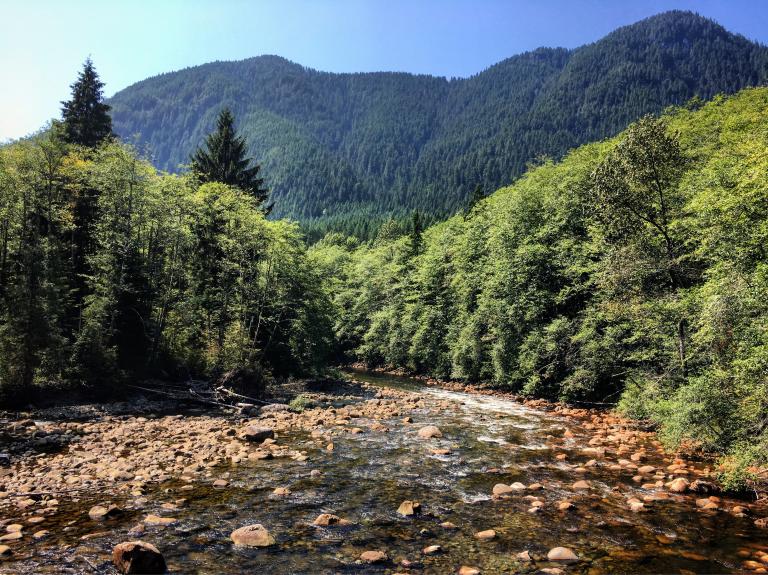
Bridge over the Seymour River. Ch’ich eliwxih is the Squamish name for the watershed and village located at the mouth of the river.
“Why is everything in the woods with you people?”
–Cruella Deville, Once Upon a Time, Season 5, Episode 19
For all the photographs I take and writing I do about trees, forests, theology and walking, I must admit that I also love watching movies. Netflix has been a regular guilty pleasure for me, one I eschew during Lent (a great sacrifice!). I have watched a lot of shows, and I find Netflix’s original series to be mostly very well done, interesting and timely. One thing that I keep noticing in many of the more recent shows, is that the scenery and cityscapes are very similar to my own. It is no secret that Vancouver, British Columbia has become “Hollywood North” and movies and TV producers flock here during all months of the year to set their stories in our futuristic skyline, our gritty downtown eastside and Chinatown, or, our majestic forests.
Sometimes Vancouver itself serves as a substitute city for where the film is supposed to be based. Other times, the vast forests of our Pacific home are the setting of post-apocalyptic or fantasy concept films. Interestingly enough, British Columbia’s official tourism slogan is ‘Super, Natural’ riffing on the Supernatural. Major films and TV shows have taken advantage of Vancouver’s diverse settings: The X-Files, Battlestar Galactica, Twilight, various X-Men franchises, Dirk Gently, Deadpool, Supernatural, Jumanji, have all been filmed in or around the Vancouver area. For a full list see this very long Wikipedia page.
I grew up in Southern California, a place that is also steeped in Hollywood imaginaries. Even my own neighborhood growing up even gave a nod to fantasy. The architecture and landscaping were mostly done according to the taste of the owner, not necessarily according to the region. We had country style homes with wrap around porches and horse corrals, sleek modern glass boxes, New Mexico style adobe and cactus gardens, and Spanish colonial style with evergreen pine trees or tropical ficus. Our backyard pool gave the impression of an alpine oasis, in the middle of a Mediterranean desert. Pine, palm or eucalyptus trees lined many of the streets so that we felt like we were in a land of eternal green and eternal summer.
And of course we kept our lawns pristine year round. Nature was malleable because we had the climatic flexibility and the water resources to adapt the place to our preferences and imaginations. And don’t get me wrong, I am not complaining! My neighborhood was a lush arboretum of vastly more tree and plant biodiversity than ever existed before settlers arrived. There were also many fruit trees as well: Pomegranate, kumquat, fig, loquat, persimmon, orange, lemon, apple and nectarine trees, all of which we enjoyed as roving bands of pre-teens.
Three shows that I have watched in the last few years have really got me thinking about the way our imaginations shape nature in a place like Vancouver which has world class natural beauty. Once Upon a Time, a clever mashup of just about every classic European and Disney fairy tale with a modern and overtly feminist spin. The 100, a post-apocalyptic sci-fi series where the last humans fight to survive on a toxic planet among hostile rivals; and The Man in the High Castle (Amazon Prime), a fascinating historical sci-fi drama that imagines a North America where Japan and Germany won WWII. However, an alternative reality which shows a different outcome to the war has been captured by a series of 16mm films which a small but dedicated resistance must gather at any cost.
Each of these series makes use of the urban and forested landscapes here in BC. But what is it about this landscape and our modern understanding of nature that makes British Columbia such a hotspot for sci-fi and post-apocalyptic themed shows? I propose that our modern understanding of nature as ‘greenspace’ is the imaginative descendent of our more overtly colonial-era notion of Terra Nullius, or, nobody’s land. The only way we could be convinced of a landscape’s authenticity in a film is if it holds a cultural significance that is stripped of its previously rich cultural meanings. During colonization and conflict between European powers, if land was understood to be unoccupied, it was annexable by the state. Roman law applied a similar concept to abandoned building or recovered slaves. It was basically a legalized version of finders-keepers.
Joseph Trutch was the first Lieutenant Governor of British Columbia. He believed that First Nations peoples did not actually own the land, because they didn’t have the concept of private property, so it was fair game for settlers. Governor General James Douglas characterized indigenous people as “mere wandering denizens of the forest.” Douglas like virtually all settlers who arrived here, could not see just how lush with food production zones the place actually was. What they saw was unkempt, untidy and un-owned wilderness. This is why much of British Columbia territory remains ‘unceded’ today, because no treaties were seen as necessary in lands where no one lived.
As is commonly known, many indigenous communities were decimated by diseases even before settlers arrived in BC, but during their pre-colonial civilization, which had been more or less intact for 10,000 years. First Peoples held clan and kin-based usufruct rights to land as berry, salmon, hunting or other food gathering territories. These were for the most part demarcated and understood by First Peoples.
In fact, what the Europeans mistook for vacant wilderness, for Terra Nullius, were the neglected remains of deeply human-influenced food forests, pharmacies, woodshops and shore gardens. As disease swept over the region, traditional food production methods and zones became neglected. Before disease hit, massive old growth Western Red Cedars were used for cordage, canoes, and long house planks. Fire was used to keep trees out of hereditary berry patches and camas bulb gardens. Herring and salmon spawning sites were enhanced with tree branches, which created more surface area for fish to lay their eggs on. The local breed of Salish Wooly Dogs (now extinct) were bred for their hair, and packs of the adorable creatures sometimes occupied entire islands. In addition, Coast Salish and inland peoples actively cultivated groves of crabapple and hazelnut trees which were traded north to south making their way as far as what is now the Yukon Territory. And lastly, thousands of kilometers of coastline were modified to enhance clam productivity by carrying large rocks to the low tide mark so that steeper shorelines would eventually level out, creating more surface area for clams to breed.
In addition to their pervasive agro-ecological influence, for all First Peoples, the features, creatures and places of the land were alive with personhood, significance and story. These are not my stories to tell, but I can say that for example, many creatures such as orcas, wolves, frogs, ravens and bears were totems of family lineages, and were thus often portrayed on long house, shaman and village poles.
Prominent geological features, rocks and peaks were often understood as ‘transformer sites’, or sites where legendary people and creatures were either punished or rewarded by supernatural beings and consequently converted into the feature as it appears today. This is widely understood to be the origin of Skalsh rock (called Siwash rock in signage), located off the shore of Stanley Park. For geologists, the rock is a basaltic obtrusion of volcanic origin, which resisted erosion in the mostly sandstone foundations of the rest of the park. A large Squamish village was located in Stanley Park, and for Coast Salish peoples, the site commemorates the transformation of Skalsh by Xaays, a supernatural being, to memorialize the ideal of Fatherhood and the warrior. However, various nations have their own stories associated with this rock.
Other places such as obsidian deposits are places where Thunderbird shot lightning from its eyes. Other sites are the very places where humans emerged from the watery chaos of their respective creation stories. The land was not the background of the human story, it was itself an actor bursting with uses, meaning and stories of its own.
This is what I mean when I marvel at how easy it is for us to see the forest as a kind of neutral space. Vancouver has maps with detailed streets and addresses, but forested areas are often blocks of monochromatic ‘green space.’ This simplified representation renders these rich places as essentially culturally neutral, primordially natural where we stressed out urbanites can come to relax, hike, run or walk our dogs.
If Once Upon a Time had shown a scene of Mount Rushmore, and claimed it was an ancient pagan shrine to unknown deities, Euro-North Americans would understandably balk unconvinced. That is simply not believable given what we know about the presidential persons whose likenesses are carved into the living rock of that monument. Yet, if Once Upon a Time flashes a scene with a Musqueam or Squamish Transformer site that is clearly identifiable within those worlds, we settlers see beautiful scenery. This goes for The 100 and Man in the High Castle as well. A post-apocalyptic landscape and an imaginary Nazi regime are just as believable in these forests to eyes that see only green space.
Clearly I too enjoy spending time in these beautiful places, and I have gotten to know their contours and inhabits to some degree during my 6 years in Vancouver. I have done this largely within my own Western scientific and religious paradigms, both of which have served me quite well. I am not seeking to fully enter into the worlds of indigenous peoples, or assume their significance. However, I would like to be better equipped to respect the rich cultural history of this landscape, just as I would if I entered a cathedral for the first time. While some sites should not be publicly known because of their sacredness, others could be more widely popularized through interpretive signs, greater cultural and historical awareness campaigns and bi-cultural place naming initiatives. And perhaps some of these shows could begin with territorial acknowledgements of the traditional territories where their heroes are winning hearts and minds.
Resources
- https://www.thecanadianencyclopedia.ca/en/article/salish-woolly-dog
- https://pressbooks.bccampus.ca/knowinghome/
- http://staff.royalbcmuseum.bc.ca/2016/11/18/a-lekwungen-herring-fishing-site-in-esquimalt-harbour/
- https://aabc.ca/resources/historical-photographs/
- http://www.sfu.ca/brc/imeshMobileApp/place-names.html
Previous Post

August 19, 2019
Mass Grave
Next Post
August 19, 2019 Crucifixion of the Earth
Browse Our Archives
Select a Category Anthropocene Camino de Santiago Catholicism Film Holyscapes Homily Liturgy Monk Nature New Monasticism New Story Pilgrimage Poetry Politics Prayer Religion and Spirituality Silence Spiritual Ecology Spring Spriritual Ecology Theology Uncategorized Walking Writing
Select a Month June 2020 May 2020 April 2020 March 2020 February 2020 January 2020 December 2019 November 2019 August 2019 June 2019 May 2019 April 2019 January 2019 December 2018 November 2018 October 2018 September 2018 August 2018 July 2018 June 2018 May 2018 April 2018 March 2018 February 2018 January 2018 November 2017 October 2017 September 2017 August 2017 July 2017 June 2017 May 2017 April 2017 March 2017 February 2017 January 2017 December 2016 November 2016 October 2016 September 2016 August 2016 July 2016 June 2016 May 2016 April 2016 March 2016 February 2016 January 2016 December 2015 November 2015
Follow Us!
TAKE THE
Religious Wisdom Quiz
I carried a letter from the king giving me authority and resources to rebuild Jerusalem. Who am I?
Select your answer to see how you score.
Nehemiah Ezra Zerubbabel Artaxerxes
Related posts from Holyscapes
Jo Jo Rabbit and Self Giving Love
TRENDING AT PATHEOS Contemplative

Handy Contemplative Practices for Political Spaces
A Spiritually Grounded Presence In order to bring a spiritually grounded presence...

Halloween: The Holiday of Loving Your Neighbor
All Hallows Eve Is Halloween the least Christian holiday in America, or...

Can Love Be Saved? Some Thoughts on the...
Happy Valentine's Day! I recently published a post on Patreon called Can...

"This Loving, Uniting Embrace": the Holy Ordinary
Today's guest post is by Mark Longhurst, author of The Holy Ordinary:...

How Are We Called to Live?: More About...
How Are We Called to Live? Many of us struggle with discerning...

A Spiritual Practice of Reading: Join Us Online
A Spiritual Practice of Reading A healthy spiritual practice of reading is...
view all Contemplative blogs
Ad-Free & Subscriber Log-In Subscription Support
- About Us
- 2026 Calendar
- Videos
- Podcasts
- Library of World Religions
- Faith In Media Tracker
- Advertise With Us
- Write for Us
- Privacy Policy
- Terms of Service
- Do Not Sell My Data
- Contact Us
- Radiant Digital
- Manage Newsletter Subscriptions
- Unsubscribe From Notifications
- Sitemap
Copyright 2008-2026, Patheos. All rights reserved.
Subscription Support Ad-Free & Subscriber Log-In
Follow Patheos