
BuddhistCatholicContemplativeEvangelicalGeneral ChristianHinduJewishLatter-day SaintMuslimNew VisionsProgressive Christian
Beliefs
- Buddhist
- Catholic
- Contemplative
- Evangelical
- General Christian
- Hindu
- Jewish
- Latter-day Saint
- More Voices
- Muslim
- New Visions
- Pagan
- Progressive Christian
Topics
- Religion News
- Food and Religion
- Sports and Religion
- Religious Art
- Religious Music and Entertainment
- Religious Events
- History and Religion
- Style and Religion
- Politics and Religion
- Women in Religion
- Recreation Outdoors and Religion
- Business Finance and Religion
- Careers Workplace and Religion
- Education and Religion
- Family Parenting and Religion
- Health Fitness and Religion
- Home and Religion
- Relationships and Religion
- Technology and Religion
- Travel and Religion
Columnists
- Buddhist Columnists
- Business Finance and Religion Columnists
- Careers Workplace and Religion Columnists
- Catholic Columnists
- Contemplative Columnists
- Education and Religion Columnists
- Evangelists Columnists
- Family Parenting and Religion Columnists
- General Christian Columnists
- Health Fitness and Religion Columnists
- Hindu Columnists
- History and Religion Columnists
- Home and Religion Columnists
- Jewish Columnists
- More Voices Columnists
- Latter Day Columnists
- Muslim Columnists
- New Visions Columnists
- Nonreligious Columnists
- Pagan Columnists
- Politics and Religion Columnists
- Progressive Columnists
- Recreation Outdoors and Religion Columnists
- Relationships and Religion Columnists
- Religion News Columnists
- Religious Art Columnists
- Religious Events Columnists
- Religious Music and Entertainment Columnists
- Sports and Religion Columnists
- Style and Religion Columnists
- Technology and Religion Columnists
- Travel and Religion Columnists
- Women in Religion Columnists
Resource Library
- 2026 Calendar
- Library of World Religions
- The 100 Most Holy Places on Earth
- Patheos Answers
- Podcasts
- Videos
- Faith Leaders Database
- Anglican Episcopalian
- Bahai
- Baptist
- Buddhism
- Christianity
- Confucianism
- Eastern Orthodoxy
- Hinduism
- Holiness and Pentecostal
- ISKCON
- Islam
- Judaism
- Lutheran
- Methodist
- The Church of Jesus Christ of Latter-day Saints
- New Age
- Paganism
- Presbytarian and Reformed
- Protestantism
- Religion Behind the Scenes
- Roman Catholic
- Scientology
- Shia Islam
- Sikhism
- Sufism
- Sunni Islam
- Taoism
- Zen
- See all religions
Research Tools
 Ad-Free & Subscriber Log-In Subscription Support
Ad-Free & Subscriber Log-In Subscription Support
Follow Patheos 

- Trending:
- Forgiveness
- |
- Marriage
- |
- Consciousness
- |
- Death Penalty
- |
- Election
- |
- Halloween
 Holyscapes
- Home
- Contemplative
- A Night for All Souls in the Local Cemetery
A Night for All Souls in the Local Cemetery
Last updated on: November 2, 2018 at 9:12 am by Jason M. Brown
A Night for All Souls in the Local Cemetery 2018-11-02T09:12:31-08:00 Jason M. Brown
Patheos Explore the world's faith through different perspectives on religion and spirituality! Patheos has the views of the prevalent religions and spiritualities of the world.
“And when the earth shall claim your limbs, then shall you truly dance.”
–Kahlil Gibran
“When you see my corpse is being carried
Don’t cry for my leaving
I’m not leaving
I’m arriving at eternal love.”
–Jalāl ad-Dīn Muhammad Rūmī.
Introduction
I am always up for visiting a new church or religious service. So when I read the syllabus for a class I taking on liturgy at the Vancouver School of Theology, the assignment I was most excited about was the opportunity to visit an unfamiliar tradition’s worship service. As a professor of religious studies and world religions in Salt Lake City from 2011-2013, I have visited many churches, meeting houses, temples and synagogues. I have even studied the Vedas in a custom pyramid[1] with a front door that opens like the DeLorean from Back to the Future. (At the end of the service, I was casually handed a glossy illustrated manual about giving your partner the perfect orgasm).
After two weeks of trying to attend various Pentecostal and Evangelical churches that did not conflict with my current Sunday obligations at Saint James Anglican Church, I decided to write about my experiences at this year’s Night for All Souls[2], a thoroughly secular community art project put on by resident artists at the Mountain View Cemetery, Vancouver proper’s only cemetery. The grounds buried their first European immigrant in 1886, and encompasses 106 acres, with approximately 92,000 grave sites and 145,000 buried remains.[3] It is a lovely place with views of the mountains, and gorgeous Victorian headstones among various elderly trees. In North American culture generally, there seems to be a difficulty talking about and dealing with death, and a lack of significant rituals within or outside traditional religious institutions. The artists of Mountain View Cemetery hope to change that. In the following I will reflect on my own experience at the multi-day event, its liturgical elements, and its potential for greater engagement with the religions.
Night for All Souls
The purpose of the Night for All Souls event is to engage the ancient holy days of All Saints and All Souls. The atmosphere is essentially post-religious, but the general public is invited to bring their own ideas and beliefs to the event and interact with several shrines and stations, where they can make art, candles, or write notes to their beloved dead. The website for the event explains:
“In many cultures around the world, the days at the end of October and beginning of November are considered an important time for honoring the dead in our lives. In our modern, urban, and relatively transient culture, traditional “village” customs have been left behind, though not the human impulses that led to these traditions. All Souls at the Mountain View Cemetery is a non-denominational sacred event, and an opportunity for people to share their own customs and experiences.”[4]
‘Many cultures’ and ‘non-denominational’ scrubs the event of any hint of an endorsement of the holy-days Pagan and Christian origins. Yet despite the inherent fear of mentioning the R-word, the residents are confident that the role of the artist is to create a safe container for people to bring what traditions they may have left to the space.
Samhain and Allhallowtide
In Europe, indigenous traditions developed with the cycles of the Northern hemisphere’s seasons. The festival of Samhain (pronounced Saw-win), marks the Gaelic transition from the harvest to winter darkness. It was a time when the veil between the worlds was thinnest, and the ancestors and faeries could move between worlds more easily. James Frazer, in The Golden Bough suggests that the date is less important to farmers than to herds’ people.[5] Some important tombs in Ireland are also aligned with the date of Samhain, which falls between the Autumn Equinox and the Winter Solstice.
In Neo-Pagan and Neo-Shamanic practices, Samhain is the day for connecting with the ancestors, and visiting the land of the dead through trance. I am fascinated with this time of year, and European traditions around marking the passing of time. That is why, though I am not planning to attend this year, for the last several years I have attended Reclaim Vancouver’s[6] annual Samhain celebration which includes a circle casting, guided meditation, and a circle dance.
Of course in secular North America, Halloween (All Hallows Eve) is the most popular equivalent to this day of transgressive world bending. During Samhain and many other fall festival rituals that honored the dead, people would dress up as spirits or ancestors or saints or gods and go house to house in exchange for food, offerings, fuel for bone-fires or presents.
While today the Christian Triduum of All-Hallows-Tide, the Christian feasts of All Hallows Eve, All Saints Day and All Souls Day, correspond with these feasts, they did not emerge directly out of their earlier Pagan equivalents. It was not until 609 that All Saints Day was designated to honor all the martyrs of the church and her Saints. Originally celebrated on May, or in April by the Irish, All Souls Day was not celebrated until the 11th century.
In North America, while Halloween is a popular secular holiday, the religious significance has faded. And while Neo-Pagan circles are reviving the pre-Christian traditions, North American Christians do not have a strong tradition of honoring and remembering the dead with festive celebrations. We often look to syncretic practices like Dia De Muertos in Mexico, Day of the Dead, as morbid, cult-like and strange.
My Experience at Night for All Souls
In order to get a close up look at the event I decided to volunteer. The opening night was on Saturday October 27. I was a tea runner, so I helped out cleaning and stocking tea cups for the Celebration Hall where there were tables to sit, and stations to make crafts, or weave small messages into a community tapestry. I also ran hot water out to the Chinese Pavilion where there was a shrine and bonfire.
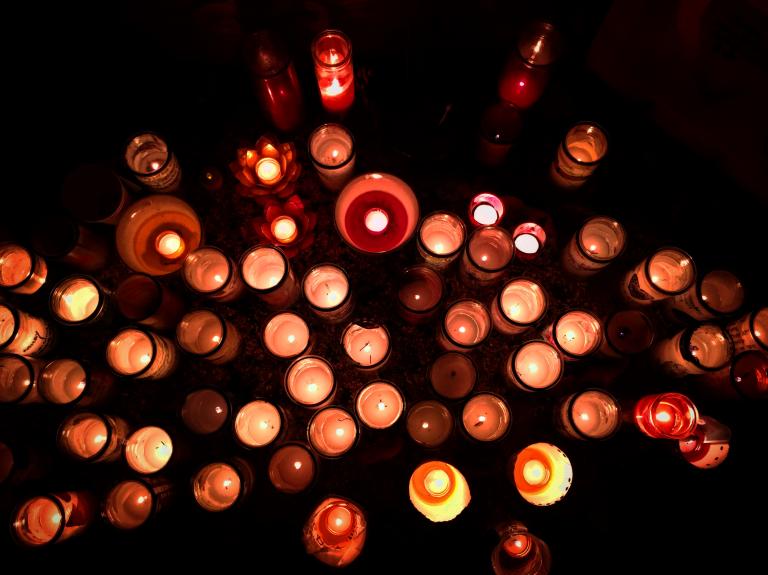
It was quite beautiful to see families and people of all ages coming in from the rain for tea, sitting at tables and talking about death, dying, and the ancestors. They could look up ancestors buried in the cemetery at one station, or write notes to the dead that were later woven into a tapestry on the wall.
Out in the cemetery, there were station dedicated to missing indigenous women, those who had died by suicide and overdose, one to pets and one to infants and children; but as one of the organizers said, most of the shrines are not themed, because people are not defined by their death. There was also a large tryptic with candles, incense and a marker so that people could leave pictures and write the names of the dead. The event spanned over a week.
On Tuesday, October 30, 2018, I attended a choral performance by the Little Chamber Orchestra that Could, a Vancouver fixture that often performs at Cemetery cultural and seasonal events. The performance was “The First Stage” by Joelysa Pankanea, a piece that grapples with the sudden death of her mother to cancer. During the song, the choir elevated into heavenly harmonies, and breathy pauses signifying life’s last gasps of air. They were accompanied by a quiet marimba and upright bass cello. It was a beautiful performance, bare bones harmonies and poignant dialogue pointing to the tragic end of the composer’s mother. No matter how we dress it up, in art, or theology, death is the gritty, breath taking, sweat inducing price of knowing that we are alive. The event wrapped up on Thursday night with a closing procession, where a contemporary big band ensemble visits each of the shrines, each heavy laden with custom candles, messages and notes written to the beloved dead.
Secular Liturgy
What struck me about this event was how its form, structure and content were all referring to various religious and cultural markers surrounding honoring the dead and the saints, but all of the obvious religious symbols or references were nowhere to be seen. The event was “non-denominational” and thus participants could hold their own private views of death, but nothing in the art or setting or programming suggested what to believe about its finality or the continuity of life beyond. There was no Lex Orandi, Lex Credendi. The event was an open container for participants to fill however they saw fit. Many had abandoned religion, were immigrants from other countries now living in Canada. The sometimes trite, even trivial assurances of organized religion were absent.
Each of the familiar elements of a religious service were present: Music, procession, fire, candles, images, notes and messages hung from string and trees, incense, prayer flags, and of course shrines/altars. The one shrine that did feel vaguely religious, was, far from the main shrine, at the Chinese Pagoda in the North section, a bon fire for burning rice paper silver and gold bars to bless the ancestors with wealth and riches in the afterlife and ask for their favor in return. This practice, of offering the dead life like and practical items, cuts across Chinese folk religions, Confucianism and Taoism. Otherwise, participants were on their own.
I am very grateful for this event. I think all of us, religious and non-religious need more and better rituals and practices around death and dying. We need more frank conversations about the pain of loss, and more engagement with our grief, regardless of our theologies of an afterlife. Death needs to be brought out of the shadows. It is liturgy, even in this most stripped down and symbolically sterile examples, that can help us through this process.
However, despite my enthusiastic endorsement of Night for All Souls, I feel off about its overall lack of religious voices. I wonder how many people coming to the space would like to hear what actual religious traditions have to say about dealing with life’s most difficult truth. I applaud the effort and the art and the interest, but I want to see more religious people involved. Precisely because religious people, despite having rich theological and ritual traditions, still need help working through death, we all do, every generation does. I want to know how religious and non-religious people grapple with death and dying, what poets and scriptures they look to for solace, what networks they rely on when the grief is too much to bear; what communities bring them food when they are too sad to cook.
[2] https://nightforallsouls.com/
[3] https://vancouver.ca/your-government/mountain-view-cemetery.aspx
[4] https://nightforallsouls.com/
[5] Frazer, Sir James George. The Golden Bough: A Study in Magic and Religion. Forgotten Books, 2008. p.644
[6] http://vancouverreclaiming.org/
Previous Post

October 30, 2018
Learning to Live in Place
Next Post
December 4, 2018 Look to the Trees: Homily, Dec. 4, 2018
Browse Our Archives
Select a Category Anthropocene Camino de Santiago Catholicism Film Holyscapes Homily Liturgy Monk Nature New Monasticism New Story Pilgrimage Poetry Politics Prayer Religion and Spirituality Silence Spiritual Ecology Spring Spriritual Ecology Theology Uncategorized Walking Writing
Select a Month June 2020 May 2020 April 2020 March 2020 February 2020 January 2020 December 2019 November 2019 August 2019 June 2019 May 2019 April 2019 January 2019 December 2018 November 2018 October 2018 September 2018 August 2018 July 2018 June 2018 May 2018 April 2018 March 2018 February 2018 January 2018 November 2017 October 2017 September 2017 August 2017 July 2017 June 2017 May 2017 April 2017 March 2017 February 2017 January 2017 December 2016 November 2016 October 2016 September 2016 August 2016 July 2016 June 2016 May 2016 April 2016 March 2016 February 2016 January 2016 December 2015 November 2015
Follow Us!
TAKE THE
Religious Wisdom Quiz
What does the rider of the White Horse in Revelations carry?
Select your answer to see how you score.
A bow A sword A scroll Scales
Related posts from Holyscapes




A Guide Book to America’s Sacred Groves: A...
TRENDING AT PATHEOS Contemplative

Handy Contemplative Practices for Political Spaces
A Spiritually Grounded Presence In order to bring a spiritually grounded presence...

Halloween: The Holiday of Loving Your Neighbor
All Hallows Eve Is Halloween the least Christian holiday in America, or...

Can Love Be Saved? Some Thoughts on the...
Happy Valentine's Day! I recently published a post on Patreon called Can...

"This Loving, Uniting Embrace": the Holy Ordinary
Today's guest post is by Mark Longhurst, author of The Holy Ordinary:...

How Are We Called to Live?: More About...
How Are We Called to Live? Many of us struggle with discerning...

A Spiritual Practice of Reading: Join Us Online
A Spiritual Practice of Reading A healthy spiritual practice of reading is...
view all Contemplative blogs
Ad-Free & Subscriber Log-In Subscription Support
- About Us
- 2026 Calendar
- Videos
- Podcasts
- Library of World Religions
- Faith In Media Tracker
- Advertise With Us
- Write for Us
- Privacy Policy
- Terms of Service
- Do Not Sell My Data
- Contact Us
- Radiant Digital
- Manage Newsletter Subscriptions
- Unsubscribe From Notifications
- Sitemap
Copyright 2008-2026, Patheos. All rights reserved.
Subscription Support Ad-Free & Subscriber Log-In
Follow Patheos